AI Agents for Data Teams: Separating Hype from Production-Ready Tools
Every vendor now has an 'AI agent.' After evaluating dozens of them, here's what actually works and what's still a demo-only fantasy.
EB
Egor Burlakov
••6 min read
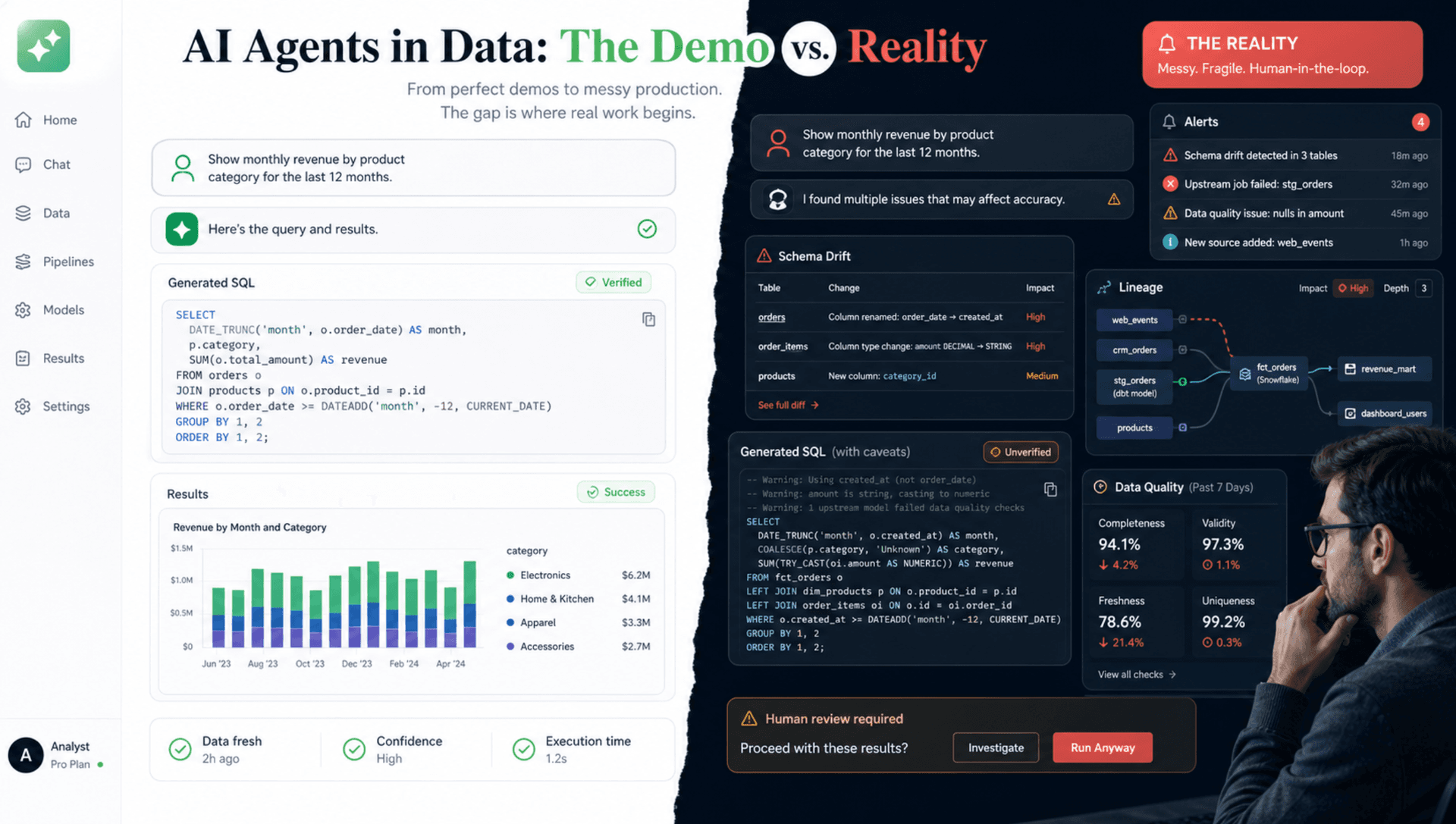
Sometime in the past two years, every data tool vendor decided that their product needed an "AI agent." The word "agent" has been stretched so far beyond its original meaning that it now covers everything from a chatbot that writes SQL queries to a fully autonomous system that supposedly builds and monitors data pipelines while you sleep. The marketing materials are breathless, the demos are impressive, and the gap between the demo and production reality is, in most cases, enormous.
I'm not saying AI agents for data are useless — some of them are genuinely useful. But after evaluating dozens of these tools and talking to teams that have tried to deploy them, I think the market deserves a more honest assessment of what works, what doesn't, and what might work in a year or two.
What "AI Agent" Actually Means in Data
Let's start with definitions, because the term is doing a lot of heavy lifting. An AI agent is a system that can perceive context, decide what to do next, and take actions toward a goal. In the data world, that usually means a tool that can use metadata, call other systems, and complete a task with some degree of autonomy. By that definition, many products called “agents” are really assistants with tool access, which is not the same thing.
The data tools that call themselves agents roughly fall into three categories.
Query agents translate natural language into SQL, run the query, and interpret the results. This is the most mature category by a wide margin. Tools in this space connect to your warehouse schema, understand your table relationships, and let non-technical users ask questions like "What were our top 10 customers by revenue last quarter?" without writing a single line of SQL.
Pipeline agents aim to automate parts of the data engineering workflow — generating transformation code, suggesting schema changes, or creating data models from plain-language descriptions. These are more ambitious and, unsurprisingly, less reliable.
Governance agents try to automate data cataloging, classification, lineage tracking, and compliance monitoring. Instead of manually tagging every column in every table as PII or non-PII, an AI agent scans your warehouse and does it for you.
What Actually Works Today
The honest answer is that text-to-SQL has gotten remarkably good, and almost everything else is still a work in progress.
Modern text-to-SQL agents can do a surprisingly good job on straightforward analytical questions, especially when the schema is clean and the metadata is well-documented. But even 80–90% accuracy leaves a lot of room for error, and in analytics, that missing 10–20% matters more than it sounds. A wrong answer does not just create a bad query; it can create a bad meeting, a bad discussion, and a bad decision. If a product manager pulls a number that looks plausible but is wrong, the mistake can spread through the organization faster than the correction.
The key qualifier in that paragraph is "well-documented." Text-to-SQL agents are only as good as the metadata they have access to. If your tables have clear names, your columns have descriptions, and your relationships are documented, these tools work well. If your warehouse looks like it was designed by someone playing Scrabble with a bag of abbreviations, no amount of AI can save you. I've seen companies spend six months trying to deploy a text-to-SQL agent before realizing that the actual problem was that nobody could explain what tbl_cust_xref_v2_final_FINAL contains.
Automated documentation and cataloging is another area where AI is providing real value today, even if it's less flashy than autonomous pipeline building. Tools that scan your warehouse, generate descriptions for tables and columns, infer relationships, and maintain a living data catalog are saving data teams dozens of hours per month on what was previously soul-crushing manual work.
What Doesn't Work Yet
Autonomous pipeline generation is the big promise and the biggest gap. The idea of describing a business requirement in natural language and having an AI agent generate the entire pipeline — ingestion, transformation, tests, monitoring — is compelling in a demo and terrifying in production. The problem isn't that LLMs can't write SQL or Python, because they absolutely can. The problem is that data pipelines have consequences, and a subtly wrong transformation can corrupt downstream analytics in ways that take weeks to detect.
I've seen demos where an AI agent creates a dbt model from a natural language description, and the SQL looks perfect. But "looks perfect" and "handles edge cases correctly in production at 3 AM when the source schema changes" are very different standards. Until we have AI that can reason about data semantics, not just data syntax, autonomous pipeline generation will remain a developer productivity tool rather than a replacement for data engineers.
Self-healing pipelines are another category that sounds incredible on a slide deck. The pitch goes like this: when a pipeline breaks, the AI agent diagnoses the problem and fixes it automatically. In practice, the "fixes" tend to be limited to retrying failed jobs (which a simple cron wrapper does equally well) or applying schema migration patches (which are often wrong in subtle and expensive ways). The fundamental challenge is that most pipeline failures are caused by problems outside the pipeline — source systems changing, upstream dependencies failing, business logic evolving — and diagnosing these requires contextual knowledge that current AI models simply don't have.
The Trust Problem
Even when AI agents produce correct results, there's a deeper challenge that the industry hasn't solved: trust. Data engineering is a discipline where mistakes compound. A wrong join condition doesn't just affect one query — it affects every dashboard, report, and ML model downstream. This is why data engineers obsess over testing, lineage, and validation in ways that application developers sometimes find excessive.
When you ask a data team to trust an AI agent with write access to production data, you're asking them to accept a risk profile that's fundamentally different from using AI as a code suggestion tool. A GitHub Copilot suggestion that's wrong gets caught at code review. An AI agent that autonomously pushes a bad transformation to production might not be caught until the CFO asks why revenue is off by 40%.
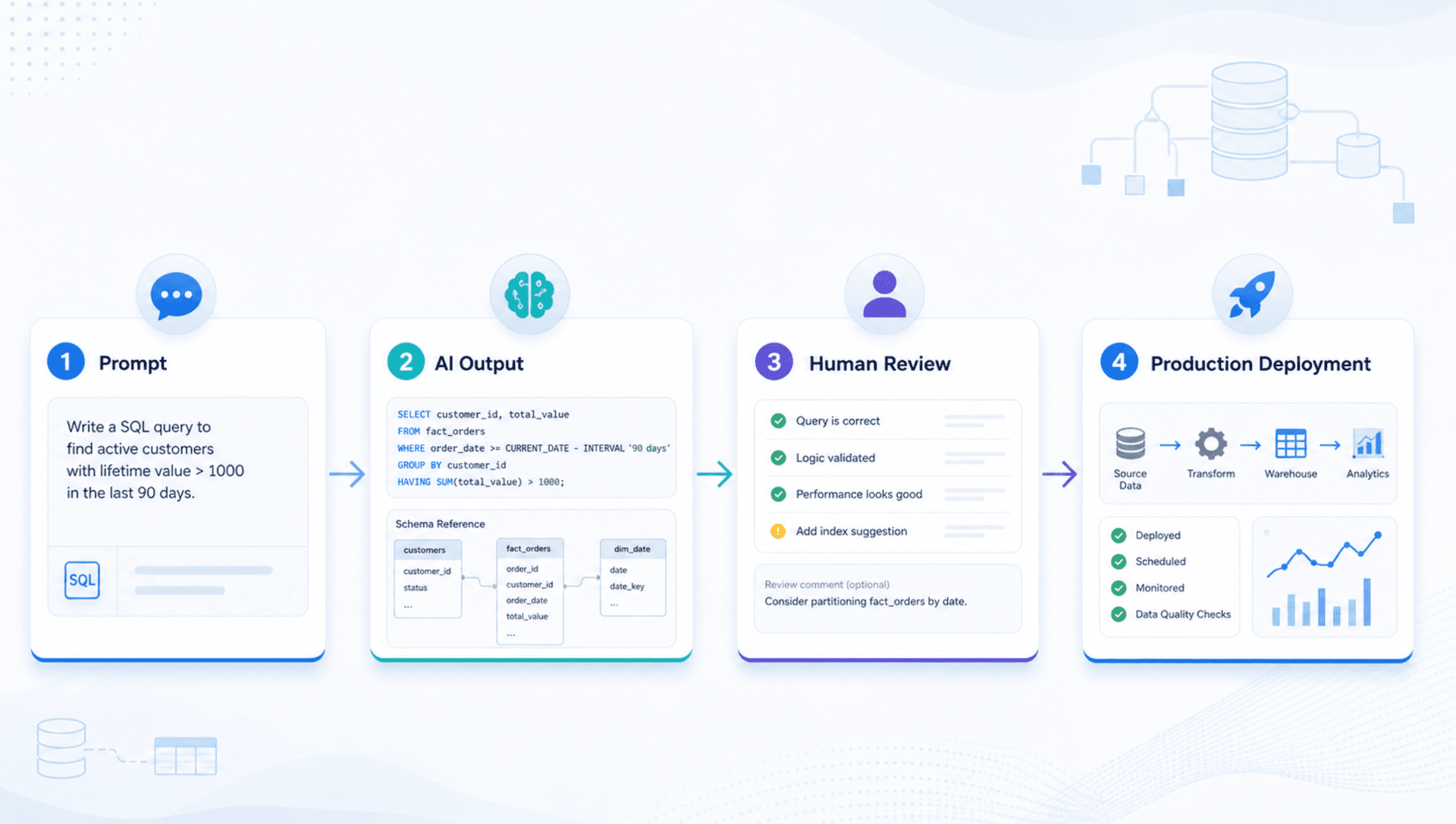
This doesn't mean we should avoid AI agents in data — it means we should be thoughtful about where we deploy them and how much autonomy we grant. The pattern that works today is "AI proposes, human approves." The agent generates the SQL, the dbt model, or the schema change, and a human reviews it before it touches production data. It's less exciting than full autonomy, but it captures most of the productivity gains with a fraction of the risk.
Practical Advice for Data Teams
If you're evaluating AI agents for your data team, here's what I'd recommend based on what I've seen work.
Start with text-to-SQL for exploratory analytics. It's the most mature use case, the risk is low (read-only queries), and the productivity gains are immediate and measurable. But invest in your metadata first — document your schemas, add column descriptions, define key metrics. The AI is only as good as the context you give it.
Use AI for code generation, not code execution. Let agents suggest dbt models, generate test cases, and draft documentation, but keep a human in the loop for anything that modifies production data. The 80% productivity gain from AI-assisted coding comes without the tail risk of autonomous execution.
Be skeptical of vendor demos. Every AI agent looks incredible on a curated demo dataset with clean schemas and simple queries. Ask vendors to demo on your actual data, with your actual schema complexity, and watch how the accuracy changes. If a vendor won't do this, that tells you something important.
Measure the impact honestly. Track how many queries the text-to-SQL agent handles correctly without human intervention, how much time the documentation agent saves, and how many pipeline agent suggestions get accepted versus rejected. If the acceptance rate is below 50%, the tool is creating more work than it saves.
The AI agents that matter in 2026 aren't the ones promising to replace your data team — they're the ones making your existing team two to three times more productive at the tasks they're already doing. That's less dramatic than "autonomous data engineering," but it's real, it's measurable, and it's available today.
EB
Written by Egor Burlakov
Engineering and Science Leader with experience building scalable data infrastructure, data pipelines and science applications. Sharing insights about data tools, architecture patterns, and best practices.
Explore Further
Dive deeper into the tools and categories mentioned in this article.