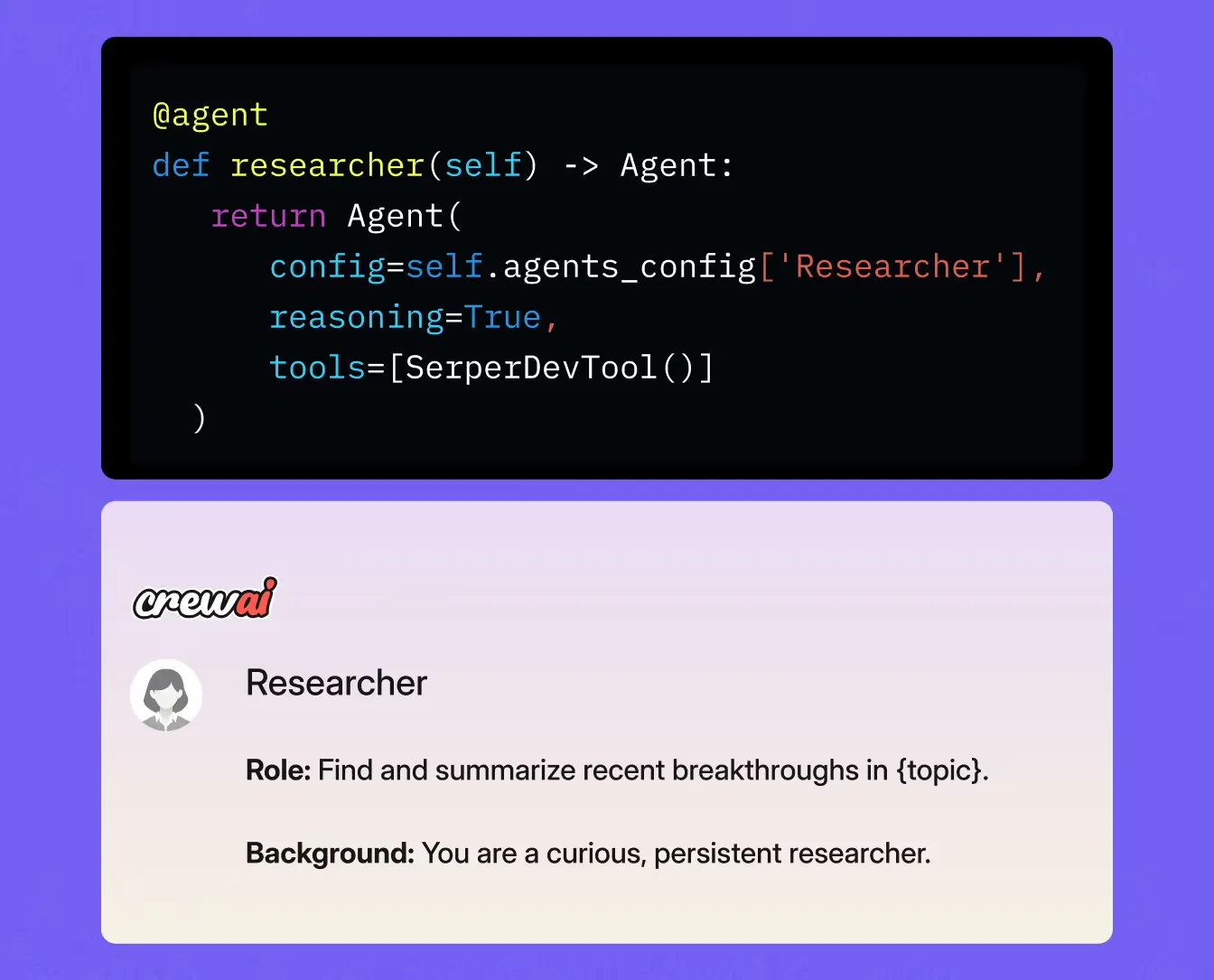
Finding the best AI agents & infrastructure tools is critical for teams building autonomous systems that interact with browsers, APIs, messaging platforms, and internal data. This category spans agent frameworks that execute multi-step workflows, monitoring platforms that trace every LLM call, security layers that guard credentials at runtime, and CRM-integrated agents that qualify leads and book appointments around the clock. Whether you need a browser-capable agent, real-time security monitoring, or a neural coordination protocol, the landscape in 2026 offers purpose-built options across every price point.
How to Choose
Selecting the right AI agent infrastructure depends on how your agents operate, what they access, and what guardrails you need. Below are the criteria that matter most, with concrete examples from the tools in this category.
Security model and credential isolation. Agents with system access need more than API keys locked in a vault. Clam enforces a semantic firewall on its network boundary so the agent itself never touches raw credentials. AgentVault takes a different approach with real-time credential scanning and dangerous command blocking via a self-hosted proxy at $49/month for Pro. If your agents run code autonomously, verify that the tool prevents data leakage at the network layer, not just at the prompt level.
Observability and tracing depth. Knowing what an agent did matters as much as what it produced. Auditi captures every OpenAI, Anthropic, and Google API call with just 2-line auto-instrumentation and runs 7+ LLM-as-Judge evaluators automatically on each trace. Real-time cost tracking helps you spot runaway spending before it escalates. Choose observability tools based on whether you need cost tracking, built-in eval, or the ability to turn production traces into fine-tuning datasets.
Deployment model: cloud, self-hosted, or hybrid. BU runs fully in the cloud with browser, terminal, and persistent memory included at no cost. Auditi self-hosts with a single docker compose command using Python SDK, FastAPI, and React. Match the deployment model to your data residency and latency requirements.
Integration breadth. Count the channels and protocols your agents need to reach. BU has built integrations for Slack, Gmail, Linear, and 100+ more services. Hashgrid takes a protocol-level approach where any agent, tool, or database becomes a node on the grid. The right choice depends on whether you need pre-built connectors or a general coordination primitive.
Pricing transparency and scaling costs. Usage-based pricing can surprise you. Clam starts at $50/month but scales through $75, $150, and up to $1,240/month tiers. AgentVault offers a free self-hosted MIT license with paid plans at $49/month (Pro) and $199/month (Enterprise). Open-source options like Auditi eliminate recurring fees entirely but shift ops burden to your team.
Top Tools
Clam
Clam turns your AI agent into an automation manager that writes Python, tests it, deploys it, and keeps it running 24/7. When something breaks, the agent fixes the code itself and builds you a customizable UI with dashboards and charts that you or the AI can reshape on the fly. What sets Clam apart is its semantic firewall on the network boundary, which categorizes threats into data leakage, instruction manipulation, and autonomous code execution risks, keeping credentials safe from the agent at all times.
Best suited for: Teams that want self-healing automations with built-in security guardrails and customizable dashboards.
Pricing: Usage-based starting at $50/month, with tiers at $75/month, $150/month, and enterprise spend up to $1,240/month (CPL at $14.76).
Limitation: Usage-based pricing with a CPL of $14.76 can be unpredictable for high-volume automation workloads, and there is no flat-rate unlimited plan.
Hashgrid — Neural Information Exchange
Hashgrid is a routing and preference protocol where intelligent compute units match, exchange small messages, score interactions, and re-match. The neural matching engine at its core processes 50 swipes per second, and the learning signal is just the score, so local memory stays fully private within each node. It takes 5 minutes to join the grid and create nodes from your agents, tools, or databases using the Node Actor interface.
Best suited for: Multi-agent orchestration where agents, tools, and data sources need dynamic, privacy-preserving coordination through Edge Actions.
Pricing: Free to start; enterprise plans available for production deployments.
Limitation: The Grid Environment requires customizing rules and dynamics for each use case, which adds setup time compared to plug-and-play alternatives.
AgentVault
AgentVault provides real-time security monitoring for AI agents with a dashboard that tracks all agent activity, blocks dangerous commands, and scans for exposed credentials. The self-hosted proxy gives you complete visibility and control with full audit trails, permission approvals, and network monitoring. It ships under the MIT license so you can inspect every line of code guarding your agents.
Best suited for: Development teams running AI agents with system access who need real-time threat detection, rate limiting, and compliance-ready audit trails.
Pricing: Free self-hosted (MIT license); Starter at $0/month, Pro at $49/month, Enterprise at $199/month.
Limitation: Built in response to a specific security incident, so the feature set is narrowly focused on security monitoring rather than general-purpose agent orchestration.
Auditi
Auditi combines tracing and evaluation in one open-source tool with 2-line auto-instrumentation that captures all OpenAI, Anthropic, and Google API calls. It ships with 7+ LLM-as-Judge evaluators that run automatically on traces, plus human annotation workflows for cases where AI judges are not enough. Production traces can be turned directly into fine-tuning datasets, and real-time cost tracking keeps spending visible at all times.
Best suited for: ML engineering teams that want open-source observability with built-in LLM evaluation and the ability to convert traces into training data.
Pricing: Free and open source (self-hosted via Docker Compose with Python SDK, FastAPI, and React stack).
Limitation: As an open-source project, Auditi requires your team to manage hosting, upgrades, and scaling without vendor support.
BU
BU lets you deploy fully autonomous AI agents with a single prompt. Each agent gets a browser with CAPTCHA solving, terminal access for running commands and scripts, and persistent memory with a file system. BU has solved authentication and built integrations for Slack, Gmail, Linear, and 100+ more services, converting a single prompt into a complex workflow via one API call.
Best suited for: Developers who need browser-capable autonomous agents with pre-built integrations for web scraping, monitoring, and testing workflows.
Pricing: Free to use with no published paid tiers.
Limitation: Free pricing with no published paid tiers raises questions about long-term sustainability and enterprise SLA guarantees.
Comparison Table
The following table summarizes the top AI agent tools in this category, comparing their target use case, pricing structure, and the single feature that most distinguishes each platform from the rest of the field. Use this alongside the detailed profiles above to narrow your shortlist based on budget and deployment requirements.
| Tool | Best For | Pricing | Key Strength |
|---|---|---|---|
| Clam | Self-healing automations | From $50/month (usage-based, CPL $14.76) | Semantic firewall isolating credentials from agents |
| Hashgrid | Multi-agent coordination | Free to start; enterprise available | Neural matching engine at 50 swipes/sec with full node privacy |
| AgentVault | Agent security monitoring | Free (MIT); Pro $49/month; Enterprise $199/month | Real-time command blocking with credential scanning |
| Auditi | LLM observability and eval | Free and open source | 7+ auto-evaluators with 2-line instrumentation |
| BU | Browser automation agents | Free | Single-prompt deployment with 100+ integrations and CAPTCHA solving |
Our Methodology
We evaluated 21 AI agent and infrastructure tools in this category using a structured framework tailored to the unique demands of autonomous agent systems. Our assessment weighs five dimensions: security architecture, observability depth, deployment flexibility, integration ecosystem, and total cost of ownership.
For security, we examined how each tool isolates agent access from sensitive credentials and whether it provides runtime guardrails. Clam's semantic firewall categorizes threats across data leakage, instruction manipulation, and code execution risks. AgentVault's proxy blocks dangerous commands and scans for credentials in real time, with full audit trails for compliance investigations. We weighted tools higher when they offered verifiable, auditable security controls rather than just policy documentation.
Deployment flexibility scored based on whether the tool supports cloud, self-hosted, and edge options. We confirmed that Auditi deploys with a single Docker Compose command using its Python SDK, FastAPI, and React stack. BU operates entirely in the cloud with browser, terminal, and persistent memory baked in.
We prioritized tools with transparent, published pricing and noted where sales contact is required. All 21 tools in this category have a published, source-backed review; the table below is ordered by reader demand rather than by any score we assign.
Frequently Asked Questions
What is the difference between an AI agent framework and an AI agent monitoring tool?
An AI agent framework provides the runtime environment where agents execute tasks. BU, for example, gives each agent a browser with CAPTCHA solving, terminal access, and persistent memory so it can autonomously browse websites, run scripts, and interact with 100+ integrated services via one API call. A monitoring tool like Auditi sits alongside the agent to capture every API call with 2-line instrumentation, evaluate outputs with 7+ LLM-as-Judge evaluators, and track costs in real time. AgentVault adds a security-specific monitoring layer with dangerous command blocking and credential scanning. Most production deployments need both: a framework to run the agent and a monitoring layer to observe, evaluate, and audit its behavior.
How much does it cost to run AI agents in production?
Costs vary dramatically based on deployment model and scale. Free and open-source tools like Auditi and BU eliminate licensing fees but require you to manage infrastructure. Clam's usage-based pricing starts at $50/month and can reach $1,240/month for heavy workloads, with a cost per lead of $14.76. AgentVault offers a free self-hosted option under the MIT license, with Pro at $49/month and Enterprise at $199/month. The biggest hidden cost is often the LLM API spend behind the agents, not the infrastructure tooling itself.
Can AI agents handle customer-facing conversations reliably?
Yes, but the tool must be purpose-built for it. Hashgrid's scoring mechanism allows agents to learn from interaction quality, with the score serving as the learning signal while local memory stays private. For customer-facing use cases, look for tools that offer multi-channel support, document-trained responses, and built-in scheduling rather than general-purpose agent frameworks.
What security measures should I look for in AI agent infrastructure?
Start with credential isolation. Clam enforces a semantic firewall at the network boundary that prevents agents from accessing raw credentials, categorizing threats across data leakage, instruction manipulation, and autonomous code execution. AgentVault provides real-time dashboard monitoring, dangerous command blocking, permission approvals, rate limiting, and credential scanning with full audit trails under an MIT license. At minimum, your agent infrastructure should offer network-level monitoring, command-level blocking for dangerous operations, and complete audit trails. Self-hosted options give you more control but require your team to maintain the security infrastructure.