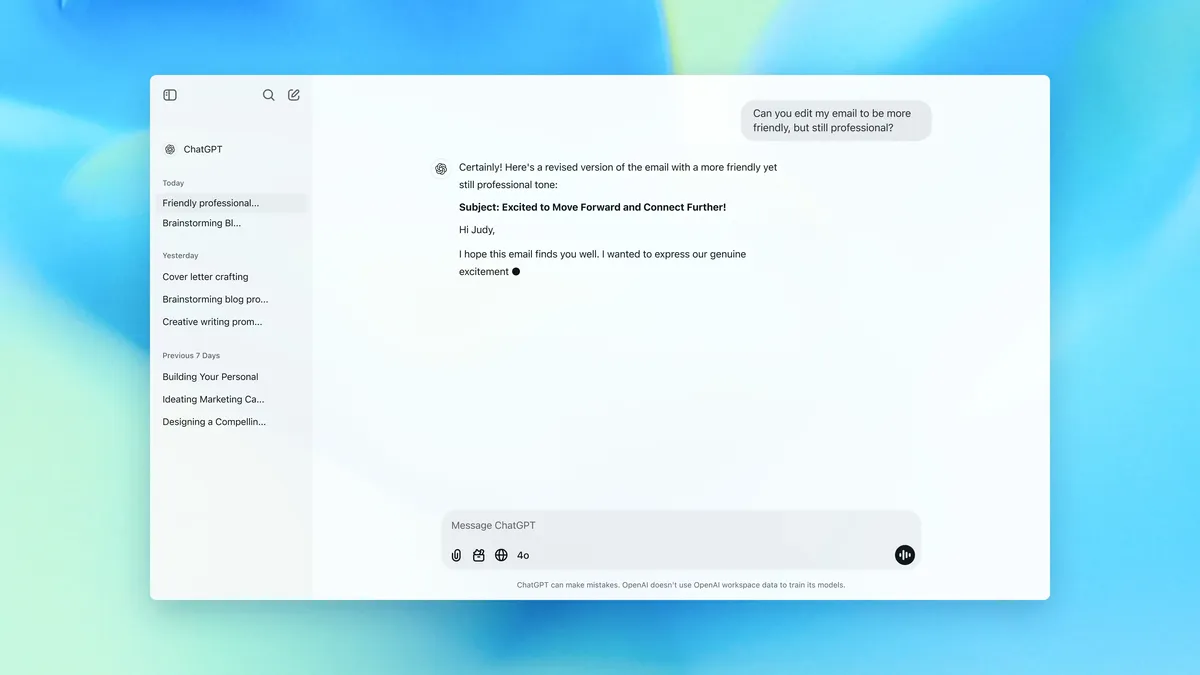
OpenAI: product and architecture
OpenAI is the AI research company behind GPT-4, GPT-5.4, DALL-E, Whisper, and ChatGPT, the products that brought artificial intelligence into mainstream consciousness. This openai review evaluates the platform from the perspective of developers and businesses building on top of OpenAI's API, covering its models, pricing, architecture, and competitive position as of April 2026. With a 9.2 out of 10 rating from 41 user reviews, OpenAI has maintained its position as the benchmark that the rest of the AI industry measures itself against. Whether you are integrating language models into a SaaS product, building autonomous agents, or using ChatGPT for daily workflows, OpenAI offers the broadest model lineup and the most mature API platform in the large language model space. We tested the latest GPT-5.4 family of models across coding, reasoning, content generation, and agent workflows to assess where OpenAI delivers and where competitors have closed the gap.
Overview
OpenAI is an AI research and deployment company headquartered in San Francisco, founded with the mission of building safe artificial general intelligence. The company has evolved from a research lab into the dominant commercial AI platform, powering applications from individual ChatGPT users to enterprise deployments at scale.
These models offer context lengths up to 1.05 million tokens for GPT-5.4 and 400,000 tokens for the mini and nano variants, with a maximum output of 128,000 tokens across all tiers. The knowledge cutoff for the GPT-5.4 family is August 31, 2025.
Beyond language models, OpenAI offers the Agents SDK for building production-ready AI agents, Agent Builder for visual-first agent creation, ChatKit for customizable frontend agent experiences, and the Realtime API for voice-powered applications. The platform includes enterprise-grade security features: SOC 2 Type 2 compliance, HIPAA-eligible BAA agreements, data encryption at rest with AES-256 and in transit with TLS 1.2+, zero data retention policies by request, and data residency controls. Notable enterprise customers include Zillow, Rakuten, STADLER, and Gradient Labs.
Key Features and Architecture
OpenAI’s API platform presents three GPT-5.6 models with a 1.05M-token context length and a 128K maximum output: GPT-5.6 Sol at $4.00 per 1M input tokens and $20.00 per 1M output tokens; GPT-5.6 Terra at $2.00 per 1M input tokens and $12.00 per 1M output tokens; and GPT-5.6 Luna at $0.20 per 1M input tokens and $1.20 per 1M output tokens. The displayed standard processing rates apply to context lengths under 270K.
The platform supports agent workflows through the Agents SDK and Responses API, with built-in tools including web search, file search, and remote MCP servers. The Realtime API is positioned for natural-sounding voice agents.
OpenAI describes use cases including coding, customer support, personalized recommendations, research and data analysis, content generation, and education.
Enterprise features listed for operating at scale include no training on your data, zero data retention by request, data residency controls, SOC 2 Type 2 compliance, SSO and MFA, IP allowlists and mTLS, encryption at rest and in transit, role-based access controls, project-level usage and cost activity, and billing and usage alerts.
Ideal Use Cases
OpenAI is best for development teams building AI-powered products that need the most capable language models available. If you are building customer-facing chatbots, coding assistants, content generation pipelines, or recommendation engines, GPT-5.4 provides the strongest baseline performance.
It excels for enterprise AI deployments that require compliance certifications, data residency controls, and dedicated account management. The SOC 2 Type 2 compliance, HIPAA BAA availability, and zero data retention policy make it suitable for regulated industries including healthcare and finance.
Agent builders benefit from the integrated Agents SDK, Agent Builder, ChatKit, and evaluation tools. OpenAI provides the most complete agent development platform, from prototyping on a visual canvas to deploying production agents with monitoring.
High-volume API consumers can optimize costs by choosing among three model tiers. Teams processing millions of tokens daily can use GPT-5.4 nano at $0.20 per 1 million input tokens for classification and routing, GPT-5.4 mini at $0.75 per 1 million input tokens for standard tasks, and GPT-5.4 for complex reasoning, keeping total costs manageable.
OpenAI is not suitable for teams that need fully on-premises or self-hosted models. The API is cloud-only with no option to run models locally. Teams with strict data sovereignty requirements that cannot use cloud APIs should evaluate open-weight alternatives.
Strengths & Trade-offs
Pros: GPT-5.6 Sol Input: $4.00 per 1M tokens Output: $20.00 per 1M tokens 1.05M context length 128K max output tokens
- Three-tier model pricing lets you optimize cost vs. capability, from $0.20 per 1M tokens (nano) to $2.50 per 1M tokens (full)
- Complete agent development platform with Agents SDK, Agent Builder, ChatKit, and built-in evaluations
- Enterprise-grade security: SOC 2 Type 2, HIPAA BAA, AES-256 encryption, zero data retention option
- Realtime API enables voice-powered applications with natural-sounding agents
- Extensive developer ecosystem with comprehensive API documentation, playground, and migration guides
Cons:
- Cloud-only with no self-hosted or on-premises option for teams needing full data control
- Usage-based pricing can be unpredictable for high-volume applications without careful cost monitoring
- Vendor lock-in risk: building deeply on OpenAI-specific features makes switching to alternatives costly
- Rate limits and availability can be a concern during peak demand periods