Decision comparison
OpenClaw vs OpenAI
Choose OpenClaw when the goal is a user-controlled personal assistant that can operate through messaging, voice, browser automation, and plugins on local or cloud infrastructure. Choose OpenAI when building a managed production application around GPT models, vision, audio, long-context processing, or Realtime API experiences.
Used together. These are normally used together rather than chosen between. The comparison explains what each one does in the stack.
These are different kinds of product — AI Assistant and Foundation Model Provider.
Quick Comparison
| Decision factor | OpenClaw | OpenAI |
|---|---|---|
| Best For | Personal assistants requiring multi-channel messaging, voice control, browser automation, plugins, and strong control over local or cloud deployment. | Teams building production AI applications needing text, code, vision, audio, long-context models, and realtime customer experiences through APIs. |
| Architecture | Open-source TypeScript personal-assistant project deployable locally or in cloud environments, with messaging, voice, browser automation, and plugin capabilities. | Hosted AI platform offering API access to GPT models plus text, code, vision, audio, image-generation, speech, and Realtime API capabilities. |
| Pricing Model | Contact for pricing | Contact for pricing |
| Ease of Use | Designed around personal-assistant interactions across messaging and voice channels; setup complexity depends on chosen local or cloud deployment and plugins. | Managed APIs and official Python library reduce infrastructure work; teams still need application integration, usage controls, and model-selection decisions. |
| Scalability | Can run locally or in the cloud; practical scaling depends on the selected hosting environment, automation workload, integrations, and model providers. | Hosted API architecture is suited to production workloads; GPT-5.4 mini and nano support up to 1.05M context length and 128K output tokens. |
| Community/Support | Public GitHub repository reports 389,084 stars, TypeScript as its primary language, and release v2026.9.2 dated September 5, 2026. | Official Python library repository reports 31,470 stars, Apache-2.0 licensing, and release v3.5.0 dated August 27, 2026. |
OpenClaw
- Best For:
- Personal assistants requiring multi-channel messaging, voice control, browser automation, plugins, and strong control over local or cloud deployment.
- Architecture:
- Open-source TypeScript personal-assistant project deployable locally or in cloud environments, with messaging, voice, browser automation, and plugin capabilities.
- Pricing Model:
- Contact for pricing
- Ease of Use:
- Designed around personal-assistant interactions across messaging and voice channels; setup complexity depends on chosen local or cloud deployment and plugins.
- Scalability:
- Can run locally or in the cloud; practical scaling depends on the selected hosting environment, automation workload, integrations, and model providers.
- Community/Support:
- Public GitHub repository reports 389,084 stars, TypeScript as its primary language, and release v2026.9.2 dated September 5, 2026.
OpenAI
- Best For:
- Teams building production AI applications needing text, code, vision, audio, long-context models, and realtime customer experiences through APIs.
- Architecture:
- Hosted AI platform offering API access to GPT models plus text, code, vision, audio, image-generation, speech, and Realtime API capabilities.
- Pricing Model:
- Contact for pricing
- Ease of Use:
- Managed APIs and official Python library reduce infrastructure work; teams still need application integration, usage controls, and model-selection decisions.
- Scalability:
- Hosted API architecture is suited to production workloads; GPT-5.4 mini and nano support up to 1.05M context length and 128K output tokens.
- Community/Support:
- Official Python library repository reports 31,470 stars, Apache-2.0 licensing, and release v3.5.0 dated August 27, 2026.
Public signals
Verified factual signals only. Bars appear only for like-for-like metrics with five weekly assessments for every tool; missing evidence stays explicit. These signals do not establish enterprise adoption, product quality, or total cost.
| Metric | OpenClaw | OpenAI |
|---|---|---|
| Docker Hub pulls(Product adoption) | 204.0k | Not available |
| GitHub commits, 90d(Product adoption) | 34.8k | Not available |
| GitHub stars(Product adoption) | 389,000+ | Not available |
| Search interest(Market interest) | 31 | 459 |
| Hacker News mentions, 90d(Community interest) | 119 | 1.5k |
| npm weekly downloads(Developer adoption) | 3.2M | 29.5M |
| Stack Overflow questions(Community interest) | 2 | 2.5k |
| GitHub commits, 90d(Developer adoption) | Not available | 129 |
| GitHub stars(Developer adoption) | Not available | 31,000+ |
| Hugging Face downloads(Product adoption) | Not available | 44.3M |
| Hugging Face likes(Product adoption) | Not available | 14.1k |
| Product Hunt comments(Community interest) | Not available | 1 |
| Product Hunt rating(Community interest) | Not available | 5.0/5 |
| Product Hunt reviews(Community interest) | Not available | 1 |
| Product Hunt votes(Community interest) | Not available | 7 |
| PyPI weekly downloads(Developer adoption) | Not available | 65.5M |
As of September 14, 2026 — updated weekly.
Health & risk evidence
Observed public-source checks for mapped package versions and repositories.
OpenClaw
September 14, 2026Package vulnerabilities
npm · openclaw@2026.9.4
0 vulnerabilities
across 1 package
Repository security score
Not available
OpenAI
September 14, 2026Package vulnerabilities
npm · openai@7.15.0 · PyPI · openai@3.13.0
0 vulnerabilities
across 2 packages
Repository security score
Not available
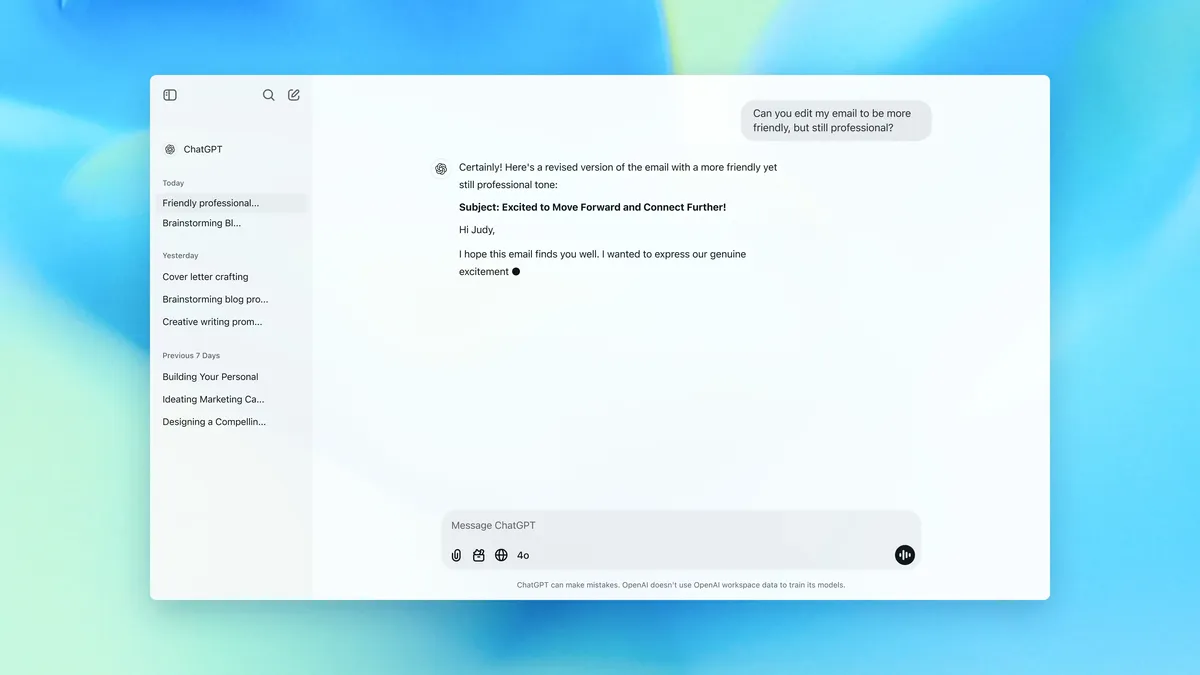
Interface Preview
OpenAI
Feature Comparison
| Feature | OpenClaw | OpenAI |
|---|---|---|
| Deployment and control | ||
| Deployment model | Runs locally or in cloud environments chosen by users | Provides hosted models and services through OpenAI APIs |
| User control emphasis | Emphasizes user control, extensibility, and privacy | Provides managed platform access to proprietary AI models |
| Primary implementation language | TypeScript is the repository's primary language | Python is the official library repository's primary language |
| Agent interaction | ||
| Messaging channels | Supports multi-channel messaging for personal assistant interactions | ChatGPT and APIs provide conversational AI access |
| Voice interaction | Includes voice control for operating the personal assistant | Supports audio processing and realtime customer experiences |
| Browser automation | Automates browser tasks through its assistant capabilities | No browser automation capability is specified in supplied data |
| Model and AI capabilities | ||
| Text and code generation | Assistant framework executes tasks across supported environments | API offers models for text generation and code generation |
| Vision and image capabilities | No vision or image-generation capability is specified in supplied data | Provides vision processing and DALL-E 3 image generation |
| Realtime experiences | Voice control supports direct assistant interaction workflows | Realtime API supports rich customer experiences and support |
| Extensibility and ecosystem | ||
| Plugin model | Plugin ecosystem extends assistant behaviors and integrations | No plugin ecosystem is specified in supplied data |
| Platform scope | Targets any operating system and platform | Delivers capabilities through hosted products and APIs |
| Official developer package | Public TypeScript repository supplies the core assistant project | Official Python library provides OpenAI API access |
| Scale, limits, and project status | ||
| Context capacity | Context limits depend on the selected underlying model provider | GPT-5.4 mini and nano support 1.05M context length |
| Maximum output | Output limits depend on the selected underlying model provider | GPT-5.4 mini and nano allow 128K output tokens |
| Repository release activity | Latest release v2026.9.2 published September 5, 2026 | Latest library release v3.5.0 published August 27, 2026 |
Deployment and control
Deployment model
User control emphasis
Primary implementation language
Agent interaction
Messaging channels
Voice interaction
Browser automation
Model and AI capabilities
Text and code generation
Vision and image capabilities
Realtime experiences
Extensibility and ecosystem
Plugin model
Platform scope
Official developer package
Scale, limits, and project status
Context capacity
Maximum output
Repository release activity
How they fit together
Choose OpenClaw when the goal is a user-controlled personal assistant that can operate through messaging, voice, browser automation, and plugins on local or cloud infrastructure. Choose OpenAI when building a managed production application around GPT models, vision, audio, long-context processing, or Realtime API experiences.
What each one handles
Use OpenClaw for:
Choose OpenClaw for personal or internal automations where local deployment, privacy posture, multi-channel interaction, browser control, and plugin extensibility are central requirements.
Use OpenAI for:
Choose OpenAI for customer-facing or product AI workloads that need managed APIs for GPT-based text, code, vision, audio, image generation, or realtime interactions.
These roles reflect the available product evidence. Most teams run both; which one owns a given job depends on your stack and team.
Frequently Asked Questions
What is the main difference between OpenClaw and OpenAI?
OpenClaw is an open-source personal AI assistant project focused on operating across messaging channels, voice control, browser automation, and plugins. It can run locally or in the cloud and explicitly emphasizes user control, extensibility, and privacy. OpenAI is a hosted AI company and platform that provides API access to GPT models and capabilities for text, code, vision, audio, image generation, and realtime experiences. They can be complementary: an OpenClaw deployment may use an AI model provider, while OpenAI provides managed model services.
Which is better for small teams?
For a small team building a customer-facing AI feature quickly, OpenAI is generally the more direct fit because managed APIs reduce the need to host model infrastructure, and the supplied capabilities include GPT-5.4 mini, GPT-5.4 nano, vision, audio, and the Realtime API. For a small team automating internal workflows or creating a personal-assistant-style tool, OpenClaw is a strong fit when browser automation, multi-channel messaging, local deployment, and a plugin ecosystem matter. The key trade-off is managed API convenience versus deployment control.
Can I migrate from OpenClaw to OpenAI?
A migration is possible at the application-design level, but it is not a like-for-like product migration. OpenClaw supplies an assistant framework with multi-channel messaging, voice control, browser automation, and plugins, whereas OpenAI supplies hosted model and API capabilities. A team can replace or add model calls with OpenAI APIs while retaining its own workflow orchestration, integrations, and user interface. If moving away from OpenClaw entirely, the team would need to reimplement any messaging connectors, browser automations, plugin behavior, and deployment operations that its OpenClaw setup currently provides.
What are the pricing differences?
OpenClaw is described as an open-source project, but the supplied pricing details say to contact OpenClaw for pricing and the repository metadata lists its license as NOASSERTION. That means self-hosting cost, commercial terms, and permitted usage should be confirmed with the project rather than assumed from the open-source description alone. OpenAI uses a usage-based pricing model and publishes pricing for individual, business, and enterprise plans, but the supplied source does not provide dollar amounts, token rates, free-tier limits, or plan prices. Therefore neither tool has a specific public dollar figure available in this comparison data.