Choosing the best MLOps & AI platforms requires evaluating how each tool handles the full machine learning lifecycle, from experiment tracking and model training through deployment and production monitoring. The MLOps market now spans everything from open-source frameworks with 18,000+ GitHub stars to fully managed cloud services offering access to 200+ foundation models. Whether your team needs Kubernetes-native orchestration, Git-like data versioning, or one-click deployment to production, the tools below represent the strongest options available today. This guide breaks down the top platforms based on real capabilities, pricing structures, and practical tradeoffs for data and ML engineering teams.
How to Choose
Infrastructure Integration and Portability -- Evaluate whether a platform locks you into a single cloud provider or works across environments. MLflow, for instance, operates with no vendor lock-in and integrates with LangChain, OpenAI, PyTorch, and 100+ AI frameworks, while Amazon SageMaker is tightly coupled with AWS services like its Lakehouse architecture and SageMaker Feature Store. Teams already invested in one cloud ecosystem may benefit from native integration, but multi-cloud shops need portable tooling.
Experiment Tracking Depth -- The ability to track, compare, and reproduce experiments is the backbone of MLOps. Neptune.ai is purpose-built for monitoring months-long foundation model training runs, allowing teams to visualize and compare thousands of metrics in seconds. Comet ML takes a different angle with built-in LLM tracing, automated prompt engineering, and ML unit-testing alongside traditional experiment tracking. Pick a tool whose tracking granularity matches your workflow complexity.
Deployment and Serving Capabilities -- How a platform gets models from notebooks into production matters enormously. Kubeflow provides a standardized distributed inference platform via KServe and supports AutoML with hyperparameter tuning and neural architecture search through Katib. Amazon SageMaker offers auto-scaling model deployment with fully managed infrastructure. BentoML takes a serving-focused approach with its unified model serving framework and packaged Bento archives. Match the deployment model to your team's infrastructure expertise.
Cost Structure and Scaling Economics -- Pricing models vary drastically across this category. Open-source tools like MLflow, Kubeflow, and DVC carry zero licensing costs under Apache 2.0 but require infrastructure and engineering time to self-host. Comet ML offers a free tier with Pro plans starting at $19/month. Cloud-managed platforms like Amazon SageMaker and Gemini Enterprise Agent Platform (formerly Google Cloud AI Platform) charge on a usage-based model per instance-hour, which can scale unpredictably with large training jobs. Google Cloud offers $300 in free credits for new customers to trial Gemini Enterprise Agent Platform.
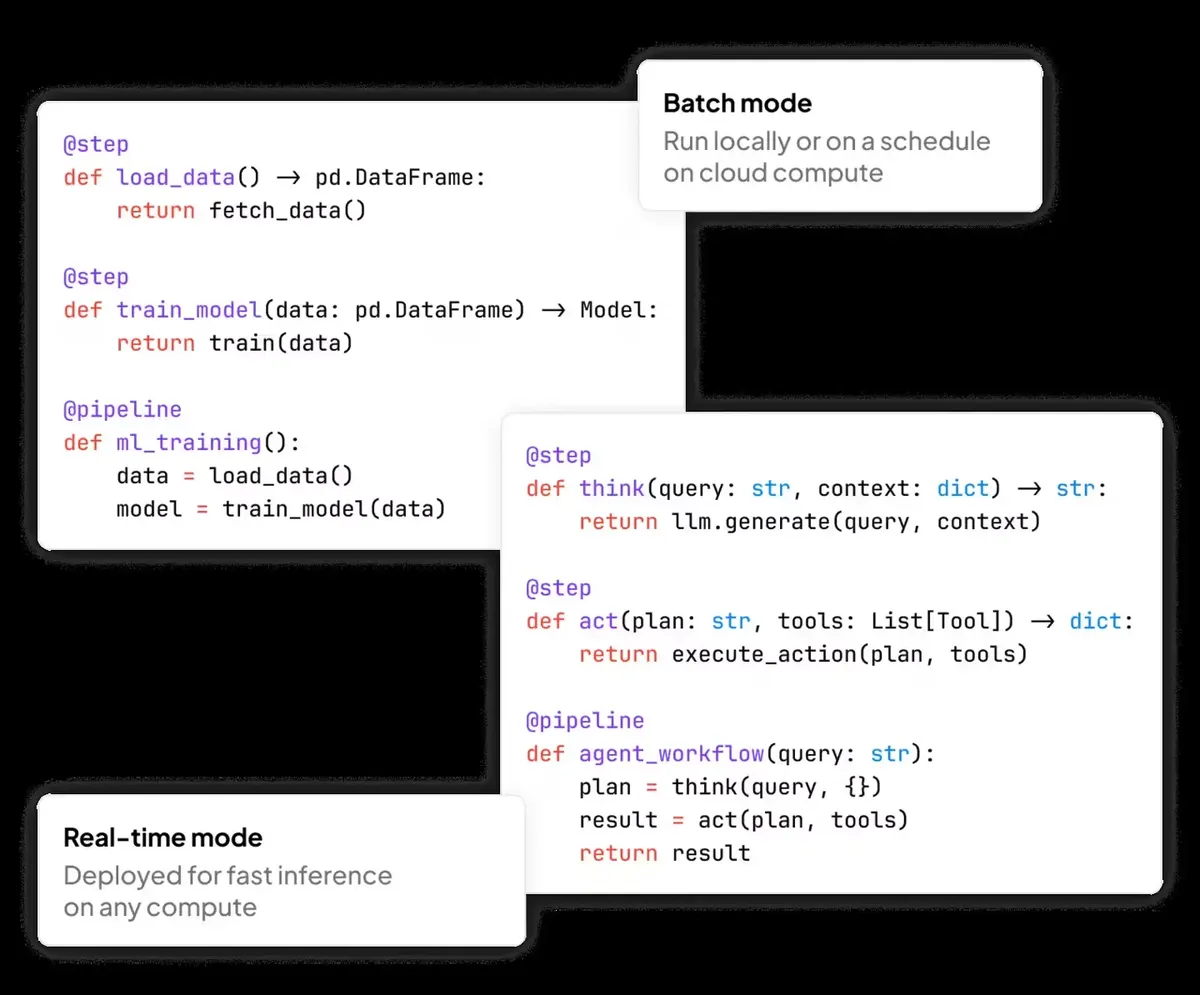
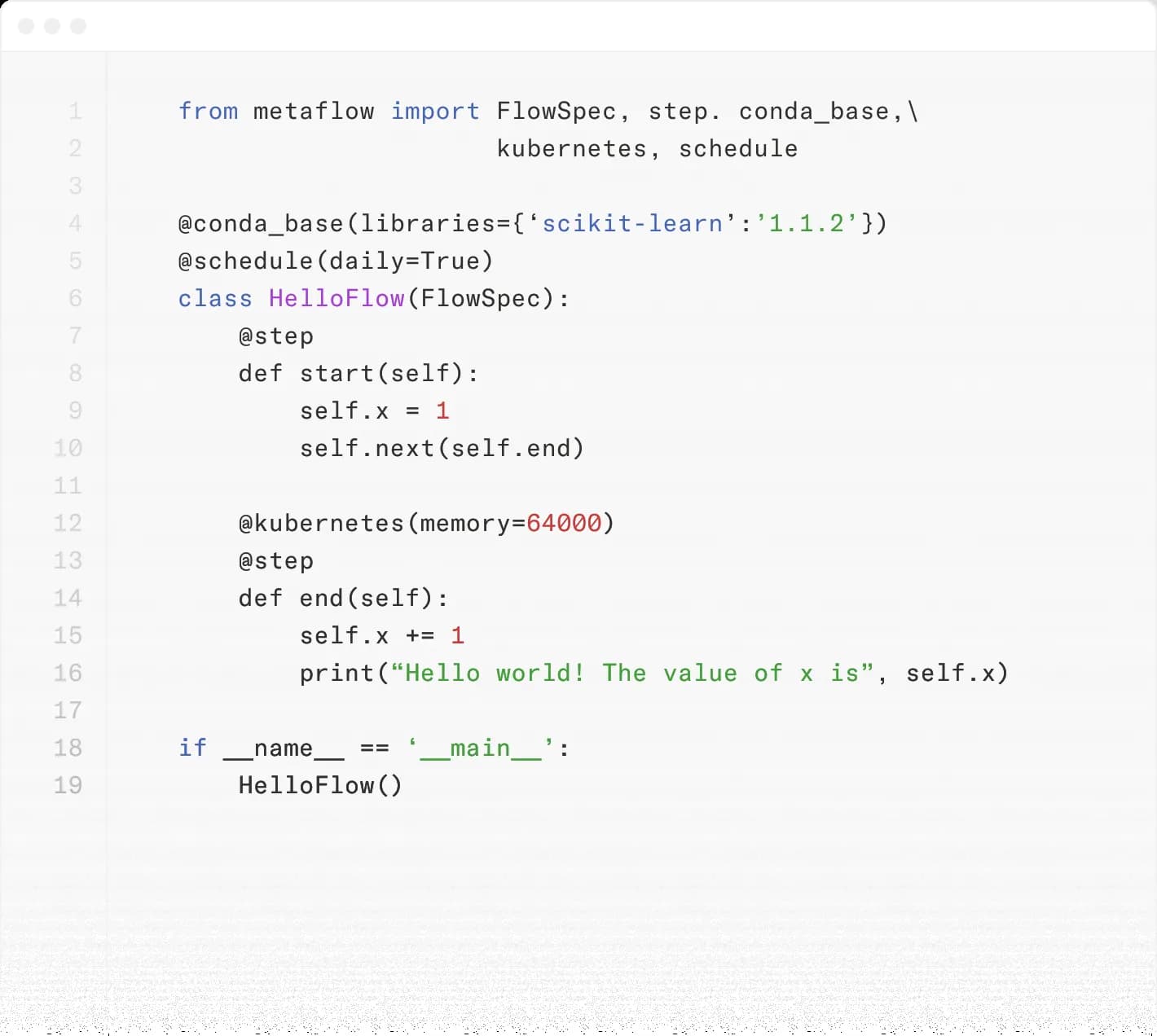
Pipeline Orchestration and Reproducibility -- Reproducible, automated pipelines separate ad hoc modeling from production ML. Kubeflow Pipelines (KFP) provides scalable ML workflows on Kubernetes, while Metaflow tracks and stores variables inside each flow automatically for debugging and reproducibility. ClearML offers automated pipeline orchestration with a single solution covering ML, DL, and GenAI jobs. Consider whether your team needs code-first pipeline definitions or a visual orchestration dashboard.
Data and Model Versioning -- Keeping track of which dataset version produced which model version is essential for auditability. DVC brings Git-like version control to ML projects and supports multiple remote storage backends including S3, GCS, Azure, and SSH. ClearML provides fully differentiable data management with version control on top of object storage providers. Without proper versioning, debugging production model regressions becomes guesswork.
Top Tools
Amazon SageMaker
Amazon SageMaker is the most comprehensive managed MLOps service in the AWS ecosystem, combining fully managed Jupyter notebooks, SageMaker Autopilot for automated model building, and a dedicated Feature Store for centralized feature management. Its Unified Studio consolidates the data science workflow into a single interface backed by a Lakehouse architecture that bridges analytics and ML workloads. Pricing is usage-based on instance hours and data processing, with no free tier available.
Best suited for: Enterprise teams already invested in the AWS ecosystem who want a fully managed end-to-end ML platform without stitching together multiple tools.
Pricing: Usage-based, billed per instance-hour for training and inference compute.
Limitation: Heavy AWS lock-in -- migrating trained models and pipelines to another cloud requires significant rearchitecting, and costs can escalate quickly with large-scale training jobs due to opaque per-instance billing.
Gemini Enterprise Agent Platform
Gemini Enterprise Agent Platform, formerly Vertex AI, provides a unified development platform with access to Gemini models for multimodal understanding alongside a Model Garden containing 200+ foundation models. Vertex AI Studio enables interactive prompt design, testing, and management, while integrated MLOps tools handle workflow automation and project standardization. New customers receive up to $300 in free credits to evaluate the platform.
Best suited for: Teams building generative AI applications who want access to Google's Gemini models and a broad catalog of foundation models within a single managed platform.
Pricing: Pay-as-you-go based on training, prediction, and managed ML service usage; $300 free trial credits for new accounts.
Limitation: Like SageMaker, the platform ties you to one cloud provider, and pay-as-you-go costs for foundation model inference can be difficult to forecast without careful usage monitoring.
Kubeflow
Kubeflow is a widely adopted open-source AI platform for Kubernetes environments, with 258M+ PyPI downloads, 33,100+ GitHub stars, and 3,000+ contributors. It offers a composable, modular architecture with Kubeflow Pipelines for scalable ML workflows, Katib for automated hyperparameter tuning and neural architecture search, and KServe for standardized distributed model serving. Its cloud-native model registry manages models, versions, and ML artifact metadata.
Best suited for: Platform engineering teams running Kubernetes who need a modular, battle-tested foundation for building internal ML platforms with full control over infrastructure.
Pricing: Free and open source; infrastructure costs depend on the underlying Kubernetes cluster.
Limitation: Kubeflow has a steep learning curve that assumes strong Kubernetes expertise -- teams without dedicated platform engineers will struggle with installation, configuration, and day-to-day maintenance.
Comet ML
Comet ML provides an end-to-end model evaluation platform that covers experiment tracking, production monitoring, and LLM-specific workflows in a single product. Its standout capabilities include LLM tracing for debugging agent behavior, automated prompt engineering to optimize prompts algorithmically, and built-in evaluation metrics that eliminate the need for separate testing frameworks. The platform also supports ML unit-testing, model versioning, and dataset management for full lifecycle coverage.
Best suited for: Data science teams working with both traditional ML and LLM-based applications who need unified experiment tracking with production monitoring in one tool.
Pricing: Free tier at $0/month; Pro plan at $19/month per user; Enterprise tier with custom pricing.
Limitation: The Pro tier at $19/month per user can add up quickly for larger teams, and the free tier has usage limits that growing teams will outpace within months.
ClearML
ClearML is an open-source MLOps platform that covers experiment tracking, pipeline orchestration, dataset versioning, model deployment, and GPU compute orchestration in a single unified system. Originally developed as Allegro Trains, it features fractional GPU support for maximizing hardware utilization and an orchestration dashboard for managing compute resources across teams. Its data management layer provides fully differentiable version control on top of S3, GCS, Azure, and NAS storage backends.
Best suited for: Teams that need a single open-source platform spanning the entire ML workflow from experiments to GPU orchestration, without assembling multiple disconnected tools.
Pricing: Open-source version is free; managed cloud starts at $15/month.
Limitation: The breadth of ClearML's feature set means each individual component (experiment tracking, serving, orchestration) is less specialized than best-of-breed alternatives focused on a single function.
Kedro
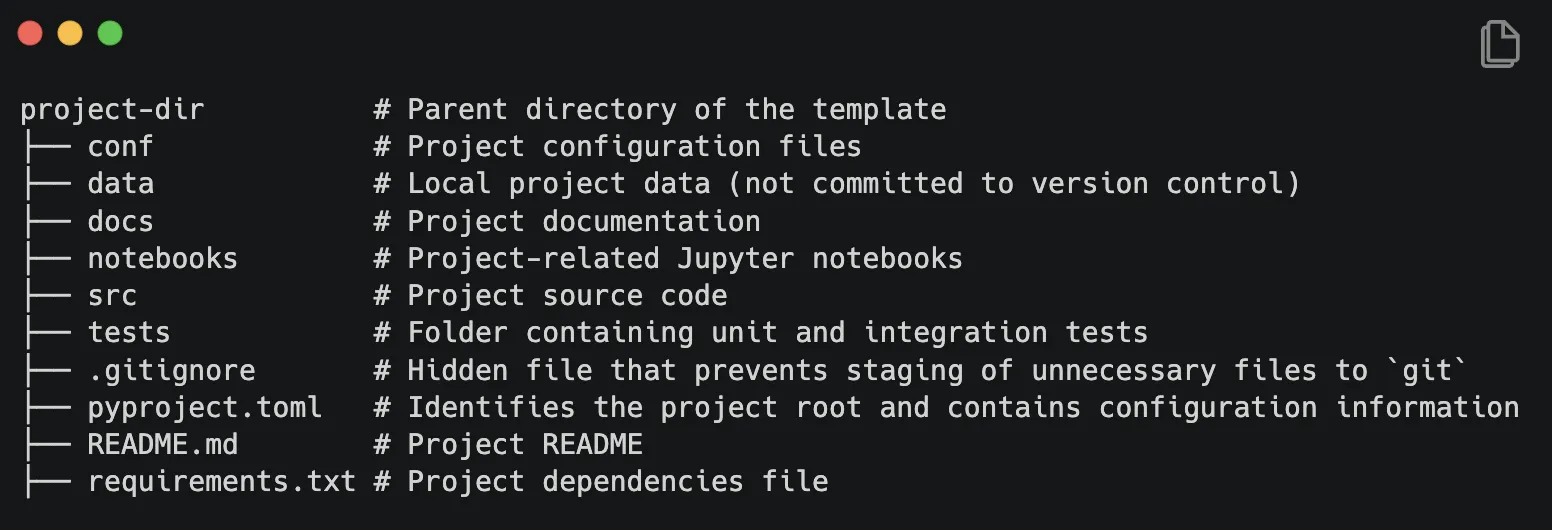
Kedro is an open-source Python framework developed by McKinsey's QuantumBlack that enforces software engineering best practices in data science and ML pipeline code. It provides a standardized project template, a Data Catalog abstraction layer for dataset-driven workflows, automatic dependency resolution between pure Python functions, and built-in pipeline visualization. Kedro is part of the Linux Foundation's LF AI & Data initiative and integrates with pytest for test-driven development and Sphinx for documentation.
Best suited for: Data science teams that want to write production-quality, maintainable pipeline code using software engineering conventions without adopting heavy infrastructure tooling.
Pricing: Free and open source.
Limitation: Kedro focuses on code structure and pipeline definition rather than deployment or serving -- teams still need separate infrastructure for running pipelines at scale and deploying models to production endpoints.
Comparison Table
| Tool | Best For | Pricing | Key Strength |
|---|---|---|---|
| Amazon SageMaker | AWS-native enterprise ML | Usage-based per instance-hour | Fully managed end-to-end platform with Feature Store and Autopilot |
| Gemini Enterprise Agent Platform | Generative AI with foundation models | Pay-as-you-go; $300 free credits | Access to Gemini models and 200+ foundation models via Model Garden |
| Kubeflow | Kubernetes-native ML orchestration | Free, open source | 258M+ PyPI downloads; modular architecture with Katib AutoML |
| Comet ML | Experiment tracking with LLM support | Free tier; Pro at $19/month | LLM tracing, automated prompt engineering, and ML unit-testing |
| ClearML | Unified open-source MLOps | Open source free; cloud from $15/month | Single platform covering experiments, pipelines, GPU orchestration |
| Kedro | Production-quality ML pipeline code | Free, open source | Software engineering best practices with Data Catalog and pipeline visualization |
Our Methodology
Our evaluation of MLOps and AI platforms weighs five core dimensions specifically relevant to ML engineering teams making production deployment decisions. First, we assess lifecycle coverage: how much of the ML workflow a single platform handles, from data versioning and experiment tracking through model serving and production monitoring, versus requiring integration with external tools. Second, we measure deployment flexibility, examining whether each platform supports on-premises, multi-cloud, and hybrid environments, or constrains teams to a single vendor's infrastructure.
Third, we analyze real-world adoption signals including GitHub stars, PyPI download counts, contributor community size, and documented production usage at scale. Tools like MLflow (18,000+ stars) and Kubeflow (33,100+ stars, 258M+ downloads) demonstrate sustained community investment that correlates with long-term viability and ecosystem breadth. Fourth, we evaluate pricing transparency and scalability economics, distinguishing between genuinely free open-source tools, freemium tiers with meaningful limits like Comet ML's $19/month Pro plan, and usage-based models where costs may scale unpredictably. Finally, we consider the operational burden each tool places on engineering teams, factoring in infrastructure requirements, learning curve, and the expertise needed to maintain the platform in production. Every tool listed on this page was reviewed against published documentation, feature specifications, and community feedback current as of early 2026.
Frequently Asked Questions
What is the difference between MLflow and Kubeflow?
MLflow and Kubeflow serve overlapping but distinct roles in the MLOps stack. MLflow focuses primarily on experiment tracking, model versioning, and a central model registry, offering a lightweight experience that integrates with 100+ frameworks including LangChain, OpenAI, and PyTorch. Kubeflow is a Kubernetes-native platform that provides full pipeline orchestration, distributed training, AutoML via Katib, and model serving through KServe. In practice, many teams use MLflow for experiment tracking within a broader Kubeflow deployment, since Kubeflow handles infrastructure orchestration while MLflow handles the data science workflow layer.
Are open-source MLOps tools production-ready?
Several open-source MLOps tools are battle-tested at enterprise scale. MLflow is used by Fortune 500 companies and has 18,000+ GitHub stars, while Kubeflow has accumulated 258M+ PyPI downloads and 3,000+ contributors building production AI platforms on Kubernetes. ClearML originated as Allegro Trains at Allegro AI and has been deployed in production environments for experiment tracking, pipeline orchestration, and GPU management. The tradeoff is operational responsibility: self-hosting means your team manages servers, databases, and upgrades, which requires dedicated platform engineering resources that managed services like SageMaker or Gemini Enterprise Agent Platform abstract away.
How much do managed MLOps platforms cost compared to open-source?
The cost gap depends heavily on scale and team composition. Open-source tools like MLflow, Kubeflow, and DVC have zero licensing fees under Apache 2.0, but self-hosting requires compute infrastructure and engineering time for maintenance. On the managed side, Comet ML offers a free tier with Pro plans at $19/month per user, and ClearML's managed cloud starts at $15/month. Amazon SageMaker and Gemini Enterprise Agent Platform use usage-based pricing tied to instance hours and data processing volumes, with Google offering $300 in trial credits for new Gemini Enterprise Agent Platform customers. For a mid-size team running moderate training workloads, managed platform costs can easily reach thousands per month, making the build-versus-buy decision a function of available engineering bandwidth versus budget.
Can I use multiple MLOps tools together?
Yes, and most production ML teams do exactly that. A common pattern combines MLflow for experiment tracking with Kubeflow Pipelines for workflow orchestration and DVC for data versioning across S3, GCS, or Azure storage backends. ClearML similarly integrates with cloud object storage for data management while providing its own orchestration dashboard. Kedro handles pipeline code structure and reproducibility, pairing naturally with deployment tools like Kubeflow or cloud-managed services. The key is selecting tools with non-overlapping responsibilities: one system for versioning, one for orchestration, one for serving, and one for tracking.