Metaflow: product and architecture
Overview
Metaflow was developed at Netflix starting in 2018 to address the gap between data science prototyping and production deployment. Netflix open-sourced it in 2019, and it has since gained 8K+ GitHub stars. The project is now maintained by Outerbounds, a company founded by Metaflow's original creators (Ville Tuulos and others) that has raised $35M+ in funding. Metaflow is used by Netflix, 23andMe, CNN, Realtor.com, and hundreds of other organizations. The framework's core philosophy is "human-centric ML" — making it easy for data scientists to build production workflows without learning infrastructure tools. Metaflow automatically versions every run (code, data, and artifacts), provides seamless scaling from laptop to cloud, and integrates with AWS (Step Functions, Batch) and Kubernetes for production execution.
Key Features and Architecture
Python-Native Workflow API
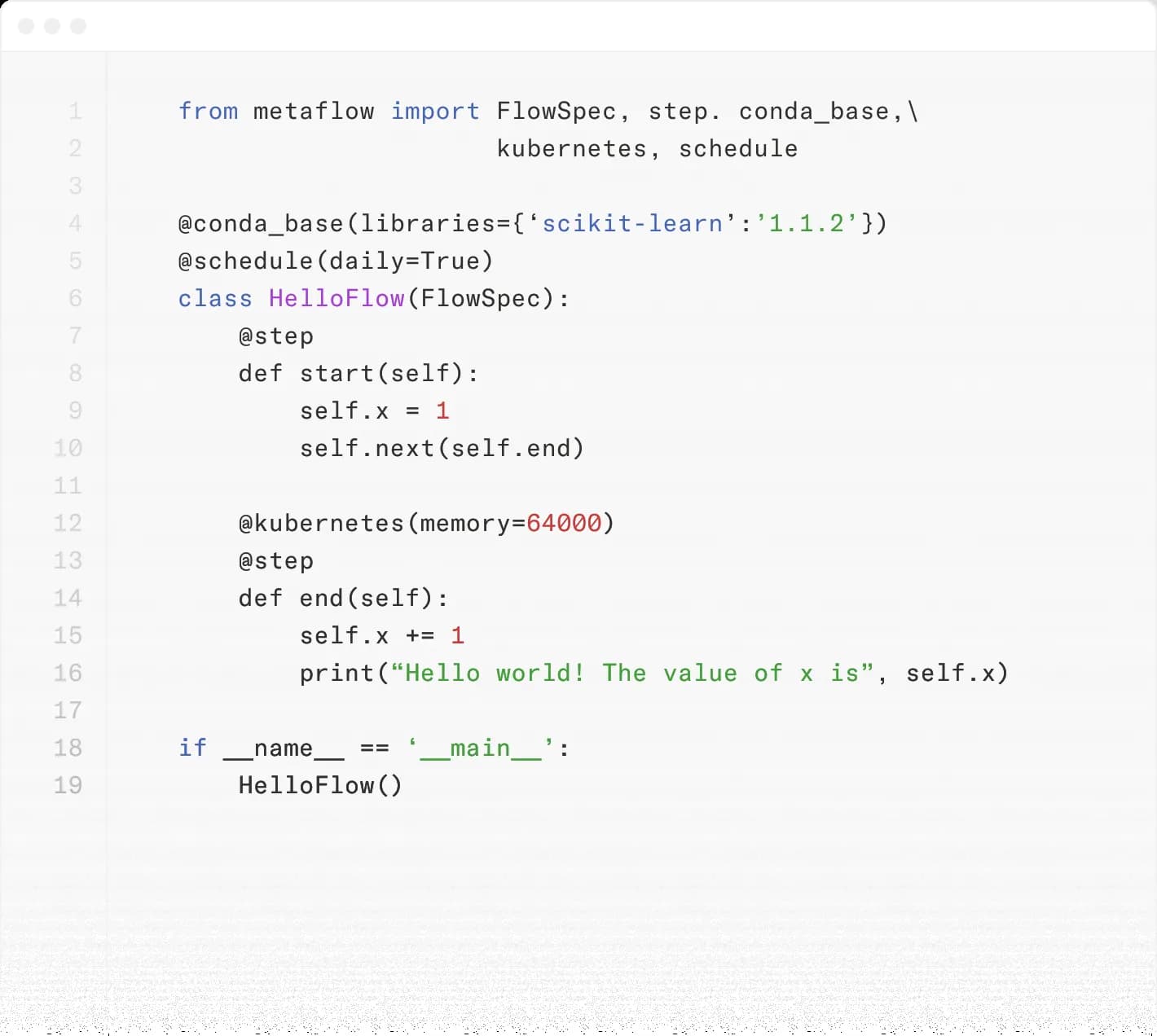
Define ML workflows as Python classes with @step decorated methods. Each step is a Python function that can access data from previous steps via self. The API feels like writing normal Python — no YAML, no DAG definitions, no container specs. Branching, joining, and foreach parallelism are expressed naturally in the class structure.
Automatic Versioning
Every Metaflow run automatically versions code, data, and artifacts. You can access any previous run's data with Flow('MyFlow').latest_run or browse specific runs by ID. This eliminates the need for separate experiment tracking for reproducibility — every run is fully reproducible by default. The versioning system uses content-addressed storage for deduplication.
Seamless Cloud Scaling
Run the same workflow locally for development and on AWS Batch or Kubernetes for production — no code changes needed. Metaflow handles resource provisioning, data transfer, and environment setup. The @resources decorator specifies CPU, memory, and GPU requirements per step. The @batch or @kubernetes decorators route steps to cloud execution.
Data Management
Metaflow's data layer handles passing data between steps with automatic serialization, compression, and storage. Large datasets are stored in S3 (or compatible storage) and loaded lazily. The @card decorator generates visual reports for each step, providing lightweight experiment tracking without a separate UI.
Production Scheduling
Deploy workflows to AWS Step Functions or Argo Workflows for production scheduling with metaflow production deploy. Metaflow handles the translation from Python workflow to cloud-native orchestration, including retry logic, timeout handling, and failure notifications.
Ideal Use Cases
Data Science Teams at Scale
Teams of 10+ data scientists who need to move from notebooks to production without learning infrastructure tools. Metaflow's Python-native API means data scientists write workflows in familiar Python while platform engineers configure the underlying infrastructure once. Netflix uses Metaflow for hundreds of production ML workflows.
ML Pipeline Orchestration
Organizations that need reliable, versioned ML pipelines for training, feature engineering, and batch inference. Metaflow's automatic versioning and cloud scaling make it ideal for pipelines that run daily or weekly on large datasets. The built-in retry logic and failure handling ensure production reliability.
Rapid Prototyping to Production
Teams that want to eliminate the gap between notebook experimentation and production deployment. With Metaflow, the same code runs locally during development and on cloud infrastructure in production — no rewriting, no containerization, no YAML configuration.
Batch Processing Workflows
Data teams running batch processing jobs (feature computation, model retraining, data transformation) that need versioning, scheduling, and scaling. Metaflow's step-based architecture with automatic data passing is well-suited for multi-step batch workflows.
Pricing and Licensing
Metaflow employs an open-source licensing model under the Apache-2.0 license, enabling self-hosted deployment at no cost. This model aligns with industry standards for open-source tools, where users gain full access to source code, modification rights, and the ability to deploy the software without vendor lock-in. While no specific pricing tiers or subscription models are disclosed, the open-source nature eliminates direct costs for software licenses, though infrastructure, maintenance, and support may incur expenses depending on deployment scale.
For tools in this category, pricing factors such as per-seat licensing, usage-based billing, or hidden costs (e.g., cloud provider dependencies, compliance certifications, or enterprise support) often influence total cost of ownership. Metaflow’s open-source approach avoids per-seat or subscription fees, but organizations should evaluate infrastructure requirements, integration complexity, and long-term maintenance costs.
Typical price ranges for comparable tools in data orchestration and workflow management often span from free tiers with usage limits to enterprise plans costing thousands annually. However, Metaflow’s model prioritizes flexibility and cost transparency, making it particularly appealing for teams seeking self-hosted, scalable solutions. To assess alignment with organizational needs, stakeholders should review the official documentation for deployment options, support tiers, and compliance benchmarks.
Strengths & Trade-offs
Pros
- Pythonic API — define workflows as Python classes; no YAML, no DAG definitions, no container specs
- Automatic versioning — every run versions code, data, and artifacts; full reproducibility by default
- Seamless scaling — same code runs locally and on AWS Batch/Kubernetes; no code changes for production
- Netflix-proven — battle-tested at Netflix scale with hundreds of production workflows
- 8K+ GitHub stars — active community, good documentation, responsive maintainers
- Lightweight — pip install and start; no Kubernetes cluster or Docker required for development
Cons
- No experiment tracking UI — automatic versioning captures data but lacks W&B-style visualization; need separate tool
- No model serving — orchestrates training pipelines but doesn't handle model deployment; need BentoML or Seldon
- AWS-centric — best integration with AWS (Batch, Step Functions, S3); Kubernetes support is newer and less mature
- Opinionated structure — the step-based workflow model doesn't fit all use cases; less flexible than Airflow
- Outerbounds pricing — managed platform is expensive for small teams; open-source lacks a web UI