Decision comparison
Metaflow vs Weights & Biases
Metaflow and Weights & Biases solve different parts of the ML lifecycle. Metaflow is the stronger choice for teams that need end-to-end workflow orchestration, production deployment, and multi-cloud compute scaling. W&B wins for teams whose primary need is experiment tracking, visualization, and collaborative model comparison. Many teams use both together, with Metaflow handling orchestration and W&B handling experiment logging.
Architecture choice. These take different approaches to the same problem. Read the table as a fit question rather than a feature race.
These are different kinds of product — ML Pipeline Framework and Experiment Tracking.
Quick Comparison
| Decision factor | Metaflow | Weights & Biases |
|---|---|---|
| Primary Focus | End-to-end ML workflow orchestration from development through production deployment | ML experiment tracking platform with visualization dashboards and model registry |
| Pricing Model | GitHub license: Apache-2.0 (tool can be self-hosted for free) | Free (Free tier), $60/mo (Pro), CONTACT US (Enterprise) |
| Cloud Support | Multi-cloud with native support for AWS, Azure, GCP, and custom Kubernetes clusters | SaaS-hosted platform with optional self-hosted enterprise deployment via Docker |
| Experiment Tracking | Built-in automatic versioning of variables and artifacts across flow steps | Dedicated tracking with rich visualizations for metrics, hyperparameters, and GPU usage |
| Workflow Orchestration | Python-native DAG orchestration with recursive and conditional step support | No built-in workflow orchestration; focuses on tracking and model management |
| Collaboration Features | Git-based collaboration with shared artifact store and automatic versioning | Team dashboards, shared experiments, reports, and team-based access controls |
Metaflow
- Primary Focus:
- End-to-end ML workflow orchestration from development through production deployment
- Pricing Model:
- GitHub license: Apache-2.0 (tool can be self-hosted for free)
- Cloud Support:
- Multi-cloud with native support for AWS, Azure, GCP, and custom Kubernetes clusters
- Experiment Tracking:
- Built-in automatic versioning of variables and artifacts across flow steps
- Workflow Orchestration:
- Python-native DAG orchestration with recursive and conditional step support
- Collaboration Features:
- Git-based collaboration with shared artifact store and automatic versioning
Weights & Biases
- Primary Focus:
- ML experiment tracking platform with visualization dashboards and model registry
- Pricing Model:
- Free (Free tier), $60/mo (Pro), CONTACT US (Enterprise)
- Cloud Support:
- SaaS-hosted platform with optional self-hosted enterprise deployment via Docker
- Experiment Tracking:
- Dedicated tracking with rich visualizations for metrics, hyperparameters, and GPU usage
- Workflow Orchestration:
- No built-in workflow orchestration; focuses on tracking and model management
- Collaboration Features:
- Team dashboards, shared experiments, reports, and team-based access controls
Public signals
Verified factual signals only. Bars appear only for like-for-like metrics with five weekly assessments for every tool; missing evidence stays explicit. These signals do not establish enterprise adoption, product quality, or total cost.
| Metric | Metaflow | Weights & Biases |
|---|---|---|
| GitHub commits, 90d(Product adoption) | 38 | 459 |
| GitHub stars(Product adoption) | 10,000+ | 11,000+ |
| Search interest(Market interest) | 2 | 0 |
| PyPI weekly downloads(Product adoption) | 87.4k | 3.0M |
| Stack Overflow questions(Community interest) | 31 | 139 |
| Docker Hub pulls(Product adoption) | Not available | 4.0M |
| Hacker News mentions, 90d(Community interest) | Not available | 0 |
| Hugging Face downloads(Product adoption) | Not available | 2.4k |
| Hugging Face likes(Product adoption) | Not available | 31 |
| npm weekly downloads(Developer adoption) | Not available | 17.4k |
As of September 14, 2026 — updated weekly.
Health & risk evidence
Observed public-source checks for mapped package versions and repositories.
Metaflow
September 14, 2026Package vulnerabilities
PyPI · metaflow@2.19.39
0 vulnerabilities
across 1 package
Repository security score
Not available
Weights & Biases
September 14, 2026Package vulnerabilities
npm · @wandb/sdk@0.5.1 · PyPI · wandb@0.29.0
0 vulnerabilities
across 2 packages
Repository security score
Not available
Interface Preview
Metaflow
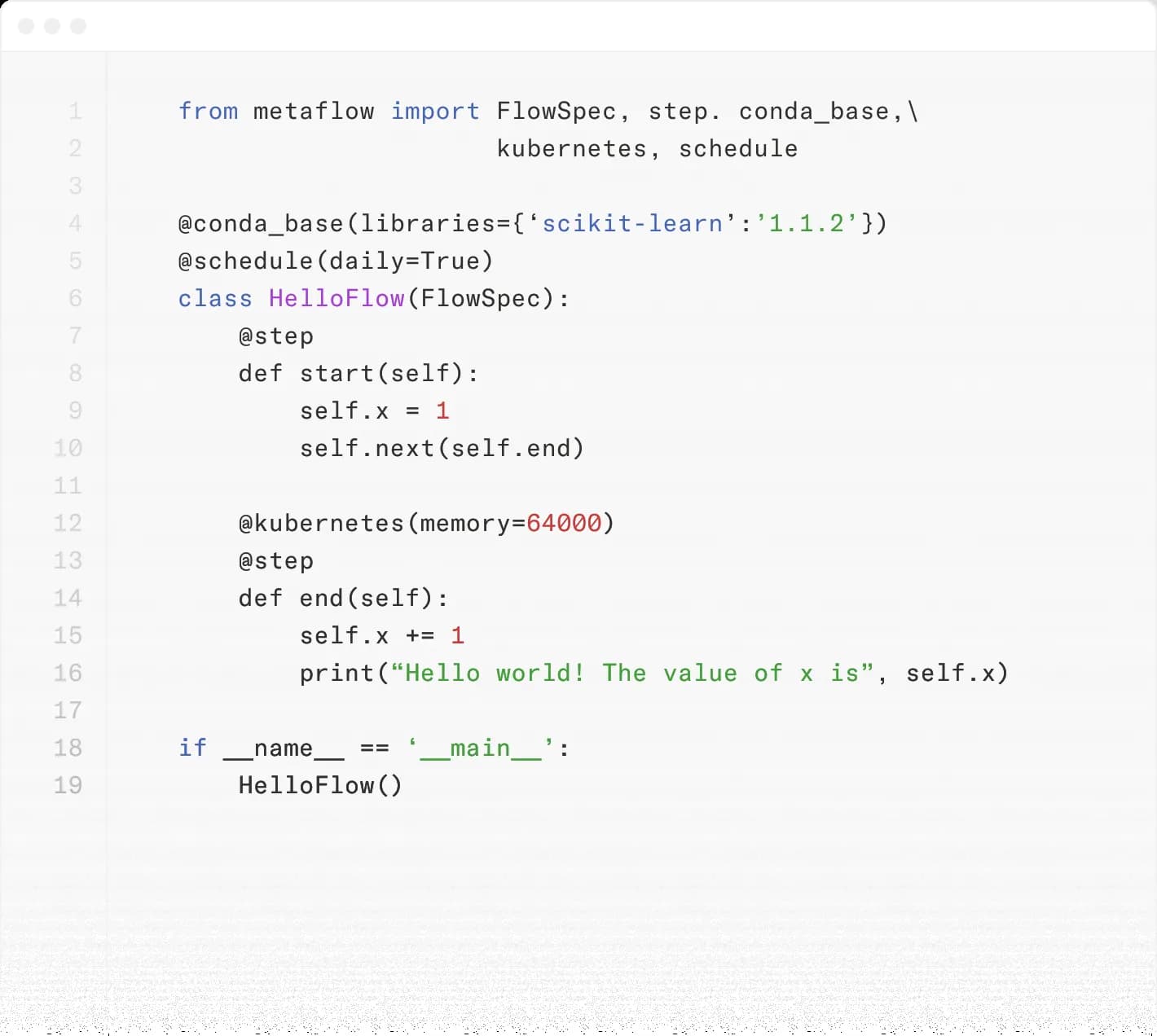
Feature Comparison
| Feature | Metaflow | Weights & Biases |
|---|---|---|
| Experiment Tracking & Versioning | ||
| Automatic Experiment Logging | Automatically tracks and stores variables inside each flow step for debugging and analysis | Comprehensive logging of metrics, hyperparameters, git commits, model weights, GPU usage, and predictions |
| Artifact Versioning | Flows data across steps with automatic versioning of all intermediate artifacts | Full model registry with lineage tracking and asset versioning across experiments |
| Visualization Dashboards | Real-time dynamic cards for building observable ML systems with live updates | Rich interactive dashboards for comparing runs, visualizing metrics, and sharing reports |
| Workflow & Orchestration | ||
| Pipeline Definition | Python-native DAG definition with plain Python code, no YAML or config files required | No pipeline orchestration; designed to integrate with external orchestrators |
| Production Deployment | One-command deployment to production with event-driven triggering and scheduling | CI/CD automations and Slack/email alerts for model deployment monitoring |
| Conditional Logic | Supports recursive and conditional steps for building agentic and branching workflows | Not applicable; W&B tracks experiments rather than orchestrating workflow logic |
| Infrastructure & Compute | ||
| GPU & Compute Scaling | Scales to cloud GPUs, multiple cores, and large memory instances with built-in compute management | Tracks GPU usage metrics but does not provision or manage compute resources |
| Cloud Provider Support | Native deployment on AWS EKS, Azure AKS, GCP GKE, and custom Kubernetes clusters | SaaS platform with enterprise self-hosted option supporting Docker-based deployment |
| Data Warehouse Access | Built-in data access from data warehouses with automatic data flow between steps | Focuses on experiment data; integrates with external data sources via SDK |
| Collaboration & Security | ||
| Team Collaboration | Git-based workflow sharing with automatic artifact versioning for team coordination | Unlimited teams, shared experiment dashboards, reports, and service accounts on Pro tier |
| Access Controls | Relies on infrastructure-level access controls through cloud provider IAM policies | Team-based access controls on Pro, custom roles and SSO on Enterprise tier |
| Compliance & Audit | Integrates with existing infrastructure security and data governance policies on your cloud | Enterprise tier offers HIPAA compliance, audit logs, customer-managed encryption keys |
| Developer Experience | ||
| Getting Started | One-click local development stack setup on laptop; Metaflow Sandbox for browser-based trials | Free tier sign-up with Python SDK integration; runs locally with Docker for self-hosted |
| Language & Framework Support | Python-native with support for any Python ML library and dependency management via uv | Python SDK with integrations for PyTorch, TensorFlow, Keras, JAX, and reinforcement learning |
| Hyperparameter Optimization | Supports parallel execution of parameter sweeps through fan-out step patterns | Dedicated Sweeps feature for automated hyperparameter search and tuning |
Experiment Tracking & Versioning
Automatic Experiment Logging
Artifact Versioning
Visualization Dashboards
Workflow & Orchestration
Pipeline Definition
Production Deployment
Conditional Logic
Infrastructure & Compute
GPU & Compute Scaling
Cloud Provider Support
Data Warehouse Access
Collaboration & Security
Team Collaboration
Access Controls
Compliance & Audit
Developer Experience
Getting Started
Language & Framework Support
Hyperparameter Optimization
Which approach fits
Metaflow and Weights & Biases solve different parts of the ML lifecycle. Metaflow is the stronger choice for teams that need end-to-end workflow orchestration, production deployment, and multi-cloud compute scaling. W&B wins for teams whose primary need is experiment tracking, visualization, and collaborative model comparison. Many teams use both together, with Metaflow handling orchestration and W&B handling experiment logging.
When each approach fits
Choose Metaflow if:
Choose Metaflow if your team needs an open-source framework for orchestrating end-to-end ML pipelines from development to production. It excels at multi-cloud deployment across AWS, Azure, and GCP, scales compute to GPUs and large memory instances, and handles data flow between pipeline steps automatically. Originally battle-hardened at Netflix, it is the right pick for teams that want full control over their infrastructure without vendor lock-in or per-seat licensing costs.
Choose Weights & Biases if:
Choose Weights & Biases if your team prioritizes experiment tracking, model comparison, and collaborative visualization over workflow orchestration. W&B provides best-in-class dashboards for logging metrics, hyperparameters, and model artifacts with a generous free tier for up to 5 seats. The Pro tier starts at $60/month, billed monthly and adds team collaboration features, while Enterprise offers HIPAA compliance and dedicated support for regulated industries.
These scenarios reflect the available product evidence. Your requirements, existing stack, and team expertise should guide the final decision.
Frequently Asked Questions
Can Metaflow and Weights & Biases be used together?
Yes, Metaflow and W&B complement each other well and many ML teams use both tools in their stack. Metaflow handles the workflow orchestration, compute scaling, and production deployment side of the pipeline, while W&B provides the experiment tracking, visualization, and model registry capabilities. You can integrate W&B logging calls directly inside Metaflow flow steps to get the orchestration benefits of Metaflow with the rich experiment dashboards of W&B. This combination gives teams full pipeline management alongside detailed experiment analysis without either tool limiting the other.
Is Metaflow truly free, and what are the costs of self-hosting?
Metaflow is fully open source under the Apache-2.0 license, so the software itself is free with no per-seat or per-usage charges. However, self-hosting Metaflow on cloud infrastructure does incur costs for the underlying compute, storage, and networking resources from your cloud provider. You will pay for the EC2 instances, S3 storage, or equivalent resources on Azure and GCP that Metaflow uses to run your workflows. There is no paid Metaflow tier or vendor licensing fee, which makes it cost-effective for teams that already have cloud infrastructure budgets in place.
What does the Weights & Biases free tier include?
The W&B free tier includes up to 5 model seats, 5 GB per month of storage, AI application evaluations, tracing, and scorers, AI model experiment tracking, asset registry and lineage tracking, CI/CD automations, and Slack and email alerts with community support. It is designed for individual researchers and personal AI development projects. The free tier covers the core experiment tracking and visualization features, making it a solid starting point. Teams that outgrow the free tier can upgrade to Pro, which starts at $60/month, billed monthly, for up to 10 seats, 100 GB of storage, team-based access controls, and priority support.
Which tool is better for production ML deployments at scale?
For production ML deployments at scale, Metaflow is the stronger choice because it was purpose-built for taking ML projects from experimentation to production. Originally developed at Netflix to handle demanding real-life ML and data science workflows, Metaflow provides one-command production deployment, event-driven scheduling, multi-cloud compute scaling with GPU support, and checkpointing for long-running training jobs. W&B is not an orchestration or deployment tool; it tracks and visualizes experiments but relies on external tools like Metaflow, Airflow, or Kubeflow for actual production pipeline management and scheduling.
How do Metaflow and W&B compare on GitHub community activity?
Both tools have strong open-source communities. Metaflow has over 10,000 GitHub stars with its repository licensed under Apache-2.0, actively maintained with the latest release being version 2.19.22. W&B has over 11,000 GitHub stars under the MIT license, with its latest release being version 0.28.1. Both repositories are written primarily in Python and are actively pushed to. Metaflow covers extensive GitHub topics including agents, distributed training, and high-performance computing, while W&B focuses on experiment tracking, hyperparameter optimization, and deep learning framework integrations for PyTorch, TensorFlow, Keras, and JAX.