Decision comparison
Domino Data Lab vs Weights & Biases
Domino Data Lab is the right choice for large enterprise ML organizations that need centralized compute governance, model deployment, and regulatory compliance in a single platform. Weights & Biases is the right choice for ML teams of any size that prioritize experiment tracking velocity, visualization quality, and accessible pricing. For many teams, these tools are complementary rather than competitive.
Architecture choice. These take different approaches to the same problem. Read the table as a fit question rather than a feature race.
These are different kinds of product — ML Platform and Experiment Tracking.
Quick Comparison
| Decision factor | Domino Data Lab | Weights & Biases |
|---|---|---|
| Best For | Enterprise ML teams needing governed model lifecycle management at scale | ML practitioners who need best-in-class experiment tracking and visualization |
| Platform Scope | Full MLOps platform: workspaces, compute orchestration, model registry, governance, and RBAC | Focused on experiment tracking, model management, dataset versioning, and hyperparameter sweeps |
| Pricing Model | Domino Data Lab uses enterprise quote-based pricing only. No public pricing, no self-serve plans, no free tier. Deployment options: Domino Cloud (hosted), self-hosted, or hybrid. Annual enterprise contracts. Contact sales for pricing. Third-party estimates suggest six-figure annual contracts for enterprise deployments. | Free (Free tier), $60/mo (Pro), CONTACT US (Enterprise) |
| Ease of Adoption | Requires enterprise procurement cycle, dedicated onboarding, and platform team investment | Sign up in minutes, two-line SDK integration, immediate value from first experiment log |
| Scalability | Enterprise-grade GPU scheduling, Kubernetes-backed compute with on-demand scaling | Cloud-hosted SaaS scales transparently; self-hosted available for Enterprise tier |
| Community & Ecosystem | Compact community; strong enterprise partnerships with NVIDIA, AWS, and Snowflake | Large open-source community, 700K+ users, integrations with PyTorch, TensorFlow, Hugging Face |
Domino Data Lab
- Best For:
- Enterprise ML teams needing governed model lifecycle management at scale
- Platform Scope:
- Full MLOps platform: workspaces, compute orchestration, model registry, governance, and RBAC
- Pricing Model:
- Domino Data Lab uses enterprise quote-based pricing only. No public pricing, no self-serve plans, no free tier. Deployment options: Domino Cloud (hosted), self-hosted, or hybrid. Annual enterprise contracts. Contact sales for pricing. Third-party estimates suggest six-figure annual contracts for enterprise deployments.
- Ease of Adoption:
- Requires enterprise procurement cycle, dedicated onboarding, and platform team investment
- Scalability:
- Enterprise-grade GPU scheduling, Kubernetes-backed compute with on-demand scaling
- Community & Ecosystem:
- Compact community; strong enterprise partnerships with NVIDIA, AWS, and Snowflake
Weights & Biases
- Best For:
- ML practitioners who need best-in-class experiment tracking and visualization
- Platform Scope:
- Focused on experiment tracking, model management, dataset versioning, and hyperparameter sweeps
- Pricing Model:
- Free (Free tier), $60/mo (Pro), CONTACT US (Enterprise)
- Ease of Adoption:
- Sign up in minutes, two-line SDK integration, immediate value from first experiment log
- Scalability:
- Cloud-hosted SaaS scales transparently; self-hosted available for Enterprise tier
- Community & Ecosystem:
- Large open-source community, 700K+ users, integrations with PyTorch, TensorFlow, Hugging Face
Public signals
Verified factual signals only. Bars appear only for like-for-like metrics with five weekly assessments for every tool; missing evidence stays explicit. These signals do not establish enterprise adoption, product quality, or total cost.
| Metric | Domino Data Lab | Weights & Biases |
|---|---|---|
| GitHub commits, 90d(Developer adoption) | 3 | Not available |
| GitHub stars(Developer adoption) | 58 | Not available |
| Search interest(Market interest) | 0 | 0 |
| Hacker News mentions, 90d(Community interest) | 0 | 0 |
| PyPI weekly downloads(Developer adoption) | 11.0k | Not available |
| Docker Hub pulls(Product adoption) | Not available | 4.0M |
| GitHub commits, 90d(Product adoption) | Not available | 459 |
| GitHub stars(Product adoption) | Not available | 11,000+ |
| Hugging Face downloads(Product adoption) | Not available | 2.4k |
| Hugging Face likes(Product adoption) | Not available | 31 |
| npm weekly downloads(Developer adoption) | Not available | 17.4k |
| PyPI weekly downloads(Product adoption) | Not available | 3.0M |
| Stack Overflow questions(Community interest) | Not available | 139 |
As of September 14, 2026 — updated weekly.
Health & risk evidence
Observed public-source checks for mapped package versions and repositories.
Domino Data Lab
September 14, 2026Package vulnerabilities
PyPI · dominodatalab@2.2.0
0 vulnerabilities
across 1 package
Repository security score
Not available
Weights & Biases
September 14, 2026Package vulnerabilities
npm · @wandb/sdk@0.5.1 · PyPI · wandb@0.29.0
0 vulnerabilities
across 2 packages
Repository security score
Not available
Interface Preview
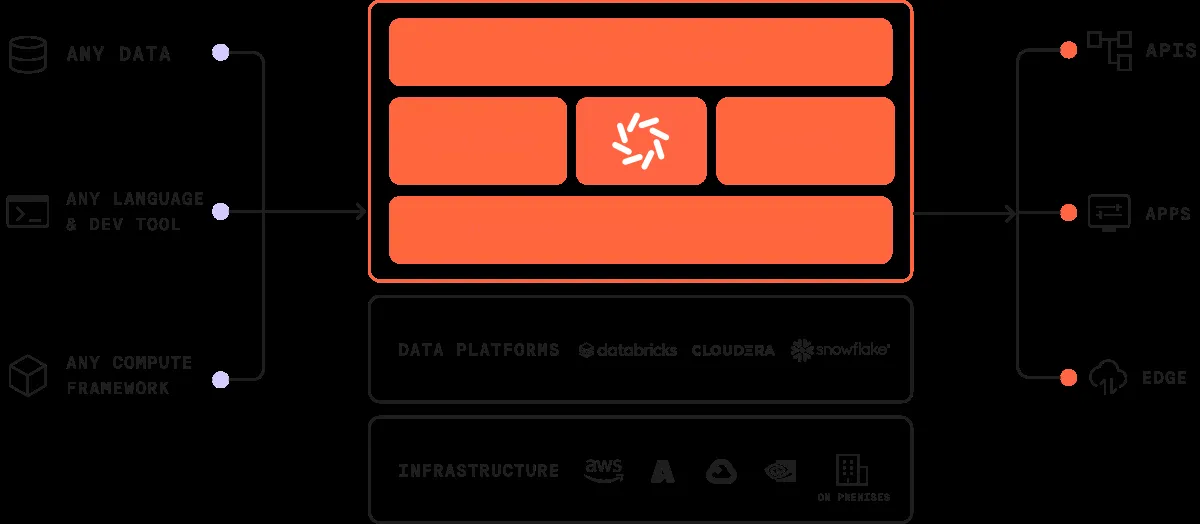
Domino Data Lab
Feature Comparison
| Feature | Domino Data Lab | Weights & Biases |
|---|---|---|
| Core Capabilities | ||
| Experiment Tracking | Built-in experiment tracking within the platform, tied to compute environments | Best-in-class experiment tracking with real-time dashboards, custom panels, and two-line SDK integration |
| Model Registry | Enterprise model registry with approval workflows, lineage tracking, and governance controls | Model Registry with model cards, lineage, and automated model promotion workflows |
| Compute Management | Centralized GPU/CPU scheduling with Kubernetes orchestration and on-demand hardware provisioning | No native compute management; relies on user-provisioned infrastructure (AWS, GCP, on-prem) |
| Hyperparameter Tuning | Supports integration with external tuning frameworks like Ray Tune and Optuna | Native Sweeps feature with Bayesian, grid, and random search strategies built into the platform |
| Dataset Versioning | Data management through Domino Data Sources with access control and versioned snapshots | W&B Artifacts for dataset versioning with lineage tracking and deduplication |
| Collaboration & Governance | ||
| Team Collaboration | Project-based collaboration with shared workspaces, environment templates, and code review workflows | W&B Reports for sharing interactive analysis, team dashboards, and experiment comparisons |
| Access Control | Enterprise RBAC with project-level, data-level, and environment-level permissions | Team and project-level access controls; fine-grained RBAC available on Enterprise tier |
| Governance & Compliance | Model approval workflows, audit trails, regulatory documentation, and SOC 2 Type II compliance | Audit logs and SSO on Enterprise tier; SOC 2 Type II compliant |
| Environment Management | Reproducible compute environments with Docker-based environment definitions and versioning | No native environment management; environment details captured as metadata in experiment logs |
| Deployment & Operations | ||
| Model Deployment | One-click model APIs, batch scoring, and model monitoring within the platform | No native model serving; integrates with external serving platforms like SageMaker and Vertex AI |
| Model Monitoring | Built-in model monitoring for data drift, prediction quality, and performance degradation | Experiment metric monitoring; production model monitoring requires external integration |
| Deployment Options | Domino Cloud (hosted), self-hosted on Kubernetes, or hybrid deployment | Cloud SaaS (default), self-hosted (Dedicated Cloud or On-Prem) on Enterprise tier |
| SDK & API Integration | Python SDK, CLI, and REST API for programmatic platform access | Lightweight Python SDK with two-line integration, REST API, and CLI tools |
Core Capabilities
Experiment Tracking
Model Registry
Compute Management
Hyperparameter Tuning
Dataset Versioning
Collaboration & Governance
Team Collaboration
Access Control
Governance & Compliance
Environment Management
Deployment & Operations
Model Deployment
Model Monitoring
Deployment Options
SDK & API Integration
Which approach fits
Domino Data Lab is the right choice for large enterprise ML organizations that need centralized compute governance, model deployment, and regulatory compliance in a single platform. Weights & Biases is the right choice for ML teams of any size that prioritize experiment tracking velocity, visualization quality, and accessible pricing. For many teams, these tools are complementary rather than competitive.
When each approach fits
Choose Domino Data Lab if:
Choose Domino Data Lab if you have 20+ ML practitioners, need centralized GPU scheduling across teams, require model governance with audit trails for regulatory compliance, and have the budget for enterprise software.
Choose Weights & Biases if:
Choose Weights & Biases if you need best-in-class experiment tracking and visualization, want to start with a free tier and scale pricing with team size, or need a lightweight tool that integrates into your existing compute infrastructure.
Choose Weights & Biases if:
Choose W&B for teams under 15 ML practitioners where experiment velocity matters more than platform-level governance, and where the $60/mo per-user Pro tier delivers immediate ROI through faster experiment iteration.
These scenarios reflect the available product evidence. Your requirements, existing stack, and team expertise should guide the final decision.
Frequently Asked Questions
Can Weights & Biases replace Domino Data Lab entirely?
Not directly. W&B excels at experiment tracking, hyperparameter tuning, and model management, but it does not provide compute infrastructure management, environment orchestration, or model deployment capabilities that Domino includes. Teams using W&B typically pair it with separate infrastructure tools like Kubernetes, AWS SageMaker, or Google Vertex AI to cover the full MLOps lifecycle.
Is Domino Data Lab worth the enterprise price tag for a small ML team?
For teams under 10 ML practitioners, Domino's enterprise pricing is difficult to justify. The platform's value proposition centers on centralized governance, compute scheduling across large teams, and regulatory compliance workflows that smaller teams rarely need. A combination of W&B for experiment tracking plus a lightweight compute solution delivers better cost-to-value for small teams.
Can I use Weights & Biases inside a Domino Data Lab environment?
Yes. Many enterprise teams run W&B as the experiment tracking layer within Domino's managed compute environments. Domino provides the infrastructure and governance layer while W&B handles the experiment visualization and comparison workflows. This combination is common in organizations that need both enterprise governance and best-in-class experiment tracking.
Which tool has better support for deep learning and GPU workloads?
Both handle GPU workloads but at different layers. Domino manages the GPU infrastructure itself, handling scheduling, allocation, and multi-GPU orchestration across teams. W&B operates at the experiment layer, tracking GPU utilization metrics, training curves, and model performance regardless of where the compute runs. For GPU infrastructure management, Domino wins. For GPU experiment visibility, W&B wins.