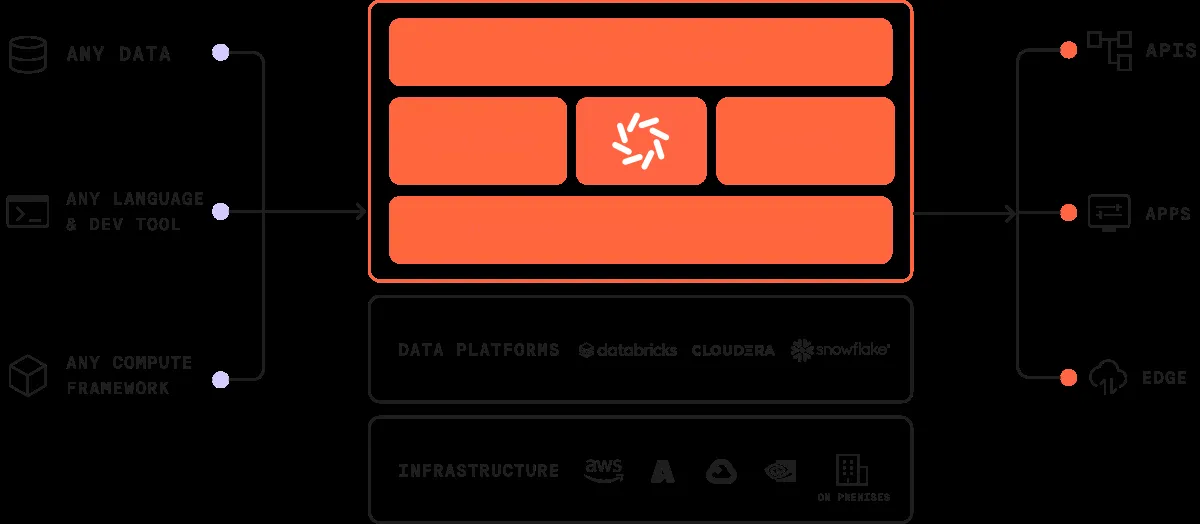
Domino Data Lab: product and architecture
This Domino Data Lab review breaks down one of the most governance-heavy enterprise MLOps platforms on the market. Domino Data Lab positions itself as the control plane for machine learning in regulated, large-scale environments. It targets data science teams that need reproducible environments, model monitoring, and audit trails without stitching together 15 open-source tools. If your organization runs ML models in production across AWS, Azure, or GCP and compliance is non-negotiable, Domino belongs on your shortlist. If you are a solo data scientist or a startup with a 3-person team, this platform will be overkill in both complexity and cost.
Overview
Domino Data Lab is an enterprise MLOps platform built for organizations that treat machine learning as a core business function, not a side project. Founded in 2013, the company has carved out a specific niche: large enterprises in financial services, healthcare, insurance, and government that must satisfy strict regulatory and auditability requirements around model governance.
The platform sits between your data infrastructure and production model serving. It provides a unified layer for environment management, experiment tracking, model registry, deployment pipelines, and monitoring. Unlike cloud-native solutions such as Amazon SageMaker or Vertex AI that lock you into a single cloud provider, Domino operates as a multi-cloud and hybrid-cloud orchestration layer. It runs on Kubernetes and supports deployment across AWS, Azure, GCP, and on-premises data centers simultaneously.
Domino is not a lightweight tool. It is designed for teams of 50 or more data scientists who need centralized governance, reproducibility, and collaboration at scale. The platform enforces role-based access control (RBAC), maintains complete audit logs, and provides model approval workflows that satisfy SOC 2, HIPAA, and other compliance frameworks.
Key Features and Architecture
Domino Data Lab organizes its capabilities around six core pillars that address the full ML lifecycle.
Collaborative Workspaces. Data scientists get browser-based access to Jupyter notebooks, RStudio, VS Code, and other IDEs through Domino's workspace launcher. Every session runs in a containerized environment with full dependency isolation. Teams share projects, datasets, and code through a Git-backed repository system that tracks every experiment run.
Environment Management. This is where Domino differentiates itself from most competitors. The platform uses Docker containers with deterministic builds. You define your compute environment once (Python 3.11, TensorFlow 2.15, CUDA 12.2, specific library versions), and every team member gets the exact same setup. Environments are versioned, auditable, and can be locked down by administrators to prevent unapproved packages.
Model Registry and Version Control. Every model artifact, training run, and hyperparameter set is tracked in the Domino model registry. Models go through configurable approval gates before promotion to staging or production. The registry integrates with CI/CD pipelines and supports automated validation checks.
Model Monitoring. Production models are tracked for data drift, prediction drift, and performance degradation. Domino provides dashboards for monitoring model accuracy over time and can trigger automated retraining pipelines when drift exceeds configurable thresholds. Integration with alerting systems like PagerDuty and Slack ensures teams catch issues before they impact business outcomes.
GPU Cluster Management. Domino includes a resource scheduler built on Kubernetes that manages GPU and CPU allocation across teams. Administrators set quotas per team or project, and the scheduler handles job queuing, preemption, and auto-scaling. The platform supports NVIDIA A100 and H100 GPUs and integrates with cloud spot instances for cost optimization.
Access Control and Compliance. RBAC policies govern who can view, edit, deploy, or approve models. Every action is logged in an immutable audit trail. The platform generates compliance reports for regulatory submissions and supports integration with enterprise identity providers through SAML and LDAP.
Ideal Use Cases
Regulated financial services. Banks and insurance companies running credit scoring, fraud detection, or risk models need the audit trails and approval workflows Domino provides. Model governance is a regulatory requirement in this sector, and Domino was built specifically for it.
Healthcare and life sciences. Organizations developing clinical trial models, drug discovery pipelines, or diagnostic AI need HIPAA-compliant infrastructure with reproducible environments. Domino provides the compliance framework and environment determinism these teams require.
Large enterprise ML teams (50+ data scientists). When you have dozens of data scientists sharing GPU clusters, collaborating on experiments, and deploying models to production, centralized governance becomes essential. Domino handles resource scheduling, environment standardization, and knowledge sharing at this scale.
Hybrid and multi-cloud deployments. Organizations that run workloads across AWS, Azure, and on-premises data centers need an orchestration layer that abstracts the infrastructure. Domino's Kubernetes-based architecture provides this without vendor lock-in.
Don't use this tool if you are a startup or small team with fewer than 20 data scientists. The deployment complexity, enterprise sales cycle, and cost structure make no sense at that scale. Use MLflow with managed infrastructure instead.
Pros and Cons
Pros:
- Best-in-class environment reproducibility with deterministic Docker builds
- Comprehensive audit trails and RBAC designed for regulated industries
- True multi-cloud and hybrid deployment support on Kubernetes
- Strong model monitoring with drift detection and automated alerting
- Collaborative workspaces supporting Jupyter, RStudio, and VS Code
- GPU cluster scheduling with team-level quotas and auto-scaling
Cons:
- No public pricing; requires sales engagement for any cost estimate
- High total cost of ownership, especially for self-hosted deployments
- Steep learning curve for administrators managing the Kubernetes infrastructure
- Overkill for small teams or organizations with fewer than 20 ML practitioners