ClearML: product and architecture
Our ClearML review verdict: choose ClearML when you need one open-source control layer for experiments, datasets, pipelines, compute scheduling, and serving—and are prepared to operate a broader MLOps platform. It is a strong fit for engineering-led teams that value self-hosting and lifecycle coverage over the smallest possible setup. Avoid it when lightweight experiment tracking is the whole requirement; ClearML’s breadth becomes operational overhead rather than an advantage.
ClearML positions itself as an AI infrastructure platform rather than a single-purpose tracking product. The platform combines experiment tracking, pipeline orchestration, dataset versioning, model deployment, and compute orchestration, with self-hosted and managed-cloud options. Its website describes a three-layer platform spanning development through production and says 2,100+ organizations use ClearML worldwide; we treat that figure as a vendor adoption signal, not independent proof of enterprise penetration.
The project is open source under the Apache-2.0 license and its primary language is Python. Its GitHub repository had 6,818 stars, last received a push on August 11, 2026, and listed v2.1.11 as its latest release on August 7, 2026. Those are useful public indicators of an active project, but they should not replace an architecture review or proof of fit in your own environment.
Overview
ClearML is best understood as a unified MLOps and AI-infrastructure platform for teams that want to manage the path from an experiment to an operational workload without stitching together a separate tracker, scheduler, data catalog, and pipeline interface. It originated as Allegro Trains at Allegro AI and was rebranded as ClearML in 2021. The platform’s scope includes ML and LLM-oriented workflows, making it materially broader than a tracker-only deployment.
The core decision is about consolidation. ClearML brings experiments, artifacts, datasets, models, orchestration, scheduling, and serving into one product surface, which can reduce handoffs and fragmented workflow metadata. The trade-off is that teams must accept ClearML as a central platform with its own operational model instead of adopting a narrow component around an existing stack.
ClearML’s website frames its infrastructure offering around a control plane for GPU clusters across on-premises, cloud, or hybrid environments. It also names multi-tenancy, role-based access control, and billing as built-in platform capabilities. That orientation makes ClearML especially relevant to data leaders who need governance and infrastructure visibility alongside model-development workflows, rather than merely a place to plot training metrics.
We recommend ClearML for platform-minded data and ML organizations that want a self-hosted, Apache-2.0-licensed foundation and can assign ownership for it. For a small analytics team that does not train or deploy models, the platform is over-scoped. For a mature data organization already committed to separate orchestration, experiment, and deployment layers, adoption should be evaluated as a consolidation decision—not a casual SDK addition.
Key Features and Architecture
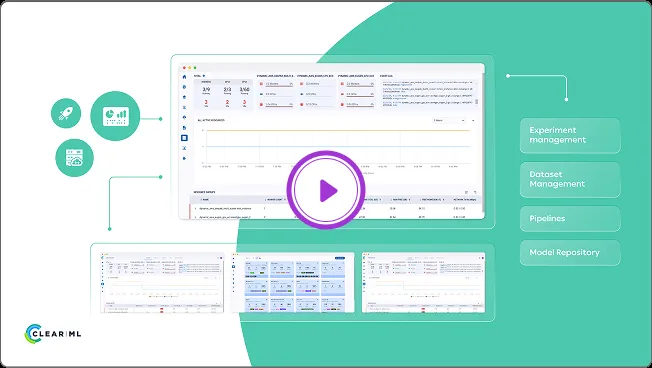
ClearML’s architecture covers several connected lifecycle functions rather than treating each experiment as an isolated record. Its repository describes the product as combining experiment management, data management, pipelines, orchestration, scheduling, and serving in one MLOps/LLMOps solution. That single-platform design is the product’s defining strength: it creates a common project, task, dataset, model, and artifact context across work that is often split among multiple tools.
-
Experiment tracking: ClearML automatically logs hyperparameters, metrics, console output, Git diffs, and uncommitted code changes. This reduces the manual instrumentation burden for model-development teams and preserves code-state context that is often lost when only parameters and final metrics are captured. The cost is that teams need to standardize their ClearML task workflow rather than treat tracking as an optional afterthought.
-
Project dashboards and comparisons: Every listed pricing tier includes a project dashboard plus comparisons across experiments, datasets, and models. This matters because a model result without its associated input dataset or artifact lineage is difficult to evaluate in practice. ClearML’s comparison surface is designed to keep those objects together, though it does not remove the need for teams to define evaluation criteria and naming conventions.
-
Pipeline automation: ClearML can turn Python functions into pipeline steps. The supplied review data states that ClearML handles dependency injection, result caching, and parallel execution automatically, while the pricing material describes a “2-line Integration” that can convert code or a repository into a fully orchestrated DevOps solution. This is powerful for Python-first teams, but the convenience is coupled to ClearML’s pipeline conventions and execution model.
-
Dataset and artifact management: Dataset versioning is a first-class component of the platform, alongside artifacts and model comparisons. The platform documentation inventory also identifies ClearML Data, Hyper-Datasets, Hyper-Dataset Frames, dataviews, and querying as product areas. For teams working with repeatedly refreshed training data, this is more useful than experiment tracking alone because it puts data objects beside the training records that consume them.
-
Compute and queue orchestration: ClearML’s Infrastructure Control Plane connects and manages GPU clusters across on-premises, cloud, and hybrid environments. Its documentation inventory includes agents, execution modes, queues and scheduling, agent deployment, cloud autoscalers, and remote-session tooling. This gives infrastructure teams a route to coordinate compute capacity and workload execution from the same ecosystem as development metadata, but it also makes ClearML a platform that requires real operational ownership.
-
Model deployment and serving: Model deployment is explicitly part of the product description, and the repository description includes serving. ClearML’s documentation inventory includes
clearml-serving, which confirms serving is part of the product surface rather than an implied downstream integration. The available material does not provide deployment throughput, latency, supported runtime, or reliability metrics, so those must be validated directly before production commitments.
The platform also includes security-oriented enterprise capabilities: multi-tenancy, role-based access control, and billing are named in ClearML’s website description. Those controls matter when several teams share infrastructure, especially when GPU costs need allocation. However, the supplied evidence does not establish how these controls are packaged across commercial tiers, so buyers should make entitlement details a procurement question rather than assume all capabilities are available everywhere.
Ideal Use Cases
ClearML is most compelling for a 10-to-50-person ML or data platform group supporting several model-development teams and shared GPU infrastructure. In that setting, separate teams can benefit from a common place to track experiments, version datasets, schedule workloads, and compare model outputs. The control-plane framing is particularly relevant when compute runs across both internal infrastructure and cloud resources, because ClearML explicitly supports on-premises, cloud, and hybrid GPU cluster management.
A second strong scenario is a regulated or security-conscious organization that needs a self-hosted option while keeping the ML lifecycle in one platform. ClearML’s Apache-2.0 open-source license, self-hosted availability, multi-tenancy, and role-based access control provide a concrete starting point for this model. This is not a guarantee of regulatory compliance; it is a reason to assess ClearML when internal deployment and access boundaries are non-negotiable.
A third use case is a product organization moving from individual Python training scripts toward repeatable pipelines. ClearML can convert Python functions into pipeline steps and provides dependency injection, caching, and parallel execution. That makes it practical for teams that want to operationalize existing repositories without rebuilding their workflow around a different programming language or adopting separate tools for tracking and orchestration.
ClearML can also serve data leaders responsible for GPU cost visibility and workload coordination rather than only model-science productivity. The vendor’s three-layer framing links infrastructure control, AI development, and production operations. The relevant trade-off is organizational: a data team that only owns SQL transformations and BI assets will not realize enough value from GPU scheduling, model serving, or experiment lineage to justify this platform’s breadth.
Don’t use ClearML if your team only needs a lightweight place to log metrics and parameters for occasional experiments. The third-party review explicitly recommends MLflow instead for that narrower requirement, and we agree with the underlying decision logic: adopting the full ClearML platform solely for tracking creates unnecessary setup and governance work. Also avoid selecting it solely because it is open source; self-hosting shifts responsibility for operations, upgrades, storage configuration, and access management to your team.
Strengths & Trade-offs
ClearML’s main advantage is not a single feature but the ability to link development records and operating workflows in one platform. That is valuable when teams otherwise have disconnected experiment trackers, dataset records, scheduling tools, and model deployment processes. Its limitations are equally clear: the platform is broad, and that breadth is a poor trade for teams seeking only a small tracking SDK.
Pros
-
Unified lifecycle coverage: ClearML includes experiment tracking, pipeline orchestration, dataset versioning, model deployment, and compute orchestration in one product. This gives data leaders a coherent system boundary for ML operations instead of forcing users to reconcile records across multiple products.
-
Low-friction Python workflow entry: The pricing material states that repositories can be integrated into an orchestrated DevOps solution with two lines of Python. Combined with automatic logging of metrics, hyperparameters, console output, Git diffs, and uncommitted changes, this reduces repetitive tracking code for Python-based model teams.
-
Useful comparison context: Project dashboards and comparisons across experiments, datasets, and models are explicitly included in the listed tiers. The ability to evaluate those related objects together is more practical than evaluating a metric chart without knowing the data version or resulting model artifact.
-
Self-hosted open-source foundation: ClearML is Apache-2.0 licensed and offers self-hosted deployment. This is a concrete benefit for organizations that need control over their environment rather than a cloud-only MLOps service.
-
Infrastructure-aware scope: GPU cluster management across on-premises, cloud, and hybrid environments, plus named multi-tenancy, role-based access control, and billing capabilities, make ClearML relevant to shared-platform operations. This is stronger than a developer-only tracking tool when compute allocation and organizational boundaries matter.
Cons
-
Too much platform for tracking-only needs: ClearML includes scheduling, serving, dataset versioning, and compute orchestration in addition to experiment tracking. The external review specifically identifies MLflow as the better choice when lightweight tracking is all that is required.
-
Self-hosting carries a real operating burden: ClearML offers a self-hosted option, but the available documentation inventory includes server architecture, deployment, upgrades, configuration, storage configuration, agents, and queues. Those are capabilities to manage, not free operational simplicity.
-
Commercial price clarity is weak in the supplied material: Only $15 for an unknown tier is provided, while Free / Pro and Scale / Enterprise lack tier-specific amounts and differentiated inclusions. That makes cost forecasting difficult until ClearML confirms a tailored quote and billing model.
-
Production-serving evidence is incomplete: ClearML includes deployment and serving, but the supplied data gives no performance, uptime, deployment-runtime, or scaling metrics. Teams with strict production SLOs should not infer those properties from feature availability alone.