Decision comparison
Neptune.ai vs ClearML
Neptune.ai and ClearML serve fundamentally different scopes within the MLOps landscape. Neptune is a deep, specialized experiment tracker built for frontier model research, now being acquired by OpenAI to power their internal training infrastructure. ClearML is a comprehensive open-source MLOps platform that covers the full machine learning lifecycle from experiment tracking through pipeline orchestration, dataset versioning, model serving, and GPU cluster management. For most ML teams, ClearML delivers far more functionality at a fraction of the cost, while Neptune occupies a narrow but critical niche in large-scale foundation model training.
Neptune.ai is no longer available as an active product
Neptune.ai shut down its hosted service permanently on March 5, 2026 following its acquisition by OpenAI. Treat this page as historical context rather than a current buying page.
Active alternatives to evaluate
Architecture choice. These take different approaches to the same problem. Read the table as a fit question rather than a feature race.
These are different kinds of product — Experiment Tracking and ML Platform.
Quick Comparison
| Decision factor | Neptune.ai | ClearML |
|---|---|---|
| Primary Focus | Deep experiment tracking and visualization for foundation model training at scale | Full-stack MLOps covering experiments, pipelines, data, serving, and compute orchestration |
| Deployment Model | Enterprise managed service; now integrating into OpenAI's training stack | Self-hosted open source, hosted free tier, or managed cloud and on-prem options |
| Pipeline Orchestration | Not a core capability; focused on experiment tracking and monitoring | Built-in pipeline automation with caching, parallel execution, and CI/CD integration |
| Pricing Model | Contact for pricing | Open Source free, $15/unknown tier |
| Open Source | Proprietary platform with no open-source offering | Apache-2.0 licensed with 6,500+ GitHub stars and active community |
| Best For | Research teams training large foundation models that need deep metric analysis | ML teams needing a unified self-hostable platform for the full model lifecycle |
Neptune.ai
- Primary Focus:
- Deep experiment tracking and visualization for foundation model training at scale
- Deployment Model:
- Enterprise managed service; now integrating into OpenAI's training stack
- Pipeline Orchestration:
- Not a core capability; focused on experiment tracking and monitoring
- Pricing Model:
- Contact for pricing
- Open Source:
- Proprietary platform with no open-source offering
- Best For:
- Research teams training large foundation models that need deep metric analysis
ClearML
- Primary Focus:
- Full-stack MLOps covering experiments, pipelines, data, serving, and compute orchestration
- Deployment Model:
- Self-hosted open source, hosted free tier, or managed cloud and on-prem options
- Pipeline Orchestration:
- Built-in pipeline automation with caching, parallel execution, and CI/CD integration
- Pricing Model:
- Open Source free, $15/unknown tier
- Open Source:
- Apache-2.0 licensed with 6,500+ GitHub stars and active community
- Best For:
- ML teams needing a unified self-hostable platform for the full model lifecycle
Public signals
Verified factual signals only. Bars appear only for like-for-like metrics with five weekly assessments for every tool; missing evidence stays explicit. These signals do not establish enterprise adoption, product quality, or total cost.
| Metric | Neptune.ai | ClearML |
|---|---|---|
| GitHub commits, 90d(Developer adoption) | 0 | Not available |
| GitHub stars(Developer adoption) | 16 | Not available |
| Search interest(Market interest) | 1 | 0 |
| Product Hunt comments(Community interest) | 0 | Not available |
| Product Hunt reviews(Community interest) | 0 | Not available |
| Product Hunt votes(Community interest) | 6 | Not available |
| PyPI weekly downloads(Developer adoption) | 22.5k | Not available |
| Stack Overflow questions(Community interest) | 20 | 54 |
| Docker Hub pulls(Product adoption) | Not available | 87.0k |
| GitHub commits, 90d(Product adoption) | Not available | 79 |
| GitHub stars(Product adoption) | Not available | 6,500+ |
| PyPI weekly downloads(Product adoption) | Not available | 160.3k |
As of September 14, 2026 — updated weekly.
Health & risk evidence
Observed public-source checks for mapped package versions and repositories.
Neptune.ai
September 14, 2026Package vulnerabilities
PyPI · neptune@1.14.0.post2
0 vulnerabilities
across 1 package
Repository security score
Not available
ClearML
September 14, 2026Package vulnerabilities
PyPI · clearml@2.1.12
0 vulnerabilities
across 1 package
Repository security score
Not available
Interface Preview
ClearML
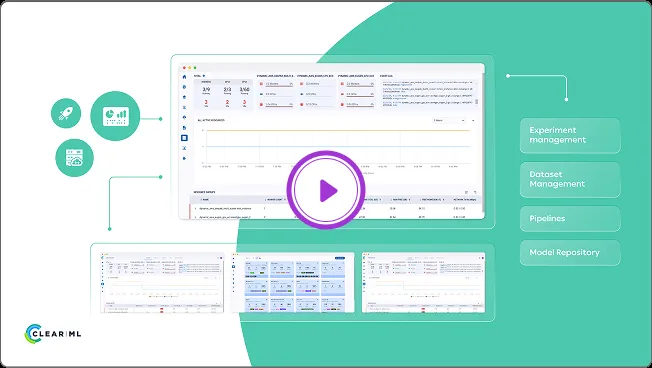
Feature Comparison
| Feature | Neptune.ai | ClearML |
|---|---|---|
| Experiment Tracking | ||
| Automatic Logging | Tracks hyperparameters, metrics, and model artifacts across long training runs | Auto-logs hyperparameters, metrics, console output, git diffs, and uncommitted code changes with zero manual calls |
| Experiment Comparison | Compare thousands of runs and analyze metrics across layers in seconds | Side-by-side comparison of experiments, datasets, and models with 2D/3D visualizations |
| Long-Running Training Support | Purpose-built for monitoring months-long foundation model training with branches | Supports ongoing experiment tracking with remote execution via ClearML Agents |
| Pipeline & Orchestration | ||
| Pipeline Automation | Not a core capability; focused purely on experiment tracking | Turn any Python function into a pipeline step with dependency injection and result caching |
| Remote Execution | No built-in remote execution or agent-based job scheduling | ClearML Agents queue and execute experiments on GPU clusters, cloud VMs, and on-prem infrastructure |
| Hyperparameter Optimization | Not offered as a built-in capability | Built-in HPO controller supporting grid search, random search, and Bayesian optimization |
| Data & Model Management | ||
| Dataset Versioning | Tracks artifacts but does not provide dedicated dataset versioning | Built-in dataset versioning tied directly to experiments with S3, GCS, Azure, and NAS support |
| Model Serving | Not offered; focused on the training phase of the model lifecycle | Cloud-ready model serving with GPU optimization backed by Nvidia-Triton |
| Model Repository | Stores model metadata and training artifacts for comparison | Centralized model repository with versioning, lineage tracking, and deployment integration |
| Infrastructure & Compute | ||
| GPU Cluster Management | No built-in compute orchestration or GPU management | Infrastructure Control Plane manages GPU resources across on-prem, cloud, and hybrid environments |
| Fractional GPUs | Not verified | Dynamic fractional GPU allocation to maximize compute utilization across teams |
| Cloud Auto-Scaling | Not available as a platform capability | Auto-scaling across AWS, GCP, and Azure available on Pro tier and above |
| Platform & Integration | ||
| Framework Integration | Integrates with major ML frameworks for experiment tracking | Auto-logging for TensorFlow, PyTorch, scikit-learn, XGBoost, LightGBM, Matplotlib, and TensorBoard |
| Self-Hosting | No self-hosted option available | Full self-hosted deployment with unlimited experiments and complete data sovereignty |
| GenAI Deployment | Focused on training infrastructure rather than GenAI application deployment | GenAI App Engine for deploying LLMs with built-in access control, monitoring, and one-click launch |
Experiment Tracking
Automatic Logging
Experiment Comparison
Long-Running Training Support
Pipeline & Orchestration
Pipeline Automation
Remote Execution
Hyperparameter Optimization
Data & Model Management
Dataset Versioning
Model Serving
Model Repository
Infrastructure & Compute
GPU Cluster Management
Fractional GPUs
Cloud Auto-Scaling
Platform & Integration
Framework Integration
Self-Hosting
GenAI Deployment
Which approach fits
Neptune.ai and ClearML serve fundamentally different scopes within the MLOps landscape. Neptune is a deep, specialized experiment tracker built for frontier model research, now being acquired by OpenAI to power their internal training infrastructure. ClearML is a comprehensive open-source MLOps platform that covers the full machine learning lifecycle from experiment tracking through pipeline orchestration, dataset versioning, model serving, and GPU cluster management. For most ML teams, ClearML delivers far more functionality at a fraction of the cost, while Neptune occupies a narrow but critical niche in large-scale foundation model training.
When each approach fits
Choose Neptune.ai if:
Choose Neptune.ai if your primary need is deep experiment tracking for large-scale foundation model training. Neptune excels at monitoring months-long training runs with multiple steps and branches, comparing thousands of experiments in seconds, and analyzing metrics across model layers. It was built for the specific demands of frontier AI research, and its acquisition by OpenAI validates its strength in this niche. However, its enterprise-only pricing and uncertain standalone future after the OpenAI acquisition make it a consideration primarily for large research organizations with specific foundation model training needs.
Choose ClearML if:
Choose ClearML if you need a unified platform that handles the full ML lifecycle without vendor lock-in. ClearML provides experiment tracking, pipeline orchestration, dataset versioning, model serving, hyperparameter optimization, and GPU cluster management in a single open-source platform. Its free self-hosted tier delivers unlimited experiments with complete data sovereignty, and the Pro tier at $15/user/month adds team collaboration features at dramatically lower cost than alternatives. With 6,600+ GitHub stars, 300,000+ users, and 2,100+ organizations, ClearML has proven community traction and enterprise adoption.
These scenarios reflect the available product evidence. Your requirements, existing stack, and team expertise should guide the final decision.
Frequently Asked Questions
What is the main difference between Neptune.ai and ClearML?
Neptune.ai is a specialized experiment tracker designed for monitoring and visualizing foundation model training at scale, with particular strength in comparing thousands of runs and analyzing metrics across model layers. ClearML is a comprehensive open-source MLOps platform that covers the entire machine learning lifecycle, including experiment tracking, pipeline orchestration, dataset versioning, model serving, and compute orchestration. Neptune focuses deeply on the experiment tracking phase, while ClearML provides breadth across the full ML workflow.
Is ClearML really free to use?
Yes, ClearML offers a genuinely free self-hosted Community edition under the Apache-2.0 license that includes unlimited experiment tracking and full platform features. The hosted free tier provides 100GB artifact storage, 1GB metric events, and 1M API calls per month for teams up to three users. The Pro tier at $15/user/month adds cloud auto-scaling, hyperparameter optimization, and pipeline triggers for teams up to ten. Scale and Enterprise tiers offer custom pricing for organizations needing advanced infrastructure management, SSO, and dedicated support.
What happened to Neptune.ai and is it still available?
OpenAI announced a definitive agreement to acquire Neptune.ai in December 2025. The acquisition brings Neptune's experiment tracking and training monitoring tools into OpenAI's research infrastructure. Neptune has been working closely with OpenAI to develop tools that enable researchers to compare thousands of runs, analyze metrics across layers, and surface training issues. As of 2026, Neptune's standalone product availability may be limited as the platform integrates into OpenAI's training stack. Teams evaluating Neptune should confirm current availability and pricing directly.
Can ClearML replace Neptune.ai for experiment tracking?
ClearML provides robust experiment tracking that covers the core use cases Neptune.ai addresses, including automatic logging of hyperparameters, metrics, git diffs, and code changes. ClearML's auto-magical tracking requires zero manual logging calls, and it supports comparison of experiments with rich 2D and 3D visualizations. However, Neptune.ai was purpose-built for monitoring months-long foundation model training runs with multiple steps and branches, which is a more specialized capability. For most ML teams running standard training workflows, ClearML's experiment tracking is a strong alternative that also provides pipeline orchestration, dataset versioning, and model serving in the same platform.
Which platform is better for teams with limited budgets?
ClearML is the clear winner for budget-conscious teams. Its self-hosted open-source edition provides unlimited experiments, full platform access, and complete data sovereignty at zero cost. The hosted free tier covers small teams without requiring infrastructure setup. Even the Pro tier at $15/user/month is significantly cheaper than most commercial MLOps platforms. Neptune.ai operates on enterprise-only pricing with no public tiers, making it inaccessible for teams that cannot negotiate custom contracts. For startups, academic researchers, and small ML teams, ClearML delivers substantially more value per dollar.