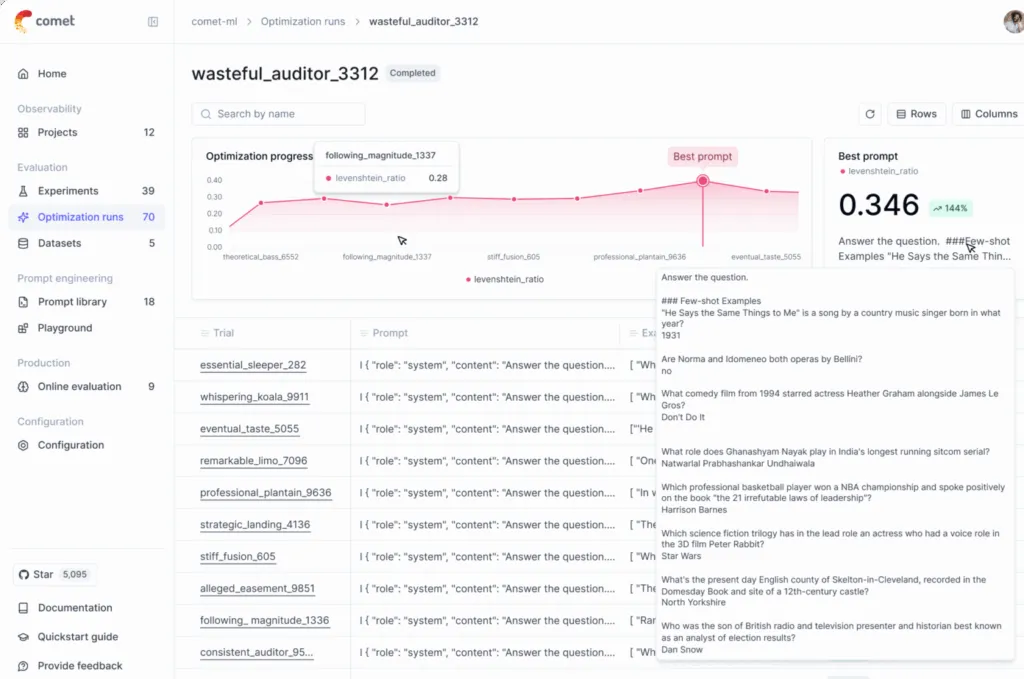
If you are evaluating Comet ML alternatives, you are likely running into one of three friction points: enterprise-only governance features, usage-based limits that tax evaluation at scale, or the operational burden of self-hosting for production workloads. Comet ML is a freemium MLOps platform that provides experiment tracking, model management, and -- through its open-source Opik product -- LLM observability, tracing, and evaluation. Its Pro Cloud plan starts at $19/month and its Free Cloud tier supports up to 10 team members with 25,000 spans per month. However, critical features like SSO, RBAC, audit logs, and compliance certifications are locked behind the Enterprise tier, pushing growing teams toward custom contracts before they are ready. We have tested the leading alternatives across deployment flexibility, pricing transparency, and evaluation capabilities to help you find the right fit.
Top Alternatives Overview
Weights & Biases is the most direct commercial competitor to Comet ML. It provides experiment tracking, model registry, hyperparameter sweeps, and LLM evaluation through its Weave product. W&B's Free tier includes up to 5 model seats and 5 GB of storage per month. The Pro plan costs $60/month and supports up to 10 model seats with 100 GB of storage. Enterprise pricing is custom and includes SSO, HIPAA compliance, custom roles, and audit logs. W&B has over 11,000 GitHub stars for its open-source client library. Where Comet ML gates governance to Enterprise, W&B makes team-based access controls available at the Pro tier, which matters for mid-sized teams that need basic collaboration security without an enterprise contract.
ClearML is an open-source MLOps platform under the Apache-2.0 license that covers the full ML lifecycle: experiment tracking, pipeline orchestration, dataset versioning, model serving, and hyperparameter optimization. Its Community tier is free for teams up to 3 users with 100 GB artifact storage. The Pro tier costs $15/user/month and adds cloud auto-scaling, hyperparameter optimization, and pipeline automations for up to 10 users. Scale and Enterprise tiers add Kubernetes integration, SSO, fractional GPUs, and multi-tenant infrastructure management. ClearML has over 6,500 GitHub stars and is one of the few platforms that genuinely delivers a full self-hosted MLOps stack at no cost through its open-source edition.
Neptune.ai was a dedicated experiment tracker known for handling large-scale training runs with fast metadata querying and visualization. OpenAI entered into a definitive agreement to acquire Neptune, with the stated goal of integrating Neptune's tools into OpenAI's training stack. Neptune's product had supported tracking thousands of runs, analyzing metrics across layers, and surfacing issues during model training. Given the acquisition, Neptune's future as a standalone product is uncertain, but its technology is likely to influence the next generation of training observability tools.
MLflow is the most widely adopted open-source experiment tracking platform, with over 27,000 GitHub stars and an Apache-2.0 license. Created by Databricks, it provides experiment tracking, model registry, model deployment, and an evaluation framework for both traditional ML and LLMs. MLflow is entirely free to self-host and has deep integrations with Databricks, Azure ML, and Amazon SageMaker. It lacks a managed cloud offering from the MLflow project itself (Databricks provides managed MLflow), which means self-hosting teams own the operational burden. For teams already invested in the Databricks ecosystem, MLflow is essentially free and fully integrated.
DVC (Data Version Control) is an open-source tool with over 15,000 GitHub stars and an Apache-2.0 license that brings Git-like version control to ML projects. It tracks datasets, models, and experiments alongside code using Git, and works with any storage backend including S3, GCS, Azure, and SSH. DataChain Studio (formerly DVC Studio) provides a web UI for experiment tracking and collaboration. DVC is the strongest choice when data and model versioning are your primary concern and you want everything managed through Git workflows rather than a separate tracking platform.
Kedro is an open-source Python framework developed by QuantumBlack (McKinsey) for building reproducible, maintainable data and ML pipelines. It enforces software engineering best practices with a standardized project template, data catalog abstraction, and pipeline visualization. Kedro has over 10,000 GitHub stars and is part of the Linux Foundation's LF AI & Data. It is not a direct replacement for Comet ML's experiment tracking but complements tools like MLflow or DVC by adding pipeline structure and reproducibility that Comet ML does not natively provide.
Architecture and Approach Comparison
Comet ML and its alternatives split into two architectural camps: managed platforms with proprietary backends and open-source tools you deploy yourself.
Comet ML runs a dual-product architecture. Comet MLOps handles traditional experiment management -- logging metrics, hyperparameters, code changes, and model artifacts through its Python SDK with integrations for PyTorch, TensorFlow, Keras, scikit-learn, XGBoost, and Hugging Face. Opik, Comet's open-source LLM evaluation product, provides tracing, annotation, automated scoring with LLM-as-a-judge metrics, and agent optimization. Opik can be self-hosted or used via Comet's cloud. The two products share the Comet platform but have separate pricing structures and feature sets.
Weights & Biases follows a similar dual-track approach: its core platform handles experiment tracking and model management, while Weave handles LLM application tracing and evaluation. W&B's architecture is primarily SaaS-first with an enterprise self-hosted option. Its client library is open-source (MIT license), but the server is proprietary.
ClearML takes the broadest architectural approach among the alternatives. Its open-source platform includes experiment tracking, pipeline orchestration with dependency injection and result caching, dataset versioning, model serving with REST endpoints, and a remote execution agent system that supports GPU clusters and cloud VMs. The ClearML AI Infrastructure Platform adds an Infrastructure Control Plane for GPU resource management across on-premise, cloud, and hybrid environments.
MLflow's architecture is modular: Tracking, Models, Model Registry, and Projects are separate components that can be used independently. This modularity means you can adopt MLflow's experiment tracking without buying into its deployment model. MLflow stores data in a backend store (database) and an artifact store (object storage), making it straightforward to deploy on any infrastructure.
DVC operates entirely through the Git workflow. Experiments are tracked as Git commits with lightweight metafiles pointing to data and model artifacts stored in external storage. This architecture means there is no server to maintain -- your Git repository and cloud storage are the entire backend.
Pricing Comparison
| Tool | Pricing Model | Starting Price | Free Tier | Enterprise |
|---|
| Comet ML | Freemium | $19/month (Pro Cloud) | Yes (10 users, 25k spans) | Custom |
| Weights & Biases | Freemium | $60/month (Pro) | Yes (5 model seats) | Custom |
| ClearML | Freemium | $15/user/month (Pro) | Yes (3 users, 100 GB) | Custom |
| Neptune.ai | Enterprise | Contact for pricing | Previously available | Acquisition by OpenAI |
| MLflow | Open Source | $0 (self-hosted) | Full platform free | Via Databricks |
| DVC | Open Source | $0 (self-hosted) | Full platform free | Via DataChain Studio |
| Kedro | Open Source | $0 | Full framework free | N/A |
Comet ML sits in the middle of the pricing spectrum. Its Pro Cloud plan at $19/month is significantly cheaper than Weights & Biases at $60/month for comparable managed experiment tracking. However, ClearML's Pro tier at $15/user/month includes pipeline orchestration, hyperparameter optimization, and cloud auto-scaling that Comet ML does not offer at any tier. The open-source alternatives -- MLflow, DVC, and Kedro -- cost nothing to run but shift operational responsibility to your team.
The real cost difference surfaces at the governance boundary. Comet ML gates SSO, RBAC, audit logs, and compliance certifications entirely to its Enterprise tier. W&B provides team-based access controls at the Pro tier. ClearML's Scale tier includes SSO and priority support. For teams that need governance controls without enterprise pricing, ClearML and W&B provide earlier access to those features.
When to Consider Switching
We recommend exploring Comet ML alternatives when your team's requirements have outgrown what the Free and Pro tiers offer, or when a different architectural approach better matches your workflow.
If governance and access control are blocking you, both Weights & Biases and ClearML provide role-based access and team management at their mid-tier plans rather than requiring an enterprise contract. ClearML's Scale tier adds SSO and Kubernetes integration for organizations that need infrastructure-level governance without enterprise-only pricing.
If you need a full MLOps platform rather than just experiment tracking, ClearML covers experiment management, pipeline orchestration, dataset versioning, model serving, and compute orchestration in a single open-source package. Comet ML's Opik covers LLM evaluation well, but the broader MLOps lifecycle -- pipelines, model serving, compute scheduling -- requires assembling additional tools around Comet.
If your team is deeply embedded in the Databricks ecosystem, MLflow provides native experiment tracking and model registry at no additional cost. Migrating from Comet ML to MLflow in a Databricks environment eliminates a separate vendor dependency entirely.
If data and model versioning through Git workflows is your priority, DVC offers a fundamentally different approach. Instead of logging experiments to a separate platform, DVC tracks everything alongside your code in Git, which appeals to teams that prefer infrastructure-minimal tooling.
If Comet ML's pricing works for your team and you actively use both Comet MLOps and Opik for experiment tracking and LLM evaluation respectively, staying makes sense. The combination of traditional ML experiment management and GenAI observability in one vendor is a genuine differentiator that few competitors match at Comet's price point.
Migration Considerations
Migrating from Comet ML requires planning around experiment history, SDK integrations, and team workflows.
Comet ML's Python SDK hooks into training frameworks through decorators and context managers. Moving to Weights & Biases involves replacing comet_ml.Experiment calls with wandb.init() and corresponding logging methods -- the migration surface is primarily at the instrumentation layer, not the training code itself. Moving to ClearML is similarly straightforward: ClearML's two-line integration auto-captures most framework outputs without explicit logging calls, which can actually reduce instrumentation code during migration.
Experiment history is the harder problem. Comet ML does not offer a bulk export API for migrating historical runs to a competing platform. We recommend keeping read-only access to your Comet ML account for historical reference while logging new experiments to your target platform. For teams with strict data retention requirements, export critical run metadata and artifacts via Comet's REST API before decommissioning.
If you use Opik for LLM tracing and evaluation, note that Opik is open source and can be self-hosted independently of Comet's commercial platform. Teams migrating away from Comet MLOps for experiment tracking can potentially continue using Opik for LLM evaluation if that component is working well.
For teams moving to MLflow, the Databricks community maintains migration utilities and documentation for common experiment tracking migrations. The MLflow Tracking API maps closely to Comet's concepts of experiments, runs, parameters, and metrics.
Plan for a one-to-two-week parallel logging period where both platforms receive experiment data simultaneously. This validates that your new tool captures everything your team relies on before fully cutting over. The most common migration surprise is not the SDK swap itself but discovering which custom dashboards, alert rules, and team workflows need recreation in the new platform.