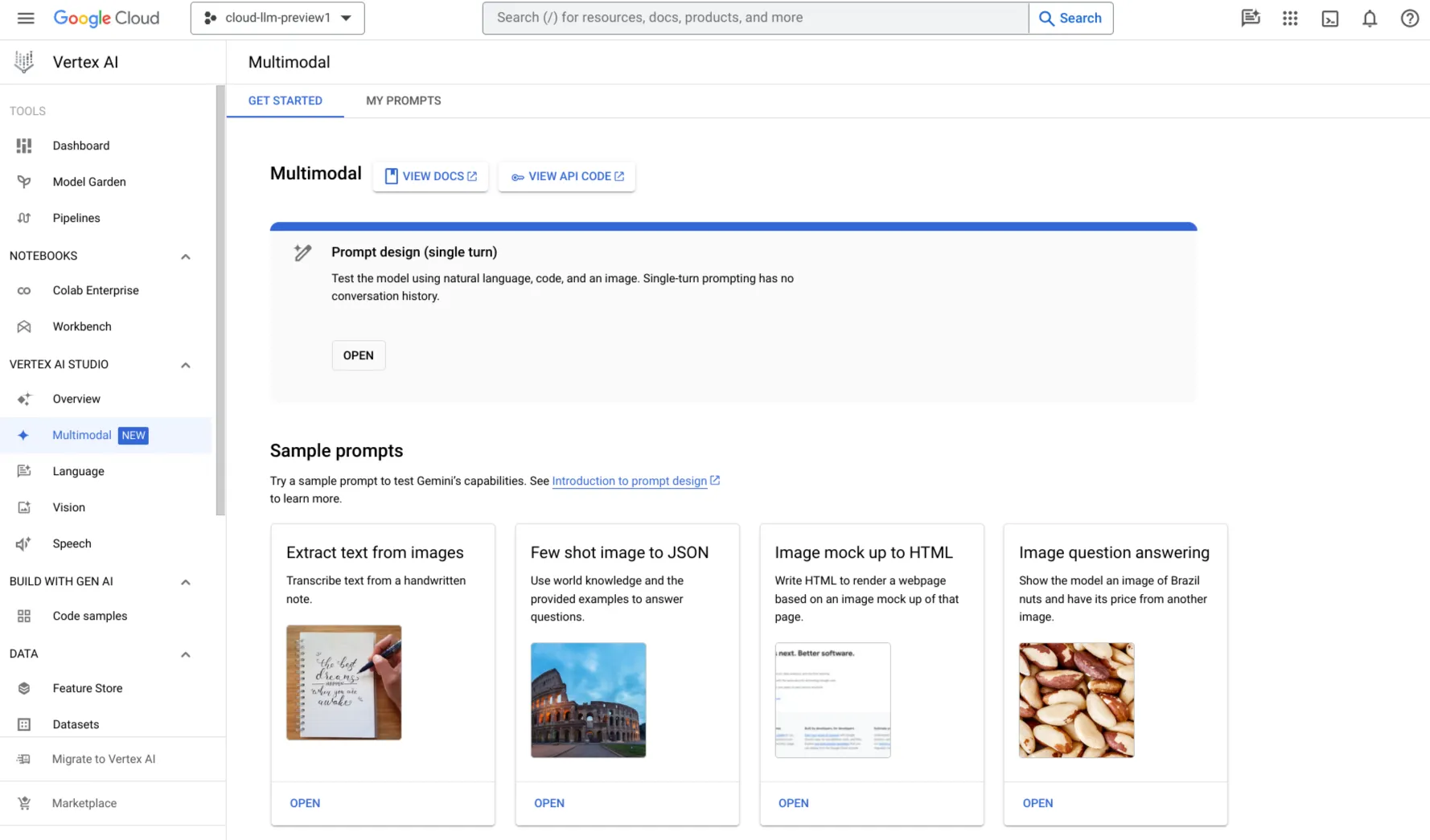
Google Cloud AI Platform tool details
This review provides an in-depth analysis of Google Cloud's AI Platform, a comprehensive solution for data engineers, analytics leaders, and other professionals involved in machine learning model development and deployment. The platform offers extensive features and integrations designed to streamline the entire lifecycle of ML models.
Overview
Google Cloud AI Platform, now known as Vertex AI, is an enterprise-grade, fully-managed environment aimed at accelerating AI innovation through a unified approach to data science and engineering tasks. It leverages Google’s powerful Gemini models and provides access to over 200 pre-built foundation models for rapid application development. The platform supports the entire ML model lifecycle from training to deployment, enabling users to build generative AI applications swiftly with minimal overhead.
Google Cloud AI Platform is designed to streamline the machine learning lifecycle from development to deployment. It integrates seamlessly with Google's other cloud services, offering tools for data labeling and model training at scale. The platform includes AutoML for users without extensive machine learning expertise, enabling them to build custom models using their datasets. Additionally, it supports a variety of frameworks such as TensorFlow, PyTorch, and Scikit-learn, making it adaptable to diverse project requirements.
Key Features and Architecture
Overview of Core Components
Vertex AI consists of several key components that collectively form a robust framework for ML operations:
-
Vertex AI Studio: A collaborative development environment that integrates Jupyter Notebooks, TensorFlow Extended (TFX), and other tools to streamline the creation and testing phases of ML projects.
-
Agent Builder: Enables users to build conversational agents using natural language processing (NLP) capabilities provided by Google's advanced models. This feature is particularly useful for creating chatbots or voice assistants that can understand complex user interactions.
-
Foundation Models: An extensive library of pre-trained AI models covering various domains such as NLP, vision, and speech recognition. These models are optimized for performance and accuracy on the Google Cloud infrastructure, allowing developers to deploy them directly without significant customization efforts.
Technical Specifications
Vertex AI supports a wide range of ML frameworks including TensorFlow, PyTorch, XGBoost, and Scikit-learn, ensuring compatibility with existing projects or new initiatives. It offers automatic scaling capabilities for training jobs based on resource demands, which helps in optimizing costs while maintaining high performance levels during peak usage times.
Integration Capabilities
The platform seamlessly integrates with other Google Cloud services such as BigQuery, Dataflow, and Pub/Sub, facilitating data ingestion, preprocessing, and real-time streaming scenarios. Additionally, it supports industry-standard APIs for model serving, enabling easy integration into existing infrastructure or web applications.
Ideal Use Cases
Enterprise-Scale Projects
For large enterprises looking to implement AI-driven solutions across multiple business units, Vertex AI provides the necessary scalability and flexibility through its managed services and pre-built models. Organizations can leverage this platform to develop customized predictive analytics systems tailored to specific industry needs without requiring extensive internal expertise in machine learning.
Rapid Prototyping and Innovation
Startups or small teams aiming to quickly prototype new ideas around generative AI benefit from Vertex AI's streamlined workflow and access to cutting-edge technology like Gemini. This allows them to iterate rapidly on their models, experiment with different configurations, and validate concepts efficiently before scaling up operations.
Research and Development Initiatives
Academic institutions or research labs engaged in fundamental studies of machine learning algorithms can utilize Vertex AI’s extensive resources for conducting large-scale experiments involving complex datasets. The platform’s support for diverse ML frameworks and robust compute infrastructure makes it an ideal environment for pushing the boundaries of AI research.
Pricing and Licensing
Google Cloud AI Platform follows a usage-based pricing model, where costs are calculated based on the specific AI and machine learning services consumed. This includes charges for model training, prediction serving, and managed machine learning pipelines. The platform does not use a fixed subscription or tiered plan structure; instead, every workload is billed according to actual resource consumption.
Key factors that influence your total cost on Google Cloud AI Platform include the type and duration of compute resources allocated during training jobs, the volume of prediction requests processed, the region where resources are deployed, and the complexity of managed pipeline orchestrations. Costs scale proportionally with the size of datasets, the number of training iterations, and the frequency of inference calls.
Google Cloud provides a Vertex AI pricing calculator that allows teams to estimate costs based on projected workloads before committing resources. This tool is particularly valuable for data engineering and analytics teams who need to forecast budgets for large-scale machine learning operations.
For the most accurate and current pricing information, including region-specific rates and any available free-tier credits for new accounts, visit the official Google Cloud AI Platform pricing page directly. Comparing resource costs across regions and evaluating committed-use discounts can help optimize spending for production deployments.
Pros and Cons
Pros
- Comprehensive Feature Set: Vertex AI integrates numerous tools for every stage of ML development, from training to deployment.
- Scalability and Performance: The platform scales automatically based on demand, ensuring optimal resource utilization without manual intervention.
- Integration with Google Cloud Services: Seamless connectivity with other GCP offerings facilitates end-to-end data management workflows.
- Access to Advanced Models: Leveraging pre-trained models like Gemini enables users to focus more on application logic rather than model training.
Cons
- Complexity for Beginners: The extensive feature set and integration options might overwhelm new users unfamiliar with Google Cloud ecosystem.
- Cost Management Challenges: Pay-as-you-go pricing can lead to unpredictable expenses if usage patterns are not closely monitored.
- Limited Customization Options: While the platform provides many out-of-the-box solutions, customization beyond basic configurations may require additional effort.
Pros include the ability to leverage Google Cloud's powerful infrastructure for large-scale training tasks, extensive support for multiple ML frameworks, and robust security features. However, users might face a learning curve due to its comprehensive feature set and complex configuration options, which can be daunting for beginners or those new to cloud-based machine learning platforms. The pay-as-you-go pricing model, while flexible, may result in unexpected costs if not carefully monitored.
Alternatives and How It Compares
Ins
Forge InsForge offers a more lightweight solution focused on rapid prototyping and experimentation. Compared to Vertex AI, it lacks extensive enterprise-level features but excels in simplicity and ease of use for smaller projects or startups.
Convix Hub
Convix Hub targets businesses requiring real-time analytics and data visualization capabilities alongside ML model development. While it provides robust reporting tools, its machine learning functionalities are less comprehensive compared to Google Cloud's offerings.
Amazon Sage
Maker Amazon SageMaker is a direct competitor offering similar end-to-end AI services but with distinct pricing models and integration options tailored towards AWS ecosystem users. It supports more flexible deployment strategies, including serverless architectures for prediction endpoints.
Glippy Chrome Extension
Glippy focuses on automating routine tasks within the development cycle via browser extensions rather than providing full-stack ML capabilities like Vertex AI does. Its niche focus makes it less competitive in broader enterprise scenarios but valuable for specific automation needs.
Dablin
Dablin emphasizes collaborative coding environments and version control systems specifically designed for data science teams. While it excels in team collaboration features, its machine learning functionalities are limited compared to what is offered by Google Cloud AI Platform.
In summary, while alternatives like InsForge and Convix Hub cater to niche requirements or simpler use cases, Amazon SageMaker presents the closest competition with comparable feature sets but differing strengths in deployment flexibility and ecosystem integration.
Frequently Asked Questions
What is Google Cloud AI Platform?
Google Cloud AI Platform is an end-to-end platform for building, deploying, and managing machine learning models on Google Cloud. It provides tools for data labeling, model training, hyperparameter tuning, and deployment.
Is Google Cloud AI Platform free to use?
No, Google Cloud AI Platform uses a usage-based pricing model where you pay based on the resources your models consume during training and serving. There is no free tier specifically for this platform.
How does Google Cloud AI Platform compare to AWS SageMaker?
Both platforms offer similar capabilities, such as machine learning model development and deployment. However, Google Cloud AI Platform may offer integrated services within the Google ecosystem, while AWS SageMaker might have a wide range of built-in algorithms.
Is Google Cloud AI Platform good for large-scale data processing?
Yes, Google Cloud AI Platform is well-suited for large-scale data processing as it supports distributed training and can handle big datasets efficiently with its scalable infrastructure.
Can I use my own machine learning frameworks on Google Cloud AI Platform?
Yes, you can use your own machine learning frameworks such as TensorFlow or PyTorch on the Google Cloud AI Platform. It supports custom training scripts and provides flexibility in choosing your development environment.
What kind of support does Google provide for users of the AI Platform?
Google offers various levels of support, including self-service documentation, community forums, and paid support options such as business, premium, and enterprise tiers which include elevated SLAs and dedicated technical account managers.