MLflow: product and architecture
MLflow is the open-source platform for managing the end-to-end machine learning lifecycle, from experiment tracking through model deployment, with 18,000+ GitHub stars and adoption by the majority of ML teams worldwide. In this MLflow review, we examine how the Databricks-created platform became the standard for ML experiment tracking and model management.
Overview
MLflow (mlflow.org) was created by Databricks in 2018 and open-sourced under the Apache 2.0 license. It has 18,000+ GitHub stars, 700+ contributors, and is a widely adopted ML lifecycle management tool. MLflow is used by thousands of organizations including Microsoft, Facebook, Expedia, and the US Department of Defense.
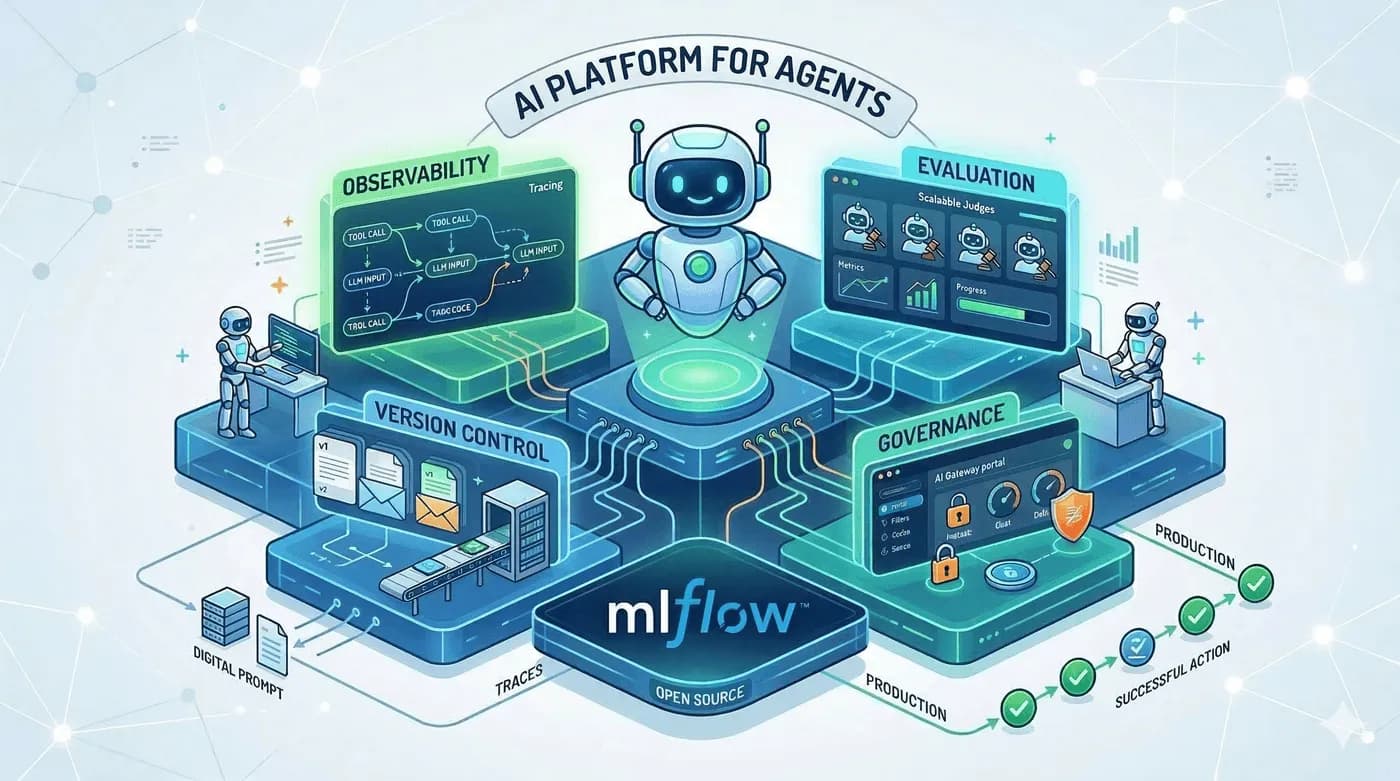
The platform addresses four stages of the ML lifecycle: Tracking (logging experiments, parameters, metrics, and artifacts), Projects (packaging ML code for reproducibility), Models (standardized model packaging format), and Model Registry (centralized model store with versioning and stage transitions). In 2023, MLflow added LLM support with MLflow Deployments (unified API for LLM providers) and evaluation tools for generative AI.
MLflow is framework-agnostic — it works with scikit-learn, PyTorch, TensorFlow, XGBoost, Hugging Face, LangChain, OpenAI, and any Python-based ML framework. Databricks provides a managed MLflow experience integrated with their lakehouse platform, but MLflow runs independently on any infrastructure.
Key Features and Architecture
Experiment Tracking
The core feature: log parameters, metrics, and artifacts for every ML experiment run. A single mlflow.log_param() or mlflow.autolog() call captures hyperparameters, training metrics (loss, accuracy, F1), model artifacts, and environment details. The tracking UI provides comparison views, metric plots, and search across thousands of runs.
Model Registry
A centralized model store with versioning, stage transitions (Staging → Production), and approval workflows. Teams register trained models, add descriptions and tags, promote models through stages with comments, and track which model version is currently serving in production.
MLflow Models (Packaging)
A standard format for packaging ML models that includes the model artifact, dependencies, and a prediction interface. MLflow Models can be deployed to any serving infrastructure — REST API, batch inference, Spark UDF, or cloud platforms (SageMaker, Azure ML) — without rewriting serving code.
MLflow Deployments (LLM Gateway)
A unified API for interacting with LLM providers (OpenAI, Anthropic, Cohere, Hugging Face, self-hosted models). MLflow Deployments provides a single interface for routing requests, managing API keys, and tracking LLM usage across providers.
Autologging
Automatic experiment logging for popular frameworks — call mlflow.autolog() and MLflow automatically captures parameters, metrics, and model artifacts for scikit-learn, PyTorch, TensorFlow, XGBoost, LightGBM, and Spark ML training runs without manual logging code.
MLflow Evaluate
Tools for evaluating ML models and LLMs against datasets with built-in metrics (accuracy, ROUGE, toxicity, relevance) and custom metrics. Evaluation results are logged as MLflow runs for comparison and tracking.
Ideal Use Cases
ML Experiment Tracking
The primary use case: data scientists tracking hundreds of experiment runs with different hyperparameters, features, and architectures. MLflow's tracking UI enables comparison across runs to identify the best-performing configuration.
Model Deployment Pipeline
ML engineering teams use the Model Registry to manage the model promotion lifecycle — from experimental models through staging validation to production deployment. Approval workflows and stage transitions provide governance for production ML.
LLM Application Development
Teams building applications with LLMs use MLflow Deployments as a unified gateway to multiple LLM providers, MLflow Evaluate for measuring response quality, and experiment tracking for prompt engineering iterations.
Reproducible ML Research
Research teams use MLflow Projects to package ML code with dependencies and data references, ensuring experiments can be reproduced by other team members or in different environments.
Pricing and Licensing
MLflow employs an open-source licensing model (Apache-2.0), with self-hosted deployment available at no cost. This model eliminates direct licensing fees, making it accessible for organizations of all sizes. However, open-source tools often require evaluation of total cost of ownership (TCO), including infrastructure, integration, and support. For this category of machine learning lifecycle management tools, pricing factors typically include deployment flexibility (self-hosted vs. cloud), support tiers (community vs. enterprise), and integration with existing data platforms. While MLflow’s core functionality is free, enterprise users may need to consider costs associated with managed services, compliance certifications, or advanced features available in commercial distributions. Open-source tools like MLflow generally avoid per-seat or usage-based pricing, but organizations should assess infrastructure scalability and potential hidden costs in deployment and maintenance. To confirm current licensing terms, deployment options, and enterprise capabilities, consult MLflow’s official documentation or contact the vendor directly.
Strengths & Trade-offs
Pros
- Open-source and free — Apache 2.0 license with no feature restrictions; the most cost-effective ML lifecycle tool
- Industry standard — 18,000+ GitHub stars, 700+ contributors; the most widely adopted experiment tracking platform
- Framework-agnostic — works with scikit-learn, PyTorch, TensorFlow, XGBoost, Hugging Face, LangChain, and any Python ML framework
- Autologging — one line of code captures all experiment details for major frameworks; minimal integration effort
- LLM support — MLflow Deployments and Evaluate extend the platform to generative AI use cases
- Multi-cloud managed options — available as managed service on Databricks, AWS SageMaker, and Azure ML
Cons
- UI is functional, not beautiful — the tracking UI works but lacks the polish and collaboration features of Weights & Biases
- Limited collaboration features — no built-in commenting, sharing, or team workspaces in the open-source version; Databricks adds these
- Self-hosted maintenance — running MLflow at scale requires managing the tracking server, database, and artifact storage
- No feature store — MLflow doesn't manage feature engineering or feature serving; requires a separate tool (Feast, Tecton)
- No pipeline orchestration — MLflow tracks experiments but doesn't orchestrate training pipelines; requires Airflow, Dagster, or similar