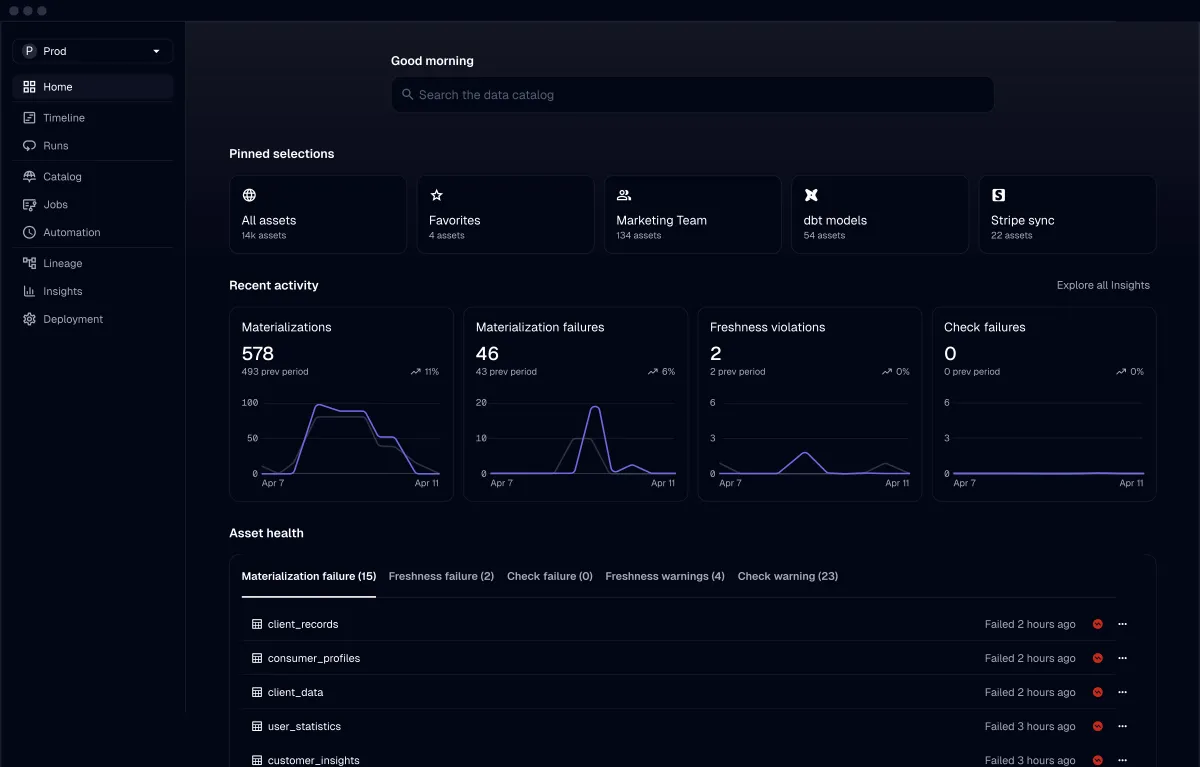
Dagster: product and architecture
Our verdict in this dagster data orchestrator review: Dagster is one of the strongest choices for teams that want orchestration to revolve around data assets, their lineage, and their current state—not merely a sequence of tasks. We recommend it for data and analytics engineering organizations that need a unified control plane for ETL/ELT, dbt transformations, and AI or ML workflows, and are willing to adopt its asset-centric development model.
Dagster is open source under Apache-2.0, written primarily in Python, and has 15,983 GitHub stars. Those are useful public adoption signals, not proof of enterprise fit; the decisive question is whether your team benefits from modeling tables, datasets, models, and reports as first-class assets. Its latest listed release is 1.13.17, dated August 7, 2026, and the repository was last pushed on August 13, 2026.
Overview
Dagster positions itself as a platform for building, scaling, and observing AI and data pipelines. Its central design choice is to treat pipelines as collections of data assets rather than as task graphs alone: teams declare functions and the assets those functions produce or update, then use Dagster to run those functions at appropriate times and keep assets current.
That framing is valuable when an organization’s real operational concern is the health of a warehouse table, a dbt model, a machine-learning model, or a report. Instead of asking only whether a scheduled task succeeded, the team can organize work around which asset changed, where it came from, and what needs to run next. Dagster describes this as a unified control plane for pipelines, transformations, and full-scale AI and ML operations.
The product’s supported workflow scope is broad but coherent: it covers ETL and ELT pipelines that move data from SaaS applications and APIs into warehouses such as Snowflake or BigQuery; transformations using dbt, Databricks, or Python; and ML development workflows involving data preparation and model training. That breadth is a strength when these workloads belong to one data platform team. It can be unnecessary complexity for a team that only needs a narrow scheduler.
Dagster Labs is the organization behind the open-source project and Dagster+, its enterprise data platform offering. The available product information also documents a 30-day free trial for Dagster+, plus tutorials, reference documentation, examples, and Dagster University for structured learning. We view those enablement materials as important because Dagster’s core ideas are not interchangeable with conventional task-first orchestration.
Key Features and Architecture
Dagster’s defining technical feature is unified data-aware orchestration. It brings data lineage, metadata, data quality, and a data catalog into an end-to-end platform organized around assets. This architecture makes an asset such as a table, dataset, machine-learning model, or report the meaningful unit of development and operations, rather than treating it as an incidental output of a job.
The asset model is code-defined and declarative. Developers declare functions and identify the assets those functions produce or update; Dagster then helps run the functions and maintain asset freshness. This has a practical benefit for complex dependency structures: a quoted data engineer describes defining assets in code as minimizing the effort required to schedule and materialize a complex DAG, while another practitioner says the asset approach reduces debugging cognitive load because it aligns with lineage.
Specific capabilities include:
- Data lineage and metadata: Dagster provides a central plane for understanding lineage and monitoring asset states. This is especially relevant when transformations, pipelines, and downstream analytical outputs must be operated as one connected estate.
- dbt, Databricks, and Python orchestration: Dagster explicitly supports orchestration of dbt, Databricks, and Python transformations. It also supports ETL/ELT movement from SaaS apps and APIs into Snowflake or BigQuery.
- Modular, reusable development: The platform emphasizes modular and reusable components, declarative workflows, and branch deployments. These features target teams that need development structure without abandoning iteration speed.
- Multi-tenant code deployments: Dagster supports multi-tenant instances designed to keep code and data isolated. This matters for platform teams supporting separate tenants or organizational boundaries.
- Identity and access controls: The platform offers SSO, RBAC, and SCIM provisioning, with support for Google, GitHub, and SAML identity providers. These are concrete enterprise controls, not simply a generic claim of access management.
- Audit and retention controls: Unified audit logs track activity and system changes, alongside retention policies. This provides a basis for reviewing user actions and operational changes.
- Deployment flexibility: Dagster can run on the customer’s cloud or Dagster’s, with North American and European region support. That is useful for organizations that need a deployment choice, but it still requires selecting the operational model deliberately.
- Compliance and support: Dagster states it is independently audited and aligned with SOC 2 Type II and HIPAA standards, and offers dedicated enterprise support.
The trade-off is architectural commitment. Dagster is strongest when teams consistently model assets in code and use the resulting lineage and state model; it is weaker as a lightweight, generic workflow runner where assets, tests, staging, and production practices are not part of the operating model.
Ideal Use Cases
Dagster is best for a data platform team that owns interconnected ingestion, transformation, and consumption workflows. A team of roughly five to 20 data engineers and analytics engineers, for example, can use the asset model to make Snowflake or BigQuery datasets, dbt transformations, and downstream reports visible within one operating surface. The relevant value is not merely scheduling: it is understanding which declared assets are produced or updated by which code.
A second strong scenario is an organization running both analytics and machine-learning work. Dagster explicitly addresses pipelines for data preparation and model training, alongside dbt, Databricks, and Python transformations. A financial-services, healthcare, or SaaS organization with governed data assets can benefit from combining lineage, asset states, SSO, RBAC, SCIM, audit logs, and retention policies—provided its policy requirements match the controls Dagster documents.
A third use case is a central platform team supporting separated organizational workloads or customers. Multi-tenant code deployments are designed to keep code and data isolated, while flexible deployment lets the organization run Dagster in its cloud or use Dagster-hosted infrastructure in North American or European regions. This is a credible fit for a mature platform program; it is not evidence that Dagster automatically solves every multi-tenant architecture decision.
We recommend Dagster for teams that already treat data products as durable assets and want their orchestration, lineage, metadata, and observability to reflect that reality. It is also appropriate for teams willing to invest in developer practices across local development, unit tests, integration tests, staging, and production—the lifecycle the documentation explicitly supports.
Do not use Dagster if your only requirement is to execute a small number of disconnected scheduled tasks and you do not intend to define assets in code. Avoid it as a shortcut for governance where the team has not established asset ownership or operating practices; lineage and audit capabilities are most useful when someone acts on them. The supplied material does not provide data-volume limits, throughput benchmarks, or named enterprise customer counts, so buyers should not infer capacity guarantees from the platform description alone.
Strengths & Trade-offs
In our evaluation, Dagster’s advantages are concrete and tied to its asset-first model rather than generic orchestration claims.
Pros
- Assets are first-class operational objects. Dagster is designed around tables, datasets, ML models, and reports, which gives lineage and asset state a direct role in development and debugging.
- It spans multiple modern data workloads. The documented scope includes SaaS/API ingestion to Snowflake or BigQuery, plus dbt, Databricks, Python, AI, and ML workflows. That lets one platform standard cover more than a single transformation layer.
- It supports disciplined engineering practices. Documentation explicitly covers local development, unit tests, integration tests, staging, and production, while the product highlights modular components, declarative workflows, and branch deployments.
- Enterprise controls are specific. SSO, RBAC, SCIM, Google, GitHub, and SAML identity-provider support are named capabilities, as are audit logs, retention policies, SOC 2 Type II alignment, and HIPAA alignment.
- The open-source option reduces licensing lock-in. Apache-2.0 self-hosting gives teams a free starting point and a path that does not depend entirely on a managed service.
- Public project activity is visible. The repository has 15,983 stars, a latest listed release of 1.13.17, and a last-push date of August 13, 2026. These are useful transparency signals for technical evaluation.
Cons
- Dagster’s asset-centric model has a real learning curve. Teams accustomed to thinking only in tasks must define assets and their producing functions in code. If that modeling discipline is not adopted, the tool’s central benefits are underused.
- Pricing clarity is incomplete in the supplied plan data. The pricing page lists both “Starter Plan” at $100 and “Starter” at $1200, while plan entitlements and billing periods are not stated. This complicates direct budget comparison.
- Free-tier limits are unspecified. The open-source self-hosted option is free, but the available data does not state usage, user, support, retention, or hosting limits. Operational responsibility must be evaluated separately.
- Enterprise capabilities may require commercial engagement. Pro and Enterprise are contact-sales plans, and the supplied data does not map SSO, SCIM, audit logging, multi-tenancy, or support to exact tiers.
- It is not a purpose-built answer for simple scheduling. Dagster’s core design centers on developing and maintaining data assets. A team seeking only disconnected workflow execution will bear conceptual overhead without receiving proportional value.