Decision comparison
Astronomer vs Dagster
Astronomer delivers enterprise-grade Apache Airflow orchestration with its managed Astro platform, AI-powered tooling, and 2.5x performance gains over alternatives. Dagster offers a modern asset-centric approach with an open-source core, integrated data catalog, and developer-first workflow that appeals to teams building from scratch.
Direct comparison. These are reviewed substitutes bought for the same job, so the differences below are the ones that decide between them.
All 2 are workflow orchestrators.
Quick Comparison
| Decision factor | Astronomer | Dagster |
|---|---|---|
| Orchestration Model | Task-based DAG orchestration built on Apache Airflow with Python-defined workflows and enterprise Astro Engine runtime | Asset-centric orchestration treating pipelines as data assets with declarative dependencies and built-in lineage tracking |
| Pricing | Developer tier free, usage-based pricing with rates including $0.00, $0.13, $0.35, $0.42, $2.40 | Open-source self-hosted free (Apache-2.0), Solo Plan $10/mo, Starter Plan $100/mo, Starter $1200/mo, Pro and Enterprise Plan contact sales |
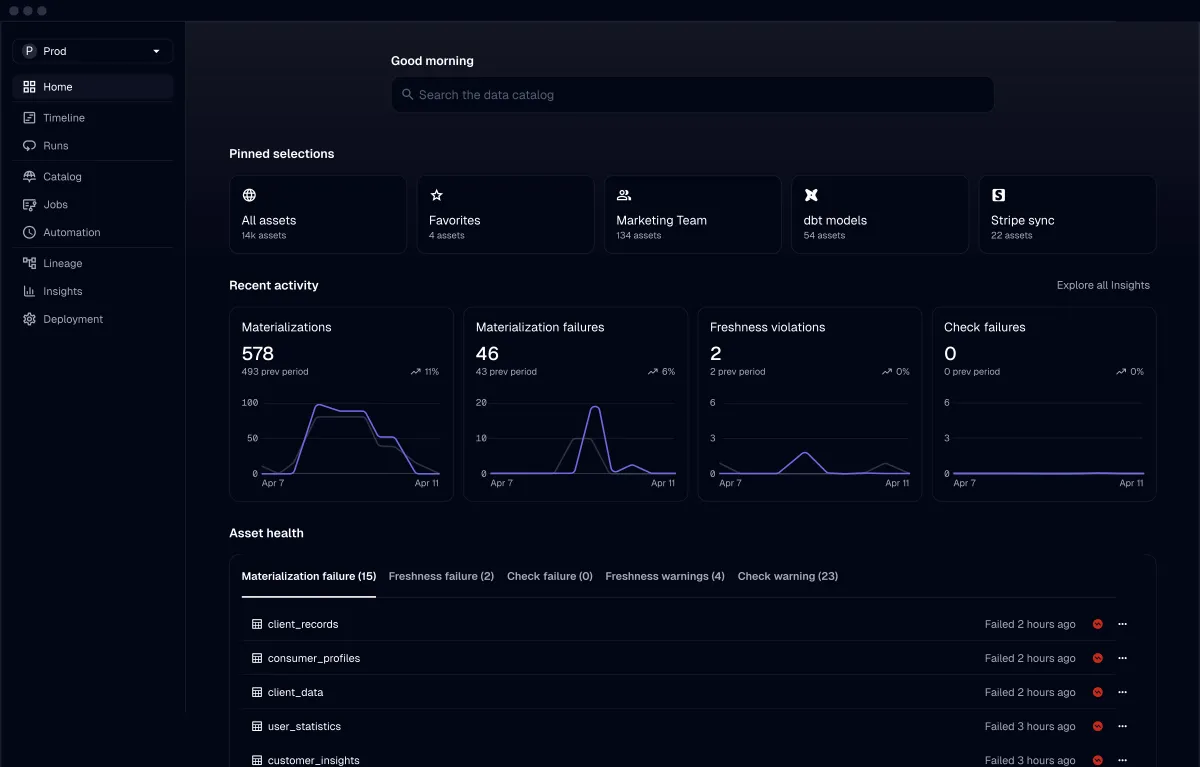
| Observability | Native data observability with pipeline lineage, SLA monitoring, data quality checks, and AI-powered root cause analysis | Integrated observability with built-in data catalog, lineage graphs, real-time health metrics, and cost tracking dashboards |
| Deployment Options | Fully managed Astro cloud with scale-to-zero compute, multi-AZ high availability, and 99.5% uptime SLA guarantee | Flexible deployment across self-hosted, Kubernetes, or managed Dagster+ cloud with hybrid bring-your-own-infrastructure patterns |
| Developer Experience | Astro CLI for local development, browser-based Astro IDE, Terraform provider, and deployments-as-code via Git workflows | Developer-friendly platform with unit testing emphasis, branch deployments, CI/CD-native workflows, and 15,000+ GitHub stars |
| Enterprise Security | SOC 2 Type II and HIPAA compliant with SAML-based SSO, audit logging, and Astro Private Cloud for air-gapped deployments | SOC 2 Type II and HIPAA compliant with SSO, RBAC, SCIM provisioning, multi-tenant isolation, and audit log retention |
Astronomer
- Orchestration Model:
- Task-based DAG orchestration built on Apache Airflow with Python-defined workflows and enterprise Astro Engine runtime
- Pricing:
- Developer tier free, usage-based pricing with rates including $0.00, $0.13, $0.35, $0.42, $2.40
- Observability:
- Native data observability with pipeline lineage, SLA monitoring, data quality checks, and AI-powered root cause analysis
- Deployment Options:
- Fully managed Astro cloud with scale-to-zero compute, multi-AZ high availability, and 99.5% uptime SLA guarantee
- Developer Experience:
- Astro CLI for local development, browser-based Astro IDE, Terraform provider, and deployments-as-code via Git workflows
- Enterprise Security:
- SOC 2 Type II and HIPAA compliant with SAML-based SSO, audit logging, and Astro Private Cloud for air-gapped deployments
Dagster
- Orchestration Model:
- Asset-centric orchestration treating pipelines as data assets with declarative dependencies and built-in lineage tracking
- Pricing:
- Open-source self-hosted free (Apache-2.0), Solo Plan $10/mo, Starter Plan $100/mo, Starter $1200/mo, Pro and Enterprise Plan contact sales
- Observability:
- Integrated observability with built-in data catalog, lineage graphs, real-time health metrics, and cost tracking dashboards
- Deployment Options:
- Flexible deployment across self-hosted, Kubernetes, or managed Dagster+ cloud with hybrid bring-your-own-infrastructure patterns
- Developer Experience:
- Developer-friendly platform with unit testing emphasis, branch deployments, CI/CD-native workflows, and 15,000+ GitHub stars
- Enterprise Security:
- SOC 2 Type II and HIPAA compliant with SSO, RBAC, SCIM provisioning, multi-tenant isolation, and audit log retention
Public signals
Verified factual signals only. Bars appear only for like-for-like metrics with five weekly assessments for every tool; missing evidence stays explicit. These signals do not establish enterprise adoption, product quality, or total cost.
| Metric | Astronomer | Dagster |
|---|---|---|
| GitHub commits, 90d(Developer adoption) | 60 | Not available |
| GitHub stars(Developer adoption) | 1,000+ | Not available |
| Search interest(Market interest) | 0 | 1 |
| Product Hunt comments(Community interest) | 0 | 11 |
| Product Hunt rating(Community interest) | Unavailable | 5.0/5 |
| Product Hunt reviews(Community interest) | 0 | 1 |
| Product Hunt votes(Community interest) | 6 | 112 |
| PyPI weekly downloads(Ecosystem adoption) | 1.8M | Not available |
| Stack Overflow questions(Community interest) | 25 | 171 |
| Docker Hub pulls(Developer adoption) | Not available | 6.2M |
| GitHub commits, 90d(Product adoption) | Not available | 265 |
| GitHub stars(Product adoption) | Not available | 16,000+ |
| Hacker News mentions, 90d(Community interest) | Not available | 3 |
| PyPI weekly downloads(Product adoption) | Not available | 1.8M |
As of September 21, 2026 — updated weekly.
Health & risk evidence
Observed public-source checks for mapped package versions and repositories.
Astronomer
September 21, 2026Package vulnerabilities
PyPI · apache-airflow@3.3.2
0 vulnerabilities
across 1 package
Repository security score
Not available
Dagster
September 21, 2026Package vulnerabilities
PyPI · dagster@1.13.23
0 vulnerabilities
across 1 package
Repository security score
github.com/dagster-io/dagster
5.1/10
Interface Preview
Astronomer
Dagster
Feature Comparison
| Feature | Astronomer | Dagster |
|---|---|---|
| Orchestration & Scheduling | ||
| Pipeline Authoring | Python DAGs using Apache Airflow with AI-assisted authoring via Airflow AI Assistant and Astro IDE browser editor | Declarative asset definitions in Python with software-defined assets, partitioning, and versioning as first-class concepts |
| Execution Engine | Astro Engine with hardened runtime, agent-based executor delivering 2.5x concurrent tasks versus managed alternatives | Data-aware orchestrator with intelligent dependency handling, partition support, incremental runs, and automatic fault tolerance |
| Scaling | Elastic auto-scaling workers that scale based on task queue depth with scale-to-zero compute and hibernating deployments | Flexible scaling from single server to Kubernetes clusters with managed Dagster+ cloud offering unlimited deployments on Pro plan |
| Observability & Monitoring | ||
| Data Lineage | Task-level pipeline lineage tracing upstream and downstream dependencies across DAGs, tables, and team boundaries | Built-in asset lineage graphs with integrated data catalog providing unified view of all assets, workflows, and metadata |
| Alerting & Debugging | AI-powered root cause analysis agent that pinpoints failures by analyzing task logs, worker metrics, and execution context | Intelligent alerts via Slack with AI-powered debugging, impact analysis, and streamlined incident resolution workflows |
| Data Quality | Built-in data quality monitoring with checks for volume, completeness, and schema consistency plus custom SQL flexibility | Embedded data quality with built-in validation, automated testing, freshness checks, and proactive issue identification |
| Integrations & Ecosystem | ||
| Data Warehouse Support | Broad integration ecosystem through Apache Airflow providers supporting hundreds of services and data platforms | Native first-class integrations for Snowflake, BigQuery, Databricks, and Spark with Dagster Pipes for external systems |
| dbt Integration | Native dbt orchestration that turns dbt projects into DAGs with model-level visibility and transformation management | Deep native dbt integration as a core supported tool alongside Fivetran and Great Expectations for transformation workflows |
| Infrastructure as Code | Astro Terraform Provider for managing infrastructure as code with version-controlled configurations via CLI and API | GitOps-driven workflows with declarative pipeline definitions, branch deployments, and CI/CD-native development patterns |
| Enterprise & Security | ||
| Authentication | SAML-based SSO with enterprise SSO integration and role-based access control across workspaces and deployments | SSO with RBAC and SCIM provisioning supporting Google, GitHub, and SAML identity providers for enterprise teams |
| Compliance | SOC 2 Type II and HIPAA certified with audit logging, network isolation, and dedicated cluster deployment options | SOC 2 Type II and HIPAA aligned with independently audited security, audit logs, retention policies, and multi-tenancy |
| Deployment Isolation | Astro Private Cloud with air-gapped deployment support, deployment isolation, and multi-cluster regional management | Multi-tenant instances with code and data isolation, flexible cloud or self-hosted deployment across NA and EU regions |
| Developer Tools | ||
| Local Development | Astro CLI for full local Airflow environment with astro dev init, local testing, and single-command deployment to cloud | Strong local development emphasis with unit testing, integration tests, and staging environments built into the workflow |
| CI/CD Support | Deployments as code through Git with PR review workflows, zero-downtime upgrades, and 90-day deployment rollback history | CI/CD-native workflow with branch deployments for continuous integration, modular components, and reusable pipeline code |
| AI Capabilities | Airflow AI Assistant for DAG authoring and debugging plus Airflow MCP server granting AI agents programmatic pipeline access | Compass product that turns warehouse data into instant answers for stakeholders using AI with analyst-governed GitOps controls |
Orchestration & Scheduling
Pipeline Authoring
Execution Engine
Scaling
Observability & Monitoring
Data Lineage
Alerting & Debugging
Data Quality
Integrations & Ecosystem
Data Warehouse Support
dbt Integration
Infrastructure as Code
Enterprise & Security
Authentication
Compliance
Deployment Isolation
Developer Tools
Local Development
CI/CD Support
AI Capabilities
Which to choose
Astronomer delivers enterprise-grade Apache Airflow orchestration with its managed Astro platform, AI-powered tooling, and 2.5x performance gains over alternatives. Dagster offers a modern asset-centric approach with an open-source core, integrated data catalog, and developer-first workflow that appeals to teams building from scratch.
Best-fit scenarios
Choose Astronomer if:
We recommend Astronomer for teams already invested in Apache Airflow who need a fully managed, enterprise-grade orchestration platform. Astronomer excels when you want to eliminate Kubernetes operational overhead while gaining AI-powered observability, root cause analysis, and zero-downtime upgrades. Its usage-based pricing with a free Developer tier makes it accessible for teams scaling from small projects to production workloads running hundreds of DAGs. The Astro Engine delivers 2.5x concurrent task performance versus managed alternatives, and the 99.5% uptime SLA provides the reliability guarantees that enterprise data teams require.
Choose Dagster if:
We recommend Dagster for teams that prefer a modern, asset-centric orchestration model with strong open-source foundations. Dagster stands out when you want to treat data pipelines as collections of data assets rather than just tasks, gaining built-in lineage, a data catalog, and embedded data quality from day one. With 15,000+ GitHub stars and an Apache-2.0 license, the open-source community is strong and active. The tiered pricing starting at $10/mo for Solo makes it approachable for individual developers, while the enterprise plan with unlimited deployments scales to large platform teams. Dagster's emphasis on testability and developer experience makes it particularly compelling for teams building greenfield data platforms.
These scenarios reflect the available product evidence. Your requirements, existing stack, and team expertise should guide the final decision.
Frequently Asked Questions
What is the main architectural difference between Astronomer and Dagster?
Astronomer is built on Apache Airflow and uses a task-based DAG orchestration model where you define workflows as Python-coded Directed Acyclic Graphs with individual tasks and dependencies. Dagster takes an asset-centric approach where pipelines are modeled as collections of data assets with declarative dependencies, versioning, and partitioning as first-class concepts. This fundamental difference means Astronomer excels at orchestrating complex multi-step workflows, while Dagster provides stronger built-in lineage and a more intuitive mental model for data teams who think in terms of the datasets they produce.
How do the pricing models compare between Astronomer and Dagster?
Astronomer offers a free Developer tier and usage-based compute pricing for managed Airflow. Dagster has a free self-hosted open-source option, while managed Dagster+ starts with Solo and Starter plans and additional usage credits.
Which platform has better observability and data quality features?
Both platforms offer strong observability capabilities but take different approaches. Astronomer provides native data observability with pipeline lineage, Data Product SLAs, data quality monitoring with volume and schema checks, and a standout AI-powered root cause analysis agent that pinpoints failures by analyzing task logs and execution context. Dagster offers an integrated data catalog with auto-generated documentation, built-in data quality validation with freshness checks, real-time health metrics for freshness and cost tracking, and the Compass product for turning warehouse data into AI-powered stakeholder answers. Astronomer leans into AI-assisted debugging, while Dagster emphasizes catalog-driven discovery.
Can both Astronomer and Dagster be self-hosted?
Dagster offers a fully open-source self-hosted option under the Apache-2.0 license with 15,000+ GitHub stars, making it straightforward to deploy on your own infrastructure including single servers or Kubernetes clusters. Dagster+ managed plans also support hybrid deployments where you bring your own infrastructure. Astronomer focuses primarily on its managed Astro cloud platform, though it also offers Astro Private Cloud for enterprises that need deployments across multiple clusters and regions with air-gapped support. For teams that prioritize full self-hosted control with zero licensing cost, Dagster's open-source edition is the stronger option.
How do Astronomer and Dagster handle enterprise security and compliance?
Both platforms meet enterprise security standards with SOC 2 Type II and HIPAA compliance. Astronomer provides SAML-based SSO, audit logging, deployment rollbacks, network isolation with dedicated clusters, and Astro Private Cloud for air-gapped environments with 24/7 committer-led support. Dagster offers SSO with RBAC and SCIM provisioning supporting Google, GitHub, and SAML identity providers, multi-tenant instances for code and data isolation, audit logs with retention policies, and flexible deployment across North American and European regions. Both platforms provide the governance controls that regulated industries require.