Decision comparison
Apache Beam vs Dagster
Apache Beam excels as a portable, execution-engine-agnostic data processing framework for teams that need unified batch and streaming pipelines at massive scale, while Dagster is the stronger choice for teams seeking an asset-centric orchestration platform with built-in observability, testing, and a modern developer experience for managing complex data workflows.
Used together. These are normally used together rather than chosen between. The comparison explains what each one does in the stack.
These are different kinds of product — Data Processing Engine and Workflow Orchestrator.
Quick Comparison
| Decision factor | Apache Beam | Dagster |
|---|---|---|
| Best For | Large-scale unified batch and streaming data processing across multiple execution engines | Asset-centric data orchestration with built-in lineage, observability, and dbt integration |
| Pricing | Free and open source | Open-source self-hosted free (Apache-2.0), Solo Plan $10/mo, Starter Plan $100/mo, Starter $1200/mo, Pro and Enterprise Plan contact sales |
| Learning Curve | Steep learning curve requiring understanding of PCollection, PTransform, and runner abstractions | Moderate learning curve with Python-native APIs and strong local development support |
| Primary Language | Java, Python, Go, and Scala SDKs for multi-language pipeline development | Python-native with declarative asset definitions and modular components |
| Deployment Options | Runs on Apache Flink, Spark, Google Cloud Dataflow, and Hazelcast Jet | Self-hosted single server, Kubernetes, or fully managed Dagster Cloud with hybrid options |
| Community Size | 8,500+ GitHub stars with active Apache Software Foundation community backing | 16,000+ GitHub stars with rapidly growing open-source community and Dagster Labs backing |
Apache Beam
- Best For:
- Large-scale unified batch and streaming data processing across multiple execution engines
- Pricing:
- Free and open source
- Learning Curve:
- Steep learning curve requiring understanding of PCollection, PTransform, and runner abstractions
- Primary Language:
- Java, Python, Go, and Scala SDKs for multi-language pipeline development
- Deployment Options:
- Runs on Apache Flink, Spark, Google Cloud Dataflow, and Hazelcast Jet
- Community Size:
- 8,500+ GitHub stars with active Apache Software Foundation community backing
Dagster
- Best For:
- Asset-centric data orchestration with built-in lineage, observability, and dbt integration
- Pricing:
- Open-source self-hosted free (Apache-2.0), Solo Plan $10/mo, Starter Plan $100/mo, Starter $1200/mo, Pro and Enterprise Plan contact sales
- Learning Curve:
- Moderate learning curve with Python-native APIs and strong local development support
- Primary Language:
- Python-native with declarative asset definitions and modular components
- Deployment Options:
- Self-hosted single server, Kubernetes, or fully managed Dagster Cloud with hybrid options
- Community Size:
- 16,000+ GitHub stars with rapidly growing open-source community and Dagster Labs backing
Public signals
Verified factual signals only. Bars appear only for like-for-like metrics with five weekly assessments for every tool; missing evidence stays explicit. These signals do not establish enterprise adoption, product quality, or total cost.
| Metric | Apache Beam | Dagster |
|---|---|---|
| GitHub commits, 90d(Product adoption) | 804 | 253 |
| GitHub stars(Product adoption) | 8,500+ | 16,000+ |
| Search interest(Market interest) | 0 | 1 |
| Hacker News mentions, 90d(Community interest) | 1 | 3 |
| PyPI weekly downloads(Product adoption) | 809.2k | 1.8M |
| Stack Overflow questions(Community interest) | 4.9k | 171 |
| Docker Hub pulls(Developer adoption) | Not available | 6.2M |
| Product Hunt comments(Community interest) | Not available | 11 |
| Product Hunt rating(Community interest) | Not available | 5.0/5 |
| Product Hunt reviews(Community interest) | Not available | 1 |
| Product Hunt votes(Community interest) | Not available | 112 |
As of September 14, 2026 — updated weekly.
Health & risk evidence
Observed public-source checks for mapped package versions and repositories.
Apache Beam
September 14, 2026Package vulnerabilities
PyPI · apache-beam@2.75.0
0 vulnerabilities
across 1 package
Repository security score
Not available
Dagster
September 14, 2026Package vulnerabilities
PyPI · dagster@1.13.21
0 vulnerabilities
across 1 package
Repository security score
github.com/dagster-io/dagster
4.8/10
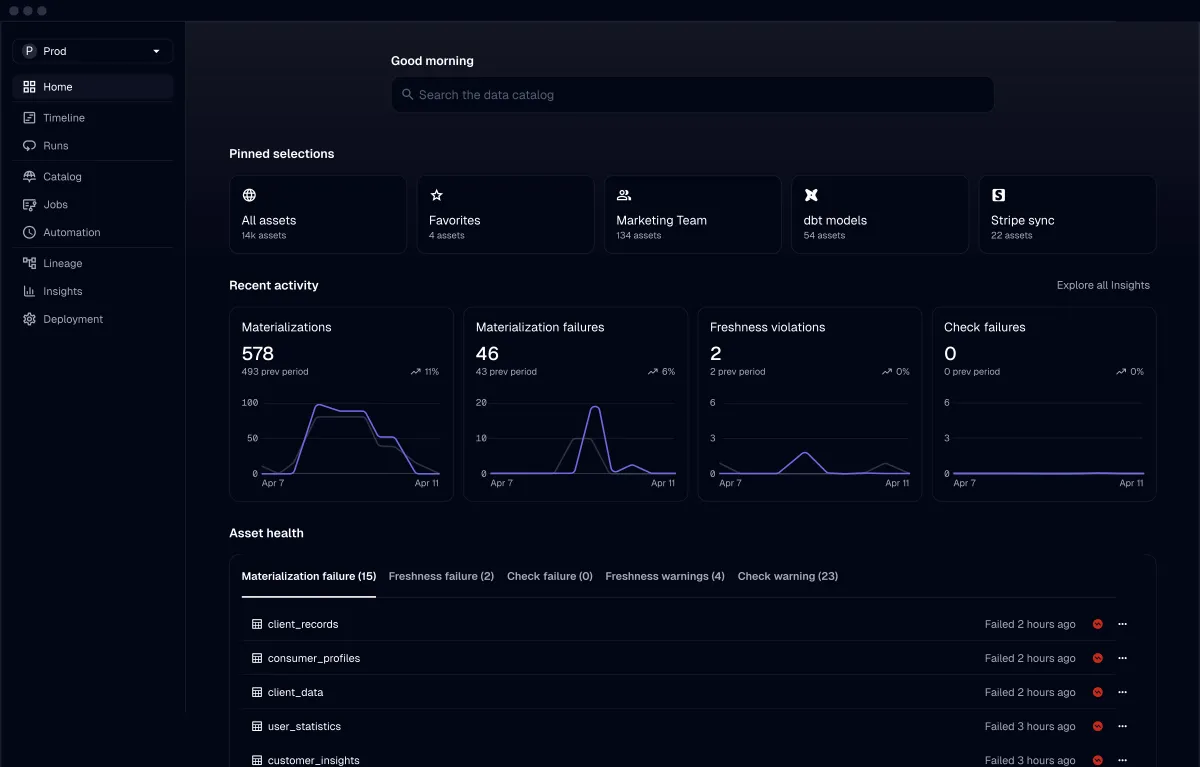
Interface Preview
Dagster
Feature Comparison
| Feature | Apache Beam | Dagster |
|---|---|---|
| Core Processing | ||
| Batch Processing | Unified model handles batch natively with PCollection abstractions | Orchestrates batch pipelines through asset-centric scheduling and partitioning |
| Stream Processing | First-class streaming with windowing, triggers, and watermarks built into the model | Supports sensor-based triggering but not designed as a native stream processor |
| Multi-Language Support | Java, Python, Go, and Scala SDKs with cross-language pipeline support | Python-only with Dagster Pipes for observability of external language jobs |
| Orchestration & Workflow | ||
| Asset-Centric Orchestration | Pipeline-centric model focused on data transformations rather than asset management | Core design philosophy treating pipelines as collections of versioned data assets |
| DAG Visualization | Basic pipeline visualization available through runner-specific UIs like Dataflow | Rich built-in UI with interactive lineage graphs, health checks, and dashboards |
| Scheduling & Automation | Relies on external schedulers or runner platforms for job scheduling | Built-in schedules, sensors, and auto-materialization policies for automation |
| Integrations & Ecosystem | ||
| Data Warehouse Connectors | IO connectors for BigQuery, JDBC, and various data sinks and sources | Native integrations for Snowflake, BigQuery, Databricks, and Fivetran |
| dbt Integration | No native dbt integration; requires custom pipeline development | First-class dbt integration with automatic asset mapping and lineage |
| ML/AI Framework Support | TensorFlow Extended built on Beam; supports ML pipeline preprocessing at scale | ML workflow orchestration with experiment tracking and model training pipelines |
| Developer Experience | ||
| Local Development & Testing | DirectRunner for local testing; Beam Playground for browser-based experimentation | Emphasis on unit testing, local dev server, and CI integration for pipelines |
| Documentation & Learning | Comprehensive Apache docs, Beam Playground, and Tour of Beam learning guide | Dagster University courses, detailed docs, and hands-on tutorials |
| Branch Deployments | No built-in branch deployment support; managed through CI/CD externally | Native branch deployments for testing pipeline changes before production |
| Enterprise & Security | ||
| Compliance Certifications | Inherits compliance from chosen runner platform; no standalone certifications | SOC 2 Type II and HIPAA compliance with independent auditing on Dagster+ |
| Access Control | Managed through the execution platform; no built-in RBAC | SSO, RBAC, and SCIM provisioning with Google, GitHub, and SAML IdP support |
| Multi-Tenancy | Achieved through runner-level isolation and resource management | Multi-tenant instances with isolated code deployments on Dagster+ |
Core Processing
Batch Processing
Stream Processing
Multi-Language Support
Orchestration & Workflow
Asset-Centric Orchestration
DAG Visualization
Scheduling & Automation
Integrations & Ecosystem
Data Warehouse Connectors
dbt Integration
ML/AI Framework Support
Developer Experience
Local Development & Testing
Documentation & Learning
Branch Deployments
Enterprise & Security
Compliance Certifications
Access Control
Multi-Tenancy
How they fit together
Apache Beam excels as a portable, execution-engine-agnostic data processing framework for teams that need unified batch and streaming pipelines at massive scale, while Dagster is the stronger choice for teams seeking an asset-centric orchestration platform with built-in observability, testing, and a modern developer experience for managing complex data workflows.
What each one handles
Use Apache Beam for:
Choose Apache Beam when your primary challenge is large-scale data processing that must run portably across multiple execution engines like Flink, Spark, or Google Cloud Dataflow. It is ideal for organizations processing trillions of events daily, teams that need multi-language SDK support across Java, Python, Go, and Scala, and use cases where streaming with advanced windowing and watermarks is a core requirement. Companies like LinkedIn, Booking.com, and Palo Alto Networks rely on Beam for mission-critical, high-throughput data processing.
Use Dagster for:
Choose Dagster when you need a modern data orchestration platform that treats data assets as first-class citizens with built-in lineage, observability, and quality checks. It is the better fit for Python-centric data teams orchestrating dbt transformations, ELT pipelines, and ML workflows who value a strong local development experience with unit testing and branch deployments. Dagster Cloud offers enterprise-ready features including SOC 2 Type II compliance, RBAC, and managed infrastructure, making it suitable for teams that want to reduce operational overhead while maintaining full visibility into pipeline health.
These roles reflect the available product evidence. Most teams run both; which one owns a given job depends on your stack and team.
Frequently Asked Questions
Can Apache Beam and Dagster be used together?
Apache Beam and Dagster serve complementary roles and can work together effectively in a data platform. Dagster acts as the orchestration layer, scheduling and monitoring your overall data workflow, while Apache Beam handles the heavy data processing within individual pipeline steps. You can use Dagster to trigger and observe Beam jobs running on execution engines like Google Cloud Dataflow or Apache Flink. Dagster Pipes enables metadata tracking and observability for external jobs, so your Beam processing steps become visible assets within the Dagster lineage graph. This combination gives you portable, high-throughput processing from Beam and unified orchestration with lineage from Dagster.
Which tool is better for real-time streaming data processing?
Apache Beam is the clear winner for real-time streaming data processing. Its unified programming model was designed from the ground up to handle streaming with sophisticated features like windowing strategies (fixed, sliding, and session windows), triggers, and watermarks for managing late-arriving data. Beam pipelines can process millions of events per second on runners like Apache Flink and Google Cloud Dataflow. Dagster supports sensor-based triggering and can orchestrate near-real-time workflows, but it is fundamentally an orchestrator rather than a stream processing engine. For true low-latency, event-by-event streaming, Apache Beam is the appropriate tool.
How do the pricing models compare between Apache Beam and Dagster?
Apache Beam is completely free and open source under the Apache-2.0 license, though you will incur costs from your chosen execution engine such as Google Cloud Dataflow or managed Flink clusters. Dagster offers a free open-source self-hosted option also under Apache-2.0. For managed hosting, Solo is $10/month plus $0.040 per credit, and Starter is $100/month plus $0.035 per credit. for production pipelines with up to 3 users, and Pro and Enterprise plans with custom pricing for sizable teams. Both Dagster+ paid tiers include a 30-day free trial. The total cost depends on your infrastructure choices, team size, and whether you prefer managing your own deployment or using a managed service.
Which tool has better community support and ecosystem maturity?
Both tools have strong communities, but they differ in nature. Apache Beam, backed by the Apache Software Foundation, has 8,500+ GitHub stars, a mature ecosystem dating back to its 2016 introduction by Google, and proven adoption at companies like LinkedIn, HSBC, and Lyft processing trillions of events. Dagster, backed by Dagster Labs, has 15,000+ GitHub stars and a rapidly growing community with strong momentum in the modern data stack. Dagster offers Dagster University for structured learning and has native integrations with popular tools like dbt, Snowflake, and Databricks. Apache Beam has extensive enterprise adoption for heavy data processing, while Dagster has strong traction among modern data engineering teams building asset-centric workflows.
What are the main architectural differences between Apache Beam and Dagster?
The fundamental architectural difference is that Apache Beam is a data processing framework while Dagster is a data orchestration platform. Beam uses a pipeline-centric model built around PCollections (datasets), PTransforms (operations), and PipelineRunners that execute on distributed backends. Its write-once-run-anywhere approach abstracts the execution engine, letting you move between Flink, Spark, and Dataflow without rewriting code. Dagster uses an asset-centric model where pipelines are defined as collections of data assets with explicit dependencies, versioning, and partitioning. Dagster provides a control plane with built-in scheduling, observability, and a data catalog, while Beam focuses purely on the computation layer and relies on external tools for orchestration and monitoring.