Decision comparison
CloudQuery vs Dagster
CloudQuery and Dagster serve fundamentally different roles in the modern data stack. CloudQuery excels at extracting and querying cloud infrastructure data for security, compliance, and FinOps use cases. Dagster excels at orchestrating end-to-end data pipelines with asset-centric scheduling, lineage, and observability. The right choice depends on whether your primary need is cloud visibility or pipeline orchestration.
Used together. These are normally used together rather than chosen between. The comparison explains what each one does in the stack.
These are different kinds of product — ELT Platform and Workflow Orchestrator.
Quick Comparison
| Decision factor | CloudQuery | Dagster |
|---|---|---|
| Primary Use Case | Cloud asset inventory, security, and compliance | Data pipeline orchestration and observability |
| Language | Go | Python |
| License | MPL-2.0 | Apache-2.0 |
| Pricing Model | The CloudQuery CLI is open source under MPL 2.0 and free to self-host. The hosted platform bills on usage, which CloudQuery describes as priced solely on what you consume; no rate is published, and a free trial is offered. | Open-source self-hosted free (Apache-2.0), Solo Plan $10/mo, Starter Plan $100/mo, Starter $1200/mo, Pro and Enterprise Plan contact sales |
| GitHub Stars | 6,377 | 15,348 |
| Deployment | CLI (self-hosted) or managed platform | Self-hosted, Kubernetes, managed cloud, or hybrid |
CloudQuery
- Primary Use Case:
- Cloud asset inventory, security, and compliance
- Language:
- Go
- License:
- MPL-2.0
- Pricing Model:
- The CloudQuery CLI is open source under MPL 2.0 and free to self-host. The hosted platform bills on usage, which CloudQuery describes as priced solely on what you consume; no rate is published, and a free trial is offered.
- GitHub Stars:
- 6,377
- Deployment:
- CLI (self-hosted) or managed platform
Dagster
- Primary Use Case:
- Data pipeline orchestration and observability
- Language:
- Python
- License:
- Apache-2.0
- Pricing Model:
- Open-source self-hosted free (Apache-2.0), Solo Plan $10/mo, Starter Plan $100/mo, Starter $1200/mo, Pro and Enterprise Plan contact sales
- GitHub Stars:
- 15,348
- Deployment:
- Self-hosted, Kubernetes, managed cloud, or hybrid
Public signals
Verified factual signals only. Bars appear only for like-for-like metrics with five weekly assessments for every tool; missing evidence stays explicit. These signals do not establish enterprise adoption, product quality, or total cost.
| Metric | CloudQuery | Dagster |
|---|---|---|
| GitHub commits, 90d(Product adoption) | 348 | 265 |
| GitHub stars(Product adoption) | 6,500+ | 16,000+ |
| Search interest(Market interest) | Unavailable | 1 |
| Product Hunt comments(Community interest) | 1 | 11 |
| Product Hunt rating(Community interest) | Unavailable | 5.0/5 |
| Product Hunt reviews(Community interest) | 0 | 1 |
| Product Hunt votes(Community interest) | 7 | 112 |
| Docker Hub pulls(Developer adoption) | Not available | 6.2M |
| Hacker News mentions, 90d(Community interest) | Not available | 3 |
| PyPI weekly downloads(Product adoption) | Not available | 1.8M |
| Stack Overflow questions(Community interest) | Not available | 171 |
As of September 21, 2026 — updated weekly.
Health & risk evidence
Observed public-source checks for mapped package versions and repositories.
CloudQuery
September 21, 2026Package vulnerabilities
Not available
Repository security score
github.com/cloudquery/cloudquery
5.4/10
Dagster
September 21, 2026Package vulnerabilities
PyPI · dagster@1.13.23
0 vulnerabilities
across 1 package
Repository security score
github.com/dagster-io/dagster
5.1/10
Interface Preview
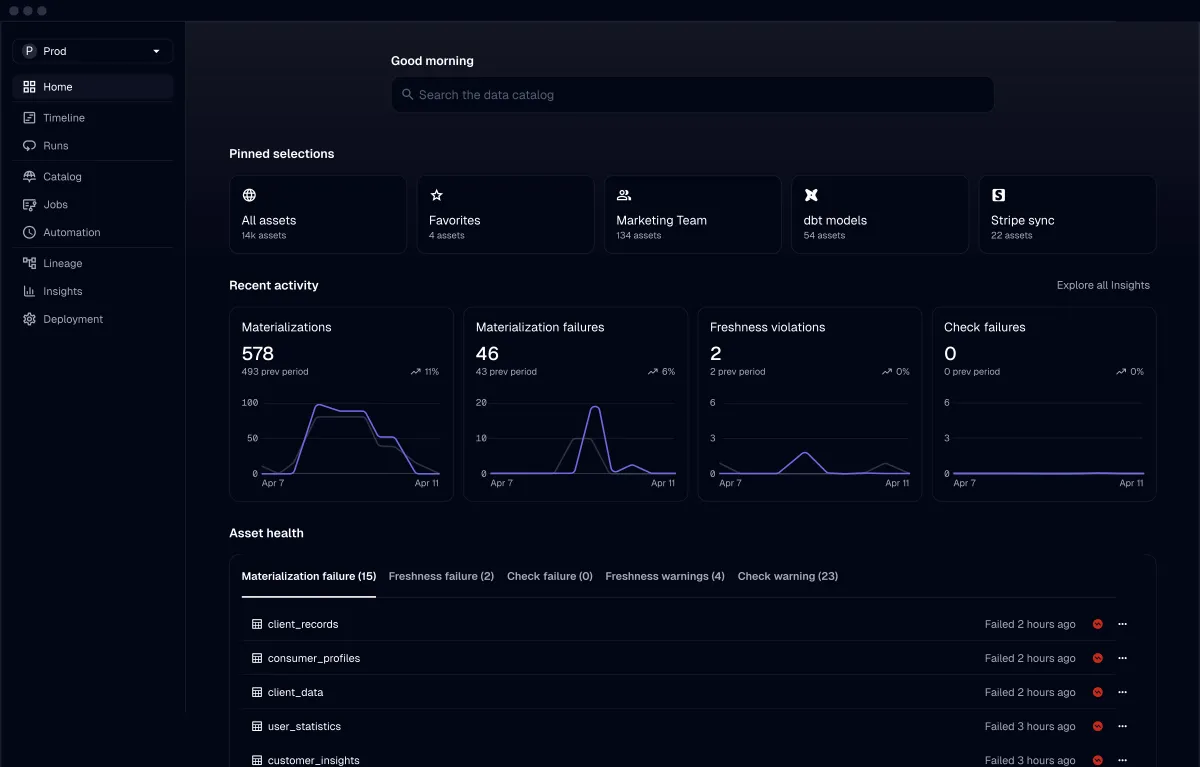
Dagster
Feature Comparison
| Feature | CloudQuery | Dagster |
|---|---|---|
| Core Capabilities | ||
| Cloud Asset Inventory | Full multi-cloud inventory with 50+ integrations across AWS, GCP, Azure, and SaaS tools | Not a core feature; requires external tools or custom integrations for cloud asset discovery |
| Data Pipeline Orchestration | Focused on extract-and-load from cloud APIs; no general-purpose pipeline scheduling | Full asset-centric orchestration with scheduling, partitioning, dependency management, and fault tolerance |
| Data Transformation | SQL-based policy queries and data normalization; no built-in transformation pipeline | Native dbt integration, Python transformations, and declarative asset-based transformation workflows |
| Data Quality | Policy-based validation for cloud configuration drift and misconfiguration detection | Built-in data quality checks, freshness monitoring, and automated validation embedded in pipeline code |
| AI and ML Support | AI-powered natural language query assistant for exploring cloud inventory data | Full ML pipeline orchestration for data prep, model training, experiment tracking, and AI applications |
| Observability and Monitoring | ||
| Data Lineage | Cross-resource relationship mapping showing connected cloud assets and dependencies | Built-in asset lineage graphs with dependency tracking across the entire data pipeline |
| Monitoring and Alerting | Event-driven triggers on drift, cost spikes, and security findings with webhook notifications | Intelligent Slack alerts, AI-powered debugging, impact analysis, and real-time health metrics |
| Data Catalog | Unified cloud asset catalog with normalized schema and metadata enrichment from 50+ sources | Integrated data catalog with asset documentation, ownership tracking, and cross-team discovery |
| Cost Visibility | FinOps integration for tracking cost allocation, identifying unused resources, and right-sizing | Built-in cost tracking and insights for monitoring data platform operational expenses |
| Platform and Operations | ||
| Integrations Ecosystem | Deep coverage for cloud platforms (AWS, GCP, Azure, Kubernetes) plus security and FinOps tools | Broad data stack integrations including Snowflake, BigQuery, dbt, Databricks, Spark, and Fivetran |
| Deployment Flexibility | CLI for self-hosted use or fully managed CloudQuery Platform | Self-hosted (single server or Kubernetes), managed Dagster Cloud, or hybrid deployments |
| Security and Compliance | Continuous compliance monitoring, security posture assessment, and SQL-based policy enforcement | SOC 2 Type II, HIPAA alignment, RBAC, SCIM provisioning, and audit logs for platform governance |
| Automation and Workflows | Event-driven workflows triggered by drift, cost spikes, or security findings with webhook support | Declarative scheduling, partitioned runs, sensors, and CI/CD-native branch deployment workflows |
| Enterprise Support | Tiered support plans (Free, Silver, Gold, Platinum) with SLAs up to 24/7 coverage | Dedicated enterprise support, private Slack channels, personalized onboarding, and uptime SLAs |
| Open Source | Open-source CLI under MPL-2.0 license, written in Go with 6,000+ GitHub stars | Open-source under Apache-2.0 license, written in Python with 15,000+ GitHub stars |
Core Capabilities
Cloud Asset Inventory
Data Pipeline Orchestration
Data Transformation
Data Quality
AI and ML Support
Observability and Monitoring
Data Lineage
Monitoring and Alerting
Data Catalog
Cost Visibility
Platform and Operations
Integrations Ecosystem
Deployment Flexibility
Security and Compliance
Automation and Workflows
Enterprise Support
Open Source
How they fit together
CloudQuery and Dagster serve fundamentally different roles in the modern data stack. CloudQuery excels at extracting and querying cloud infrastructure data for security, compliance, and FinOps use cases. Dagster excels at orchestrating end-to-end data pipelines with asset-centric scheduling, lineage, and observability. The right choice depends on whether your primary need is cloud visibility or pipeline orchestration.
What each one handles
Use CloudQuery for:
Platform engineering, security, and DevOps teams that need unified multi-cloud asset inventory, compliance monitoring, and infrastructure automation across AWS, GCP, Azure, and 50+ integrations.
Use Dagster for:
Data engineering teams building production ETL/ELT pipelines, dbt transformations, ML workflows, or AI applications that need asset-centric orchestration with built-in lineage, testing, and observability.
These roles reflect the available product evidence. Most teams run both; which one owns a given job depends on your stack and team.
Frequently Asked Questions
Can CloudQuery and Dagster be used together?
Yes. CloudQuery handles cloud infrastructure data extraction while Dagster orchestrates broader data pipelines. Teams often use CloudQuery as a data source within Dagster-orchestrated workflows, combining cloud asset inventory with downstream analytics and transformation pipelines.
Which tool is better for security and compliance monitoring?
CloudQuery is purpose-built for this use case. It provides continuous compliance monitoring, security posture assessment, audit-ready reports, and SQL-based policy enforcement across multi-cloud environments. Dagster does not offer native security monitoring features.
Which tool has better support for dbt and data transformations?
Dagster has a significant advantage here with native dbt integration, declarative asset definitions, and a full transformation orchestration layer. CloudQuery focuses on data extraction and loading rather than transformation workflows.
What are the open-source licensing differences?
CloudQuery uses the MPL-2.0 (Mozilla Public License) and is written in Go. Dagster uses the Apache-2.0 license and is written in Python. Both are fully open-source for self-hosted deployments, with paid managed platform options available.
Which tool scales better for enterprise use?
Both offer enterprise-grade capabilities but in different domains. CloudQuery scales for multi-cloud asset inventory with support tiers up to Platinum (24/7 SLA). Dagster scales for data pipeline orchestration with SOC 2 Type II compliance, HIPAA alignment, RBAC, and multi-tenant deployments.