Decision comparison
Apache Airflow vs Dagster
Dagster is the better choice for new projects where asset lineage, testing, and observability are priorities. Airflow remains the stronger choice for large-scale production environments with existing investments and teams that need the broadest integration ecosystem.
Direct comparison. These are reviewed substitutes bought for the same job, so the differences below are the ones that decide between them.
All 2 are workflow orchestrators.
Quick Comparison
| Decision factor | Apache Airflow | Dagster |
|---|---|---|
| Best For | Established teams needing proven, task-based workflow orchestration at scale | Modern data teams building asset-centric platforms with built-in observability |
| Architecture | Task/DAG-centric with scheduler, workers, and extensible operators | Asset-centric with software-defined assets, lineage, and type-checking |
| Pricing Model | Free and open-source under the Apache License 2.0 | Open-source self-hosted free (Apache-2.0), Solo Plan $10/mo, Starter Plan $100/mo, Starter $1200/mo, Pro and Enterprise Plan contact sales |
| Ease of Use | Steeper learning curve; powerful once mastered; vast community resources | Conceptual shift required; excellent local dev and testing experience |
| Scalability | Battle-tested at massive scale with Kubernetes, Celery, and cloud-managed options | Scales well on Kubernetes; newer but proven in production at growing organizations |
| Community/Support | 46,000+ GitHub stars, massive Slack community, hundreds of providers | 16,000+ GitHub stars, active Slack, rapidly growing with strong dbt ecosystem ties |
Apache Airflow
- Best For:
- Established teams needing proven, task-based workflow orchestration at scale
- Architecture:
- Task/DAG-centric with scheduler, workers, and extensible operators
- Pricing Model:
- Free and open-source under the Apache License 2.0
- Ease of Use:
- Steeper learning curve; powerful once mastered; vast community resources
- Scalability:
- Battle-tested at massive scale with Kubernetes, Celery, and cloud-managed options
- Community/Support:
- 46,000+ GitHub stars, massive Slack community, hundreds of providers
Dagster
- Best For:
- Modern data teams building asset-centric platforms with built-in observability
- Architecture:
- Asset-centric with software-defined assets, lineage, and type-checking
- Pricing Model:
- Open-source self-hosted free (Apache-2.0), Solo Plan $10/mo, Starter Plan $100/mo, Starter $1200/mo, Pro and Enterprise Plan contact sales
- Ease of Use:
- Conceptual shift required; excellent local dev and testing experience
- Scalability:
- Scales well on Kubernetes; newer but proven in production at growing organizations
- Community/Support:
- 16,000+ GitHub stars, active Slack, rapidly growing with strong dbt ecosystem ties
Public signals
Verified factual signals only. Bars appear only for like-for-like metrics with five weekly assessments for every tool; missing evidence stays explicit. These signals do not establish enterprise adoption, product quality, or total cost.
| Metric | Apache Airflow | Dagster |
|---|---|---|
| Docker Hub pulls(Product adoption) | 1.6B | Not available |
| GitHub commits, 90d(Product adoption) | 2.0k | 265 |
| GitHub stars(Product adoption) | 46,000+ | 16,000+ |
| Search interest(Market interest) | 2 | 1 |
| Hacker News mentions, 90d(Community interest) | 1 | 3 |
| PyPI weekly downloads(Product adoption) | 1.8M | 1.8M |
| Stack Overflow questions(Community interest) | 10.6k | 171 |
| Docker Hub pulls(Developer adoption) | Not available | 6.2M |
| Product Hunt comments(Community interest) | Not available | 11 |
| Product Hunt rating(Community interest) | Not available | 5.0/5 |
| Product Hunt reviews(Community interest) | Not available | 1 |
| Product Hunt votes(Community interest) | Not available | 112 |
As of September 21, 2026 — updated weekly.
Health & risk evidence
Observed public-source checks for mapped package versions and repositories.
Apache Airflow
September 21, 2026Package vulnerabilities
PyPI · apache-airflow@3.3.2
0 vulnerabilities
across 1 package
Repository security score
github.com/apache/airflow
7.3/10
Dagster
September 21, 2026Package vulnerabilities
PyPI · dagster@1.13.23
0 vulnerabilities
across 1 package
Repository security score
github.com/dagster-io/dagster
5.1/10
Interface Preview
Apache Airflow
Dagster
Feature Comparison
| Feature | Apache Airflow | Dagster |
|---|---|---|
| Core Capabilities | ||
| Pipeline Model | Task-based DAGs defining execution order and dependencies | Software-defined assets declaring data outputs and their dependencies |
| Workflow Authoring | Python DAG files with operators, sensors, and TaskFlow decorators | Python asset definitions with type annotations, configs, and resource injection |
| Scheduling | Cron-based and data-aware scheduling with catchup and backfill | Declarative schedules and sensors with asset-aware freshness policies |
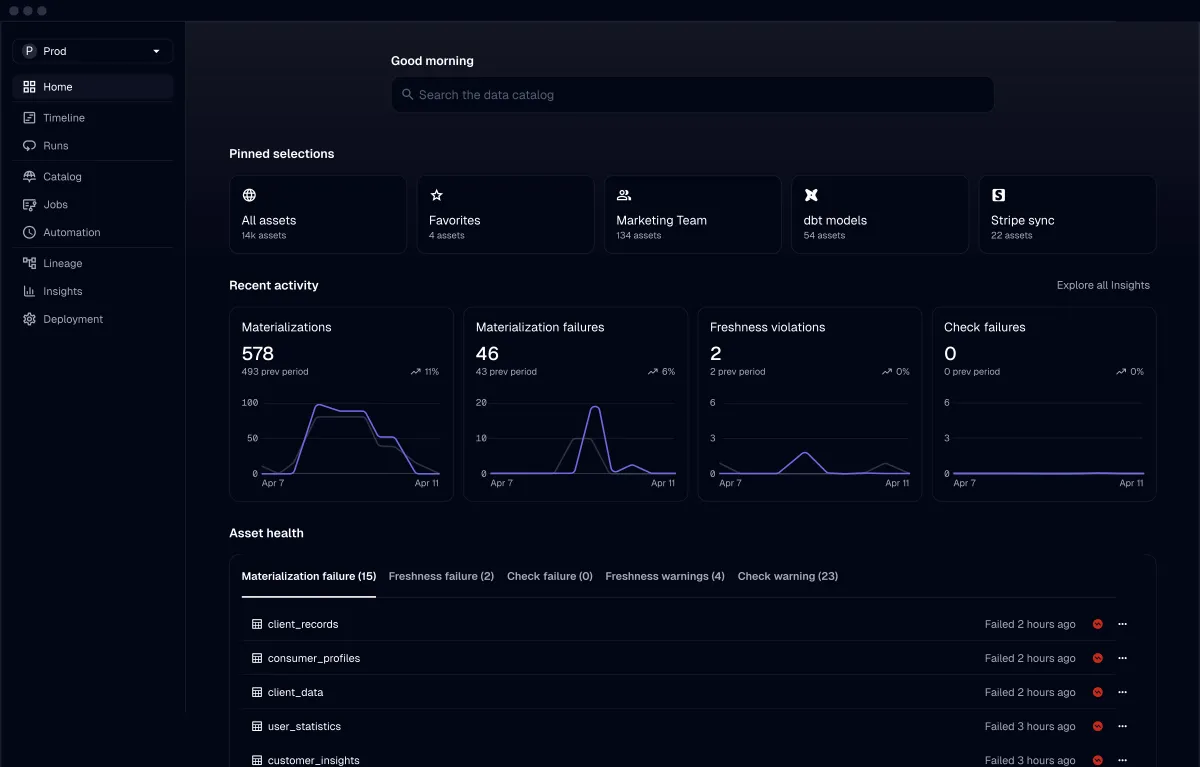
| Web UI | DAG-centric UI showing runs, task states, logs, and Gantt charts | Asset-centric UI with lineage graph, run timeline, health checks, and catalog |
| Testing Support | Limited built-in testing; requires mocking operators and connections | First-class unit testing with in-process execution and resource mocking |
| Data Management | ||
| Lineage | Dataset-aware scheduling introduced in 2.x; limited built-in lineage | Built-in asset lineage graphs with automatic dependency tracking and visualization |
| Observability | Basic task monitoring; requires external tools for data-level observability | Integrated asset health checks, freshness monitoring, and alerting dashboards |
| Partitioning | Manual partition handling through templated parameters and XCom | First-class partition definitions with automatic backfill and incremental materialization |
| dbt Integration | Community-maintained dbt operators for triggering dbt runs | Native dbt asset integration mapping dbt models directly to Dagster assets |
| Data Quality | Requires external tools like Great Expectations or dbt tests | Built-in asset checks and integration with Great Expectations as resources |
| Operations & Deployment | ||
| Self-hosted Deployment | Docker, Kubernetes (Helm chart), or standalone; well-documented mature options | Docker, Kubernetes, or single server; requires understanding of Dagster daemon and webserver |
| Managed Options | Astronomer (~$0.42/hr), Amazon MWAA, Google Cloud Composer | Dagster Cloud with Solo (~$10/mo), team, and enterprise tiers; hybrid deployment support |
| Integration Ecosystem | Hundreds of community providers covering virtually every cloud and SaaS service | Growing library with strong dbt, Snowflake, BigQuery, Fivetran, and Spark integrations |
| CI/CD Support | Git-based DAG deployment; CI/CD requires custom setup | Built-in branch deployments, code review workflows, and CI/CD patterns |
| License | Apache 2.0 - completely free with no restrictions | Apache 2.0 for open-source core; Dagster Cloud is a paid managed service |
Core Capabilities
Pipeline Model
Workflow Authoring
Scheduling
Web UI
Testing Support
Data Management
Lineage
Observability
Partitioning
dbt Integration
Data Quality
Operations & Deployment
Self-hosted Deployment
Managed Options
Integration Ecosystem
CI/CD Support
License
Which to choose
Dagster is the better choice for new projects where asset lineage, testing, and observability are priorities. Airflow remains the stronger choice for large-scale production environments with existing investments and teams that need the broadest integration ecosystem.
Best-fit scenarios
Choose Apache Airflow if:
We recommend Airflow for organizations with established data engineering teams of 5-20 people who need a proven, battle-tested orchestration platform. Airflow is the right choice when your workflows are primarily task-oriented (run this ETL job, then this, then that) rather than asset-oriented. If your team has existing Airflow expertise or you are hiring from a talent pool where Airflow experience is common, the productivity advantage of familiarity is significant. Airflow excels when you need integrations with a wide variety of systems. Its provider ecosystem covers hundreds of services, and community support means you can find answers to virtually any question on Stack Overflow or the Airflow Slack. Organizations running complex, heterogeneous workflows that go beyond data processing (infrastructure provisioning, ML model training, CI/CD triggers) will find Airflow's general-purpose task model more natural. Teams processing hundreds of terabytes daily with established Kubernetes-based deployments should stick with Airflow rather than migrating for marginal gains.
Choose Dagster if:
We recommend Dagster for teams of 3-15 data engineers and analytics engineers building new data platforms from scratch or replacing fragile legacy pipelines. Dagster is the superior choice when data asset lineage, freshness monitoring, and quality checks are top priorities. If your stack relies heavily on dbt, Snowflake, BigQuery, and modern data tools, Dagster's native integrations with these tools create a tighter development experience than Airflow's equivalent providers. Dagster is particularly well-suited for organizations that value software engineering practices for data. The emphasis on unit testing, local development, CI/CD workflows, and type-safe configurations means teams spend less time debugging production failures. ML engineering teams building feature pipelines, training workflows, and model deployment systems will appreciate the asset-centric model for tracking data dependencies and freshness. Smaller teams that want built-in observability without deploying additional monitoring tools will find Dagster's integrated catalog, health checks, and alerting more productive than assembling an equivalent stack on top of Airflow.
These scenarios reflect the available product evidence. Your requirements, existing stack, and team expertise should guide the final decision.
Frequently Asked Questions
Does Airflow cost money?
No. Apache Airflow is 100% free and open-source under the Apache 2.0 license. There is no subscription or license fee. Astronomer (Astro) is a separate commercial managed service, and cloud-managed options like Amazon MWAA have their own pricing, but Airflow itself is free.
Is Dagster a DAG-based tool like Airflow?
No. Dagster uses an asset-centric model where you define data assets and their dependencies, not task-based DAGs. While Dagster does support traditional op-based graphs (similar to tasks), the recommended approach is software-defined assets that focus on data outputs rather than execution steps.
Can I migrate from Airflow to Dagster?
Yes, but it requires rethinking your pipelines from task-centric to asset-centric. Dagster provides migration guides and can run Airflow DAGs during transition, but a full migration involves rewriting pipeline logic. We recommend migrating incrementally, starting with new pipelines on Dagster while maintaining existing Airflow DAGs.
Which has better dbt integration?
Dagster has significantly better native dbt integration. Dagster maps dbt models directly to software-defined assets, providing automatic lineage, freshness tracking, and materialization management. Airflow uses community-maintained operators that trigger dbt runs but lack the deep asset-level integration.