Decision comparison
Apache Airflow vs AWS Glue
Apache Airflow and AWS Glue serve fundamentally different roles in the data pipeline ecosystem. Airflow is a general-purpose workflow orchestrator that coordinates tasks across any system, while Glue is a serverless ETL service that handles both orchestration and data processing within AWS. Teams running complex multi-cloud or hybrid pipelines benefit from Airflow's flexibility, while teams deeply invested in AWS gain from Glue's zero-ops serverless model and built-in data processing capabilities.
Workload verdict
Choose Airflow for cross-system DAG orchestration; choose AWS Glue for managed AWS ETL
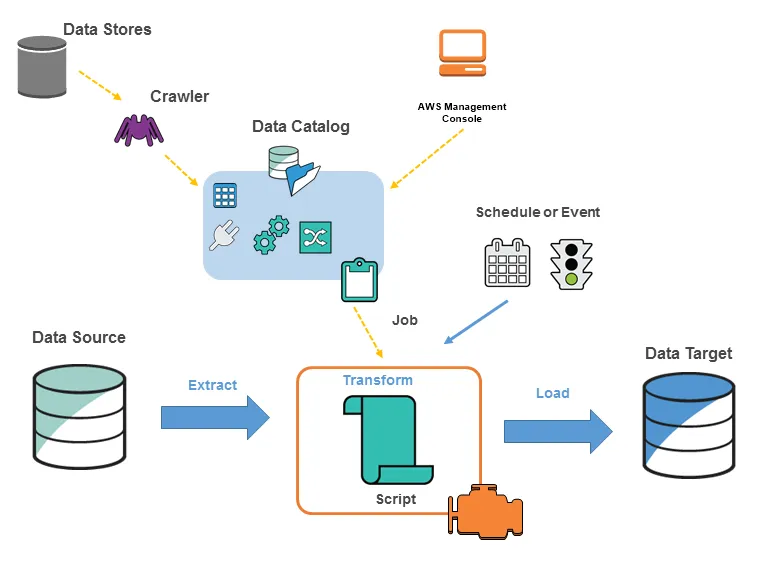
Apache Airflow coordinates workflows expressed as Python DAGs across many services and execution environments. AWS Glue is a managed, serverless data-integration service with ETL engines, a data catalog, crawlers, scheduling, and monitoring. Glue can orchestrate its own ETL jobs, while Airflow is the broader workflow control layer.
Pick Airflow when
workflows span clouds, databases, APIs, transformation tools, ML jobs, and custom Python-controlled tasks.
Pick AWS Glue when
the main need is serverless ETL, cataloging, schema discovery, and data preparation in an AWS-centered stack.
Use both when
Airflow coordinates an end-to-end pipeline and triggers Glue jobs for managed Spark-based transformation.
Architecture choice. These take different approaches to the same problem. Read the table as a fit question rather than a feature race.
These are different kinds of product — Workflow Orchestrator and ETL Platform.
Quick Comparison
| Decision factor | Apache Airflow | AWS Glue |
|---|---|---|
| Best For | Teams needing flexible, Python-native workflow orchestration across multi-cloud and on-premise environments with full DAG control | AWS-centric organizations wanting serverless ETL with automatic schema discovery, Data Catalog, and zero infrastructure management |
| Architecture | Self-managed modular system with scheduler, metadata DB, web server, and distributed workers via Celery or Kubernetes executors | Fully serverless AWS-managed service with Data Catalog, crawlers, Spark-based ETL engine, and auto-scaling workers |
| Pricing Model | Free and open-source under the Apache License 2.0 | Free tier covers the first million Data Catalog metadata objects stored and the first million requests per month. Paid usage is billed per DPU-hour rather than per GB scanned: Apache Spark ETL jobs, crawlers, interactive sessions, Iceberg table optimization, statistics generation and materialized-view refresh are each $0.44 per DPU-hour, billed per second with a one-minute minimum. Flex execution is $0.29 per DPU-hour. DataBrew interactive sessions are $1.00 per 30-minute session and DataBrew jobs $0.48 per node-hour. Data Catalog storage beyond a million objects is $1.00 per 100,000 objects per month. Rates are US East (N. Virginia) and vary by region. |
| Ease of Use | Steep learning curve requiring Python and DevOps expertise; powerful once mastered with comprehensive web UI for monitoring DAGs | Visual ETL editor in Glue Studio and DataBrew no-code interface; advanced use requires AWS ecosystem knowledge |
| Scalability | Scales via distributed executors like CeleryExecutor or KubernetesExecutor; requires manual capacity planning and infrastructure tuning | Auto-scales from gigabytes to petabytes with no infrastructure to manage; dynamically adds and removes workers based on workload |
| Community/Support | 46,000+ GitHub stars, active Apache Software Foundation community, 500+ committers, 58 reviews averaging 8.7/10 rating | AWS enterprise support tiers, integrated documentation; 42 reviews averaging 8.6/10 rating, 90% recommendation from 50 PeerSpot reviews |
Apache Airflow
- Best For:
- Teams needing flexible, Python-native workflow orchestration across multi-cloud and on-premise environments with full DAG control
- Architecture:
- Self-managed modular system with scheduler, metadata DB, web server, and distributed workers via Celery or Kubernetes executors
- Pricing Model:
- Free and open-source under the Apache License 2.0
- Ease of Use:
- Steep learning curve requiring Python and DevOps expertise; powerful once mastered with comprehensive web UI for monitoring DAGs
- Scalability:
- Scales via distributed executors like CeleryExecutor or KubernetesExecutor; requires manual capacity planning and infrastructure tuning
- Community/Support:
- 46,000+ GitHub stars, active Apache Software Foundation community, 500+ committers, 58 reviews averaging 8.7/10 rating
AWS Glue
- Best For:
- AWS-centric organizations wanting serverless ETL with automatic schema discovery, Data Catalog, and zero infrastructure management
- Architecture:
- Fully serverless AWS-managed service with Data Catalog, crawlers, Spark-based ETL engine, and auto-scaling workers
- Pricing Model:
- Free tier covers the first million Data Catalog metadata objects stored and the first million requests per month. Paid usage is billed per DPU-hour rather than per GB scanned: Apache Spark ETL jobs, crawlers, interactive sessions, Iceberg table optimization, statistics generation and materialized-view refresh are each $0.44 per DPU-hour, billed per second with a one-minute minimum. Flex execution is $0.29 per DPU-hour. DataBrew interactive sessions are $1.00 per 30-minute session and DataBrew jobs $0.48 per node-hour. Data Catalog storage beyond a million objects is $1.00 per 100,000 objects per month. Rates are US East (N. Virginia) and vary by region.
- Ease of Use:
- Visual ETL editor in Glue Studio and DataBrew no-code interface; advanced use requires AWS ecosystem knowledge
- Scalability:
- Auto-scales from gigabytes to petabytes with no infrastructure to manage; dynamically adds and removes workers based on workload
- Community/Support:
- AWS enterprise support tiers, integrated documentation; 42 reviews averaging 8.6/10 rating, 90% recommendation from 50 PeerSpot reviews
Public signals
Verified factual signals only. Bars appear only for like-for-like metrics with five weekly assessments for every tool; missing evidence stays explicit. These signals do not establish enterprise adoption, product quality, or total cost.
| Metric | Apache Airflow | AWS Glue |
|---|---|---|
| Docker Hub pulls(Product adoption) | 1.6B | Not available |
| GitHub commits, 90d(Product adoption) | 2.0k | Not available |
| GitHub stars(Product adoption) | 46,000+ | Not available |
| Search interest(Market interest) | 2 | 1 |
| Hacker News mentions, 90d(Community interest) | 1 | 0 |
| PyPI weekly downloads(Product adoption) | 1.8M | Not available |
| Stack Overflow questions(Community interest) | 10.6k | 4.2k |
| npm weekly downloads(Developer adoption) | Not available | 295.0k |
| PyPI weekly downloads(Developer adoption) | Not available | 12.9k |
As of September 21, 2026 — updated weekly.
Health & risk evidence
Observed public-source checks for mapped package versions and repositories.
Apache Airflow
September 21, 2026Package vulnerabilities
PyPI · apache-airflow@3.3.2
0 vulnerabilities
across 1 package
Repository security score
github.com/apache/airflow
7.3/10
AWS Glue
Package vulnerabilities
npm · @aws-sdk/client-glue@3.1136.0 · PyPI · aws-glue-sessions@1.0.9
0 vulnerabilities
across 2 packages
Repository security score
Not available
Interface Preview
Apache Airflow
AWS Glue
Feature Comparison
| Feature | Apache Airflow | AWS Glue |
|---|---|---|
| Data Integration & ETL | ||
| ETL Pipeline Authoring | Python DAGs with operators for any system; code-first with Jinja templating and dynamic pipeline generation | Visual drag-and-drop ETL editor in Glue Studio plus Spark-based code jobs with Python and Scala support |
| Data Source Connectivity | Hundreds of pre-built operators for GCP, AWS, Azure, databases, and third-party services via provider packages | 100+ native connectors focused on AWS services like S3, Redshift, RDS, DynamoDB, and Kinesis with crawlers |
| Schema Management | Manual schema handling through custom Python logic within DAG tasks; no built-in schema registry | Automatic schema discovery via crawlers plus Schema Registry for streaming data with Avro compatibility checks |
| Workflow Orchestration | ||
| Scheduling Capabilities | Cron-based scheduling with catchup runs, backfill support, and data-driven scheduling in Airflow 3.x | Time-based triggers, event-based triggers, and conditional triggers with EventBridge integration for scheduling |
| Dependency Management | Full DAG-based dependency graphs with branching via BranchPythonOperator, dynamic task mapping, and XComs | Job-level dependencies with workflow orchestration, predicate conditions, and CloudWatch-based monitoring |
| Error Handling & Retries | Configurable per-task retries, SLA monitoring, email alerting, and ability to clear and rerun failed tasks | Automatic job retries with error logging to CloudWatch; GenAI-powered troubleshooting for root cause analysis |
| Data Processing & Transformation | ||
| Processing Engine | Orchestrator only; delegates processing to external engines like Spark, Databricks, or custom Python scripts | Built-in Apache Spark engine with serverless execution; also supports Ray for Python-native distributed processing |
| No-Code Data Preparation | Requires Python coding for all transformations; no visual data preparation interface available natively | DataBrew provides point-and-click visual interface with 250+ built-in transformations for data normalization |
| ML-Powered Data Quality | Integrates with external tools like Great Expectations for data validation; no built-in ML data quality | FindMatches ML deduplication, sensitive data detection with PII masking, and Data Quality rulesets built in |
| Infrastructure & Operations | ||
| Infrastructure Management | Self-managed deployment requiring metadata DB, scheduler, and workers; managed via Astronomer or MWAA | Fully serverless with zero infrastructure provisioning; AWS handles compute allocation, scaling, and maintenance |
| Monitoring & Observability | Rich web UI showing DAG status, task logs, Gantt charts, and execution timelines with historical run data | CloudWatch integration for logs and metrics; Glue Studio visual monitoring with job run insights and Spark UI |
| Development Environment | Local development with any IDE; unit testing via pytest; version control with standard Git workflows | Interactive Sessions with Jupyter notebooks in Glue Studio; built-in Git integration for version control |
| Extensibility & Ecosystem | ||
| Plugin Architecture | Custom operators, sensors, and hooks in Python; thousands of community-contributed provider packages on PyPI | Custom visual transforms for reusable Spark logic; extensible via Lambda functions and Step Functions |
| Cloud & Platform Support | Cloud-agnostic with operators for AWS, GCP, Azure, and on-premise systems; runs anywhere Python runs | AWS-exclusive; deep integration with S3, Redshift, Athena, SageMaker, Lake Formation, and 100+ AWS services |
| AI & GenAI Capabilities | Orchestrates ML pipelines end-to-end including data prep, training, and deployment; integrates with MLflow | Built-in GenAI for ETL code generation, Spark job modernization, and AI-assisted debugging troubleshooting |
Data Integration & ETL
ETL Pipeline Authoring
Data Source Connectivity
Schema Management
Workflow Orchestration
Scheduling Capabilities
Dependency Management
Error Handling & Retries
Data Processing & Transformation
Processing Engine
No-Code Data Preparation
ML-Powered Data Quality
Infrastructure & Operations
Infrastructure Management
Monitoring & Observability
Development Environment
Extensibility & Ecosystem
Plugin Architecture
Cloud & Platform Support
AI & GenAI Capabilities
Which approach fits
Apache Airflow and AWS Glue serve fundamentally different roles in the data pipeline ecosystem. Airflow is a general-purpose workflow orchestrator that coordinates tasks across any system, while Glue is a serverless ETL service that handles both orchestration and data processing within AWS. Teams running complex multi-cloud or hybrid pipelines benefit from Airflow's flexibility, while teams deeply invested in AWS gain from Glue's zero-ops serverless model and built-in data processing capabilities.
When each approach fits
Choose Apache Airflow if:
We recommend Apache Airflow for data engineering teams that need a cloud-agnostic orchestration platform with maximum flexibility. Airflow is the stronger choice when your data pipelines span multiple clouds, on-premise systems, or diverse third-party services. Its Python-native DAG authoring, 46,000+ GitHub stars community, and extensive operator library make it the de-facto standard for complex workflow management. Choose Airflow when you have DevOps capacity to manage infrastructure, need fine-grained control over task dependencies and scheduling, or require orchestration that extends beyond ETL into ML pipelines, infrastructure management, and operational workflows.
Choose AWS Glue if:
We recommend AWS Glue for organizations that are heavily invested in the AWS ecosystem and want to minimize operational overhead. Glue eliminates infrastructure management entirely with its serverless architecture, automatic schema discovery, and built-in Spark processing engine. At $0.44 per DPU-hour, it offers predictable usage-based pricing without upfront commitments. Choose Glue when your data sources and destinations live primarily in AWS, when you need visual ETL authoring for less technical team members via DataBrew, or when you want built-in ML features like FindMatches deduplication and sensitive data detection without integrating external tools.
These scenarios reflect the available product evidence. Your requirements, existing stack, and team expertise should guide the final decision.
Frequently Asked Questions
Can Apache Airflow and AWS Glue be used together?
Airflow and Glue work exceptionally well together, and AWS even provides Amazon Managed Workflows for Apache Airflow (MWAA) as a managed Airflow service. In this pattern, Airflow serves as the orchestration layer, triggering and monitoring AWS Glue ETL jobs as part of broader data pipelines. You define your workflow dependencies, scheduling logic, and cross-service coordination in Airflow DAGs, while Glue handles the heavy data processing with its serverless Spark engine. This combination gives you Airflow's superior orchestration capabilities with Glue's serverless processing power, avoiding the need to manage Spark clusters yourself.
What are the true infrastructure costs of running Apache Airflow vs AWS Glue?
Apache Airflow itself is free and open-source, but self-hosting requires provisioning a metadata database (PostgreSQL or MySQL), web server, scheduler, and worker nodes. Typical cloud infrastructure costs range from $200-$2,000+ per month depending on workload scale. Managed options like Astronomer or MWAA add per-environment fees. AWS Glue charges $0.44 per DPU-hour for Spark ETL jobs, with a 15-minute job using 6 DPUs costing approximately $0.66. The Data Catalog is free for the first million objects stored and first million accesses. For teams processing moderate data volumes, Glue's pay-per-use model often costs less than maintaining dedicated Airflow infrastructure.
Which tool is better for teams without strong Python expertise?
AWS Glue is significantly more accessible for teams without deep Python skills. Glue Studio offers a visual drag-and-drop ETL editor that generates code automatically, and DataBrew provides a point-and-click interface with 250+ built-in transformations for data cleaning without any coding. Glue also supports Scala alongside Python for ETL jobs. Apache Airflow, by contrast, requires Python proficiency for everything from DAG authoring to custom operator development. Airflow follows a code-first philosophy where every workflow is defined as a Python script. Teams new to Python face a steep learning curve with Airflow's DAG concepts, operator model, and configuration system.
How do Apache Airflow and AWS Glue handle real-time or streaming data?
Neither tool is built primarily for real-time streaming, but both offer mechanisms to handle near-real-time workloads. Airflow is designed for batch orchestration and processes data on schedule-based or trigger-based intervals. It integrates with streaming platforms like Apache Kafka or Spark Streaming but does not process streams directly. AWS Glue supports streaming ETL jobs that can continuously process data from Amazon Kinesis Data Streams and Apache Kafka, running micro-batch transformations on incoming data. Glue's Schema Registry also validates and enforces schemas on streaming data with Avro compatibility checks. For organizations needing some streaming capability alongside batch ETL, Glue provides a more integrated solution.