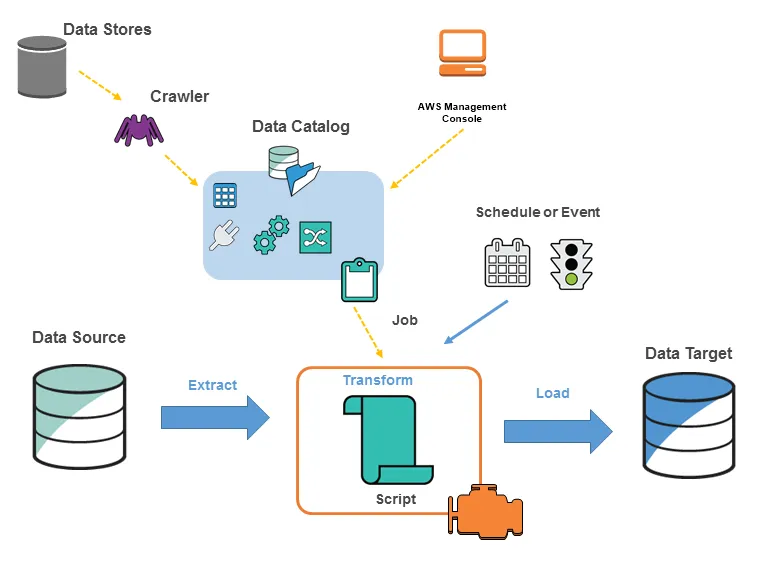
AWS Glue: product and architecture
Our verdict in this AWS Glue review: AWS Glue is a strong choice for AWS-centered data teams that need managed cataloging and Spark-oriented ETL without operating pipeline infrastructure themselves. Its serverless model, AWS Glue Data Catalog, and connectivity to more than 100 data sources make it practical for teams already moving data through AWS. The trade-off is real: Glue is weak for teams needing multi-cloud portability, rapid interactive iteration, or a low-code experience for non-developers.
Overview
AWS Glue is a managed, serverless data integration service for discovering, preparing, integrating, and modernizing ETL workloads. Users point Glue at data stored on AWS; Glue discovers the data and stores metadata such as table definitions and schemas in the AWS Glue Data Catalog. Once cataloged, the data becomes searchable, queryable, and available for ETL work.
The product is positioned around AWS-native data preparation rather than a broadly portable integration layer. AWS says Glue can discover and connect to more than 100 diverse data sources, manage metadata centrally, and visually create, run, and monitor pipelines that load data into data lakes, data warehouses, and lakehouses. That scope is useful, but it also explains why Glue is most compelling when AWS is already the center of the architecture.
AWS Glue is accessible in the next generation of Amazon SageMaker and includes built-in generative AI capabilities for modernizing Apache Spark jobs and accelerating development. In practical terms, the platform combines data discovery, metadata management, transformation jobs, and pipeline operations in one AWS service. That reduces the number of systems an AWS team must operate, but it also concentrates workflow and operational knowledge inside the AWS ecosystem.
User sentiment is generally positive but not unqualified. One review dataset gives AWS Glue an 8.6/10 rating from 42 reviews, while another records 3.9 out of 5 from 50 reviews and says 90% of respondents would recommend it. Those are useful adoption signals, not proof that Glue fits every enterprise environment. We recommend AWS Glue for technically capable teams with an AWS-first data platform; organizations prioritizing cloud neutrality should evaluate more portable tools first.
Key Features and Architecture
AWS Glue’s architectural center is the AWS Glue Data Catalog. Glue discovers data and persists associated metadata, including table definitions and schemas, in this centralized catalog. This gives data engineers a shared metadata layer rather than forcing every ETL job to independently rediscover datasets, although the resulting governance model remains anchored to AWS.
Key capabilities include:
-
Data discovery and cataloging: Glue can inspect AWS-stored data, identify metadata, and register it in the AWS Glue Data Catalog. The official pricing text states that the first 1 million objects stored and first 1 million catalog accesses are free, which makes initial catalog adoption less costly but does not remove the need to control catalog growth and access patterns.
-
ETL jobs: Teams can create and run ETL jobs in the AWS Management Console. AWS describes Glue as a service for preparing and loading data for analytics, with jobs that process and load data. The technical benefit is managed execution; the cost is that job design, debugging, and operational behavior are shaped by Glue’s AWS runtime rather than an environment the team fully controls.
-
Crawlers: Glue crawlers discover data and metadata. AWS bills crawlers at an hourly rate by the second, so discovery is not merely a setup action—it is an operational activity with usage implications. Crawlers are valuable when schemas evolve, but teams should schedule them deliberately instead of treating repeated discovery as free background automation.
-
Visual pipeline development and monitoring: AWS says users can visually create, run, and monitor data pipelines. This can help teams standardize operational workflows, particularly where pipeline visibility matters to analysts and leaders. It should not be mistaken for a complete replacement for engineering discipline: users still report that Glue favors developers over non-developers.
-
Apache Spark modernization: Glue includes generative AI capabilities intended to help modernize Apache Spark jobs. This is relevant to teams with older Spark code that want AWS-managed execution and a modernization path. The available data does not provide a quality, accuracy, or productivity benchmark for these capabilities, so buyers should validate them with representative jobs rather than assume they reduce migration effort.
-
Schema handling and transformation support: External user feedback highlights automatic schema detection, schema-updating capabilities, incremental data updates, and code generation. Reviews also identify compatibility with Python and Scala as a benefit for data tasks. At the same time, users specifically note that current language support is limited to Python and Scala and request Java support, making Glue a poor fit when Java customization is a firm requirement.
-
AWS service integration: Users specifically value Glue’s integration with AWS services such as Amazon S3, as well as Jupyter Notebook compatibility. That integration is central to Glue’s appeal: cataloging, transformation, and AWS data storage can remain closely connected. It is also the source of the product’s platform-exclusivity concern, because a tightly AWS-aligned workflow is more difficult to treat as cloud-neutral.
AWS Glue also has a public GitHub repository described as “The CloudFormation Resource Provider Package For AWS Glue.” It has 4 stars and was last pushed on August 27, 2025. Those figures are public activity signals for that repository, not a measure of AWS Glue’s enterprise adoption or product maturity.
Ideal Use Cases
AWS Glue fits best when the team’s data estate, operational model, and delivery expectations are already AWS-oriented. A data engineering group of roughly 3 to 10 engineers managing an AWS data lake can use Glue to centralize metadata in the AWS Glue Data Catalog and run ETL jobs without standing up its own ETL execution infrastructure. This is especially suitable when Amazon S3 is a meaningful part of the data flow and the team needs cataloged datasets to be searchable and queryable.
A second strong scenario is an analytics organization consolidating data preparation for a data lake, warehouse, or lakehouse on AWS. Glue’s ability to discover data, manage schemas and table definitions, and create monitored pipelines is useful when analysts depend on consistent metadata rather than one-off extracts. The service is particularly defensible when a team needs to connect to many sources—AWS advertises more than 100 diverse data sources—but still wants a single AWS-managed control point.
A third use case is an established Spark team modernizing existing transformation work. Glue’s Apache Spark modernization capabilities, code generation, Python and Scala support, and managed ETL execution can reduce infrastructure-management work for a team that already understands data engineering. This is not the same as making Spark simple: the platform still demands enough technical skill to diagnose jobs, model transformations, and manage schedules.
We also see a fit for organizations with regular metadata-discovery needs, such as data platforms ingesting new or changing datasets into AWS-managed storage. Crawlers and schema detection can reduce manual catalog maintenance. However, teams should account for the operational cost of repeated discovery and define ownership for schema changes, rather than letting crawlers create unmanaged metadata sprawl.
Do not use AWS Glue if your primary requirement is multi-cloud capability or portability across cloud platforms. User feedback directly identifies a lack of multi-cloud capability and platform exclusivity as limitations. Avoid it as the default choice for a business-led team with many non-developers, because reviewers flag non-developer usability and development tools as weaknesses; a visually managed service does not remove the need for engineering expertise.
Strengths & Trade-offs
AWS Glue’s strongest value is concentrated in AWS-native engineering workflows. Its user feedback shows solid satisfaction—8.6/10 across 42 reviews—and another review source reports that 90% of surveyed users would recommend it. Still, these positive scores coexist with meaningful platform and usability limitations.
Pros
-
Centralized metadata management through the AWS Glue Data Catalog. Glue discovers data and stores schemas and table definitions in a shared catalog, reducing repeated metadata work across ETL workflows. Reviewers specifically praise the data catalog and schema-updating capabilities.
-
Strong AWS alignment, especially with Amazon S3. Users call out Glue’s integration with AWS services such as S3 as a major strength. For an AWS data platform, this reduces integration friction between stored data, cataloged metadata, and ETL execution.
-
Managed serverless execution for Spark-oriented processing. Review feedback credits the serverless architecture with scalable, cost-effective data processing. The benefit is reduced infrastructure operation; the trade-off is usage-based spend that needs active monitoring.
-
Useful pipeline automation primitives. Triggers are highlighted as one of Glue’s better features, supporting scheduling and more structured pipeline operation. This is valuable for repeatable data movement where teams need a managed execution cadence.
-
Developer-friendly paths for Python and Scala users. Reviews identify code generation and support for common languages such as Python as practical strengths. For teams already fluent in those languages, Glue can be easier to adopt than a proprietary transformation environment.
-
Broad source-connectivity claim. AWS states that Glue can discover and connect to more than 100 diverse data sources. That breadth is useful for AWS-based integration programs, though teams should still validate each required source in a proof of concept.
Cons
-
Job startup time is a material operational limitation. Users report startup times of five to eight minutes and say one to two minutes would be preferable. This makes Glue weak for highly interactive development loops or workloads where short processing tasks must start immediately.
-
AWS platform exclusivity limits architectural flexibility. Reviewers identify the lack of multi-cloud capability as a direct drawback. If data workloads must operate consistently across clouds, Glue’s native AWS orientation becomes a strategic constraint rather than a convenience.
-
The service favors developers over non-developers. User feedback specifically lists non-developers and development tools among weaknesses. Visual pipeline capabilities help, but they do not turn Glue into a broadly accessible business-user integration product.
-
Language support is limited to Python and Scala in the supplied review data. Users request Java support for additional customization. Teams with established Java-based transformation standards should not assume a clean fit.
-
Cost perception is mixed. Although serverless execution can optimize spend for Spark jobs, reviewers also call Glue expensive. This is a common consequence of usage billing: the platform can be efficient, but inefficient scans, overly frequent crawls, or poorly controlled jobs can undermine the cost case.