Decision comparison
Azure Data Factory vs AWS Glue
Both Azure Data Factory and AWS Glue are powerful serverless data integration platforms, but each excels within its respective cloud ecosystem. The right choice depends primarily on your existing cloud infrastructure, team expertise, and specific integration requirements rather than raw feature superiority.
Architecture choice. These take different approaches to the same problem. Read the table as a fit question rather than a feature race.
Applies to: Serverless ETL and ELT pipelines inside one hyperscaler's data estate.
All 2 are ETL platforms.
Quick Comparison
| Decision factor | Azure Data Factory | AWS Glue |
|---|---|---|
| Ease of Use | Visual drag-and-drop pipeline designer with 100+ pre-built connectors requires minimal coding for common ETL workflows | Code-centric approach using PySpark or Scala with optional visual ETL editor in Glue Studio for simpler workflows |
| Data Integration | Over 100 built-in native connectors supporting Azure, AWS, GCP, and on-premises sources through self-hosted integration runtime | Deep native integration with AWS ecosystem services including S3, Redshift, RDS, and Kinesis plus JDBC connectivity to external sources |
| Pricing Model | Data pipeline orchestration: $1/1000 activity runs. Data movement: $0.25/DIU-hour. Data flow execution: $0.268/vCore-hour. SSIS integration runtime: $0.84/node/hour. Self-hosted IR: free for up to 5 nodes. | Free tier covers the first million Data Catalog metadata objects stored and the first million requests per month. Paid usage is billed per DPU-hour rather than per GB scanned: Apache Spark ETL jobs, crawlers, interactive sessions, Iceberg table optimization, statistics generation and materialized-view refresh are each $0.44 per DPU-hour, billed per second with a one-minute minimum. Flex execution is $0.29 per DPU-hour. DataBrew interactive sessions are $1.00 per 30-minute session and DataBrew jobs $0.48 per node-hour. Data Catalog storage beyond a million objects is $1.00 per 100,000 objects per month. Rates are US East (N. Virginia) and vary by region. |
| Scalability | Scales through configurable Data Integration Units and Azure Integration Runtime with manual or auto-scaling data flow clusters | Fully serverless auto-scaling adjusts DPU allocation dynamically based on workload demands without manual configuration required |
| Data Transformation | Mapping Data Flows provide visual Spark-based transformations; also supports SSIS package execution at a per-node hourly rate | Native Apache Spark and Python Shell jobs with DataBrew visual transforms, FindMatches ML deduplication, and Ray integration |
| Monitoring & Governance | Built-in monitoring hub with Azure Monitor integration, alerts, diagnostic logs, and lineage tracking through Microsoft Purview | CloudWatch integration for logging and alerts, Data Catalog for centralized metadata management, and Data Quality rule-based validation |
Azure Data Factory
- Ease of Use:
- Visual drag-and-drop pipeline designer with 100+ pre-built connectors requires minimal coding for common ETL workflows
- Data Integration:
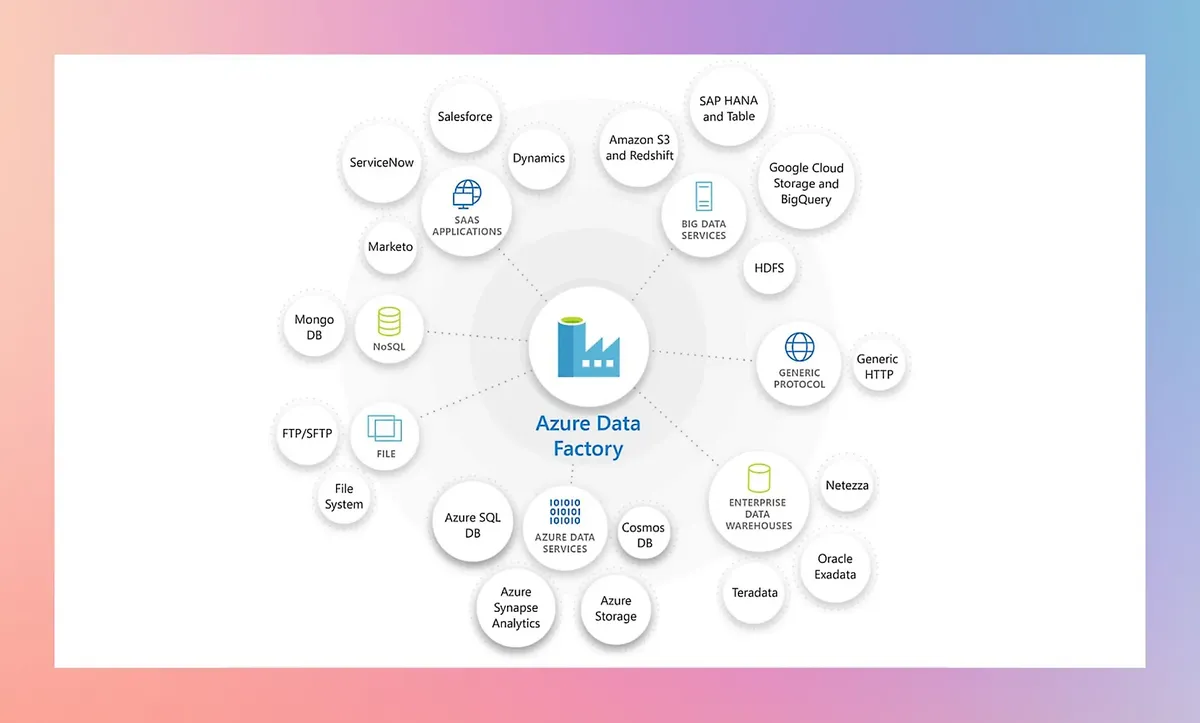
- Over 100 built-in native connectors supporting Azure, AWS, GCP, and on-premises sources through self-hosted integration runtime
- Pricing Model:
- Data pipeline orchestration: $1/1000 activity runs. Data movement: $0.25/DIU-hour. Data flow execution: $0.268/vCore-hour. SSIS integration runtime: $0.84/node/hour. Self-hosted IR: free for up to 5 nodes.
- Scalability:
- Scales through configurable Data Integration Units and Azure Integration Runtime with manual or auto-scaling data flow clusters
- Data Transformation:
- Mapping Data Flows provide visual Spark-based transformations; also supports SSIS package execution at a per-node hourly rate
- Monitoring & Governance:
- Built-in monitoring hub with Azure Monitor integration, alerts, diagnostic logs, and lineage tracking through Microsoft Purview
AWS Glue
- Ease of Use:
- Code-centric approach using PySpark or Scala with optional visual ETL editor in Glue Studio for simpler workflows
- Data Integration:
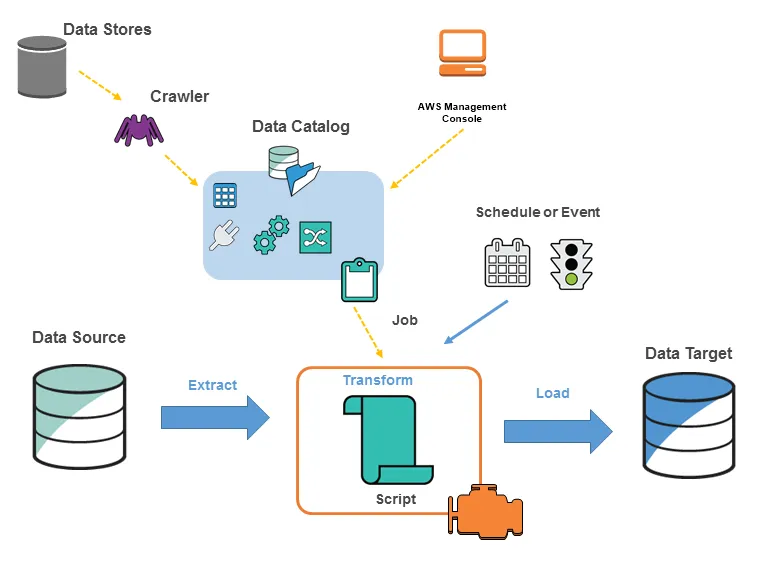
- Deep native integration with AWS ecosystem services including S3, Redshift, RDS, and Kinesis plus JDBC connectivity to external sources
- Pricing Model:
- Free tier covers the first million Data Catalog metadata objects stored and the first million requests per month. Paid usage is billed per DPU-hour rather than per GB scanned: Apache Spark ETL jobs, crawlers, interactive sessions, Iceberg table optimization, statistics generation and materialized-view refresh are each $0.44 per DPU-hour, billed per second with a one-minute minimum. Flex execution is $0.29 per DPU-hour. DataBrew interactive sessions are $1.00 per 30-minute session and DataBrew jobs $0.48 per node-hour. Data Catalog storage beyond a million objects is $1.00 per 100,000 objects per month. Rates are US East (N. Virginia) and vary by region.
- Scalability:
- Fully serverless auto-scaling adjusts DPU allocation dynamically based on workload demands without manual configuration required
- Data Transformation:
- Native Apache Spark and Python Shell jobs with DataBrew visual transforms, FindMatches ML deduplication, and Ray integration
- Monitoring & Governance:
- CloudWatch integration for logging and alerts, Data Catalog for centralized metadata management, and Data Quality rule-based validation
Public signals
Verified factual signals only. Bars appear only for like-for-like metrics with five weekly assessments for every tool; missing evidence stays explicit. These signals do not establish enterprise adoption, product quality, or total cost.
| Metric | Azure Data Factory | AWS Glue |
|---|---|---|
| Search interest(Market interest) | 1 | 1 |
| Hacker News mentions, 90d(Community interest) | 0 | 0 |
| npm weekly downloads(Developer adoption) | 9.0k | 323.1k |
| PyPI weekly downloads(Developer adoption) | 1.5M | 12.9k |
| Stack Overflow questions(Community interest) | 9.8k | 4.2k |
As of September 14, 2026 — updated weekly.
Health & risk evidence
Observed public-source checks for mapped package versions and repositories.
Azure Data Factory
September 14, 2026Package vulnerabilities
npm · @azure/arm-datafactory@20.0.0 · PyPI · azure-mgmt-datafactory@10.0.0
0 vulnerabilities
across 2 packages
Repository security score
Not available
AWS Glue
September 14, 2026Package vulnerabilities
npm · @aws-sdk/client-glue@3.1131.0 · PyPI · aws-glue-sessions@1.0.9
0 vulnerabilities
across 2 packages
Repository security score
Not available
Interface Preview
Azure Data Factory
AWS Glue
Feature Comparison
| Feature | Azure Data Factory | AWS Glue |
|---|---|---|
| Pipeline Orchestration | ||
| Visual Pipeline Designer | Drag-and-drop canvas with 90+ activities including ForEach, If, Switch, and Lookup for complex pipeline logic | Glue Studio visual editor for building DAG-based ETL jobs with drag-and-drop nodes and automatic code generation |
| Scheduling & Triggers | Schedule, tumbling window, event-based, and manual triggers with dependency chaining across pipelines | Cron-based scheduling, event-driven triggers via EventBridge, and workflow orchestration with conditional job dependencies |
| CI/CD Integration | Native Git integration with Azure DevOps and GitHub for version control, ARM template deployment across environments | Git integration with GitHub and AWS CodeCommit, deployable through Jenkins and AWS CodeDeploy automation tools |
| Data Processing | ||
| Batch Processing | Copy Activity moves data at scale with parallel DIU allocation; Mapping Data Flows run Spark clusters for batch transforms | Apache Spark ETL jobs process batch data with configurable DPU allocation and Flex execution class for cost savings |
| Streaming Support | Mapping Data Flows support streaming sources with tumbling window patterns for near-real-time micro-batch processing | Streaming ETL jobs consume data continuously from Kinesis and Kafka with micro-batch processing and checkpointing |
| Code-Based Development | Custom activities via Azure Batch, Azure Functions integration, and stored procedure execution for programmatic control | Interactive Sessions with Jupyter notebooks, PySpark and Scala script editing, plus Ray integration for Python-native scaling |
| Data Cataloging & Discovery | ||
| Metadata Management | Integrates with Microsoft Purview for unified data catalog, lineage tracking, and data classification across the estate | Built-in Data Catalog stores table definitions, schemas, and partition info; serves as central Hive metastore for Athena and EMR |
| Schema Discovery | Automatic schema detection during Copy Activity with schema drift handling and mapping in data flows | Crawlers automatically discover schemas from S3, JDBC, and DynamoDB sources with configurable classification and scheduling |
| Data Quality | Data flow validation rules and preview capabilities with Purview integration for broader data governance workflows | Native Data Quality rules engine evaluates datasets against custom rules with automated alerting and scoring metrics |
| Security & Compliance | ||
| Encryption | Data encrypted at rest with Azure-managed or customer-managed keys via Azure Key Vault; TLS 1.2 in transit | Server-side encryption for Data Catalog and job bookmarks using AWS KMS keys; TLS encryption for all data in transit |
| Access Control | Azure RBAC with custom roles, managed identities for secure service-to-service authentication without stored credentials | IAM policies with fine-grained resource-level permissions, Lake Formation integration for column-level table access control |
| Network Security | Managed Virtual Network with private endpoints, self-hosted IR for on-premises connectivity behind corporate firewalls | VPC connectivity with security groups, Glue connection objects for JDBC sources within private subnets and VPN tunnels |
| Ecosystem & Extensibility | ||
| Cloud Ecosystem | Tight integration with Azure Synapse, Databricks, Azure SQL, Blob Storage, and the broader Microsoft data platform | Deep integration with S3, Redshift, Athena, EMR, SageMaker, and Lake Formation across the AWS analytics stack |
| Hybrid Connectivity | Self-hosted Integration Runtime enables secure data movement from on-premises SQL Server, Oracle, SAP, and file systems | JDBC connections to on-premises databases through VPN or Direct Connect; no equivalent to a self-hosted agent runtime |
| API & SDK Support | REST APIs, PowerShell, .NET SDK, Python SDK, and Azure CLI for programmatic pipeline management and automation | AWS SDK support across Python (Boto3), Java, .NET, and CLI; CloudFormation and CDK for infrastructure-as-code deployments |
Pipeline Orchestration
Visual Pipeline Designer
Scheduling & Triggers
CI/CD Integration
Data Processing
Batch Processing
Streaming Support
Code-Based Development
Data Cataloging & Discovery
Metadata Management
Schema Discovery
Data Quality
Security & Compliance
Encryption
Access Control
Network Security
Ecosystem & Extensibility
Cloud Ecosystem
Hybrid Connectivity
API & SDK Support
Which approach fits
Both Azure Data Factory and AWS Glue are powerful serverless data integration platforms, but each excels within its respective cloud ecosystem. The right choice depends primarily on your existing cloud infrastructure, team expertise, and specific integration requirements rather than raw feature superiority.
When each approach fits
Choose Azure Data Factory if:
Choose Azure Data Factory if your organization operates primarily within the Microsoft Azure ecosystem or requires hybrid cloud connectivity through the self-hosted Integration Runtime. ADF excels for teams that prefer visual, low-code pipeline development with its drag-and-drop designer and 100+ built-in connectors. It is also the stronger choice for enterprises migrating existing SSIS packages to the cloud, as it provides dedicated SSIS Integration Runtime support. Organizations that need tight integration with Microsoft Purview for data governance and lineage tracking will find ADF offers a more unified experience across the Azure data platform.
Choose AWS Glue if:
Choose AWS Glue if your data infrastructure is built on AWS services like S3, Redshift, and Athena. Glue's built-in Data Catalog serves as a centralized metadata store that other AWS analytics services consume natively, creating a seamless analytics workflow. It is particularly well-suited for teams with strong Apache Spark or Python skills who prefer code-first ETL development with Interactive Sessions and notebook support. AWS Glue also provides unique capabilities like FindMatches ML-based deduplication, DataBrew for no-code data preparation, and the Flex execution class that can reduce costs by up to 34% for non-time-sensitive workloads.
These scenarios reflect the available product evidence. Your requirements, existing stack, and team expertise should guide the final decision.
Frequently Asked Questions
How does Azure Data Factory pricing compare to AWS Glue for a typical ETL workload?
Azure Data Factory charges $1.00 per 1,000 activity runs for orchestration, with separate per-DIU-hour rates for data movement and per-vCore-hour rates for Mapping Data Flows. AWS Glue charges $0.44 per DPU-hour for standard Spark ETL jobs, with the Flex execution class available at approximately $0.29 per DPU-hour for non-urgent workloads. For a mid-size workload running 6 DPUs for 15 minutes, AWS Glue costs roughly $0.66 per run. ADF pricing varies more by component since each activity type has its own rate structure. Both platforms scale costs linearly with usage, and neither charges when pipelines are idle. The total cost difference depends heavily on job complexity, data volume, and execution frequency rather than the base pricing alone.
Can Azure Data Factory and AWS Glue handle real-time streaming data?
Both platforms support near-real-time data processing through micro-batch patterns rather than true row-by-row streaming. Azure Data Factory handles streaming through Mapping Data Flows with tumbling window triggers that process incoming data in configurable time intervals, integrating with Azure Event Hubs and IoT Hub as streaming sources. AWS Glue offers dedicated streaming ETL jobs that consume data continuously from Amazon Kinesis Data Streams and Apache Kafka topics with configurable checkpoint intervals. For true sub-second latency requirements, both providers recommend their dedicated streaming services instead, such as Azure Stream Analytics or Amazon Kinesis Data Analytics. AWS Glue streaming jobs cost the standard $0.44 per DPU-hour while running continuously, making long-running streaming workloads a significant cost consideration.
Which platform offers better data cataloging and metadata management capabilities?
AWS Glue has a significant built-in advantage with its native Data Catalog, which stores table definitions, schemas, and partition information at no cost for the first million objects stored and first million accesses per month. The Data Catalog serves as a central Hive-compatible metastore that Amazon Athena, EMR, and Redshift Spectrum can query directly. Azure Data Factory relies on Microsoft Purview (a separate service with its own capacity-based pricing) for comprehensive data cataloging, classification, and lineage tracking. Purview provides broader governance features including sensitivity labeling and data estate scanning across multi-cloud environments, but requires a separate deployment and additional costs. For teams needing an integrated catalog without extra setup, AWS Glue's built-in approach is more convenient and cost-effective.
How do Azure Data Factory and AWS Glue handle hybrid and multi-cloud data integration?
Azure Data Factory offers stronger hybrid connectivity through its self-hosted Integration Runtime, a lightweight agent that installs on-premises or on any VM to securely move data from behind corporate firewalls without opening inbound ports. The self-hosted IR is free for up to 5 nodes and supports sources like SQL Server, Oracle, SAP HANA, and local file systems. AWS Glue connects to on-premises data sources through AWS Direct Connect or VPN tunnels using JDBC connection objects, which requires networking infrastructure setup rather than a simple agent installation. For multi-cloud scenarios, ADF's 100+ connectors include native support for AWS S3, Google Cloud Storage, and other non-Azure platforms. AWS Glue primarily targets AWS-native sources, though JDBC and custom connectors extend its reach. Organizations with significant on-premises data estates will generally find ADF's approach more straightforward to deploy and manage.