Decision comparison
AWS Glue vs Airbyte
AWS Glue excels as a serverless ETL powerhouse for AWS-centric organizations needing deep transformation capabilities, while Airbyte wins on connector breadth, open-source flexibility, and multi-cloud portability for ELT-focused data teams.
Architecture choice. These take different approaches to the same problem. Read the table as a fit question rather than a feature race.
Applies to: Deciding how the stack is shaped, where both products can be part of the answer.
These are different kinds of product — ETL Platform and ELT Platform.
Quick Comparison
| Decision factor | AWS Glue | Airbyte |
|---|---|---|
| Pricing Model | Free tier covers the first million Data Catalog metadata objects stored and the first million requests per month. Paid usage is billed per DPU-hour rather than per GB scanned: Apache Spark ETL jobs, crawlers, interactive sessions, Iceberg table optimization, statistics generation and materialized-view refresh are each $0.44 per DPU-hour, billed per second with a one-minute minimum. Flex execution is $0.29 per DPU-hour. DataBrew interactive sessions are $1.00 per 30-minute session and DataBrew jobs $0.48 per node-hour. Data Catalog storage beyond a million objects is $1.00 per 100,000 objects per month. Rates are US East (N. Virginia) and vary by region. | Airbyte Open Source is free and self-hosted. Standard starts at $10/month on volume-based pricing, with a free trial at signup. Pro and Enterprise Flex are capacity-based on Data Workers and are quote-based. |
| Deployment Options | Fully managed serverless on AWS only; no self-hosted or multi-cloud deployment available | Self-hosted open-source via Docker/Kubernetes, managed Airbyte Cloud, or hybrid Enterprise deployment |
| Connector Ecosystem | Connects to 100+ AWS-native and third-party sources via crawlers and JDBC with deep AWS service integration | Over 600 pre-built connectors for SaaS apps, databases, warehouses, lakes, and vector stores with community contributions |
| Data Transformation | Full ETL with Apache Spark, PySpark, and DataBrew visual transforms plus GenAI-assisted code generation | ELT-focused with minimal in-transit transforms; relies on external dbt integration for post-load transformations |
| Ease of Use | Requires AWS expertise; 5-8 minute cold start times; complex setup but powerful visual ETL studio | Low-code UI with simple source-destination configuration; 30-minute custom connector builds via CDK |
| Community & Support | Enterprise AWS support tiers with documentation; limited community outside AWS ecosystem; 8.6/10 user rating | Active open-source community with 22,000+ GitHub stars, 25,000+ Slack members; 8/10 user rating |
AWS Glue
- Pricing Model:
- Free tier covers the first million Data Catalog metadata objects stored and the first million requests per month. Paid usage is billed per DPU-hour rather than per GB scanned: Apache Spark ETL jobs, crawlers, interactive sessions, Iceberg table optimization, statistics generation and materialized-view refresh are each $0.44 per DPU-hour, billed per second with a one-minute minimum. Flex execution is $0.29 per DPU-hour. DataBrew interactive sessions are $1.00 per 30-minute session and DataBrew jobs $0.48 per node-hour. Data Catalog storage beyond a million objects is $1.00 per 100,000 objects per month. Rates are US East (N. Virginia) and vary by region.
- Deployment Options:
- Fully managed serverless on AWS only; no self-hosted or multi-cloud deployment available
- Connector Ecosystem:
- Connects to 100+ AWS-native and third-party sources via crawlers and JDBC with deep AWS service integration
- Data Transformation:
- Full ETL with Apache Spark, PySpark, and DataBrew visual transforms plus GenAI-assisted code generation
- Ease of Use:
- Requires AWS expertise; 5-8 minute cold start times; complex setup but powerful visual ETL studio
- Community & Support:
- Enterprise AWS support tiers with documentation; limited community outside AWS ecosystem; 8.6/10 user rating
Airbyte
- Pricing Model:
- Airbyte Open Source is free and self-hosted. Standard starts at $10/month on volume-based pricing, with a free trial at signup. Pro and Enterprise Flex are capacity-based on Data Workers and are quote-based.
- Deployment Options:
- Self-hosted open-source via Docker/Kubernetes, managed Airbyte Cloud, or hybrid Enterprise deployment
- Connector Ecosystem:
- Over 600 pre-built connectors for SaaS apps, databases, warehouses, lakes, and vector stores with community contributions
- Data Transformation:
- ELT-focused with minimal in-transit transforms; relies on external dbt integration for post-load transformations
- Ease of Use:
- Low-code UI with simple source-destination configuration; 30-minute custom connector builds via CDK
- Community & Support:
- Active open-source community with 22,000+ GitHub stars, 25,000+ Slack members; 8/10 user rating
Public signals
Verified factual signals only. Bars appear only for like-for-like metrics with five weekly assessments for every tool; missing evidence stays explicit. These signals do not establish enterprise adoption, product quality, or total cost.
| Metric | AWS Glue | Airbyte |
|---|---|---|
| Search interest(Market interest) | 1 | 0 |
| Hacker News mentions, 90d(Community interest) | 0 | 0 |
| npm weekly downloads(Developer adoption) | 323.1k | Not available |
| PyPI weekly downloads(Developer adoption) | 12.9k | 109.8k |
| Stack Overflow questions(Community interest) | 4.2k | 45 |
| Docker Hub pulls(Developer adoption) | Not available | 9.7M |
| GitHub commits, 90d(Product adoption) | Not available | 4.1k |
| GitHub stars(Product adoption) | Not available | 22,000+ |
| Product Hunt comments(Community interest) | Not available | 22 |
| Product Hunt rating(Community interest) | Not available | 4.4/5 |
| Product Hunt reviews(Community interest) | Not available | 5 |
| Product Hunt votes(Community interest) | Not available | 132 |
As of September 14, 2026 — updated weekly.
Health & risk evidence
Observed public-source checks for mapped package versions and repositories.
AWS Glue
September 14, 2026Package vulnerabilities
npm · @aws-sdk/client-glue@3.1131.0 · PyPI · aws-glue-sessions@1.0.9
0 vulnerabilities
across 2 packages
Repository security score
Not available
Airbyte
September 14, 2026Package vulnerabilities
PyPI · airbyte@0.62.0
0 vulnerabilities
across 1 package
Repository security score
github.com/airbytehq/airbyte
4.4/10
Interface Preview
AWS Glue
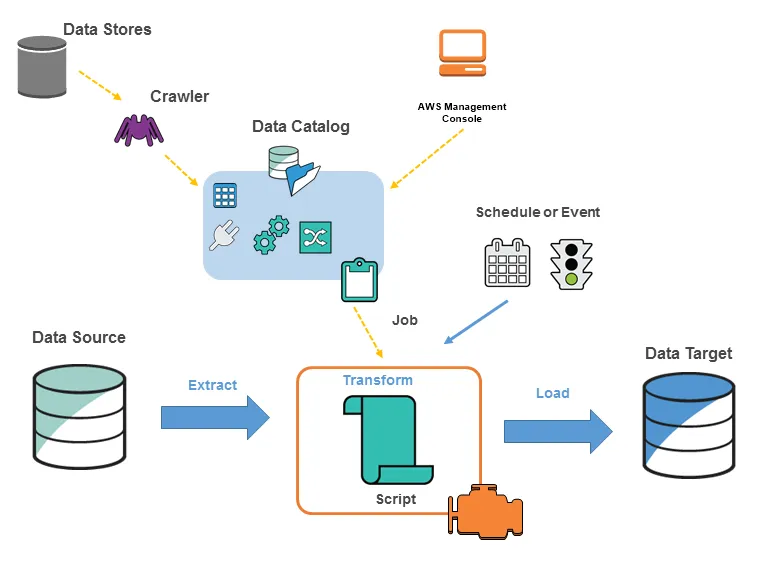
Feature Comparison
| Feature | AWS Glue | Airbyte |
|---|---|---|
| Data Integration | ||
| Pre-Built Connectors | 100+ data sources via crawlers, JDBC, and native AWS integrations | 600+ connectors for SaaS, databases, APIs, warehouses, and vector stores |
| Custom Connector Development | Custom classifiers and JDBC connections; requires Spark/Python coding | Connector Development Kit (CDK) for building custom integrations in under 30 minutes |
| CDC Support | Supports change data capture through bookmarks and JDBC incremental loads | Log-based CDC for select databases with incremental and full-refresh sync modes |
| Data Processing | ||
| Transformation Capabilities | Full Apache Spark ETL with PySpark, Scala, and 250+ DataBrew visual transformations | Minimal in-transit transforms; defers to dbt for SQL-based post-load transformations |
| Data Quality | Built-in Data Quality rules, sensitive data detection, and PII remediation tools | Schema validation and normalization; relies on downstream tools for quality checks |
| ML and AI Features | FindMatches ML deduplication, GenAI Spark upgrades, and AI-assisted troubleshooting | AI Agent Engine for powering real-time AI agent workflows and vector store destinations |
| Architecture & Deployment | ||
| Infrastructure Management | Fully serverless with automatic provisioning; no infrastructure to manage on AWS | Self-hosted requires Docker or Kubernetes management; Cloud version is fully managed |
| Auto Scaling | Dynamic auto-scaling that adds and removes DPUs based on workload demands | Scales via container orchestration; worker containers can be spawned independently |
| Multi-Cloud Support | AWS-only; tightly coupled with S3, Redshift, Athena, and other AWS services | Cloud-agnostic; deploys on any infrastructure and connects to any cloud provider |
| Operations & Governance | ||
| Metadata Management | Centralized Data Catalog with automatic schema discovery, versioning, and partition tracking | Schema management with change detection; no centralized metadata catalog |
| Security & Compliance | AWS IAM integration, encryption at rest and in transit, VPC support, and CloudTrail auditing | SOC 2 Type II certified, GDPR and HIPAA support, SSO, SCIM, RBAC, and audit logs |
| Monitoring & Observability | CloudWatch integration for logs, alerts, and job metrics with centralized monitoring | Real-time sync monitoring, error logging, and notifications with debugging autonomy |
| Developer Experience | ||
| Development Environment | Interactive Sessions, Studio Job Notebooks, and IDE integration for ETL development | Web UI for configuration plus API-driven setup; supports Terraform and version control |
| Version Control | Built-in Git integration with GitHub and AWS CodeCommit for job versioning | Open-source codebase on GitHub; Octavia CLI for configuration-as-code workflows |
| Orchestration Integration | Native scheduling, triggers, workflows, and Amazon MWAA (Airflow) integration | Integrates with Airflow, Dagster, Prefect, and other orchestration platforms via API |
Data Integration
Pre-Built Connectors
Custom Connector Development
CDC Support
Data Processing
Transformation Capabilities
Data Quality
ML and AI Features
Architecture & Deployment
Infrastructure Management
Auto Scaling
Multi-Cloud Support
Operations & Governance
Metadata Management
Security & Compliance
Monitoring & Observability
Developer Experience
Development Environment
Version Control
Orchestration Integration
Which approach fits
AWS Glue excels as a serverless ETL powerhouse for AWS-centric organizations needing deep transformation capabilities, while Airbyte wins on connector breadth, open-source flexibility, and multi-cloud portability for ELT-focused data teams.
When each approach fits
Choose AWS Glue if:
Choose AWS Glue if your organization is heavily invested in the AWS ecosystem and needs powerful data transformation capabilities built on Apache Spark. It is the stronger choice when you require serverless ETL with automatic scaling, a centralized Data Catalog for metadata management, built-in data quality rules, and sensitive data detection with PII remediation. AWS Glue is ideal for enterprises running complex ETL pipelines that integrate tightly with S3, Redshift, Athena, and other AWS analytics services, and for teams that need GenAI-assisted Spark development and troubleshooting.
Choose Airbyte if:
Choose Airbyte if your team prioritizes connector breadth, multi-cloud flexibility, and an ELT architecture where transformations happen in the warehouse via dbt. With 600+ pre-built connectors, a free self-hosted open-source option, and median contracts around $16,350/year versus unpredictable AWS usage bills, Airbyte offers stronger cost predictability. It is best for startups and mid-size data teams that want rapid pipeline setup without deep cloud expertise, need to integrate dozens of SaaS sources quickly, or want the freedom to deploy on any infrastructure without vendor lock-in.
These scenarios reflect the available product evidence. Your requirements, existing stack, and team expertise should guide the final decision.
Frequently Asked Questions
Is AWS Glue or Airbyte better for small teams with limited budgets?
Airbyte is usually the more accessible starting point for a budget-limited team because its self-hosted open-source edition is free and Cloud Standard starts at $10 per month. AWS Glue has no cost while idle, but its DPU-hour charges can become less predictable as ETL jobs grow in complexity and frequency.
Can AWS Glue and Airbyte be used together in the same data pipeline?
Yes, many organizations use both tools in a complementary architecture. Airbyte handles the data extraction and loading phase, pulling data from hundreds of SaaS applications, databases, and APIs into a central warehouse or data lake on AWS. AWS Glue then takes over for complex data transformations, data quality checks, and metadata cataloging using its Spark-based ETL engine and Data Catalog. This combination leverages Airbyte's superior connector ecosystem for ingestion and AWS Glue's powerful transformation and governance capabilities for downstream processing.
Which tool handles real-time data processing better?
Neither tool is primarily designed for true real-time streaming, but they approach near-real-time differently. AWS Glue supports streaming ETL jobs that can process data from Amazon Kinesis and Apache Kafka with micro-batch processing, and its Schema Registry validates streaming data schemas. Airbyte focuses on batch and CDC-based replication with sync intervals measured in minutes to hours, though its newer Agent Engine supports real-time direct connectors for AI agent workflows. For sub-second latency requirements, dedicated streaming tools like Apache Flink or Estuary are better suited than either platform.
How do the two platforms compare for enterprises with strict compliance requirements?
Both platforms offer strong enterprise security, but through different approaches. AWS Glue benefits from the broader AWS compliance framework including SOC 1/2/3, HIPAA, PCI DSS, FedRAMP, and ISO certifications, with IAM-based access control, encryption via KMS, VPC network isolation, and CloudTrail audit logging. Airbyte Enterprise provides SOC 2 Type II certification, GDPR and HIPAA support, SSO with SCIM provisioning, fine-grained RBAC, audit logs, and 99.9% SLA guarantees. AWS Glue has an advantage in highly regulated industries already operating within AWS GovCloud, while Airbyte offers more deployment flexibility for organizations with multi-cloud compliance needs.