Decision comparison
Coalesce vs Dagster
Coalesce and Dagster solve fundamentally different problems in the data stack. Coalesce excels as a transformation-focused platform for teams building governed ELT pipelines on Snowflake, BigQuery, Databricks, or Microsoft Fabric, while Dagster serves as a general-purpose orchestration layer that coordinates assets across your entire data and AI infrastructure. Most mature data teams will evaluate these tools for complementary rather than competing roles.
Used together. These are normally used together rather than chosen between. The comparison explains what each one does in the stack.
These are different kinds of product — Transformation Framework and Workflow Orchestrator.
Quick Comparison
| Decision factor | Coalesce | Dagster |
|---|---|---|
| Best For | Data teams running Snowflake-centric ELT who want visual modeling with code-first governance and metadata-driven development | Data engineering teams needing a general-purpose orchestrator for ETL, dbt, ML pipelines, and AI workflows across any cloud platform |
| Architecture | Cloud-native transformation layer that executes inside Snowflake, BigQuery, Databricks, and Microsoft Fabric with no separate compute engine | Open-source asset-centric orchestrator that models data assets with lineage and dependencies; runs on single server, Kubernetes, or Dagster Cloud |
| Pricing Model | Contact for pricing | Open-source self-hosted free (Apache-2.0), Solo Plan $10/mo, Starter Plan $100/mo, Starter $1200/mo, Pro and Enterprise Plan contact sales |
| Ease of Use | Visual drag-and-drop pipeline builder with AI-assisted automation; customers report 10x quicker pipeline development and 15-minute change propagation | Python-native declarative workflows with branch deployments and CI/CD integration; customers report insight delivery reduced from 6 months to 2 days |
| Scalability | Leverages underlying warehouse compute for scaling; customers report 75% quicker nightly batch processing and 80x quicker staging | Supports multi-tenant deployments, unlimited code locations on Pro plan, and Kubernetes-based horizontal scaling for large-scale data platforms |
| Community/Support | Closed-source commercial product with dedicated enterprise support; rated 10/10 on review platforms; growing Marketplace for pre-built Packages | 15,000+ GitHub stars under Apache-2.0; active Slack community, Dagster University courses, SOC 2 Type II and HIPAA certified for enterprise |
Coalesce
- Best For:
- Data teams running Snowflake-centric ELT who want visual modeling with code-first governance and metadata-driven development
- Architecture:
- Cloud-native transformation layer that executes inside Snowflake, BigQuery, Databricks, and Microsoft Fabric with no separate compute engine
- Pricing Model:
- Contact for pricing
- Ease of Use:
- Visual drag-and-drop pipeline builder with AI-assisted automation; customers report 10x quicker pipeline development and 15-minute change propagation
- Scalability:
- Leverages underlying warehouse compute for scaling; customers report 75% quicker nightly batch processing and 80x quicker staging
- Community/Support:
- Closed-source commercial product with dedicated enterprise support; rated 10/10 on review platforms; growing Marketplace for pre-built Packages
Dagster
- Best For:
- Data engineering teams needing a general-purpose orchestrator for ETL, dbt, ML pipelines, and AI workflows across any cloud platform
- Architecture:
- Open-source asset-centric orchestrator that models data assets with lineage and dependencies; runs on single server, Kubernetes, or Dagster Cloud
- Pricing Model:
- Open-source self-hosted free (Apache-2.0), Solo Plan $10/mo, Starter Plan $100/mo, Starter $1200/mo, Pro and Enterprise Plan contact sales
- Ease of Use:
- Python-native declarative workflows with branch deployments and CI/CD integration; customers report insight delivery reduced from 6 months to 2 days
- Scalability:
- Supports multi-tenant deployments, unlimited code locations on Pro plan, and Kubernetes-based horizontal scaling for large-scale data platforms
- Community/Support:
- 15,000+ GitHub stars under Apache-2.0; active Slack community, Dagster University courses, SOC 2 Type II and HIPAA certified for enterprise
Public signals
Verified factual signals only. Bars appear only for like-for-like metrics with five weekly assessments for every tool; missing evidence stays explicit. These signals do not establish enterprise adoption, product quality, or total cost.
| Metric | Coalesce | Dagster |
|---|---|---|
| GitHub commits, 90d(Developer adoption) | 25 | Not available |
| GitHub stars(Developer adoption) | 0 | Not available |
| Search interest(Market interest) | 0 | 1 |
| Hacker News mentions, 90d(Community interest) | 0 | 3 |
| npm weekly downloads(Developer adoption) | 1.5k | Not available |
| Docker Hub pulls(Developer adoption) | Not available | 6.2M |
| GitHub commits, 90d(Product adoption) | Not available | 265 |
| GitHub stars(Product adoption) | Not available | 16,000+ |
| Product Hunt comments(Community interest) | Not available | 11 |
| Product Hunt rating(Community interest) | Not available | 5.0/5 |
| Product Hunt reviews(Community interest) | Not available | 1 |
| Product Hunt votes(Community interest) | Not available | 112 |
| PyPI weekly downloads(Product adoption) | Not available | 1.8M |
| Stack Overflow questions(Community interest) | Not available | 171 |
As of September 21, 2026 — updated weekly.
Health & risk evidence
Observed public-source checks for mapped package versions and repositories.
Coalesce
September 21, 2026Package vulnerabilities
npm · @coalescesoftware/coa@7.43.0
0 vulnerabilities
across 1 package
Repository security score
Not available
Dagster
September 21, 2026Package vulnerabilities
PyPI · dagster@1.13.23
0 vulnerabilities
across 1 package
Repository security score
github.com/dagster-io/dagster
5.1/10
Interface Preview
Dagster
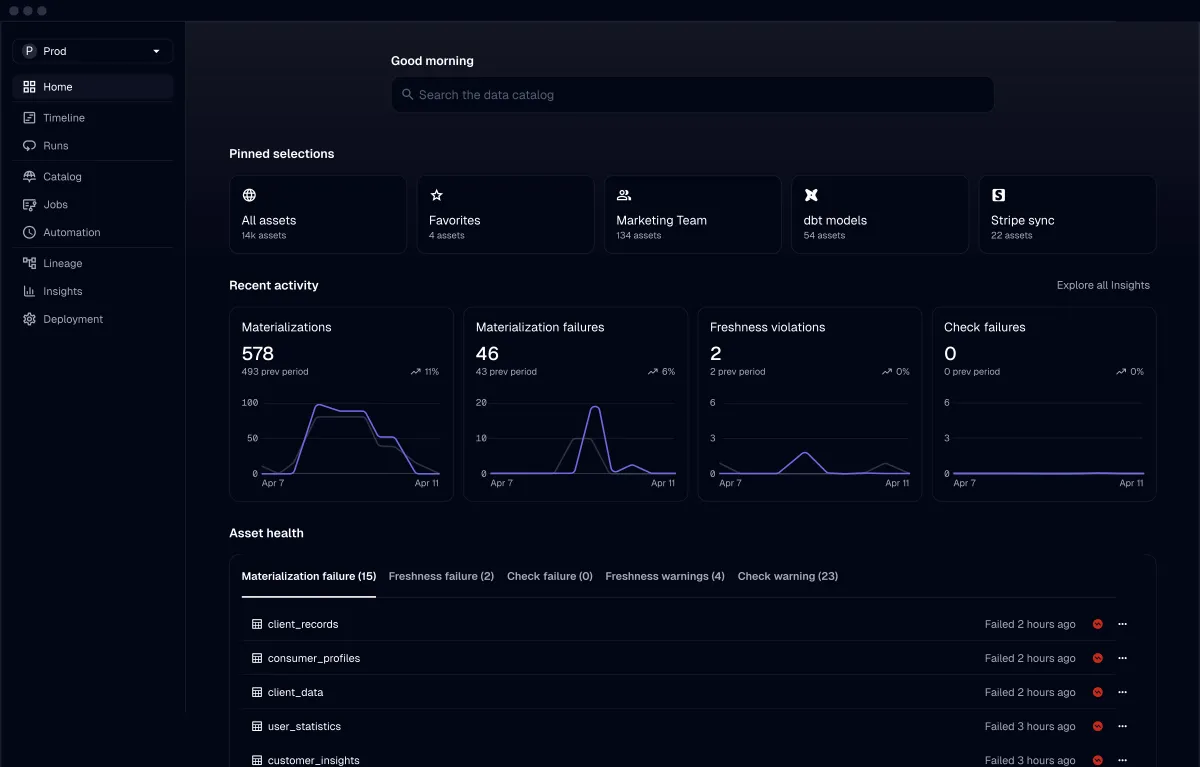
Feature Comparison
| Feature | Coalesce | Dagster |
|---|---|---|
| Data Transformation | ||
| Transformation Approach | Metadata-driven development with code templates and AI-assisted automation that executes SQL transformations directly inside the connected warehouse | Orchestrates external transformations via dbt, Databricks, Python, or Spark using asset-centric declarative workflows with partition and incremental run support |
| Pipeline Builder | Visual drag-and-drop interface with code-first control; supports bulk editing, custom node types, and reusable pipeline components via Marketplace Packages | Python-native declarative pipeline definitions with modular, reusable components; branch deployments enable dev-to-prod promotion with CI/CD integration |
| Data Modeling | Built-in visual modeling for dimensional models, Data Vault, and staging patterns with 83% reduction in time to build financial workflow models reported by customers | Delegates modeling to connected tools like dbt while providing orchestration layer; auto-generates over 1,000 dbt models reported at fintech smava |
| Observability and Lineage | ||
| Data Lineage | Live lineage tracking with column-level granularity showing real-time ownership and usage across the data lifecycle via integrated Catalog product | Built-in asset graph with end-to-end lineage visualization that models dependencies across dbt, Snowflake, Databricks, and external systems via Dagster Pipes |
| Monitoring and Alerting | Quality events and observability through the acquired SYNQ platform that surfaces issues before downstream systems fail with continuous enforcement | Intelligent Slack-based alerts with AI-powered debugging and impact analysis; real-time health metrics track freshness, performance, costs, and reliability |
| Data Catalog | Integrated Catalog product with AI-powered data discovery; one customer achieved 600 active users at rollout with 6x adoption versus previous solution | Built-in data catalog with auto-generated documentation, unified metadata view, and centralized data discovery for all assets and workflows across teams |
| Deployment and Infrastructure | ||
| Deployment Options | Fully managed cloud SaaS platform with environment management for dev/test/prod; versioned changes and Git-based version control for all pipelines | Flexible deployment on single server, Kubernetes, or managed Dagster Cloud with hybrid bring-your-own-infrastructure patterns and North American/European regions |
| Platform Integrations | Native support for Snowflake, Google BigQuery, Databricks, and Microsoft Fabric; integrates with Boomi for legacy ETL modernization from Informatica stacks | Native integrations with Snowflake, BigQuery, dbt, Databricks, Fivetran, Great Expectations, Spark, AWS, and Azure through a composable integration framework |
| Security and Compliance | Role-based governance and collaboration controls with enterprise-grade security; data stays within the customer's warehouse with no separate compute layer | SOC 2 Type II and HIPAA certified; offers SSO, RBAC, SCIM provisioning with Google/GitHub/SAML IdPs; audit logs, retention policies, and multi-tenant isolation |
| Developer Experience | ||
| Development Workflow | Visual interface with underlying code control; metadata-driven templates remove manual work so teams propagate changes to production in 15-20 minutes versus 4 days | Python-first development with local development support, unit testing, and CI pipeline integration; developer onboarding reduced from months to a single day at Magenta Telekom |
| AI Capabilities | Coalesce Copilot accelerates governed ELT development with AI-assisted automation; AI-powered metadata enrichment helps build context-rich data foundations | Compass feature turns warehouse data into instant answers for stakeholders using natural language; AI Driven Data Engineering course teaches production pipeline building |
| Version Control | Built-in Git integration with branching support; customers highlight everything in Git for version control as a key benefit over legacy ETL systems | GitOps-native workflow with branch deployments for CI; Dagster Cloud supports CI/CD-driven development with environment-specific deployments and testing |
| Data Quality and Governance | ||
| Data Quality | Acquired SYNQ in March 2026 to bring native data quality into the platform with continuous observability and early issue detection across production pipelines | Built-in data validation, automated testing, freshness checks, and partitioned asset checks embedded directly in pipeline code for proactive issue identification |
| Cost Management | Leverages warehouse-native compute so cost optimization happens at the Snowflake/Databricks level; no separate compute charges from Coalesce infrastructure | Cost tracking and insights on Pro plan surface resource utilization and operational expenses; helps teams monitor and optimize data platform spending at scale |
| Governance Controls | Governance baked into development workflows with context, documentation, and oversight at every pipeline stage ensuring compliant and consistent data delivery | Enterprise-grade governance with RBAC, SCIM, audit logs, and retention policies; multi-tenant code deployments keep teams' code and data isolated |
Data Transformation
Transformation Approach
Pipeline Builder
Data Modeling
Observability and Lineage
Data Lineage
Monitoring and Alerting
Data Catalog
Deployment and Infrastructure
Deployment Options
Platform Integrations
Security and Compliance
Developer Experience
Development Workflow
AI Capabilities
Version Control
Data Quality and Governance
Data Quality
Cost Management
Governance Controls
How they fit together
Coalesce and Dagster solve fundamentally different problems in the data stack. Coalesce excels as a transformation-focused platform for teams building governed ELT pipelines on Snowflake, BigQuery, Databricks, or Microsoft Fabric, while Dagster serves as a general-purpose orchestration layer that coordinates assets across your entire data and AI infrastructure. Most mature data teams will evaluate these tools for complementary rather than competing roles.
What each one handles
Use Coalesce for:
Choose Coalesce if your primary challenge is accelerating data transformation development inside a cloud warehouse. Teams running Snowflake-centric architectures benefit from Coalesce's metadata-driven approach, which customers report delivers 10x quicker pipeline development and 75% quicker batch processing. The visual modeling interface combined with code-first governance makes it particularly strong for organizations migrating from legacy ETL tools like Informatica, where the structured approach to Data Vault and dimensional modeling reduces migration timelines significantly.
Use Dagster for:
Choose Dagster if you need a unified orchestration platform that coordinates data pipelines, dbt transformations, ML workflows, and AI applications across multiple systems. The open-source Apache-2.0 foundation with 15,348 GitHub stars means no vendor lock-in, and the tiered pricing from free self-hosted to $10/mo Solo and $100/mo Starter plans makes entry accessible. Teams at companies like HIVED achieved 99.9% pipeline reliability with zero data incidents over three years, demonstrating Dagster's production-grade reliability for mission-critical orchestration.
These roles reflect the available product evidence. Most teams run both; which one owns a given job depends on your stack and team.
Frequently Asked Questions
Can Coalesce and Dagster be used together in the same data stack?
Coalesce and Dagster serve complementary roles and work well together. Dagster acts as the orchestration layer that schedules and monitors pipeline runs across your entire stack, while Coalesce handles the transformation logic inside your warehouse. Teams can use Dagster to trigger Coalesce jobs alongside dbt models, ML training pipelines, and data ingestion tasks, getting unified lineage and monitoring across all components. This combination gives you Coalesce's visual modeling speed for transformations with Dagster's asset-centric observability for end-to-end pipeline coordination.
What warehouse platforms does each tool support?
Coalesce natively supports Snowflake, Google BigQuery, Databricks, and Microsoft Fabric as execution targets where transformations run directly inside the warehouse compute. Dagster takes a different approach as an orchestrator that integrates with virtually any data platform through its connector framework, including Snowflake, BigQuery, Databricks, Spark, AWS services, Azure, Fivetran, and dbt. The key difference is that Coalesce executes transformation logic within the warehouse, while Dagster coordinates and monitors work happening across multiple external systems.
How do the pricing models compare between Coalesce and Dagster?
Dagster publishes pay-as-you-go pricing for its Solo and Starter plans: Solo is $10 per month plus $0.040 per credit, while Starter is $100 per month plus $0.035 per credit and supports up to 3 users. Pro pricing is not publicly listed; contact sales for details.
Which tool is better for teams new to data engineering?
Coalesce provides a more approachable starting experience for teams focused on warehouse transformations, with its visual drag-and-drop pipeline builder and AI-assisted Copilot reducing the learning curve for building ELT pipelines. Users describe it as combining an intuitive UI-driven workflow with code flexibility. Dagster requires Python proficiency but offers extensive learning resources including Dagster University courses and comprehensive documentation. Customer Magenta Telekom reduced developer onboarding from months to a single day with Dagster. The choice depends on whether your team needs visual transformation tooling or a programmatic orchestration platform.