Decision comparison
Comet ML vs MLflow
Comet ML and MLflow represent two fundamentally different approaches to the MLOps and LLMOps space. Comet ML delivers a managed, commercial platform that bundles LLM observability through Opik with traditional ML experiment tracking, enterprise security certifications, and hosted infrastructure. MLflow provides the largest open-source AI engineering platform with zero licensing costs, 100+ framework integrations, and production deployment capabilities including an AI Gateway and Agent Server. Teams that value operational simplicity, enterprise compliance, and managed hosting will lean toward Comet ML. Teams that prioritize open-source freedom, vendor independence, and the broadest ecosystem reach will choose MLflow.
Direct comparison. These are reviewed substitutes bought for the same job, so the differences below are the ones that decide between them.
All 2 are experiment tracking.
Quick Comparison
| Decision factor | Comet ML | MLflow |
|---|---|---|
| Primary Focus | End-to-end model evaluation covering LLM observability via Opik and ML experiment management | Open-source AI engineering platform for agents, LLMs, and ML model lifecycle management |
| Licensing Model | Freemium SaaS with free tier, Pro at $19/mo per user, and Enterprise custom pricing | 100% open source under Apache 2.0 with no paid tiers or licensing restrictions |
| LLM Observability | Opik provides LLM tracing, annotation, automated eval metrics, and agent optimization | OpenTelemetry-native tracing with production quality, cost, and safety monitoring |
| Experiment Tracking | Full experiment management with custom dashboards, model versioning, and dataset management | Experiment tracking with metrics logging, parameter comparison, and artifact management |
| Deployment Options | Cloud-hosted, self-hosted open-source Opik, or on-premise enterprise deployment | Self-hosted only; single command setup with Docker support available |
| Best For | Teams wanting managed infrastructure with enterprise security, SSO, and compliance features | Teams prioritizing zero vendor lock-in, full source control, and broad framework compatibility |
Comet ML
- Primary Focus:
- End-to-end model evaluation covering LLM observability via Opik and ML experiment management
- Licensing Model:
- Freemium SaaS with free tier, Pro at $19/mo per user, and Enterprise custom pricing
- LLM Observability:
- Opik provides LLM tracing, annotation, automated eval metrics, and agent optimization
- Experiment Tracking:
- Full experiment management with custom dashboards, model versioning, and dataset management
- Deployment Options:
- Cloud-hosted, self-hosted open-source Opik, or on-premise enterprise deployment
- Best For:
- Teams wanting managed infrastructure with enterprise security, SSO, and compliance features
MLflow
- Primary Focus:
- Open-source AI engineering platform for agents, LLMs, and ML model lifecycle management
- Licensing Model:
- 100% open source under Apache 2.0 with no paid tiers or licensing restrictions
- LLM Observability:
- OpenTelemetry-native tracing with production quality, cost, and safety monitoring
- Experiment Tracking:
- Experiment tracking with metrics logging, parameter comparison, and artifact management
- Deployment Options:
- Self-hosted only; single command setup with Docker support available
- Best For:
- Teams prioritizing zero vendor lock-in, full source control, and broad framework compatibility
Public signals
Verified factual signals only. Bars appear only for like-for-like metrics with five weekly assessments for every tool; missing evidence stays explicit. These signals do not establish enterprise adoption, product quality, or total cost.
| Metric | Comet ML | MLflow |
|---|---|---|
| Search interest(Market interest) | 0 | 2 |
| Product Hunt comments(Community interest) | 14 | Not available |
| Product Hunt reviews(Community interest) | 0 | Not available |
| Product Hunt votes(Community interest) | 199 | Not available |
| PyPI weekly downloads(Developer adoption) | 76.5k | Not available |
| Stack Overflow questions(Community interest) | 11 | 771 |
| GitHub commits, 90d(Product adoption) | Not available | 926 |
| GitHub stars(Product adoption) | Not available | 28,000+ |
| Hacker News mentions, 90d(Community interest) | Not available | 1 |
| PyPI weekly downloads(Product adoption) | Not available | 4.6M |
As of September 21, 2026 — updated weekly.
Health & risk evidence
Observed public-source checks for mapped package versions and repositories.
Comet ML
September 21, 2026Package vulnerabilities
PyPI · comet-ml@3.58.6
0 vulnerabilities
across 1 package
Repository security score
Not available
MLflow
September 21, 2026Package vulnerabilities
PyPI · mlflow@3.16.1
0 vulnerabilities
across 1 package
Repository security score
github.com/mlflow/mlflow
5.4/10
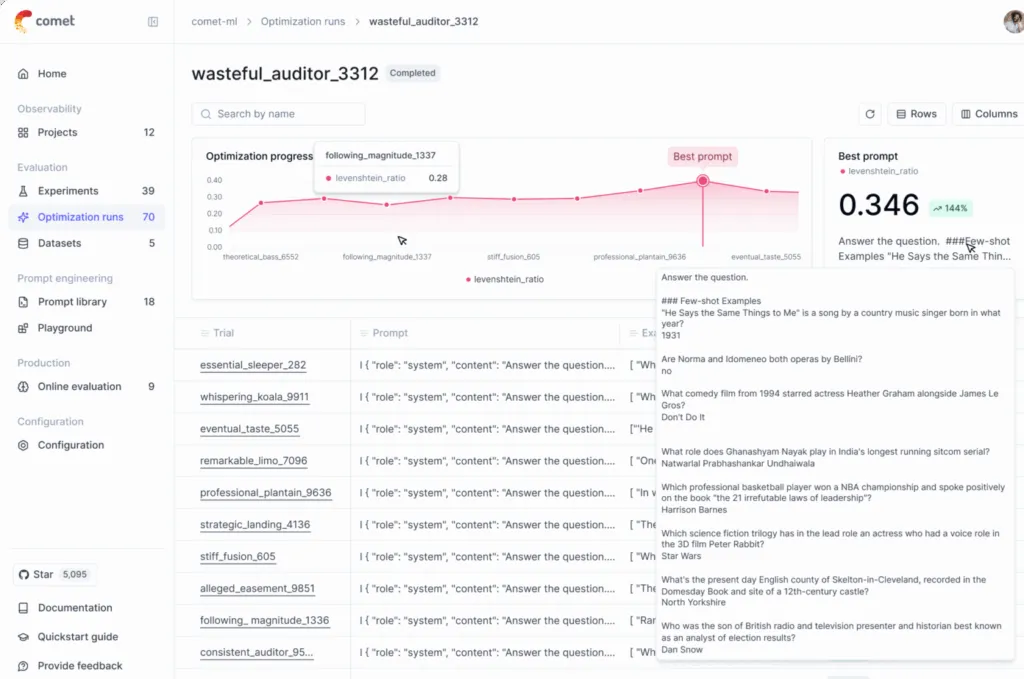
Interface Preview
Comet ML
MLflow
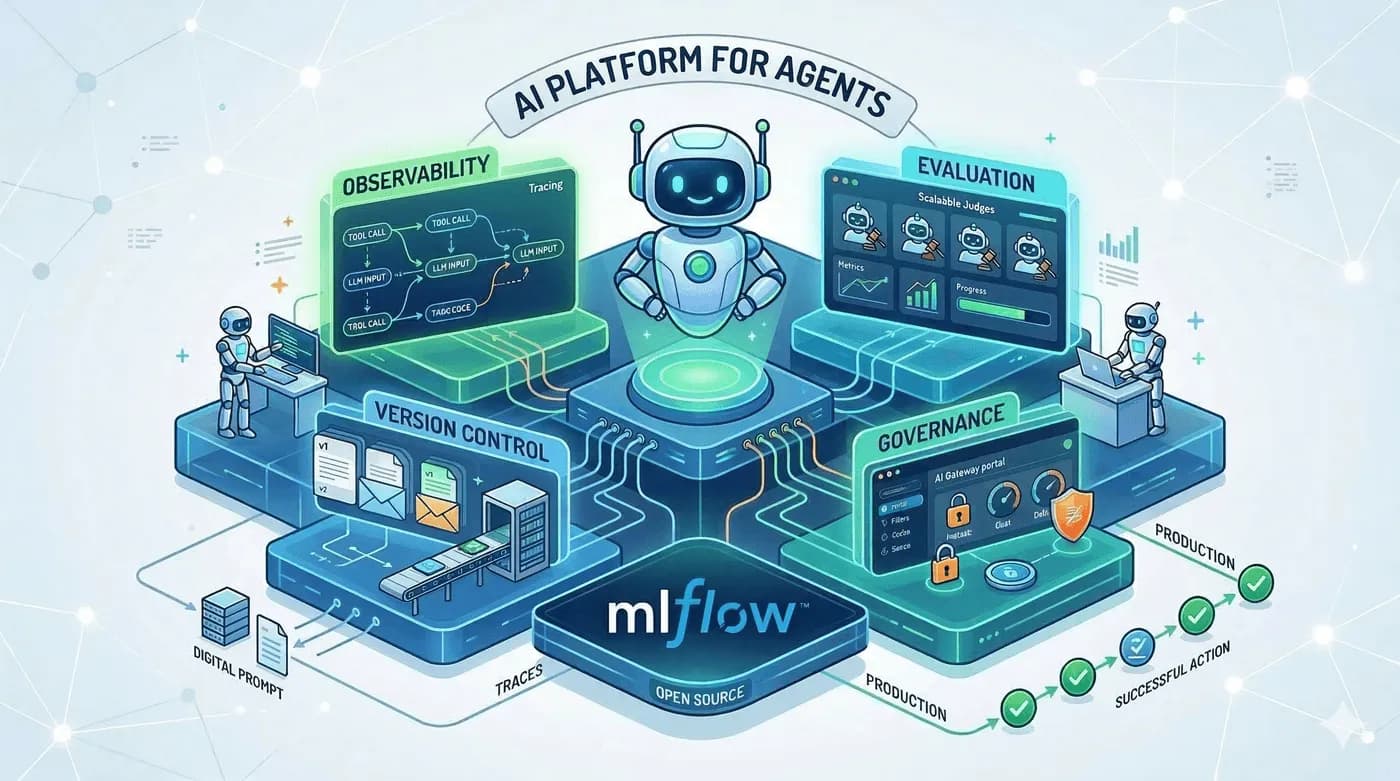
Feature Comparison
| Feature | Comet ML | MLflow |
|---|---|---|
| LLM Observability & Tracing | ||
| Application Tracing | Opik traces every step of LLM execution including context retrieval, tool selection, and user feedback | OpenTelemetry-based traces capture complete LLM application and agent behavior across any provider |
| Production Monitoring | Online evals score production data in real time to detect and mitigate issues as they arise | Production quality, cost, and safety monitoring with built-in observability dashboards |
| Multi-Framework Support | Integrations with 40+ AI frameworks including LangChain, OpenAI, and LlamaIndex | Works with 100+ AI frameworks including LangChain, OpenAI, PyTorch, and supports Python, TypeScript, Java, and R |
| Evaluation & Testing | ||
| Built-in Eval Metrics | LLM-as-a-judge metrics for hallucination, context precision, relevance, and custom scoring | 50+ built-in metrics and LLM judges with AI-powered analysis across correctness, latency, and safety |
| Dataset Management | Dataset creation and management for defining evaluation baselines and running automated experiments | Artifact logging and versioning for datasets, models, and evaluation results |
| Prompt Optimization | Automated prompt engineering that generates and tests prompts for agentic system steps | Prompt versioning with lineage tracking and state-of-the-art optimization algorithms |
| ML Experiment Management | ||
| Experiment Tracking | Full experiment management with real-time metrics, custom dashboards, and code versioning | Experiment tracking with parameter logging, metric comparison, and run management |
| Model Registry | Model versioning with reproducibility tracking and collaboration tools | Central model registry for staging, production, and archived model lifecycle management |
| Framework Integrations | Native support for PyTorch, TensorFlow, Keras, Hugging Face, XGBoost, and scikit-learn | Autologging for PyTorch, TensorFlow, scikit-learn, and dozens of other ML libraries |
| Deployment & Infrastructure | ||
| Agent Deployment | Focused on evaluation and monitoring; deployment handled by external infrastructure | Agent Server provides FastAPI-based hosting with single-command deployment to production |
| API Gateway | Not offered as a standalone capability | AI Gateway provides unified OpenAI-compatible interface for rate limiting, fallbacks, and cost control |
| Self-Hosting | Opik is open source and self-hostable; full Comet MLOps platform available for on-premise deployment | Fully self-hosted with single command startup; Docker setup available for production environments |
| Collaboration & Governance | ||
| Team Collaboration | Shared workspaces with annotation workflows and subject matter expert review capabilities | Shared tracking server with experiment and model sharing across team members |
| Access Control | SSO, org/project RBAC, and service accounts available on Enterprise tier | Community-managed access; enterprise RBAC available through Databricks managed MLflow |
| Compliance & Security | SOC 2, ISO 27001, ISO 9001, HIPAA, and GDPR compliance on Enterprise tier | Security depends on self-hosted infrastructure; no built-in compliance certifications |
LLM Observability & Tracing
Application Tracing
Production Monitoring
Multi-Framework Support
Evaluation & Testing
Built-in Eval Metrics
Dataset Management
Prompt Optimization
ML Experiment Management
Experiment Tracking
Model Registry
Framework Integrations
Deployment & Infrastructure
Agent Deployment
API Gateway
Self-Hosting
Collaboration & Governance
Team Collaboration
Access Control
Compliance & Security
Which to choose
Comet ML and MLflow represent two fundamentally different approaches to the MLOps and LLMOps space. Comet ML delivers a managed, commercial platform that bundles LLM observability through Opik with traditional ML experiment tracking, enterprise security certifications, and hosted infrastructure. MLflow provides the largest open-source AI engineering platform with zero licensing costs, 100+ framework integrations, and production deployment capabilities including an AI Gateway and Agent Server. Teams that value operational simplicity, enterprise compliance, and managed hosting will lean toward Comet ML. Teams that prioritize open-source freedom, vendor independence, and the broadest ecosystem reach will choose MLflow.
Best-fit scenarios
Choose Comet ML if:
Choose Comet ML if your organization needs enterprise-grade compliance certifications like SOC 2, ISO 27001, and HIPAA, managed cloud infrastructure without operational overhead, and structured human-in-the-loop evaluation workflows. The platform is well-suited for teams that want a turnkey solution combining LLM observability and ML experiment management with dedicated support, SLAs, and SSO integration. Comet's Opik component also offers a strong open-source option for teams that want to start with self-hosted LLM tracing and upgrade to the managed platform as needs grow.
Choose MLflow if:
Choose MLflow if your team prioritizes zero vendor lock-in, full control over infrastructure, and the broadest framework ecosystem. With 30 million monthly downloads, 20K+ GitHub stars, and backing from the Linux Foundation, MLflow offers a widely adopted open-source MLOps foundation. Its AI Gateway for cost management, Agent Server for production deployment, and OpenTelemetry-native observability make it the more complete platform for teams comfortable managing self-hosted infrastructure. MLflow is the clear choice for organizations that refuse to accept licensing constraints on their core AI engineering workflow.
These scenarios reflect the available product evidence. Your requirements, existing stack, and team expertise should guide the final decision.
Frequently Asked Questions
What is the main difference between Comet ML and MLflow?
Comet ML is a commercial platform that combines LLM observability through its open-source Opik product with a proprietary ML experiment management suite, offering managed cloud hosting, enterprise security, and compliance certifications. MLflow is a fully open-source AI engineering platform backed by the Linux Foundation that provides experiment tracking, model registry, LLM observability, an AI gateway, and agent deployment under the Apache 2.0 license with no paid tiers. The fundamental difference is managed commercial platform versus self-hosted open-source infrastructure.
Is MLflow really free compared to Comet ML?
MLflow is 100% free and open source under the Apache 2.0 license with no usage limits or paid tiers. You can self-host it at no licensing cost, though you bear the infrastructure and operational costs of running your own servers, storage, and databases. Comet ML offers a free cloud tier with up to 10 team members and 25k spans per month, a Pro tier at $19 per user per month with expanded limits, and custom Enterprise pricing. The cost comparison depends on whether your team has the capacity to manage self-hosted infrastructure or prefers a managed service.
Can Comet ML and MLflow be used together?
Yes. Some teams use MLflow for experiment tracking and model registry while using Comet's Opik for LLM observability and evaluation. MLflow's open architecture and Opik's framework integrations mean both tools can coexist in the same workflow. However, running both adds operational complexity, so most teams choose one platform as their primary MLOps backbone and layer in specialized tools only where needed.
Which platform has better LLM and agent support?
Both platforms have invested heavily in LLM and agent capabilities. Comet ML offers Opik for LLM tracing, automated evaluation metrics, annotation workflows, and an agent optimizer suite. MLflow provides OpenTelemetry-based observability, 50+ built-in evaluation metrics, prompt management, an AI Gateway for cost control, and an Agent Server for production deployment. MLflow covers a broader scope with its gateway and deployment capabilities, while Comet's Opik focuses more deeply on evaluation and human-in-the-loop annotation workflows.
Which platform is better for enterprise teams with strict compliance requirements?
Comet ML is the stronger choice for compliance-heavy environments. Its Enterprise tier includes SOC 2, ISO 27001, ISO 9001, HIPAA, and GDPR compliance, along with SSO, RBAC, service accounts, and dedicated support with SLAs. MLflow as an open-source project does not ship with built-in compliance certifications. Enterprise teams using MLflow typically rely on Databricks managed MLflow or their own infrastructure team to meet compliance requirements, which adds operational overhead.