Decision comparison
Flyte vs Metaflow
Flyte is the better choice for ML engineering teams on Kubernetes that need type-safe, cached, multi-tenant orchestration with complete data lineage. Its Kubernetes-native design, dynamic workflows, fractional GPU scheduling, and Union.ai Team plan fit teams standardizing distributed production AI workloads. Metaflow is the better choice for data science teams on AWS that need the fastest path from experiment to production without managing Kubernetes infrastructure. Its decorator-based Python workflows, automatic variable tracking, and Step Functions plus Batch execution suit teams prioritizing rapid model delivery.
Direct comparison. These are reviewed substitutes bought for the same job, so the differences below are the ones that decide between them.
All 2 are ML pipeline frameworks.
Quick Comparison
| Decision factor | Flyte | Metaflow |
|---|---|---|
| Best For | ML engineering teams needing type-safe, cached, multi-tenant Kubernetes-native orchestration, plus dynamic workflows, parallel map tasks, GPU scheduling, and reproducible versioned production AI runs. | Data science teams shipping ML models to production without managing Kubernetes, using plain Python, experiment tracking, conditional steps, cloud compute, and data-warehouse access. |
| Architecture | Kubernetes-native with control plane, data plane, and strongly typed task containers; supports Python and Java workflows, namespace isolation, and Spark, Dask, Ray, and distributed-training plugins. | Python framework with AWS Step Functions backend; no Kubernetes required, using decorator-based flows, automatic variable versioning, event integrations, and configurable local or cloud execution. |
| Pricing Model | Flyte is fully open-source and free (Apache 2.0, 80M+ downloads). Commercial managed offering via Union.ai: Team plan $950/month (includes $950 monthly usage credit) with GPU rates from T4g $0.1516/hr to H200 $1.5824/hr and B200 $2.8483/hr. CPU $0.0417/vCPU/hr, memory $0.0051/GB/hr. Enterprise plan: custom pricing with volume discounts, multi-cluster, 1-year data retention, dedicated support. Team plan supports up to 1,000 concurrent actions, 30-day retention. | GitHub license: Apache-2.0 (tool can be self-hosted for free) |
| Ease of Use | Steeper learning curve requiring Kubernetes knowledge; pure-Python authoring, local development and debugging, caching, versioning, visualization, and deployment become powerful once configured. | Minimal learning curve with decorator-based Python API; developers can use existing Python libraries, develop and debug locally, then deploy workflows with a single command. |
| Infrastructure Requirements | Requires a Kubernetes cluster for self-hosting; Union.ai managed service eliminates Kubernetes operations, while Team supports up to 1,000 concurrent actions and 30-day retention. | No Kubernetes needed; AWS Step Functions plus Batch provide serverless execution, while cloud functions can use GPUs, multiple cores, large memory, and local development tooling. |
| Community/Ecosystem | CNCF incubating, 80M+ container downloads, Spotify/Toyota adoption; GitHub has 7,414 stars, Apache-2.0 licensing, Go primary language, and v2.0.48 released September 2026. | Netflix-developed, active GitHub community, strong AWS ecosystem integration; GitHub has 10,257 stars, Apache-2.0 licensing, Python primary language, and 2.19.39 released September 2026. |
Flyte
- Best For:
- ML engineering teams needing type-safe, cached, multi-tenant Kubernetes-native orchestration, plus dynamic workflows, parallel map tasks, GPU scheduling, and reproducible versioned production AI runs.
- Architecture:
- Kubernetes-native with control plane, data plane, and strongly typed task containers; supports Python and Java workflows, namespace isolation, and Spark, Dask, Ray, and distributed-training plugins.
- Pricing Model:
- Flyte is fully open-source and free (Apache 2.0, 80M+ downloads). Commercial managed offering via Union.ai: Team plan $950/month (includes $950 monthly usage credit) with GPU rates from T4g $0.1516/hr to H200 $1.5824/hr and B200 $2.8483/hr. CPU $0.0417/vCPU/hr, memory $0.0051/GB/hr. Enterprise plan: custom pricing with volume discounts, multi-cluster, 1-year data retention, dedicated support. Team plan supports up to 1,000 concurrent actions, 30-day retention.
- Ease of Use:
- Steeper learning curve requiring Kubernetes knowledge; pure-Python authoring, local development and debugging, caching, versioning, visualization, and deployment become powerful once configured.
- Infrastructure Requirements:
- Requires a Kubernetes cluster for self-hosting; Union.ai managed service eliminates Kubernetes operations, while Team supports up to 1,000 concurrent actions and 30-day retention.
- Community/Ecosystem:
- CNCF incubating, 80M+ container downloads, Spotify/Toyota adoption; GitHub has 7,414 stars, Apache-2.0 licensing, Go primary language, and v2.0.48 released September 2026.
Metaflow
- Best For:
- Data science teams shipping ML models to production without managing Kubernetes, using plain Python, experiment tracking, conditional steps, cloud compute, and data-warehouse access.
- Architecture:
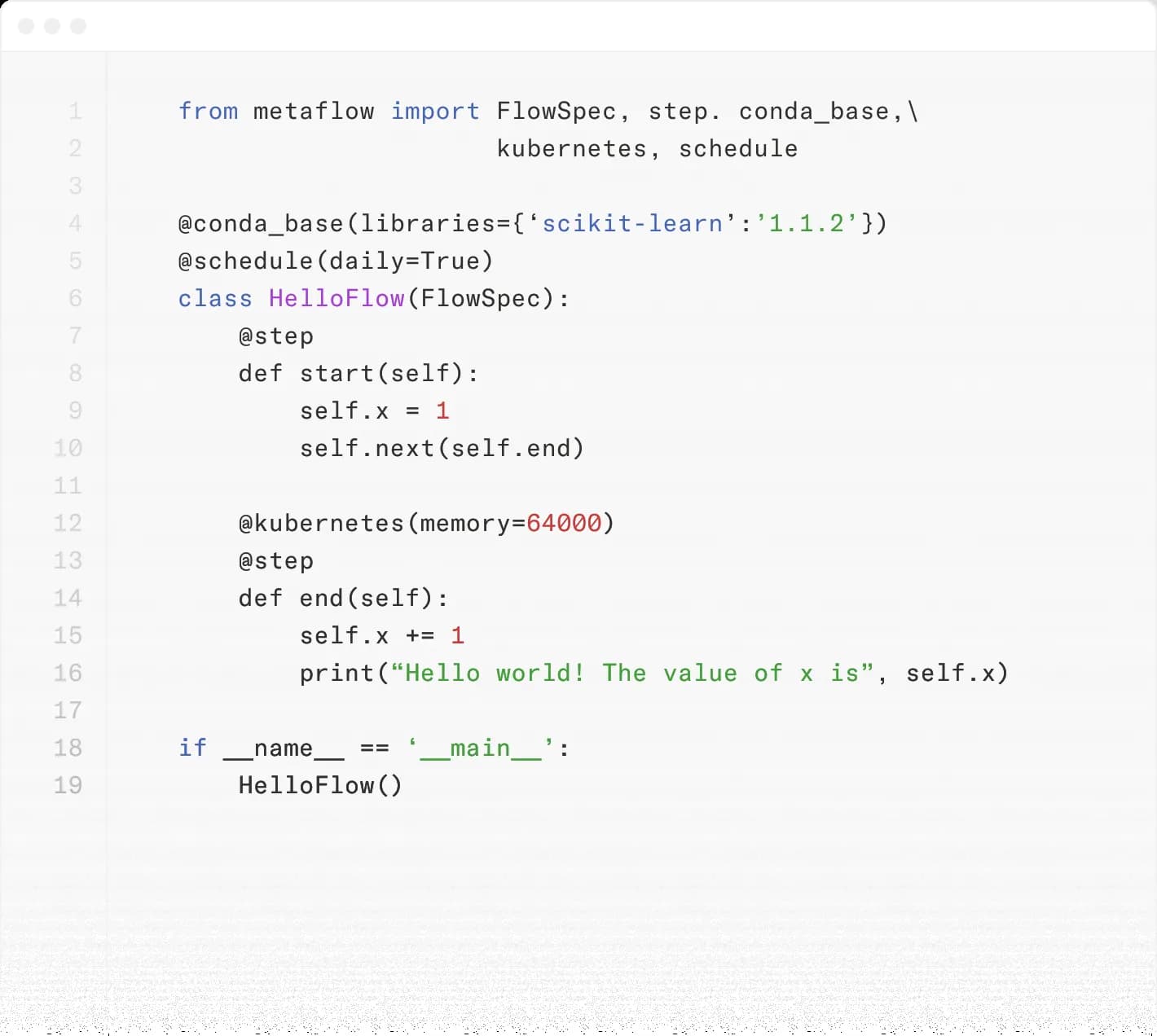
- Python framework with AWS Step Functions backend; no Kubernetes required, using decorator-based flows, automatic variable versioning, event integrations, and configurable local or cloud execution.
- Pricing Model:
- GitHub license: Apache-2.0 (tool can be self-hosted for free)
- Ease of Use:
- Minimal learning curve with decorator-based Python API; developers can use existing Python libraries, develop and debug locally, then deploy workflows with a single command.
- Infrastructure Requirements:
- No Kubernetes needed; AWS Step Functions plus Batch provide serverless execution, while cloud functions can use GPUs, multiple cores, large memory, and local development tooling.
- Community/Ecosystem:
- Netflix-developed, active GitHub community, strong AWS ecosystem integration; GitHub has 10,257 stars, Apache-2.0 licensing, Python primary language, and 2.19.39 released September 2026.
Public signals
Verified factual signals only. Bars appear only for like-for-like metrics with five weekly assessments for every tool; missing evidence stays explicit. These signals do not establish enterprise adoption, product quality, or total cost.
| Metric | Flyte | Metaflow |
|---|---|---|
| GitHub commits, 90d(Product adoption) | 334 | 38 |
| GitHub stars(Product adoption) | 7,000+ | 10,000+ |
| Search interest(Market interest) | Unavailable | 2 |
| Hacker News mentions, 90d(Community interest) | 0 | Not available |
| PyPI weekly downloads(Developer adoption) | 28.0k | Not available |
| Stack Overflow questions(Community interest) | 21 | 31 |
| PyPI weekly downloads(Product adoption) | Not available | 87.4k |
As of September 14, 2026 — updated weekly.
Health & risk evidence
Observed public-source checks for mapped package versions and repositories.
Flyte
September 14, 2026Package vulnerabilities
PyPI · flyte@2.7.2
0 vulnerabilities
across 1 package
Repository security score
Not available
Metaflow
September 14, 2026Package vulnerabilities
PyPI · metaflow@2.19.39
0 vulnerabilities
across 1 package
Repository security score
Not available
Interface Preview
Flyte

Metaflow
Feature Comparison
| Feature | Flyte | Metaflow |
|---|---|---|
| Core Orchestration | ||
| Architecture | Kubernetes-native with control plane, data plane, and admin server | Python framework with pluggable compute backends (AWS, K8s) |
| SDK Language Support | Python (primary), Java, Scala | Python only |
| Type System | Strongly-typed with Flytekit annotations for all inputs/outputs | Dynamic Python types with automatic pickling |
| Workflow Authoring | @task and @workflow decorators with explicit type signatures | @step decorators on Python class methods with minimal boilerplate |
| Production Backend | Kubernetes (required for all execution) | AWS Step Functions (primary), Argo Workflows (K8s alternative) |
| Data & Caching | ||
| Caching | Content-addressable, type-aware automatic caching across executions | Decorator-based caching with @cache step-level control |
| Data Versioning | Automatic versioning of all task inputs/outputs in Flyte blob store | Automatic artifact versioning via S3-backed Metaflow datastore |
| Container Isolation | Every task runs in its own container with declared image | @conda/@pypi decorators for per-step dependency isolation |
| Operations & Scale | ||
| Multi-Tenancy | Built-in project and domain isolation for shared installations | No built-in multi-tenancy; separate deployments per team |
| GPU Support | Native K8s GPU scheduling; Union.ai rates from T4g $0.15/hr to H200 $1.58/hr | @resources decorator for GPU allocation via underlying compute layer |
| Scheduling | Built-in LaunchPlans with cron scheduling and parameterization | Event-triggered via AWS Step Functions or Argo cron workflows |
| Web UI | Flyte Console with execution graphs, task logs, and data preview | Optional Metaflow UI for run inspection; AWS Console for Step Functions |
| Pricing & Deployment | ||
| Self-Hosted Cost | Free but requires Kubernetes cluster (EKS ~$73/mo control plane + nodes) | Free with no Kubernetes required; pay only for AWS compute |
| Managed Service | Union.ai Team $950/mo with $950 usage credit; Enterprise custom pricing | No managed service available; self-hosted only |
Core Orchestration
Architecture
SDK Language Support
Type System
Workflow Authoring
Production Backend
Data & Caching
Caching
Data Versioning
Container Isolation
Operations & Scale
Multi-Tenancy
GPU Support
Scheduling
Web UI
Pricing & Deployment
Self-Hosted Cost
Managed Service
Which to choose
Flyte is the better choice for ML engineering teams on Kubernetes that need type-safe, cached, multi-tenant orchestration with complete data lineage. Its Kubernetes-native design, dynamic workflows, fractional GPU scheduling, and Union.ai Team plan fit teams standardizing distributed production AI workloads. Metaflow is the better choice for data science teams on AWS that need the fastest path from experiment to production without managing Kubernetes infrastructure. Its decorator-based Python workflows, automatic variable tracking, and Step Functions plus Batch execution suit teams prioritizing rapid model delivery.
Best-fit scenarios
Choose Flyte if:
Choose Flyte if you have ML platform engineers, operate Kubernetes, and need type safety, intelligent caching, multi-tenancy, or multi-language SDK support for production ML systems. Choose Union.ai Team when managed operations are preferred; it costs $950/month with $950 usage credit and supports up to 1,000 concurrent actions.
Choose Metaflow if:
Choose Metaflow if your team is primarily data scientists on AWS who need to ship ML models to production quickly without managing Kubernetes infrastructure or learning a new type system. Self-host the Apache 2.0 framework for free and budget separately for AWS Step Functions, Batch, GPU, and storage consumption.
These scenarios reflect the available product evidence. Your requirements, existing stack, and team expertise should guide the final decision.
Frequently Asked Questions
Does Flyte require Kubernetes?
Flyte 2 is available locally, while Flyte 1 is the stated path for distributed execution.
Can Metaflow run on Kubernetes?
Yes. While Metaflow's primary production backend is AWS Step Functions, it also supports Argo Workflows as a Kubernetes-based execution backend. This gives teams the option to use K8s while maintaining the same Python API.
Which tool has better experiment tracking?
Both provide built-in experiment tracking. Flyte tracks all typed inputs/outputs with lineage via Flyte Console. Metaflow versions all Python variables and artifacts via its Client API. Neither replaces dedicated tools like MLflow or W&B for metric visualization.
How do Flyte and Metaflow handle GPU workloads?
Flyte handles GPU scheduling natively through Kubernetes GPU device plugins. Union.ai offers GPU rates from T4g at $0.1516/hr to H200 at $1.58/hr. Metaflow uses @resources decorators to request GPUs from the underlying compute layer (AWS Batch or Kubernetes).