Decision comparison
Metaflow vs MLflow
Metaflow and MLflow are complementary tools that address different stages of the ML lifecycle. Metaflow is a workflow orchestration framework built for ML engineers who want to write production-grade data science pipelines in plain Python, scale them to the cloud, and deploy with a single command. MLflow is an AI engineering platform built for teams that need to track experiments, manage models, observe LLM applications, and serve models in production. Metaflow gives you the pipeline backbone; MLflow gives you the experiment management, model lifecycle, and LLM tooling layer. Teams building traditional ML pipelines that need robust orchestration, cloud-agnostic compute scaling, and seamless local-to-production deployment will get the most from Metaflow. Teams building LLM applications and AI agents that need tracing, evaluation, prompt optimization, and production serving will find MLflow indispensable.
Architecture choice. These take different approaches to the same problem. Read the table as a fit question rather than a feature race.
These are different kinds of product — ML Pipeline Framework and Experiment Tracking.
Quick Comparison
| Decision factor | Metaflow | MLflow |
|---|---|---|
| Primary Focus | End-to-end ML workflow orchestration from prototyping to production deployment | AI engineering platform for tracking, evaluating, and deploying ML models and LLM applications |
| Workflow Orchestration | Native Python DAG-based workflows with decorators, recursive steps, and conditional branching | Not a workflow orchestrator; focuses on experiment management, model lifecycle, and serving |
| Experiment Tracking | Automatic versioning of all variables and artifacts within flows; built into the framework | Dedicated tracking server with UI for metrics, parameters, artifacts, and model comparison |
| LLM & Agent Support | General-purpose compute framework; supports LLM workloads through standard Python steps and GPU scheduling | Purpose-built LLMOps with tracing, prompt management, evaluation with 50+ metrics, and Agent Server |
| Cloud Support | AWS (EKS, S3, Batch, Step Functions), Azure (AKS, Blob), GCP (GKE, GCS), and custom Kubernetes | Cloud-agnostic; runs on any infrastructure; integrates with 100+ AI frameworks |
| Best For | ML engineers who want a code-first framework to orchestrate, scale, and deploy data science workflows | AI teams that need unified experiment tracking, model registry, LLM observability, and production serving |
Metaflow
- Primary Focus:
- End-to-end ML workflow orchestration from prototyping to production deployment
- Workflow Orchestration:
- Native Python DAG-based workflows with decorators, recursive steps, and conditional branching
- Experiment Tracking:
- Automatic versioning of all variables and artifacts within flows; built into the framework
- LLM & Agent Support:
- General-purpose compute framework; supports LLM workloads through standard Python steps and GPU scheduling
- Cloud Support:
- AWS (EKS, S3, Batch, Step Functions), Azure (AKS, Blob), GCP (GKE, GCS), and custom Kubernetes
- Best For:
- ML engineers who want a code-first framework to orchestrate, scale, and deploy data science workflows
MLflow
- Primary Focus:
- AI engineering platform for tracking, evaluating, and deploying ML models and LLM applications
- Workflow Orchestration:
- Not a workflow orchestrator; focuses on experiment management, model lifecycle, and serving
- Experiment Tracking:
- Dedicated tracking server with UI for metrics, parameters, artifacts, and model comparison
- LLM & Agent Support:
- Purpose-built LLMOps with tracing, prompt management, evaluation with 50+ metrics, and Agent Server
- Cloud Support:
- Cloud-agnostic; runs on any infrastructure; integrates with 100+ AI frameworks
- Best For:
- AI teams that need unified experiment tracking, model registry, LLM observability, and production serving
Public signals
Verified factual signals only. Bars appear only for like-for-like metrics with five weekly assessments for every tool; missing evidence stays explicit. These signals do not establish enterprise adoption, product quality, or total cost.
| Metric | Metaflow | MLflow |
|---|---|---|
| GitHub commits, 90d(Product adoption) | 32 | 926 |
| GitHub stars(Product adoption) | 10,000+ | 28,000+ |
| Search interest(Market interest) | 2 | 2 |
| PyPI weekly downloads(Product adoption) | 108.1k | 4.6M |
| Stack Overflow questions(Community interest) | 31 | 771 |
| Hacker News mentions, 90d(Community interest) | Not available | 1 |
As of September 21, 2026 — updated weekly.
Health & risk evidence
Observed public-source checks for mapped package versions and repositories.
Metaflow
September 21, 2026Package vulnerabilities
PyPI · metaflow@2.19.39
0 vulnerabilities
across 1 package
Repository security score
Not available
MLflow
September 21, 2026Package vulnerabilities
PyPI · mlflow@3.16.1
0 vulnerabilities
across 1 package
Repository security score
github.com/mlflow/mlflow
5.4/10
Interface Preview
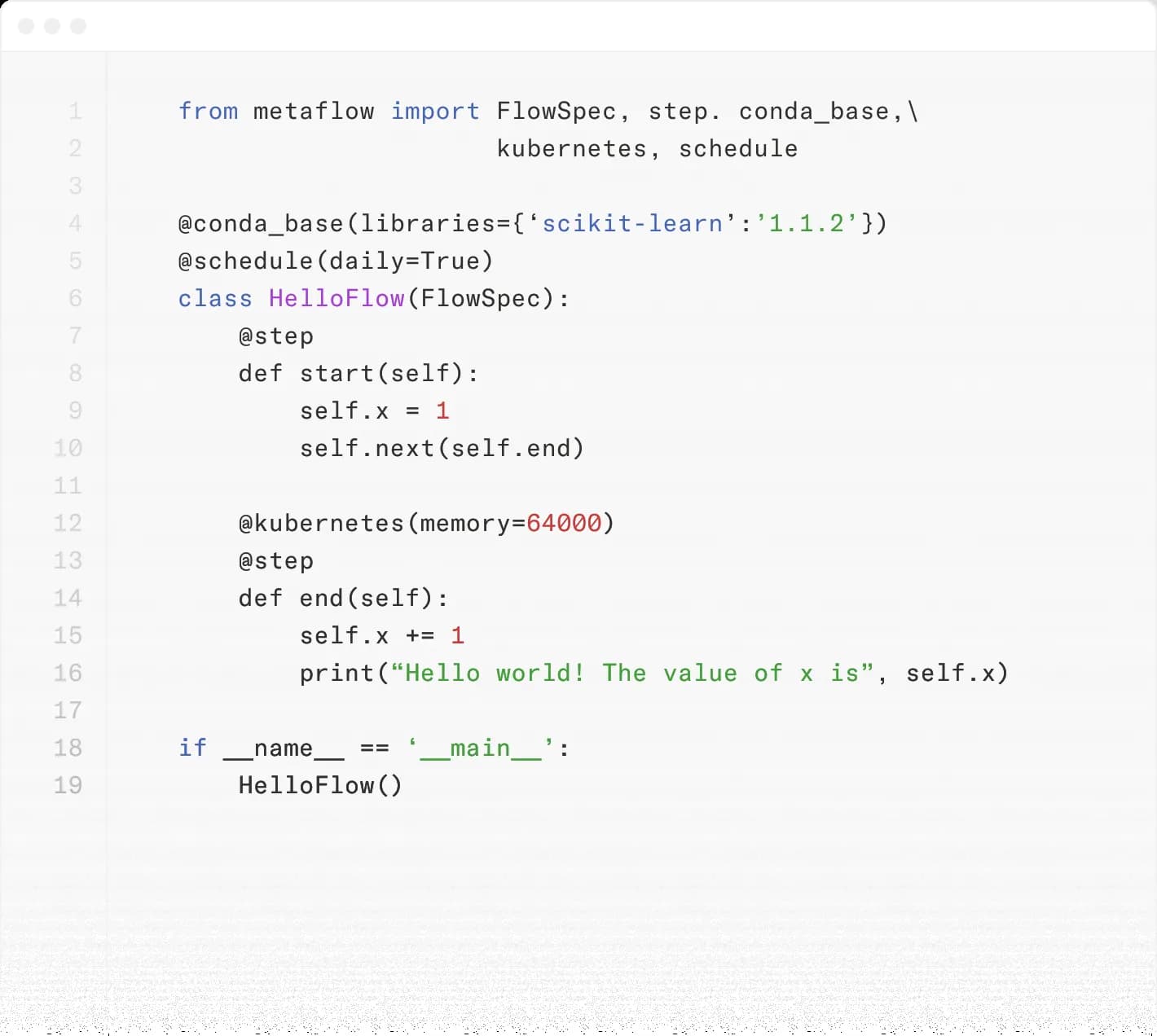
Metaflow
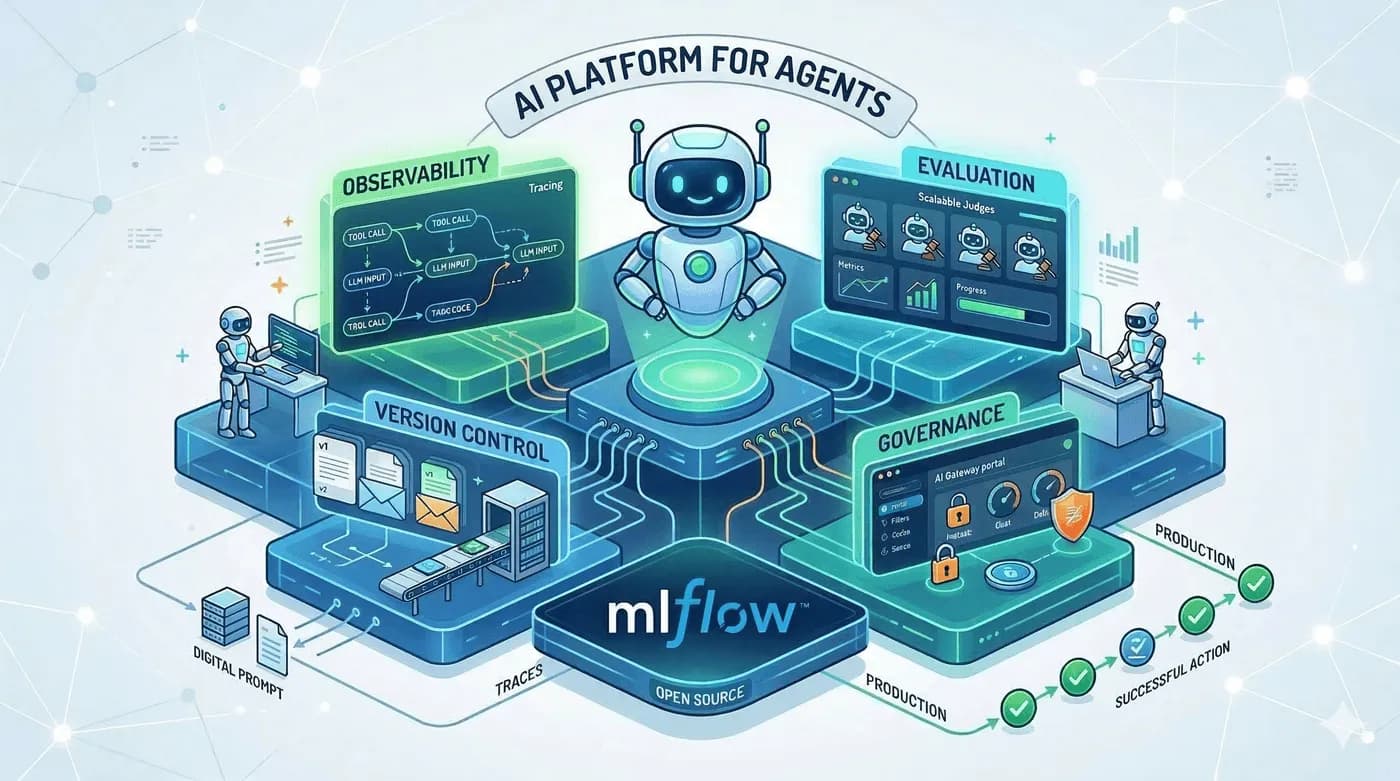
MLflow
Feature Comparison
| Feature | Metaflow | MLflow |
|---|---|---|
| Workflow & Orchestration | ||
| DAG-Based Workflows | Native Python DAGs with decorators, branching, joins, and recursive/conditional steps | Not a workflow orchestrator; designed to complement orchestration tools like Airflow or Prefect |
| Production Deployment | One-command deployment to production with event-driven scheduling and no code changes required | Model serving via MLflow Models and Agent Server with FastAPI-based hosting and streaming support |
| Compute Scaling | Built-in cloud scaling with GPU access, multi-core, large memory, and parallel instance support | Relies on external infrastructure for compute; focused on tracking and serving rather than execution |
| Experiment Tracking & Versioning | ||
| Experiment Logging | Automatic versioning of all variables and data artifacts across flow steps; implicit tracking | Explicit and autolog-based tracking of metrics, parameters, and artifacts with a dedicated tracking server |
| Model Registry | No built-in model registry; artifacts are versioned within flows | Central model registry with version management, staging, production, and archiving lifecycle |
| Experiment Comparison | Client API and metadata service for querying past runs and comparing results programmatically | Visual UI for comparing runs side-by-side with metric charts, parameter tables, and artifact inspection |
| LLM & AI Agent Capabilities | ||
| LLM Observability | General-purpose logging; no dedicated LLM tracing or observability features | OpenTelemetry-based tracing for LLM applications with production quality, cost, and safety monitoring |
| Prompt Management | Not offered; prompts managed through standard Python code within flows | Dedicated prompt versioning, testing, deployment, and automatic optimization with state-of-the-art algorithms |
| Evaluation Framework | No built-in evaluation framework; evaluation handled in user-defined flow steps | 50+ built-in metrics and LLM judges with flexible APIs for custom evaluation and regression detection |
| Infrastructure & Integration | ||
| Cloud Provider Support | Deep integrations with AWS, Azure, GCP, and Kubernetes with cloud-native deployment stacks | Cloud-agnostic deployment; runs on any infrastructure without cloud-specific integrations |
| Framework Integrations | Works with any Python library; dependency management built into the framework via @conda and @pypi decorators | Native integrations with 100+ frameworks including LangChain, OpenAI, PyTorch, and scikit-learn |
| API Gateway | Not offered; Metaflow focuses on workflow execution rather than API management | AI Gateway with unified API for LLM providers, rate limiting, fallbacks, and cost controls |
| Developer Experience | ||
| Local Development | One-click local development stack; develop and debug locally, deploy to cloud without changes | Local server via single command (uvx mlflow server); Docker setup also available |
| Notebook Support | Explore with notebooks and transition to production flows; programmatic API for notebook execution | Full notebook integration with autolog support and tracking UI accessible from any environment |
| Community & Ecosystem | 10,000+ GitHub stars; originally developed at Netflix; Apache-2.0 license | 27,000+ GitHub stars; 900+ contributors; backed by Linux Foundation; 30M+ monthly downloads |
Workflow & Orchestration
DAG-Based Workflows
Production Deployment
Compute Scaling
Experiment Tracking & Versioning
Experiment Logging
Model Registry
Experiment Comparison
LLM & AI Agent Capabilities
LLM Observability
Prompt Management
Evaluation Framework
Infrastructure & Integration
Cloud Provider Support
Framework Integrations
API Gateway
Developer Experience
Local Development
Notebook Support
Community & Ecosystem
Which approach fits
Metaflow and MLflow are complementary tools that address different stages of the ML lifecycle. Metaflow is a workflow orchestration framework built for ML engineers who want to write production-grade data science pipelines in plain Python, scale them to the cloud, and deploy with a single command. MLflow is an AI engineering platform built for teams that need to track experiments, manage models, observe LLM applications, and serve models in production. Metaflow gives you the pipeline backbone; MLflow gives you the experiment management, model lifecycle, and LLM tooling layer. Teams building traditional ML pipelines that need robust orchestration, cloud-agnostic compute scaling, and seamless local-to-production deployment will get the most from Metaflow. Teams building LLM applications and AI agents that need tracing, evaluation, prompt optimization, and production serving will find MLflow indispensable.
When each approach fits
Choose Metaflow if:
Choose Metaflow if your primary need is end-to-end ML workflow orchestration. It is the stronger choice when you need to define complex data science pipelines in Python, scale compute across AWS, Azure, GCP, or Kubernetes with built-in GPU support, and deploy workflows to production without rewriting code. Metaflow shines for teams that value a code-first, human-centric approach to ML engineering, especially those with complex multi-step workflows involving data access, feature engineering, model training, and deployment. Originally battle-hardened at Netflix, it is trusted by companies like 23andMe, CNN, and Realtor.com for production ML workloads.
Choose MLflow if:
Choose MLflow if your primary need is experiment tracking, model management, or LLM application development. It is the stronger choice when you need a visual tracking UI for comparing experiments, a central model registry with lifecycle management, or purpose-built LLMOps capabilities including tracing, evaluation, prompt optimization, and agent deployment. MLflow's 100+ framework integrations, 30 million monthly downloads, and backing by the Linux Foundation make it the industry standard for ML experiment management. Teams working heavily with LLMs and AI agents will particularly benefit from its AI Gateway, Agent Server, and OpenTelemetry-based observability.
These scenarios reflect the available product evidence. Your requirements, existing stack, and team expertise should guide the final decision.
Frequently Asked Questions
What is the main difference between Metaflow and MLflow?
Metaflow is a workflow orchestration framework that lets you define, run, and deploy ML pipelines as Python code, handling everything from local prototyping to cloud-scale execution. MLflow is an AI engineering platform focused on experiment tracking, model registry, LLM observability, and model serving. Metaflow answers the question of how to structure and run your ML workflow end-to-end; MLflow answers the question of how to track, evaluate, and manage the models and artifacts that workflow produces. The two tools are complementary and many teams use them together.
Can Metaflow and MLflow be used together?
Yes. Metaflow and MLflow solve different problems and integrate naturally. Teams commonly use Metaflow as the orchestration layer to define and execute their ML pipelines, while using MLflow inside individual Metaflow steps for experiment tracking, model logging, and registry management. This combination gives you Metaflow's production orchestration and compute scaling alongside MLflow's tracking UI, model versioning, and serving capabilities.
Which tool is better for LLM and AI agent projects?
MLflow has a significant advantage for LLM-specific workflows. It offers purpose-built features including OpenTelemetry-based tracing for LLM applications, prompt versioning and optimization, an evaluation framework with 50+ built-in metrics and LLM judges, an AI Gateway for managing LLM provider access and costs, and an Agent Server for deploying AI agents to production. Metaflow can run LLM workloads as standard Python steps with GPU scheduling, but it does not provide dedicated LLM tooling.
Which tool has better production deployment capabilities?
It depends on what you mean by deployment. Metaflow excels at deploying entire ML workflows to production, letting you go from local development to cloud-scale execution with a single command and no code changes. It handles scheduling, compute scaling, and event-driven triggering. MLflow excels at deploying trained models as REST endpoints through its model serving and Agent Server capabilities. For full pipeline orchestration in production, Metaflow is stronger. For model serving and LLM agent hosting, MLflow is stronger.
Are both tools truly free and open source?
Yes. Both Metaflow and MLflow are released under the Apache-2.0 license and can be self-hosted at no cost. Metaflow was originally developed at Netflix and open-sourced in 2019. MLflow was created by Databricks and is now backed by the Linux Foundation. Both projects are actively maintained with regular releases. MLflow's latest release is v3.11.1 (April 2026) and Metaflow's latest release is 2.19.22 (March 2026). Infrastructure costs for running either tool depend on your cloud provider and scale.