Decision comparison
Metaflow vs Kubeflow
Metaflow and Kubeflow serve different segments of the MLOps landscape. Metaflow excels as a developer-friendly Python framework that lets data scientists go from notebook experimentation to production deployment with minimal friction. Kubeflow provides a comprehensive Kubernetes-native AI platform with modular components covering the entire ML lifecycle at enterprise scale.
Direct comparison. These are reviewed substitutes bought for the same job, so the differences below are the ones that decide between them.
All 2 are ML pipeline frameworks.
Quick Comparison
| Decision factor | Metaflow | Kubeflow |
|---|---|---|
| Best For | Data scientists who want a Python-native framework for building and deploying ML workflows quickly | Platform teams building enterprise-scale AI infrastructure on Kubernetes clusters |
| Architecture | Lightweight Python framework with decorator-based flow definitions and optional cloud backends | Modular Kubernetes-native platform composed of independent projects for each ML lifecycle stage |
| Learning Curve | Low barrier to entry with plain Python workflows, local development, and notebook-friendly design | Steeper learning curve requiring Kubernetes expertise and understanding of multiple sub-components |
| Scalability | Scales individual workflows to cloud GPUs, multiple cores, and parallel instances on demand | Enterprise-grade horizontal scaling across distributed Kubernetes clusters with multi-framework support |
| Ecosystem | Focused framework with built-in versioning, orchestration, and integrations for AWS, Azure, and GCP | Broad ecosystem including Pipelines, Katib AutoML, KServe inference, Model Registry, and Spark Operator |
| Community | 10,000+ GitHub stars, originally developed at Netflix, backed by active open-source community | 15,000+ GitHub stars, 258M+ PyPI downloads, 3K contributors, backed by CNCF foundation |
Metaflow
- Best For:
- Data scientists who want a Python-native framework for building and deploying ML workflows quickly
- Architecture:
- Lightweight Python framework with decorator-based flow definitions and optional cloud backends
- Learning Curve:
- Low barrier to entry with plain Python workflows, local development, and notebook-friendly design
- Scalability:
- Scales individual workflows to cloud GPUs, multiple cores, and parallel instances on demand
- Ecosystem:
- Focused framework with built-in versioning, orchestration, and integrations for AWS, Azure, and GCP
- Community:
- 10,000+ GitHub stars, originally developed at Netflix, backed by active open-source community
Kubeflow
- Best For:
- Platform teams building enterprise-scale AI infrastructure on Kubernetes clusters
- Architecture:
- Modular Kubernetes-native platform composed of independent projects for each ML lifecycle stage
- Learning Curve:
- Steeper learning curve requiring Kubernetes expertise and understanding of multiple sub-components
- Scalability:
- Enterprise-grade horizontal scaling across distributed Kubernetes clusters with multi-framework support
- Ecosystem:
- Broad ecosystem including Pipelines, Katib AutoML, KServe inference, Model Registry, and Spark Operator
- Community:
- 15,000+ GitHub stars, 258M+ PyPI downloads, 3K contributors, backed by CNCF foundation
Public signals
Verified factual signals only. Bars appear only for like-for-like metrics with five weekly assessments for every tool; missing evidence stays explicit. These signals do not establish enterprise adoption, product quality, or total cost.
| Metric | Metaflow | Kubeflow |
|---|---|---|
| GitHub commits, 90d(Product adoption) | 38 | 12 |
| GitHub stars(Product adoption) | 10,000+ | 15,000+ |
| Search interest(Market interest) | 2 | 0 |
| PyPI weekly downloads(Product adoption) | 87.4k | Not available |
| Stack Overflow questions(Community interest) | 31 | 420 |
| Hacker News mentions, 90d(Community interest) | Not available | 1 |
| PyPI weekly downloads(Developer adoption) | Not available | 2.5M |
As of September 14, 2026 — updated weekly.
Health & risk evidence
Observed public-source checks for mapped package versions and repositories.
Metaflow
September 14, 2026Package vulnerabilities
PyPI · metaflow@2.19.39
0 vulnerabilities
across 1 package
Repository security score
Not available
Kubeflow
September 14, 2026Package vulnerabilities
PyPI · kfp@2.17.0
0 vulnerabilities
across 1 package
Repository security score
Not available
Interface Preview
Metaflow
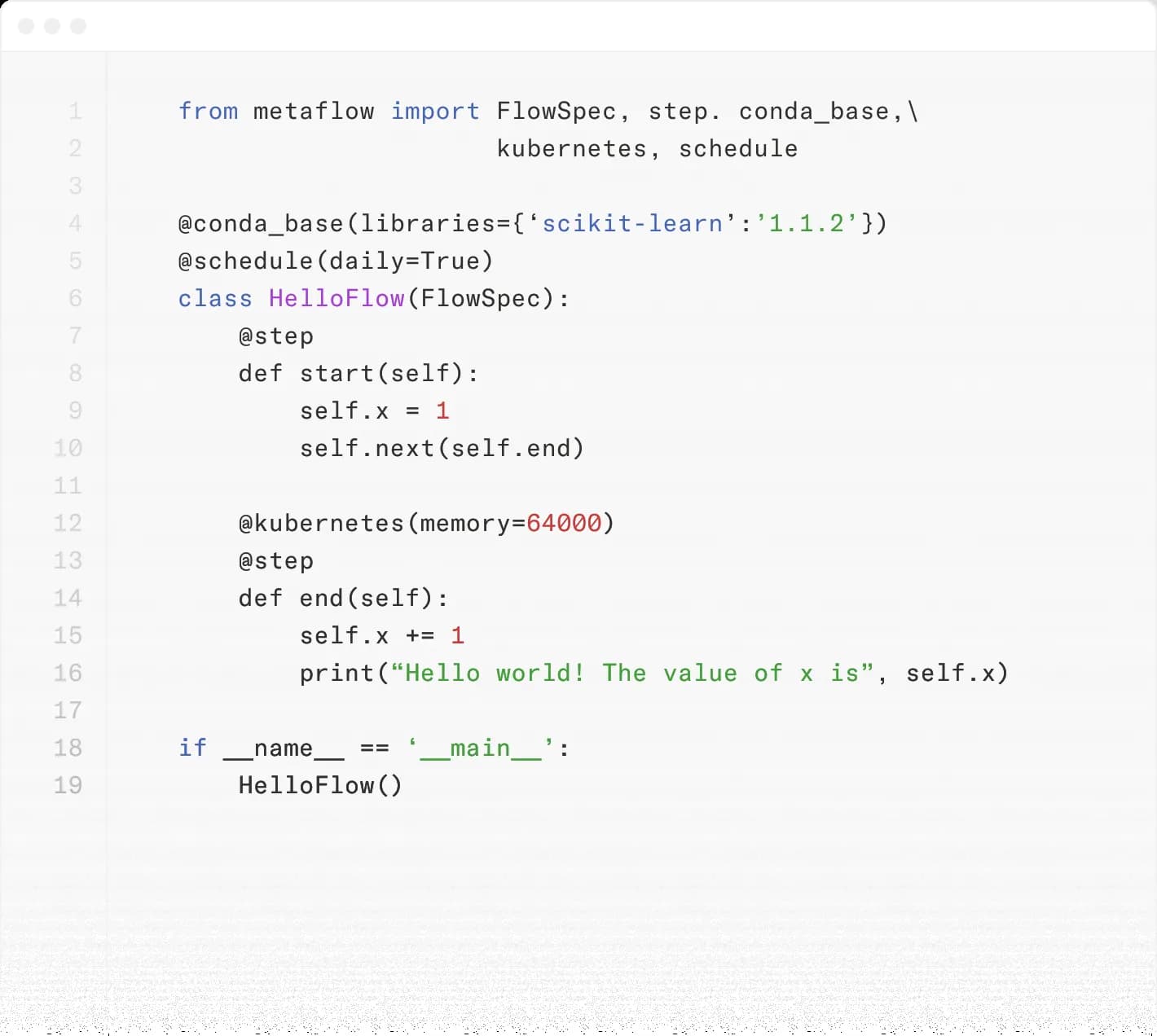
Feature Comparison
| Feature | Metaflow | Kubeflow |
|---|---|---|
| Workflow Orchestration | ||
| Pipeline Definition Language | Python decorators and classes | Python SDK and YAML DSL |
| DAG Support | Full support | Full support |
| Recursive and Conditional Steps | Full support | Not verified |
| Compute and Scaling | ||
| GPU Support | Full support | Full support |
| Distributed Training | Via cloud backends | Native with Kubeflow Trainer across PyTorch, JAX, DeepSpeed, and more |
| Auto-Scaling | Cloud-managed scaling | Kubernetes-native horizontal pod autoscaling |
| Model Management | ||
| Experiment Tracking | Built-in automatic versioning of variables and artifacts | Via Katib for hyperparameter tuning experiments |
| Model Registry | Not verified | Kubeflow Hub (formerly Model Registry) |
| AutoML / Hyperparameter Tuning | Not verified | Katib with early stopping and neural architecture search |
| Deployment and Serving | ||
| One-Command Production Deploy | Full support | Not verified |
| Model Serving / Inference | Not verified | KServe for multi-framework generative and predictive AI inference |
| Event-Driven Triggers | Full support | Via Kubernetes event handling |
| Developer Experience | ||
| Local Development | One-click local development stack with full Metaflow capabilities | Requires local Kubernetes cluster (minikube or similar) |
| Notebook Integration | Native notebook exploration and programmatic flow execution | Kubeflow Notebooks for interactive development environments |
| Web Dashboard | Monitoring GUI for flows | Kubeflow Central Dashboard connecting all component UIs |
Workflow Orchestration
Pipeline Definition Language
DAG Support
Recursive and Conditional Steps
Compute and Scaling
GPU Support
Distributed Training
Auto-Scaling
Model Management
Experiment Tracking
Model Registry
AutoML / Hyperparameter Tuning
Deployment and Serving
One-Command Production Deploy
Model Serving / Inference
Event-Driven Triggers
Developer Experience
Local Development
Notebook Integration
Web Dashboard
Which to choose
Metaflow and Kubeflow serve different segments of the MLOps landscape. Metaflow excels as a developer-friendly Python framework that lets data scientists go from notebook experimentation to production deployment with minimal friction. Kubeflow provides a comprehensive Kubernetes-native AI platform with modular components covering the entire ML lifecycle at enterprise scale.
Best-fit scenarios
These scenarios reflect the available product evidence. Your requirements, existing stack, and team expertise should guide the final decision.
Frequently Asked Questions
Can Metaflow and Kubeflow be used together?
Yes, Metaflow and Kubeflow can complement each other in certain architectures. Metaflow supports deployment on Kubernetes clusters, which means you can run Metaflow workflows on the same infrastructure where Kubeflow operates. Some teams use Metaflow for workflow orchestration and experimentation while leveraging Kubeflow components like KServe for model serving or Katib for hyperparameter tuning. However, most organizations choose one as their primary framework to keep operational complexity manageable.
Which tool has better support for distributed training of large language models?
Kubeflow has stronger native support for distributed training through the Kubeflow Trainer component, which provides Kubernetes-native distributed AI training across frameworks including PyTorch, DeepSpeed, Megatron, JAX, HuggingFace, and MLX. It handles the orchestration of multi-node training jobs directly on Kubernetes. Metaflow supports distributed compute through cloud backends and includes support for AWS Trainium for LLM training and fine-tuning, but its distributed training capabilities are more dependent on the underlying cloud provider infrastructure.
How do Metaflow and Kubeflow handle experiment tracking differently?
Metaflow takes a built-in approach to experiment tracking by automatically versioning all variables and artifacts produced inside each flow step. Every run creates a traceable lineage of data and code, making it straightforward to compare experiments and debug issues without additional tooling. Kubeflow approaches experimentation primarily through Katib, its AutoML component that manages hyperparameter tuning experiments with features like early stopping and neural architecture search. For broader experiment tracking, Kubeflow teams typically integrate external tools like MLflow or integrate with the Kubeflow Model Registry for artifact management.
Which tool is easier to get started with for a small team?
Metaflow is significantly easier to get started with for small teams. You can install it with pip, write workflows in plain Python using decorators, and develop and test everything locally on a laptop with the one-click local development stack. There is no infrastructure prerequisite beyond Python. Kubeflow requires a running Kubernetes cluster as a baseline, which means your team needs Kubernetes expertise before writing any ML code. For small teams without dedicated platform engineers, the operational overhead of maintaining Kubeflow infrastructure can outweigh the benefits of its comprehensive feature set.
How do the two tools compare for production deployment reliability?
Both tools are battle-tested in production environments. Metaflow was originally developed at Netflix to handle demanding real-life ML and AI projects, and it powers production workflows at companies like 23andMe, CNN, and Realtor.com. Its single-command deployment and event-driven triggers make production rollouts straightforward. Kubeflow inherits Kubernetes reliability guarantees including self-healing, rolling updates, and resource isolation. As a CNCF project trusted by major enterprises with over 258 million PyPI downloads, Kubeflow provides enterprise-grade production stability for organizations already invested in the Kubernetes ecosystem.