Decision comparison
OpenAI vs Anthropic
OpenAI and Anthropic represent two distinct philosophies in AI development. OpenAI delivers a broad ecosystem with mature tooling, a sizable context window on its flagship model, and competitive API pricing across three model tiers. Anthropic leads on AI safety, long-form writing quality, and document analysis through its Constitutional AI approach. For teams building production agents or needing voice capabilities, we recommend OpenAI. For organizations prioritizing safety-first AI, long-document processing, and polished prose output, we recommend Anthropic.
Direct comparison. These are reviewed substitutes bought for the same job, so the differences below are the ones that decide between them.
All 2 are foundation model providers.
Quick Comparison
| Decision factor | OpenAI | Anthropic |
|---|---|---|
| Pricing Model | Contact for pricing | Free tier, Pro $20/month, Team $25/user/month, Enterprise custom |
| API Cost (Flagship) | GPT-5.4: $2.50/1M input, $15.00/1M output | Claude Opus: premium pricing (higher per-token than OpenAI) |
| Context Window | Up to 1.05M tokens (GPT-5.4) | Up to 200K tokens (1M experimental) |
| Primary Strength | Sizable ecosystem, extensive model range, mature tooling | AI safety leadership, superior long-form writing, document analysis |
| Safety Approach | Reinforcement Learning from Human Feedback (RLHF) | Constitutional AI with explicit written principles |
| Ecosystem Size | Massive — industry-standard SDKs, thousands of integrations | Growing — approximately 30M monthly active users, expanding integrations |
OpenAI
- Pricing Model:
- Contact for pricing
- API Cost (Flagship):
- GPT-5.4: $2.50/1M input, $15.00/1M output
- Context Window:
- Up to 1.05M tokens (GPT-5.4)
- Primary Strength:
- Sizable ecosystem, extensive model range, mature tooling
- Safety Approach:
- Reinforcement Learning from Human Feedback (RLHF)
- Ecosystem Size:
- Massive — industry-standard SDKs, thousands of integrations
Anthropic
- Pricing Model:
- Free tier, Pro $20/month, Team $25/user/month, Enterprise custom
- API Cost (Flagship):
- Claude Opus: premium pricing (higher per-token than OpenAI)
- Context Window:
- Up to 200K tokens (1M experimental)
- Primary Strength:
- AI safety leadership, superior long-form writing, document analysis
- Safety Approach:
- Constitutional AI with explicit written principles
- Ecosystem Size:
- Growing — approximately 30M monthly active users, expanding integrations
Public signals
Verified factual signals only. Bars appear only for like-for-like metrics with five weekly assessments for every tool; missing evidence stays explicit. These signals do not establish enterprise adoption, product quality, or total cost.
| Metric | OpenAI | Anthropic |
|---|---|---|
| GitHub commits, 90d(Developer adoption) | 209 | 244 |
| GitHub stars(Developer adoption) | 31,000+ | 3,500+ |
| Search interest(Market interest) | 422 | 46 |
| Hacker News mentions, 90d(Community interest) | 1.6k | 1.1k |
| Hugging Face downloads(Product adoption) | 44.7M | 58.1k |
| Hugging Face likes(Product adoption) | 14.2k | 2.7k |
| npm weekly downloads(Developer adoption) | 28.2M | 28.2M |
| Product Hunt comments(Community interest) | 1 | Not available |
| Product Hunt rating(Community interest) | 5.0/5 | Not available |
| Product Hunt reviews(Community interest) | 1 | Not available |
| Product Hunt votes(Community interest) | 7 | Not available |
| PyPI weekly downloads(Developer adoption) | 68.2M | 33.1M |
| Stack Overflow questions(Community interest) | 2.5k | 2 |
As of September 21, 2026 — updated weekly.
Health & risk evidence
Observed public-source checks for mapped package versions and repositories.
OpenAI
September 21, 2026Package vulnerabilities
npm · openai@7.20.0 · PyPI · openai@3.16.2
0 vulnerabilities
across 2 packages
Repository security score
Not available
Anthropic
September 21, 2026Package vulnerabilities
npm · @anthropic-ai/sdk@0.127.0 · PyPI · anthropic@1.7.0
0 vulnerabilities
across 2 packages
Repository security score
Not available
Interface Preview
OpenAI
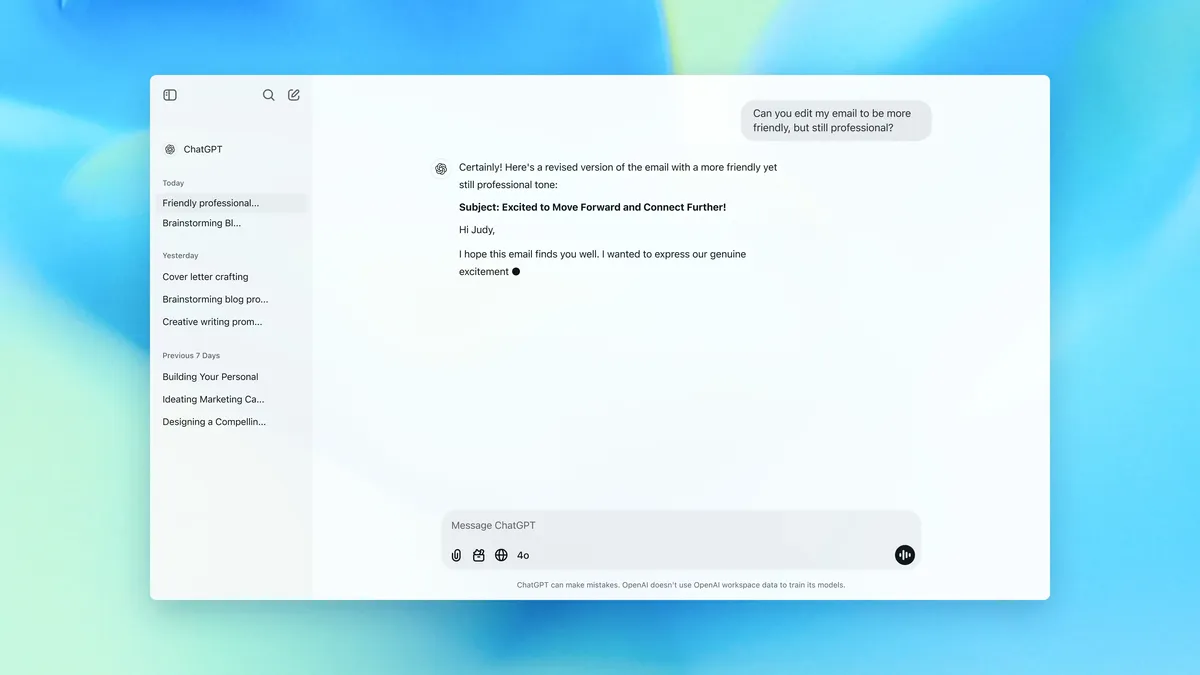
Feature Comparison
| Feature | OpenAI | Anthropic |
|---|---|---|
| Model Capabilities | ||
| Flagship Model | GPT-5.4 (1.05M context, 128K max output) | Claude Sonnet 4.6 (frontier coding, agents, professional work) |
| Budget Model | GPT-5.4 nano ($0.20/1M input, $1.25/1M output) | Claude Sonnet (included in free tier) |
| Maximum Context Window | 1.05M tokens (GPT-5.4) | 200K tokens (1M experimental) |
| Long-Form Writing Quality | Good — versatile and creative | Excellent — considered best AI writing assistant in 2026 |
| Code Generation | Excellent — strong at novel algorithms | Very strong — excels at refactoring and agents |
| Platform and Tooling | ||
| Agent Building | Agent Builder (visual) + Agents SDK (code-first) + ChatKit | Claude Code + Cowork for task delegation |
| Voice and Realtime | Realtime API for voice agents and customer experiences | Not available as dedicated API |
| Image Generation | DALL-E 3 built in | No built-in image generation |
| Consumer Interface | ChatGPT (feature-rich, GPTs marketplace) | claude.ai (clean, focused, Projects and Artifacts) |
| Desktop and Mobile Apps | ChatGPT apps on iOS, Android, macOS, Windows | Claude apps on macOS, Windows, iOS, Android |
| Enterprise and Security | ||
| Data Privacy | Zero data retention by request, SOC 2 Type 2, BAA for HIPAA | Strong encryption, clear data retention policies, HIPAA-ready |
| Access Controls | SSO, MFA, RBAC, IP allowlist, mTLS | SSO, SCIM, audit logs, advanced access controls |
| Team Plans | Business and Enterprise plans (contact sales) | Team $25/user/mo, Enterprise self-serve or sales-assisted |
| Compliance | SOC 2 Type 2, AES-256 encryption, TLS 1.2+ | Responsible Scaling Policy, Constitutional AI governance |
| Dedicated Support | Dedicated account team, solutions architects | Enterprise support (limited customer service per user reports) |
Model Capabilities
Flagship Model
Budget Model
Maximum Context Window
Long-Form Writing Quality
Code Generation
Platform and Tooling
Agent Building
Voice and Realtime
Image Generation
Consumer Interface
Desktop and Mobile Apps
Enterprise and Security
Data Privacy
Access Controls
Team Plans
Compliance
Dedicated Support
Which to choose
OpenAI and Anthropic represent two distinct philosophies in AI development. OpenAI delivers a broad ecosystem with mature tooling, a sizable context window on its flagship model, and competitive API pricing across three model tiers. Anthropic leads on AI safety, long-form writing quality, and document analysis through its Constitutional AI approach. For teams building production agents or needing voice capabilities, we recommend OpenAI. For organizations prioritizing safety-first AI, long-document processing, and polished prose output, we recommend Anthropic.
Best-fit scenarios
Choose OpenAI if:
Choose OpenAI when you need the broadest model ecosystem, mature agent-building tools (Agent Builder, Agents SDK, ChatKit), voice capabilities via the Realtime API, or image generation through DALL-E 3. OpenAI also fits teams that need a sizable context window at 1.05M tokens on GPT-5.4 and want access to budget options like GPT-5.4 nano at $0.20 per million input tokens. The extensive third-party integration library and industry-standard SDKs reduce development time for production applications.
Choose Anthropic if:
Choose Anthropic when your work demands superior long-form writing, deep document analysis across a 200K-token context window, or safety-first AI governance via Constitutional AI. Anthropic excels for legal document review, compliance workflows, medical research summarization, and any use case where hallucination reduction matters. The free tier makes it accessible for evaluation, while Team and Enterprise plans provide transparent per-seat pricing with self-serve onboarding.
These scenarios reflect the available product evidence. Your requirements, existing stack, and team expertise should guide the final decision.
Frequently Asked Questions
Which platform offers better API pricing for high-volume usage?
The supplied OpenAI evidence lists standard processing rates for contexts under 270K: GPT-5.6 Sol is $4.00 per 1M input tokens and $20.00 per 1M output tokens, while GPT-5.6 Luna is $0.20 per 1M input tokens and $1.20 per 1M output tokens. It does not provide Anthropic pricing or a like-for-like workload comparison, so it cannot establish which platform offers better economics for high-volume usage. Buyers should compare the applicable model, input and output token volumes, context length, and any batch or regional-processing terms for their own workload.
Can I use both OpenAI and Anthropic together in production?
Yes, and many engineering teams do exactly this. A common pattern involves routing different task types to the model that performs best for each use case. We see teams using OpenAI for code generation, real-time voice agents, and image creation, while sending long-document analysis, compliance reviews, and writing tasks to Anthropic's Claude. Multi-provider aggregators make it straightforward to run both through a single API endpoint with routing and failover built in.
Which platform is better for enterprise AI safety and compliance?
Both platforms offer enterprise-grade security, but their approaches differ. OpenAI provides SOC 2 Type 2 compliance, HIPAA BAAs, zero data retention policies, and infrastructure controls like IP allowlists and mTLS. Anthropic takes a governance-first approach with Constitutional AI principles, a Responsible Scaling Policy, and HIPAA-ready deployments. Anthropic's explicit written safety constitution gives organizations clearer auditability of model behavior, while OpenAI's larger compliance certification portfolio may satisfy more traditional enterprise procurement requirements.
What is the biggest practical difference between OpenAI and Anthropic for developers?
The primary practical difference is ecosystem breadth versus output quality focus. OpenAI offers a mature developer ecosystem with visual Agent Builder, code-first Agents SDK, Realtime API for voice, DALL-E 3 for images, and thousands of third-party integrations. Anthropic focuses on fewer but deeper capabilities, with Claude Code excelling at coding and agent workflows and Cowork enabling task delegation with local files and cloud apps. Developers building diverse multi-modal applications typically start with OpenAI, while those focused on code-heavy or document-heavy workflows often prefer Anthropic.