Decision comparison
Anthropic vs Mistral AI
Choose Claude for safety-critical production AI with complex tool use and long context; choose Mistral for EU data residency, open-weight self-hosting, or cost-sensitive high-volume inference. Claude is suited to customer-facing workflows needing predictable safety behavior, collaborative reasoning, and analysis of complex documents or code. Mistral is suited to private on-premises, cloud, edge, or device deployments where teams retain control of their data. A combined architecture can use Claude for production agentic features and Mistral for self-hosted fallback paths or fine-tuning experiments.
Direct comparison. These are reviewed substitutes bought for the same job, so the differences below are the ones that decide between them.
All 2 are foundation model providers.
Quick Comparison
| Decision factor | Anthropic | Mistral AI |
|---|---|---|
| Best For | Safety-critical production AI with strong tool use and long-context reasoning, including coding, agents, professional work, and critical data analysis. | EU data residency, open-weight self-hosting, cost-sensitive inference, and tailored enterprise AI systems requiring multilingual capabilities and flexible deployment. |
| Pricing | Free tier, Pro $20/month, Team $25/user/month, Enterprise custom | La Plateforme API: Mistral Small $0.1/M input, $0.3/M output tokens. Mistral Medium $2.75/M input, $8.1/M output. Mistral Large $2/M input, $6/M output. Fine-tuning from $4/M tokens. Open-weight models (Mistral 7B, Mixtral 8x7B) free to self-host under Apache 2.0. |
| Flagship model | Claude Opus 4, Sonnet 4; Claude Sonnet 4.6 is positioned for frontier coding, agents, and professional work. | Mistral Large 2, Mistral Medium; Mistral Medium API pricing is $2.75/M input tokens and $8.10/M output tokens. |
| Fast/cheap model | Claude Haiku 4; the published comparison positions it as Anthropic’s fast/cheap model alongside Free, Pro, Team, Enterprise, and API access. | Mistral Small, Mistral 7B (open); Small starts at $0.10/M input and $0.30/M output tokens, while open weights are self-hostable. |
| Deployment and data control | Cowork integrates with local files and cloud apps for delegated execution; Anthropic emphasizes Responsible Scaling Policy and Core AI safety principles. | Deploy privately on-premises, cloud, edge, or devices while retaining data control; train, distill, fine-tune, and build with open-source models. |
| Developer client and licensing | Python repository under the MIT license, with 3,857 GitHub stars; latest release v1.1.0 and last push were August 2026. | Python client library under Apache-2.0, with 764 GitHub stars; latest release v2.9.4 and last push were August 2026. |
Anthropic
- Best For:
- Safety-critical production AI with strong tool use and long-context reasoning, including coding, agents, professional work, and critical data analysis.
- Pricing:
- Free tier, Pro $20/month, Team $25/user/month, Enterprise custom
- Flagship model:
- Claude Opus 4, Sonnet 4; Claude Sonnet 4.6 is positioned for frontier coding, agents, and professional work.
- Fast/cheap model:
- Claude Haiku 4; the published comparison positions it as Anthropic’s fast/cheap model alongside Free, Pro, Team, Enterprise, and API access.
- Deployment and data control:
- Cowork integrates with local files and cloud apps for delegated execution; Anthropic emphasizes Responsible Scaling Policy and Core AI safety principles.
- Developer client and licensing:
- Python repository under the MIT license, with 3,857 GitHub stars; latest release v1.1.0 and last push were August 2026.
Mistral AI
- Best For:
- EU data residency, open-weight self-hosting, cost-sensitive inference, and tailored enterprise AI systems requiring multilingual capabilities and flexible deployment.
- Pricing:
- La Plateforme API: Mistral Small $0.1/M input, $0.3/M output tokens. Mistral Medium $2.75/M input, $8.1/M output. Mistral Large $2/M input, $6/M output. Fine-tuning from $4/M tokens. Open-weight models (Mistral 7B, Mixtral 8x7B) free to self-host under Apache 2.0.
- Flagship model:
- Mistral Large 2, Mistral Medium; Mistral Medium API pricing is $2.75/M input tokens and $8.10/M output tokens.
- Fast/cheap model:
- Mistral Small, Mistral 7B (open); Small starts at $0.10/M input and $0.30/M output tokens, while open weights are self-hostable.
- Deployment and data control:
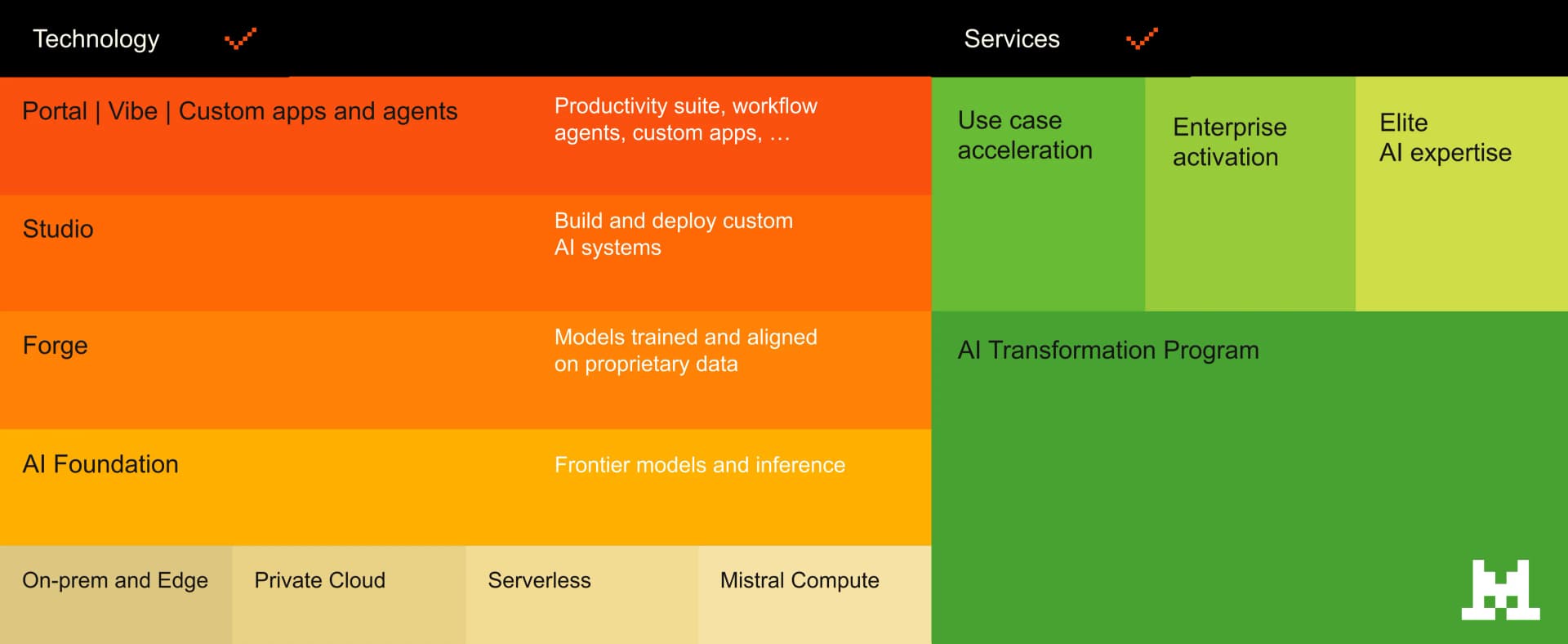
- Deploy privately on-premises, cloud, edge, or devices while retaining data control; train, distill, fine-tune, and build with open-source models.
- Developer client and licensing:
- Python client library under Apache-2.0, with 764 GitHub stars; latest release v2.9.4 and last push were August 2026.
Public signals
Verified factual signals only. Bars appear only for like-for-like metrics with five weekly assessments for every tool; missing evidence stays explicit. These signals do not establish enterprise adoption, product quality, or total cost.
| Metric | Anthropic | Mistral AI |
|---|---|---|
| GitHub commits, 90d(Developer adoption) | 244 | 28 |
| GitHub stars(Developer adoption) | 3,500+ | 767 |
| Search interest(Market interest) | 46 | 8 |
| Hacker News mentions, 90d(Community interest) | 1.1k | 5 |
| Hugging Face downloads(Product adoption) | 58.1k | 4.6M |
| Hugging Face likes(Product adoption) | 2.7k | 10.9k |
| npm weekly downloads(Developer adoption) | 28.2M | 6.0M |
| PyPI weekly downloads(Developer adoption) | 33.1M | 4.4M |
| Stack Overflow questions(Community interest) | 2 | 12 |
As of September 21, 2026 — updated weekly.
Health & risk evidence
Observed public-source checks for mapped package versions and repositories.
Anthropic
September 21, 2026Package vulnerabilities
npm · @anthropic-ai/sdk@0.127.0 · PyPI · anthropic@1.7.0
0 vulnerabilities
across 2 packages
Repository security score
Not available
Mistral AI
September 21, 2026Package vulnerabilities
npm · @mistralai/mistralai@2.7.0 · PyPI · mistralai@2.10.1
0 vulnerabilities
across 2 packages
Repository security score
Not available
Interface Preview
Mistral AI
Feature Comparison
| Feature | Anthropic | Mistral AI |
|---|---|---|
| Model Access | ||
| Flagship model | Claude Opus 4, Sonnet 4 | Mistral Large 2, Mistral Medium |
| Fast/cheap model | Claude Haiku 4 | Mistral Small, Mistral 7B (open) |
| Open-weight models | Not available — all models are proprietary | Mistral 7B, Mixtral 8x7B, Nemo, Codestral (Apache 2.0) |
| Self-hosting option | Not verified | Yes — download weights and run on own hardware |
| Developer Experience | ||
| Default context window | 200,000 tokens (1M on request for select customers) | 32,000 tokens (Mistral Large: 128,000) |
| Tool / function calling | Native; leads on agentic benchmarks | Native; less mature at complex multi-step chains |
| Prompt caching | Yes — per-message caching reduces repeated-context costs up to 90% | Not currently offered |
| Vision / multimodal | Yes — all current Claude models | Yes — Pixtral and Mistral Large |
| Dedicated code model | General Claude models plus Claude Code CLI | Codestral (dedicated code model, open-weight) |
| Ecosystem & Compliance | ||
| Primary cloud partners | AWS Bedrock, Google Vertex AI, Databricks | Azure AI, Google Vertex, self-hosted |
| Data residency | US-based; partial EU via Bedrock | EU-based by default (French company) |
| Consumer product | Claude.ai (Free, Pro $20/mo, Team $25/user/mo, Enterprise) | Le Chat (free tier plus Pro and Business) |
| SDK adoption (weekly downloads) | ~44M combined (PyPI 28M + npm 16M) | ~5M combined (npm 3.3M + PyPI) |
Model Access
Flagship model
Fast/cheap model
Open-weight models
Self-hosting option
Developer Experience
Default context window
Tool / function calling
Prompt caching
Vision / multimodal
Dedicated code model
Ecosystem & Compliance
Primary cloud partners
Data residency
Consumer product
SDK adoption (weekly downloads)
Which to choose
Choose Claude for safety-critical production AI with complex tool use and long context; choose Mistral for EU data residency, open-weight self-hosting, or cost-sensitive high-volume inference. Claude is suited to customer-facing workflows needing predictable safety behavior, collaborative reasoning, and analysis of complex documents or code. Mistral is suited to private on-premises, cloud, edge, or device deployments where teams retain control of their data. A combined architecture can use Claude for production agentic features and Mistral for self-hosted fallback paths or fine-tuning experiments.
Best-fit scenarios
Choose Anthropic if:
For customer-facing products where output reliability and brand safety are business requirements, Claude's Constitutional AI training produces the most predictable refusal behavior. Choose it for complex tool use, long-context reasoning, coding, and critical data-analysis workflows that benefit from expert-style collaboration.
Choose Mistral AI if:
For teams with EU data-residency obligations or those building in air-gapped / VPC-isolated environments, Mistral's open-weight models under Apache 2.0 are the only frontier-class option. Its private deployment options span on-premises, cloud, edge, and devices while retaining control of data.
Choose Mistral AI if:
For cost-sensitive high-volume inference at steady state, Mistral Small ($0.10/M input) and self-hosted Mixtral 8x7B undercut most frontier alternatives. Mistral Small also costs $0.30/M output tokens, while Mistral Large costs $2/M input and $6/M output tokens.
Choose Anthropic if:
Many teams benefit from using both: Claude for production agentic features, Mistral for prototyping, fine-tuning experiments, and self-hosted fallback inference paths. Use Claude’s Cowork integrations for local-file and cloud-app task execution, while retaining Mistral for private deployment scenarios.
These scenarios reflect the available product evidence. Your requirements, existing stack, and team expertise should guide the final decision.
Frequently Asked Questions
Is Claude better than Mistral for coding?
For general-purpose code generation and reasoning about existing codebases, Claude Sonnet 4 currently benchmarks higher than Mistral Large on HumanEval and SWE-bench. However, Mistral's Codestral is a dedicated code model with strong autocomplete performance and is available as open-weight, making it a better fit for IDE integrations or self-hosted developer tools. For agentic coding against a real repo, Claude Code has a meaningful lead.
Can I use Mistral's open-weight models commercially?
Yes. Mistral 7B, Mixtral 8x7B, Mistral Nemo, and Codestral are released under Apache 2.0, which permits commercial use including embedding in proprietary products, modification, and redistribution. The commercial-only models (Mistral Large, Medium, Small) are accessed via La Plateforme API under its commercial terms.
Which has better support for non-English languages?
Mistral was built with European multilingualism as an explicit design goal and generally performs better on French, German, Spanish, and Italian for nuanced writing tasks. Claude has invested in Japanese, Chinese, and Korean support. For niche languages, test both on your actual content since public benchmarks don't reflect every language pair.
Is Anthropic safer than Mistral?
Claude refuses harmful requests more reliably than Mistral and is less susceptible to common jailbreak patterns, which is useful for consumer-facing products. It also means Claude is more conservative in edge cases, which some developers find over-cautious for security research or medical contexts. Mistral is more permissive by default — an advantage for some use cases and a risk for others. Neither company has published enough adversarial red-team data for a sweeping claim.