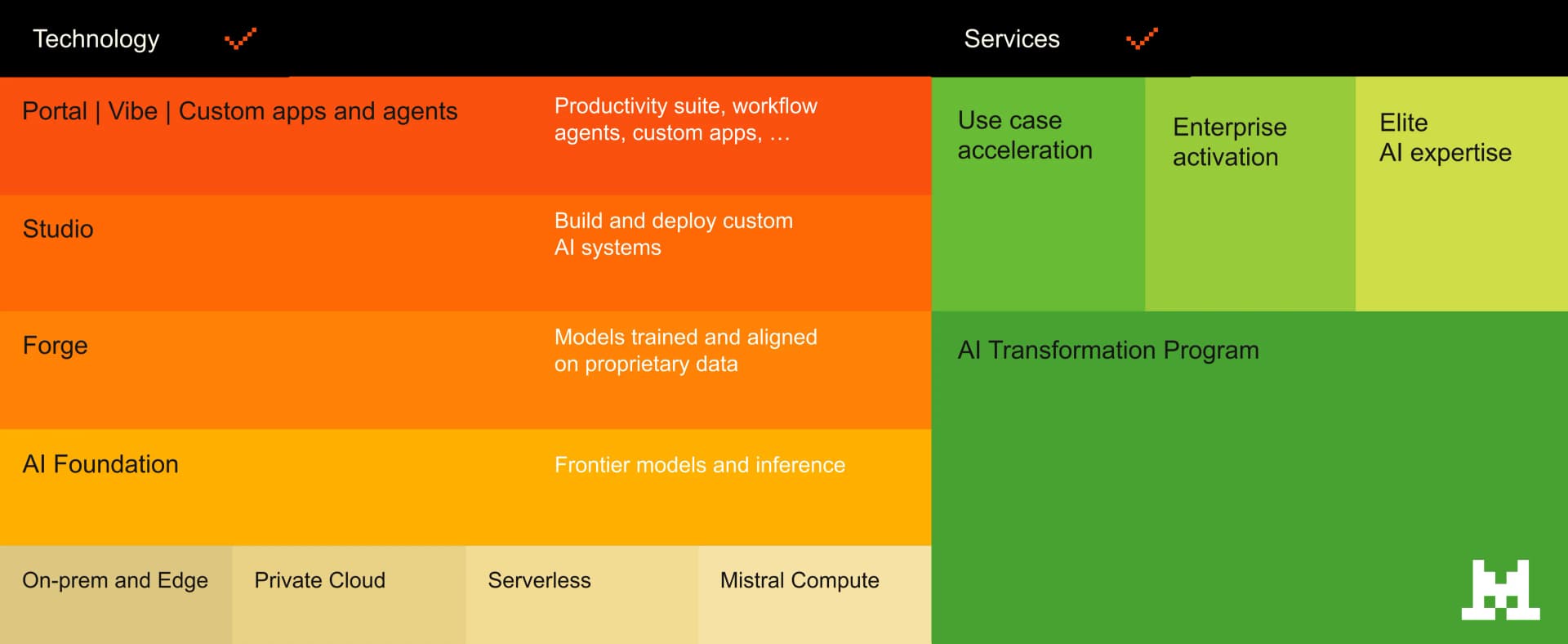
Mistral AI: product and architecture
This Mistral AI review examines the European AI company that has rapidly established itself as a serious contender in the large language model space. Founded in 2023 by former DeepMind and Meta researchers, Mistral AI has taken a distinctive approach by releasing high-performance open-weight models alongside commercial API offerings through La Plateforme. For data teams and enterprises evaluating LLM providers, Mistral offers a rare combination: models that rival GPT-4-class performance at substantially lower cost, with the flexibility to self-host or consume via a managed API. Whether you are building retrieval-augmented generation pipelines, deploying multilingual chatbots, or fine-tuning domain-specific assistants, Mistral deserves close scrutiny from any team serious about production AI.
Overview
Mistral AI operates out of Paris and has raised over $600 million in funding since its founding. The company ships both open-weight models available under the Apache 2.0 license and proprietary commercial models accessible through La Plateforme, its managed API service. The open-weight lineup includes Mistral 7B, a compact yet powerful decoder-only transformer, and Mixtral 8x7B, a sparse mixture-of-experts architecture that activates only two of its eight expert sub-networks per token. On the commercial side, Mistral Small, Mistral Medium, and Mistral Large target different performance-cost tradeoffs for various production workloads. La Plateforme also provides fine-tuning capabilities, function calling, JSON mode, and guardrails, making it a full-stack inference platform rather than just a model repository. Mistral's multilingual strength, particularly across European languages like French, German, Spanish, and Italian, sets it apart from US-centric competitors who primarily optimize for English-language tasks.
Key Features and Architecture
Mistral AI's technical differentiation starts at the architecture level. The open-weight Mistral 7B model introduced sliding window attention (SWA), which limits each token's attention to a fixed-size local window rather than the full sequence. This yields near-linear memory scaling with sequence length while preserving strong long-range reasoning through stacked layers. Grouped-query attention (GQA) further reduces the key-value cache footprint, enabling faster inference on commodity GPUs with limited VRAM.
Mixtral 8x7B scales this foundation through sparse mixture-of-experts. Each transformer layer contains eight feedforward expert blocks, but a gating network routes each token to only two experts. The result is a model with 46.7 billion total parameters but roughly 12.9 billion active parameters per forward pass, delivering performance competitive with models three to four times its active size while keeping inference costs manageable for production deployments.
La Plateforme, Mistral's managed API, exposes these models along with commercial variants through a REST API compatible with the OpenAI SDK format. Key platform capabilities include:
- Function calling and tool use for agentic workflows that require structured external API interaction
- JSON mode that constrains model output to valid JSON, critical for data pipeline integration and structured extraction tasks
- Fine-tuning API supporting LoRA-based adaptation with customer data, enabling domain-specific model customization without full retraining overhead
- Guardrails and content filtering configurable per endpoint to meet compliance requirements
- Embedding endpoints for semantic search and retrieval-augmented generation pipelines
- Batch inference for high-throughput offline processing at reduced latency sensitivity
The platform supports streaming responses and provides per-request token usage tracking for granular cost management and budgeting.
Ideal Use Cases
Mistral AI fits organizations that need high-quality language model inference without full vendor lock-in. The open-weight models are ideal for teams running on-premises or in private cloud environments where data sovereignty matters, particularly in regulated European industries subject to GDPR constraints. Self-hosting Mistral 7B on a single A100 or even consumer-grade RTX 4090 hardware keeps inference costs near zero after the initial infrastructure investment, which appeals to research labs and cost-conscious startups alike.
For startups and mid-market companies that prefer managed infrastructure, La Plateforme's commercial models handle production workloads at a low per-token cost compared to competing hosted API services. Multilingual applications benefit from Mistral's strong performance across European languages, making it a natural fit for companies operating across EU markets. Fine-tuning via the API suits teams building vertical assistants for legal, medical, or financial domains where off-the-shelf general-purpose models underperform on specialized terminology and reasoning patterns.
Pros and Cons
Pros:
- Open-weight models under Apache 2.0 allow unrestricted commercial self-hosting with no licensing fees
- Mixtral 8x7B delivers strong performance at a fraction of the active parameter count of competing dense models
- La Plateforme API pricing undercuts most major competitors on a per-token basis across all tiers
- Strong multilingual capability across European languages, a notable advantage for EU-based deployments
- Fine-tuning API supports domain adaptation without managing your own training infrastructure
- OpenAI-compatible API format simplifies migration from existing integrations with minimal code changes
Cons:
- Smaller model ecosystem compared to OpenAI, with fewer specialized model variants and less diverse tooling
- Community and third-party library support is less mature than the ecosystem around GPT-4 or Claude
- No built-in image or multimodal input support on the current generation of API models
- Enterprise support tiers and uptime SLAs are less established than those offered by larger US competitors