Decision comparison
Mistral AI vs OpenAI
Mistral AI and OpenAI represent distinct approaches in the AI platform space. Mistral’s pricing page lists Mistral Large at $0.5 /M input tokens and $1.5 /M output tokens, and describes open-weight-model terms that distinguish research or individual use from commercial deployments; commercial deployments require a Mistral license, while derivatives and production use have separate terms. Buyers considering self-hosting should confirm which licensing and separate terms apply to their intended deployment. OpenAI delivers the most comprehensive managed AI platform with frontier model capabilities, a full agent-building toolkit, and enterprise-grade compliance features for organizations building production AI applications at scale.
Direct comparison. These are reviewed substitutes bought for the same job, so the differences below are the ones that decide between them.
All 2 are foundation model providers.
Quick Comparison
| Decision factor | Mistral AI | OpenAI |
|---|---|---|
| Best For | Cost-efficient inference with open-weight models like Mixtral 8x7B, plus commercial API access via La Plateforme for teams wanting self-hosting flexibility | Enterprise-grade AI applications requiring frontier intelligence with GPT-5.4's 1.05M context window, Realtime API, and comprehensive agent-building platform |
| Model Architecture | Sparse mixture-of-experts architecture in Mixtral models activating 2 of 8 experts per token, plus dense transformer models in Mistral 7B and Mistral Large | Dense transformer architecture across GPT-5.4 family with 1.05M context length, 128K max output tokens, and multimodal capabilities for text, code, and vision |
| Pricing Model | La Plateforme API: Mistral Small $0.1/M input, $0.3/M output tokens. Mistral Medium $2.75/M input, $8.1/M output. Mistral Large $2/M input, $6/M output. Fine-tuning from $4/M tokens. Open-weight models (Mistral 7B, Mixtral 8x7B) free to self-host under Apache 2.0. | Contact for pricing |
| Ease of Use | Developer-focused La Plateforme API with OpenAI-compatible endpoints; open-weight models require infrastructure expertise for self-hosted deployment | Comprehensive developer platform with Playground testing, Agent Builder visual canvas, Agents SDK, ChatKit frontend toolkit, and extensive API documentation |
| Scalability | Self-hosted models scale with your own infrastructure; La Plateforme handles hosted scaling with fine-tuning support starting at $4/M training tokens | Enterprise-grade platform with SOC 2 Type 2 compliance, HIPAA BAA support, SSO/MFA authentication, data residency controls, and dedicated account teams |
| Open Source Commitment | Industry-leading open-weight strategy with Apache 2.0 licensed Mistral 7B and Mixtral 8x7B available for unrestricted commercial self-hosting | Closed-source proprietary models accessed exclusively through API; no self-hosting option but offers fine-tuning and prompt optimization through the platform |
Mistral AI
- Best For:
- Cost-efficient inference with open-weight models like Mixtral 8x7B, plus commercial API access via La Plateforme for teams wanting self-hosting flexibility
- Model Architecture:
- Sparse mixture-of-experts architecture in Mixtral models activating 2 of 8 experts per token, plus dense transformer models in Mistral 7B and Mistral Large
- Pricing Model:
- La Plateforme API: Mistral Small $0.1/M input, $0.3/M output tokens. Mistral Medium $2.75/M input, $8.1/M output. Mistral Large $2/M input, $6/M output. Fine-tuning from $4/M tokens. Open-weight models (Mistral 7B, Mixtral 8x7B) free to self-host under Apache 2.0.
- Ease of Use:
- Developer-focused La Plateforme API with OpenAI-compatible endpoints; open-weight models require infrastructure expertise for self-hosted deployment
- Scalability:
- Self-hosted models scale with your own infrastructure; La Plateforme handles hosted scaling with fine-tuning support starting at $4/M training tokens
- Open Source Commitment:
- Industry-leading open-weight strategy with Apache 2.0 licensed Mistral 7B and Mixtral 8x7B available for unrestricted commercial self-hosting
OpenAI
- Best For:
- Enterprise-grade AI applications requiring frontier intelligence with GPT-5.4's 1.05M context window, Realtime API, and comprehensive agent-building platform
- Model Architecture:
- Dense transformer architecture across GPT-5.4 family with 1.05M context length, 128K max output tokens, and multimodal capabilities for text, code, and vision
- Pricing Model:
- Contact for pricing
- Ease of Use:
- Comprehensive developer platform with Playground testing, Agent Builder visual canvas, Agents SDK, ChatKit frontend toolkit, and extensive API documentation
- Scalability:
- Enterprise-grade platform with SOC 2 Type 2 compliance, HIPAA BAA support, SSO/MFA authentication, data residency controls, and dedicated account teams
- Open Source Commitment:
- Closed-source proprietary models accessed exclusively through API; no self-hosting option but offers fine-tuning and prompt optimization through the platform
Public signals
Verified factual signals only. Bars appear only for like-for-like metrics with five weekly assessments for every tool; missing evidence stays explicit. These signals do not establish enterprise adoption, product quality, or total cost.
| Metric | Mistral AI | OpenAI |
|---|---|---|
| GitHub commits, 90d(Developer adoption) | 34 | 129 |
| GitHub stars(Developer adoption) | 764 | 31,000+ |
| Search interest(Market interest) | 9 | 459 |
| Hacker News mentions, 90d(Community interest) | 6 | 1.5k |
| Hugging Face downloads(Product adoption) | 4.3M | 44.3M |
| Hugging Face likes(Product adoption) | 10.9k | 14.1k |
| npm weekly downloads(Developer adoption) | 7.0M | 29.5M |
| PyPI weekly downloads(Developer adoption) | 3.9M | 65.5M |
| Stack Overflow questions(Community interest) | 12 | 2.5k |
| Product Hunt comments(Community interest) | Not available | 1 |
| Product Hunt rating(Community interest) | Not available | 5.0/5 |
| Product Hunt reviews(Community interest) | Not available | 1 |
| Product Hunt votes(Community interest) | Not available | 7 |
As of September 14, 2026 — updated weekly.
Health & risk evidence
Observed public-source checks for mapped package versions and repositories.
Mistral AI
September 14, 2026Package vulnerabilities
npm · @mistralai/mistralai@2.7.0 · PyPI · mistralai@2.10.0
0 vulnerabilities
across 2 packages
Repository security score
Not available
OpenAI
September 14, 2026Package vulnerabilities
npm · openai@7.15.0 · PyPI · openai@3.13.0
0 vulnerabilities
across 2 packages
Repository security score
Not available
Interface Preview
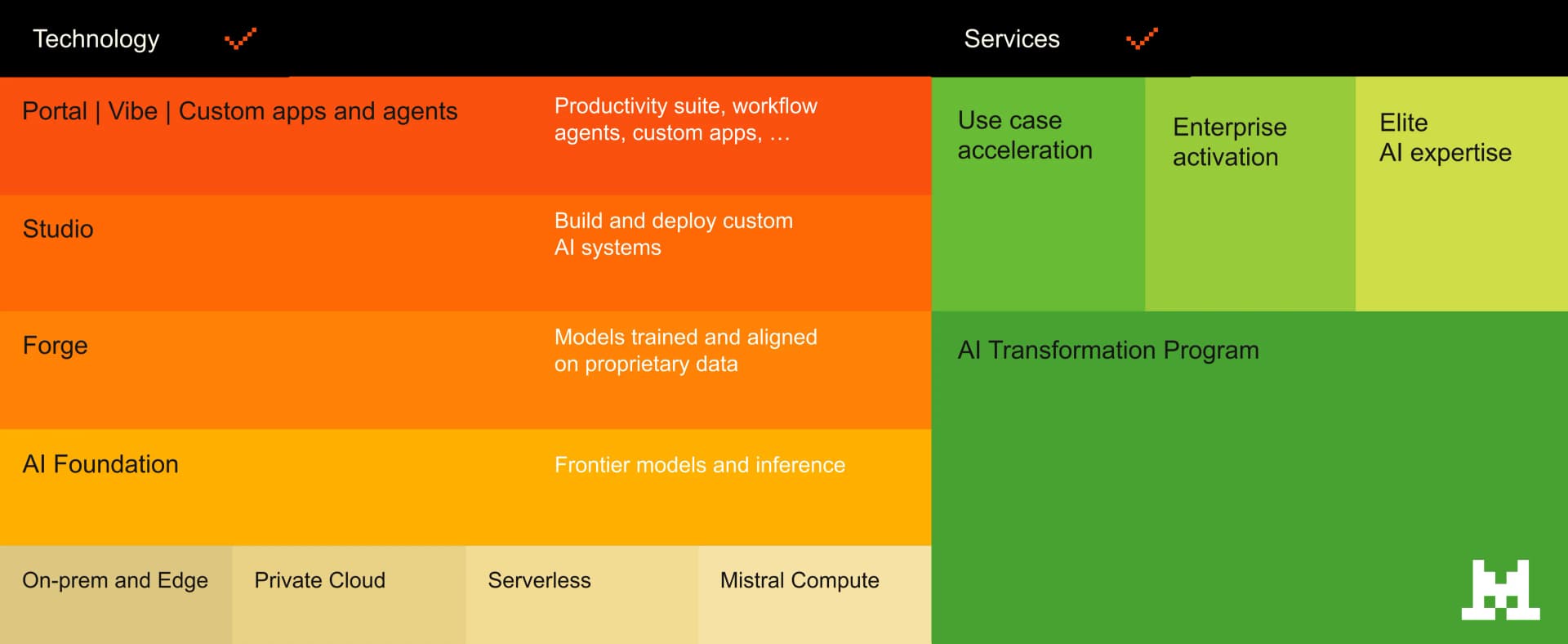
Mistral AI
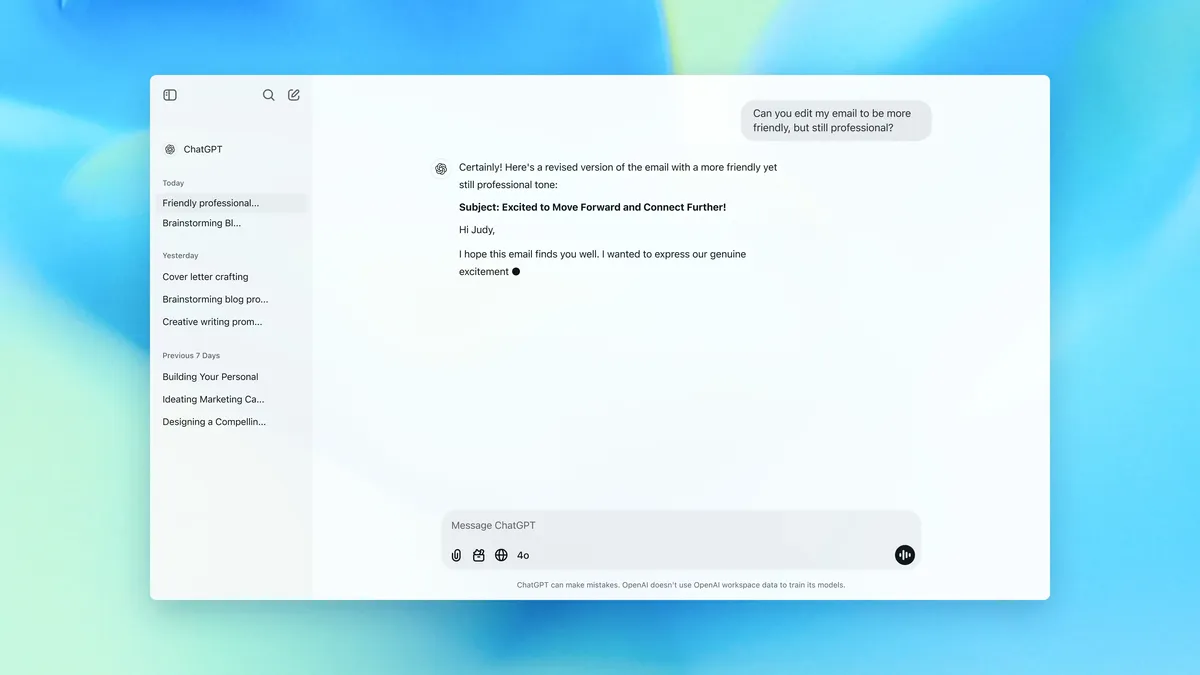
OpenAI
Feature Comparison
| Feature | Mistral AI | OpenAI |
|---|---|---|
| Model Capabilities | ||
| Flagship Model Performance | Mistral Large provides competitive reasoning and multilingual capabilities at $2/M input tokens, optimized for European language tasks | GPT-5.4 offers frontier intelligence with 1.05M context length, 128K max output tokens, and knowledge cut-off of August 2025 |
| Lightweight Model Options | Mistral Large costs $0.5 /M tokens in and $1.5 /M tokens out. | GPT-5.4 nano at $0.20/M input and $1.25/M output tokens with 400K context length and 128K max output for cost-sensitive workloads |
| Multimodal Support | Primarily focused on text generation and code tasks; vision and audio capabilities are more limited compared to broader multimodal platforms | Full multimodal platform covering text, code, vision, and audio processing with DALL-E 3 image generation and Whisper speech-to-text |
| API & Developer Experience | ||
| API Design | La Plateforme API with OpenAI-compatible chat completion endpoints, making migration straightforward for existing OpenAI API users | Comprehensive REST API with dedicated endpoints for chat completions, embeddings, images, audio, and real-time streaming via Realtime API |
| Fine-Tuning Support | Custom fine-tuning available through La Plateforme starting at $4/M training tokens for adapting models to domain-specific tasks | Fine-tuning available across the GPT model family with prompt optimization tools and evaluation frameworks for measuring performance |
| Agent Building Tools | API-first approach for building agent workflows; relies on third-party frameworks for orchestration and agent management | Full agent platform with visual Agent Builder canvas, code-first Agents SDK, ChatKit for frontend experiences, and built-in eval tools |
| Deployment & Hosting | ||
| Self-Hosting Options | Open-weight models like Mistral 7B and Mixtral 8x7B can be self-hosted under Apache 2.0 on any infrastructure without licensing fees | No self-hosting available; all models are accessed exclusively through OpenAI's managed API infrastructure |
| Data Privacy Controls | Self-hosted models keep all data on-premises with zero external data transmission; API usage governed by European GDPR-aligned privacy policies | No training on customer API data by default, zero data retention policy by request, HIPAA BAA support, and data residency controls |
| Infrastructure Requirements | Self-hosting Mixtral 8x7B requires significant GPU resources; La Plateforme API eliminates infrastructure requirements entirely | Fully managed cloud infrastructure with no hardware requirements; IP allowlist and mTLS network controls for enterprise security |
| Enterprise Features | ||
| Compliance & Certifications | European-headquartered company with GDPR-aligned data practices; self-hosted models provide full regulatory control over data residency | SOC 2 Type 2 compliance, HIPAA BAA support, AES-256 encryption at rest, TLS 1.2+ in transit, and data residency controls |
| Access Management | API key-based access control through La Plateforme; self-hosted deployments inherit your organization's existing identity management | Role-based access controls, SSO and MFA authentication, project-level permissions, and IP allowlist with mTLS network controls |
| Enterprise Support | Growing enterprise support offerings through La Plateforme; community support available for open-weight model deployments | Dedicated account teams, prioritized support, solutions architect guidance, and custom AI model collaboration with research teams |
| Pricing & Cost Management | ||
| Entry-Level Cost | Mistral Large costs $0.5 /M tokens in and $1.5 /M tokens out. | GPT-5.4 nano starts at $0.20/M input tokens; free ChatGPT tier available for individual use but API requires pay-as-you-go billing |
| Cost at Scale | Mistral Large at $2/M input and $6/M output tokens is significantly cheaper than comparable frontier models from competitors | GPT-5.4 at $2.50/M input and $15/M output tokens; volume discounts and priority processing pricing available through enterprise sales |
| Billing Controls | Usage-based billing through La Plateforme with straightforward per-token pricing across all hosted model tiers | Granular usage and cost tracking by project, billing and usage alerts to prevent overages, and detailed activity reporting |
Model Capabilities
Flagship Model Performance
Lightweight Model Options
Multimodal Support
API & Developer Experience
API Design
Fine-Tuning Support
Agent Building Tools
Deployment & Hosting
Self-Hosting Options
Data Privacy Controls
Infrastructure Requirements
Enterprise Features
Compliance & Certifications
Access Management
Enterprise Support
Pricing & Cost Management
Entry-Level Cost
Cost at Scale
Billing Controls
Which to choose
Mistral AI and OpenAI represent distinct approaches in the AI platform space. Mistral’s pricing page lists Mistral Large at $0.5 /M input tokens and $1.5 /M output tokens, and describes open-weight-model terms that distinguish research or individual use from commercial deployments; commercial deployments require a Mistral license, while derivatives and production use have separate terms. Buyers considering self-hosting should confirm which licensing and separate terms apply to their intended deployment. OpenAI delivers the most comprehensive managed AI platform with frontier model capabilities, a full agent-building toolkit, and enterprise-grade compliance features for organizations building production AI applications at scale.
Best-fit scenarios
Choose Mistral AI if:
Choose Mistral AI when its published pricing and deployment terms fit your requirements. Mistral’s pricing page states that open-weight models such as Mistral 7B are Apache 2.0 licensed for research or individual use. Commercial deployments require a Mistral license, while derivatives and production use have separate terms. For API usage, the page gives Mistral Large as $0.5 /M input tokens and $1.5 /M output tokens; it also says batch processing reduces price by 50% and cached input tokens can reduce input cost by up to 90% for repeated prompts. Confirm the applicable commercial, derivative, and production terms before selecting a self-hosting approach.
Choose OpenAI if:
Choose OpenAI if your organization needs frontier model intelligence, a comprehensive developer platform, or enterprise-grade compliance and support infrastructure. OpenAI is the right choice when you require GPT-5.4's 1.05M context window for processing very long documents, the Realtime API for voice-powered customer experiences, or the full agent-building suite including Agent Builder, Agents SDK, and ChatKit. Enterprise teams benefit from SOC 2 Type 2 compliance, HIPAA BAA support, dedicated account teams, and granular administrative controls that Mistral AI has not yet matched. The higher token pricing reflects a more mature platform with multimodal capabilities spanning text, code, vision, and audio that go well beyond what Mistral currently offers in its commercial API.
These scenarios reflect the available product evidence. Your requirements, existing stack, and team expertise should guide the final decision.
Frequently Asked Questions
How do Mistral AI and OpenAI pricing compare for a typical production workload?
For a production workload processing 100 million tokens per month, the cost differences are significant. Using Mistral Small at $0.1/M input and $0.3/M output tokens, you would pay roughly $10 for input and $30 for output, totaling approximately $40. The equivalent OpenAI GPT-5.4 nano costs $0.20/M input and $1.25/M output, bringing the total to approximately $20 plus $125 or $145 per month. At the flagship tier, Mistral Large at $2/M input and $6/M output runs approximately $800 per month, while GPT-5.4 at $2.50/M input and $15/M output costs approximately $1,750 per month. Self-hosting Mistral's open-weight models eliminates per-token costs entirely, though you bear the GPU infrastructure expense which typically ranges from $500 to $3,000 per month depending on hardware choices.
Can I migrate from OpenAI's API to Mistral AI without rewriting my application code?
Yes, Mistral AI designed La Plateforme with OpenAI-compatible API endpoints specifically to simplify migration. The chat completion endpoint follows the same request and response format that OpenAI developers are familiar with, meaning most applications only need to change the API base URL and authentication key. However, there are important differences to account for. Mistral does not offer the same breadth of multimodal endpoints, so applications using DALL-E 3 image generation, Whisper audio transcription, or the Realtime API will need alternative solutions. Fine-tuned OpenAI models cannot be transferred directly; you would need to re-run fine-tuning on Mistral's platform starting at $4/M training tokens. Testing thoroughly in a staging environment is recommended since model behavior differs even when the API format matches.
Which platform is better for organizations with strict data privacy requirements in Europe?
Mistral AI holds a clear advantage for European data privacy compliance. As a French company headquartered in Paris, Mistral AI operates under European jurisdiction and aligns its data practices with GDPR from the ground up. Mistral states that its models can be self-hosted, but its official terms distinguish open-weight models licensed under Apache 2.0 for research or individual use from commercial deployments, which require a Mistral license with separate terms for derivatives and production use. OpenAI offers strong enterprise privacy features including zero data retention policies by request, no training on API data, and data residency controls, but it remains a US-headquartered company subject to US legal frameworks including potential government data access requests. For organizations in regulated European industries like healthcare or financial services, Mistral's self-hosting option may support data-sovereignty evaluations, but buyers must confirm the applicable commercial license and deployment terms.
What are the main limitations of each platform that users should be aware of?
Mistral AI's primary limitations center on platform maturity and feature breadth. Its model lineup is smaller than OpenAI's, lacking equivalent multimodal capabilities for image generation, audio processing, and real-time voice interaction. Enterprise support infrastructure is still developing, without the dedicated account teams and solutions architects that OpenAI provides. Self-hosting open-weight models like Mixtral 8x7B requires substantial GPU resources, typically costing $500 to $3,000 per month in infrastructure alone. OpenAI's main limitations are its closed-source approach and higher pricing. There is no self-hosting option, creating vendor lock-in and data sovereignty concerns. GPT-5.4 output tokens are priced at $15/M, which is 2.5 times the $6/M output pricing of Mistral Large. Enterprise plans starting through sales contact lack the transparent pricing that technical teams prefer when evaluating options.