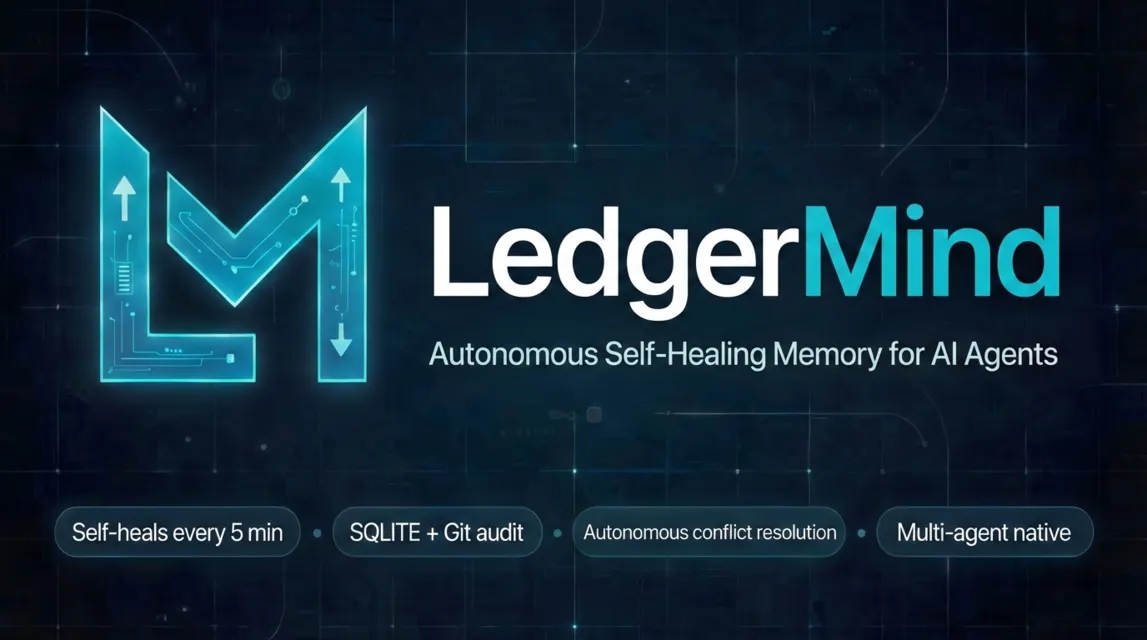
LedgerMind: product and architecture
This LedgerMind review examines a Python-based autonomous memory system designed for AI agents that need persistent, self-managing knowledge stores. Built on a SQLite and Git hybrid storage engine with a built-in reasoning layer, LedgerMind targets developers building multi-agent systems and on-device AI deployments. The project, currently at version 3.3.5 with 12 GitHub stars, occupies a niche position in the AI agent infrastructure space: rather than providing a generic vector database or a simple key-value store, it delivers a full knowledge lifecycle manager that operates without human intervention. We tested LedgerMind against its stated zero-touch promise and found a technically ambitious architecture with clear strengths in autonomous memory management.
Overview
LedgerMind is an autonomous memory system that gives AI agents the ability to store, retrieve, evolve, and self-heal their knowledge without developer intervention. The core architecture combines SQLite for structured local storage with Git for cryptographic audit trails, layered with a Python-based reasoning engine that handles conflict resolution and knowledge distillation.
The project supports MCP server integration, making it compatible with the growing ecosystem of Model Context Protocol tools. It targets three primary audiences: developers building multi-agent orchestration systems, teams deploying AI agents to edge devices where cloud-based memory is impractical, and researchers exploring autonomous agent architectures.
LedgerMind differentiates itself from general-purpose vector databases by implementing a multi-stage knowledge lifecycle where memories progress through PATTERN, EMERGENT, and CANONICAL stages. This approach means agents do not just store data; they actively refine it into actionable rules over time.
Key Features and Architecture
LedgerMind's architecture centers on three pillars: hybrid storage, autonomous lifecycle management, and cryptographic auditability.
Hybrid Storage Engine (SQLite + Git): The system uses SQLite as its primary structured data store for fast local queries, paired with Git for version-controlled, cryptographically verifiable memory snapshots. Data is persisted locally in JSON format, and the Git layer creates a full commit history of every knowledge mutation. This dual-engine approach ensures both query performance and a tamper-evident audit trail of every knowledge change an agent makes.
Multi-Stage Knowledge Lifecycle: Memories follow a defined progression from PATTERN (raw observations) through EMERGENT (correlated insights) to CANONICAL (established rules). The system automatically promotes knowledge through these stages based on the reasoning layer's confidence assessments, distilling raw agent experiences into reusable rules without manual curation.
Self-Healing Decay System: Knowledge entries that become outdated or contradicted are automatically flagged and decayed. The system resolves conflicts through Deep Truth Resolution, which performs recursive supersede chain analysis to determine which version of a memory should be treated as authoritative.
Zero-Touch Automation: All memory operations, including storage, retrieval, conflict resolution, promotion, and cleanup, run autonomously. Developers configure the system once; agents manage their own memory going forward.
MCP Server Support: LedgerMind functions as an MCP server, exposing its memory operations via a REST-compatible API. This enables integration with AI agents and tools that support the Model Context Protocol standard, including orchestration frameworks like LangChain.
Intelligent Conflict Resolution: When multiple agents write conflicting information, the built-in reasoning layer evaluates evidence chains and resolves disputes programmatically rather than requiring human arbitration.
GGUF Compatibility: The project supports GGUF model formats for its reasoning layer, aligning it with on-device and local-first AI deployment patterns where quantized models running on CPU or GPU are standard. This means the reasoning engine can run without an external API dependency.
Ideal Use Cases
LedgerMind is best for teams building autonomous multi-agent systems where agents need to accumulate and share knowledge over extended operation periods. The self-healing decay system and conflict resolution make it particularly strong for deployments with 3 or more agents writing to shared memory concurrently.
It is also well-suited for on-device AI deployments where cloud connectivity is unreliable. The SQLite-based local storage and Git-based sync model mean agents can operate offline and reconcile knowledge when connectivity resumes.
Research teams exploring autonomous agent architectures benefit from the Git-based cryptographic audit trail, which provides full provenance tracking for every knowledge mutation an agent performs. The Python codebase and CLI tooling make it straightforward to integrate into existing development workflows.
Don't use this tool if you need a production-grade, battle-tested memory system for high-traffic commercial applications. With 17 GitHub stars and an early-stage community, LedgerMind is better categorized as an innovative research project than enterprise infrastructure. Teams needing proven scalability should evaluate LangChain's memory modules or dedicated vector databases instead.
Strengths & Trade-offs
Pros:
- The SQLite and Git hybrid storage engine provides both fast local queries and a cryptographic audit trail, a combination no other tool in this category offers
- Multi-stage knowledge lifecycle (PATTERN to EMERGENT to CANONICAL) automates knowledge refinement without developer involvement
- MCP server support enables integration with the growing Model Context Protocol ecosystem
- Self-healing decay and Deep Truth Resolution handle stale and conflicting data autonomously
- Free and open-source with Python codebase, making it accessible for customization
- On-device deployment support via GGUF compatibility suits edge and offline scenarios
Cons:
- With 17 GitHub stars, the community is minimal, limiting available documentation and third-party support
- No established pricing tiers or SLA for enterprise support, which creates uncertainty for production deployments
- The project is distributed under the NCSA License., which poses legal risk for commercial adoption
- SQLite-based storage introduces scalability ceilings that dedicated distributed databases do not have