CrewAI: product and architecture
This CrewAI review evaluates the open-source multi-agent orchestration framework that has rapidly become a widely used tool for building collaborative AI agent systems. CrewAI enables developers to define autonomous AI agents with distinct roles, assign them structured tasks, and orchestrate their collaboration through crews and flows. With over 50,000 GitHub stars and over 100,000 certified developers, CrewAI targets engineering teams building production-grade agentic AI workflows. In this review, we examine its architecture, pricing, ideal use cases, and how it stacks up against competing frameworks.
Overview
CrewAI is an MIT-licensed Python framework created by Joao Moura and maintained by CrewAI Inc. Unlike LangGraph and Flowise, which extend LangChain, CrewAI is built as a standalone framework with no dependency on LangChain's abstractions. This architectural independence gives it a leaner runtime and avoids the complexity overhead that LangChain-based tools often carry.
The framework centers on three core primitives: Agents (autonomous units with roles, goals, and backstories), Tasks (units of work with expected outputs and callbacks), and Crews (teams of agents executing tasks through defined processes). Version 2.x introduced Flows, an event-driven orchestration layer for building production pipelines with state management and execution persistence.
CrewAI supports both sequential and hierarchical process execution, allowing agents to either work in order or delegate subtasks through a manager agent. It integrates natively with OpenAI, Anthropic Claude, Google Gemini, Azure OpenAI, and AWS Bedrock, with additional LLM providers accessible through LiteLLM including Groq, Mistral, Ollama for local inference, and over a dozen others. The project requires Python 3.10 or higher and uses UV as its package manager.
Key Features and Architecture
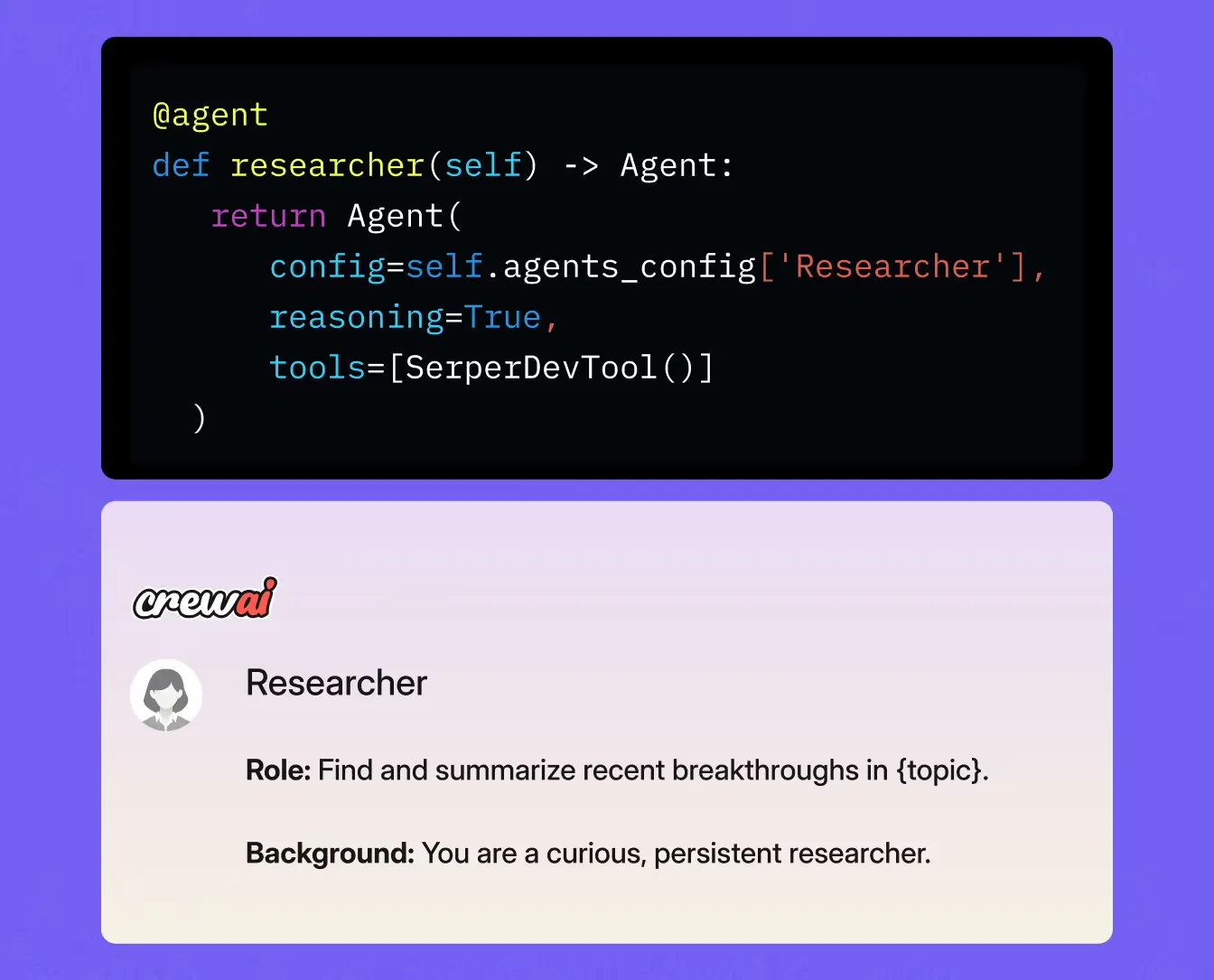
CrewAI's architecture is role-based: each agent receives a defined role, goal, and backstory that shapes its behavior and decision-making. This design pattern means agents produce more focused outputs than generic prompt-chaining approaches.
Agent Composition and Tools. Agents can be equipped with custom tools, memory systems, and knowledge bases. CrewAI provides a built-in toolkit with integrations for Gmail, Google Drive, Outlook, Microsoft Teams, OneDrive, and HubSpot. Developers can also wrap any Python function as a custom tool using the @tool decorator. Agents support structured outputs via Pydantic schemas, ensuring downstream consumers receive predictable data formats.
Flows and Event-Driven Orchestration. Flows provide production-grade workflow control beyond simple crew execution. They use @start, @listen, and @router decorators to define execution graphs with branching logic, state persistence, and resumable long-running processes. This is where CrewAI differentiates itself from simpler agent frameworks: Flows handle the operational complexity of multi-step pipelines that need to survive failures and restarts.
Memory and Knowledge. CrewAI implements short-term, long-term, and entity memory systems that allow agents to retain context across tasks within a crew execution and across separate runs. Knowledge bases let agents query structured and unstructured data sources during execution, reducing hallucination on domain-specific tasks.
Observability and Guardrails. The framework includes built-in tracing, OpenTelemetry integration, hallucination scoring, and human-in-the-loop checkpoints. Guardrails can pause execution when agent outputs fall outside defined parameters, and callbacks enable custom validation logic between task completions.
Configuration Approaches. CrewAI supports YAML-based configuration for agents and tasks (version-controllable), environment variable configuration, and direct Python code with decorators (@agent, @task, @crew). This flexibility lets teams choose between declarative and programmatic setup based on their workflow.
Ideal Use Cases
Automated Research and Report Generation. Teams of 2-10 agents can divide research tasks, cross-reference sources, and compile structured reports. CrewAI's role-based design excels here because each agent specializes in a distinct aspect of the research pipeline.
Enterprise Workflow Automation. With native integrations for Gmail, Outlook, Teams, and HubSpot, CrewAI fits organizations automating multi-step business processes. The event-driven Flows system handles approval chains and conditional routing that simpler frameworks cannot.
Content Production Pipelines. Marketing and content teams use CrewAI to orchestrate writing, editing, fact-checking, and formatting agents. The hierarchical process mode lets a manager agent coordinate quality control across the pipeline.
Rapid Prototyping with Local Models. Through Ollama integration, solo developers and small teams can prototype multi-agent systems entirely offline using local LLMs before switching to cloud providers for production deployment.
Not suitable for: Single-agent use cases where a simple API call to an LLM suffices. CrewAI's multi-agent overhead adds unnecessary complexity when you need one agent performing one task. Teams locked into the LangChain ecosystem may also find LangGraph a more natural fit, since it shares LangChain's abstractions and memory systems.
Pros and Cons
Pros:
- Standalone architecture with no LangChain dependency, resulting in a leaner codebase and fewer abstraction layers to debug
- Native support for 5 major LLM providers (OpenAI, Anthropic, Gemini, Azure, Bedrock) plus 13 more via LiteLLM, avoiding vendor lock-in
- Role-based agent design produces focused outputs relative to generic prompt chains, with Pydantic-enforced structured outputs
- Flows system provides production-grade orchestration with state persistence, resumability, and event-driven routing
- Active open-source community with 50,000+ GitHub stars, 6,900+ forks, and 100,000+ certified developers
- MIT license allows unrestricted commercial use with $0 licensing cost
Cons:
- Steeper learning curve than single-agent tools: understanding agents, tasks, crews, and flows requires significant upfront investment
- Multi-agent overhead adds latency and token cost compared to single-agent approaches, making it cost-inefficient for simple tasks
- Enterprise pricing is opaque with no published dollar amount, making budget planning difficult without a sales conversation
- Documentation, while improving, still has gaps in advanced Flow patterns and custom memory implementations