Decision comparison
CrewAI vs LangGraph
CrewAI excels at rapid multi-agent prototyping with minimal code for standard collaboration patterns, including internal automation, research, and content pipelines. LangGraph excels at production-grade agent systems where every execution path must be explicit, debuggable, stateful, and recoverable. Most teams should start with CrewAI when validating a conventional multi-agent workflow, then migrate to LangGraph when they need cycles, complex conditional logic, durable long-running state, or approval gates. Teams already using LangChain components can adopt LangGraph while preserving their existing retrievers, chains, and tools.
Direct comparison. These are reviewed substitutes bought for the same job, so the differences below are the ones that decide between them.
Applies to: Choosing between two products of the same kind for one job.
All 2 are agent frameworks.
Quick Comparison
| Decision factor | CrewAI | LangGraph |
|---|---|---|
| Best For | Rapid multi-agent prototyping with role-based orchestration and minimal boilerplate, especially enterprise automation, repetitive workflows, research, and content pipelines. | Production-grade stateful agent workflows with explicit graph-based control and LangChain integration, especially customer-facing, regulated, and long-running applications. |
| Pricing | Free tier: 50 executions/month, additional executions $0.50 each. Enterprise: custom pricing. | Open Source (free framework, LangSmith Plus $39/seat/month for managed deployment); Developer is $0/seat with 5k base traces/month, then pay-as-you-go. |
| Primary abstraction | Role-based agents with goals and backstories, assembled into crews that autonomously collaborate, use tools, and interact with enterprise applications. | Stateful graph nodes with typed state schemas, enabling durable context, memory, conditional transitions, human approvals, and recoverable execution. |
| Orchestration model | Sequential, hierarchical, or consensual processes for coordinating role-playing autonomous agents on complex tasks with configurable delegation and collaboration. | Directed graph with conditional edges and cycles, supporting explicit single-agent, multi-agent, and hierarchical control flows within one framework. |
| Key Features | Visual editor and AI copilot support no-code builders, while an API supports engineers; designed for safe, reliable enterprise-wide agent adoption. | Low-level customizable primitives, human-in-the-loop moderation and approvals, persistent memory across sessions, and native token-by-token streaming for agent actions. |
| License and Project Activity | MIT-licensed Python framework. GitHub reports 58,187 stars; latest release 1.15.20 on 2026-09-04, with a push recorded 2026-09-07. | MIT-licensed Python framework. GitHub reports 41,170 stars; latest release sdk==0.4.4 on 2026-08-27, with a push recorded 2026-09-06. |
CrewAI
- Best For:
- Rapid multi-agent prototyping with role-based orchestration and minimal boilerplate, especially enterprise automation, repetitive workflows, research, and content pipelines.
- Pricing:
- Free tier: 50 executions/month, additional executions $0.50 each. Enterprise: custom pricing.
- Primary abstraction:
- Role-based agents with goals and backstories, assembled into crews that autonomously collaborate, use tools, and interact with enterprise applications.
- Orchestration model:
- Sequential, hierarchical, or consensual processes for coordinating role-playing autonomous agents on complex tasks with configurable delegation and collaboration.
- Key Features:
- Visual editor and AI copilot support no-code builders, while an API supports engineers; designed for safe, reliable enterprise-wide agent adoption.
- License and Project Activity:
- MIT-licensed Python framework. GitHub reports 58,187 stars; latest release 1.15.20 on 2026-09-04, with a push recorded 2026-09-07.
LangGraph
- Best For:
- Production-grade stateful agent workflows with explicit graph-based control and LangChain integration, especially customer-facing, regulated, and long-running applications.
- Pricing:
- Open Source (free framework, LangSmith Plus $39/seat/month for managed deployment); Developer is $0/seat with 5k base traces/month, then pay-as-you-go.
- Primary abstraction:
- Stateful graph nodes with typed state schemas, enabling durable context, memory, conditional transitions, human approvals, and recoverable execution.
- Orchestration model:
- Directed graph with conditional edges and cycles, supporting explicit single-agent, multi-agent, and hierarchical control flows within one framework.
- Key Features:
- Low-level customizable primitives, human-in-the-loop moderation and approvals, persistent memory across sessions, and native token-by-token streaming for agent actions.
- License and Project Activity:
- MIT-licensed Python framework. GitHub reports 41,170 stars; latest release sdk==0.4.4 on 2026-08-27, with a push recorded 2026-09-06.
Public signals
Verified factual signals only. Bars appear only for like-for-like metrics with five weekly assessments for every tool; missing evidence stays explicit. These signals do not establish enterprise adoption, product quality, or total cost.
| Metric | CrewAI | LangGraph |
|---|---|---|
| GitHub commits, 90d(Product adoption) | 335 | 127 |
| GitHub stars(Product adoption) | 58,000+ | 41,000+ |
| Search interest(Market interest) | 4 | 10 |
| Hacker News mentions, 90d(Community interest) | 8 | 22 |
| PyPI weekly downloads(Product adoption) | 585.4k | 10.0M |
| Stack Overflow questions(Community interest) | 40 | 143 |
| npm weekly downloads(Developer adoption) | Not available | 2.5M |
As of September 14, 2026 — updated weekly.
Health & risk evidence
Observed public-source checks for mapped package versions and repositories.
CrewAI
September 14, 2026Package vulnerabilities
PyPI · crewai@1.15.21
0 vulnerabilities
across 1 package
Repository security score
Not available
LangGraph
September 14, 2026Package vulnerabilities
npm · @langchain/langgraph@1.4.15 · PyPI · langgraph@1.2.11
0 vulnerabilities
across 2 packages
Repository security score
Not available
Interface Preview
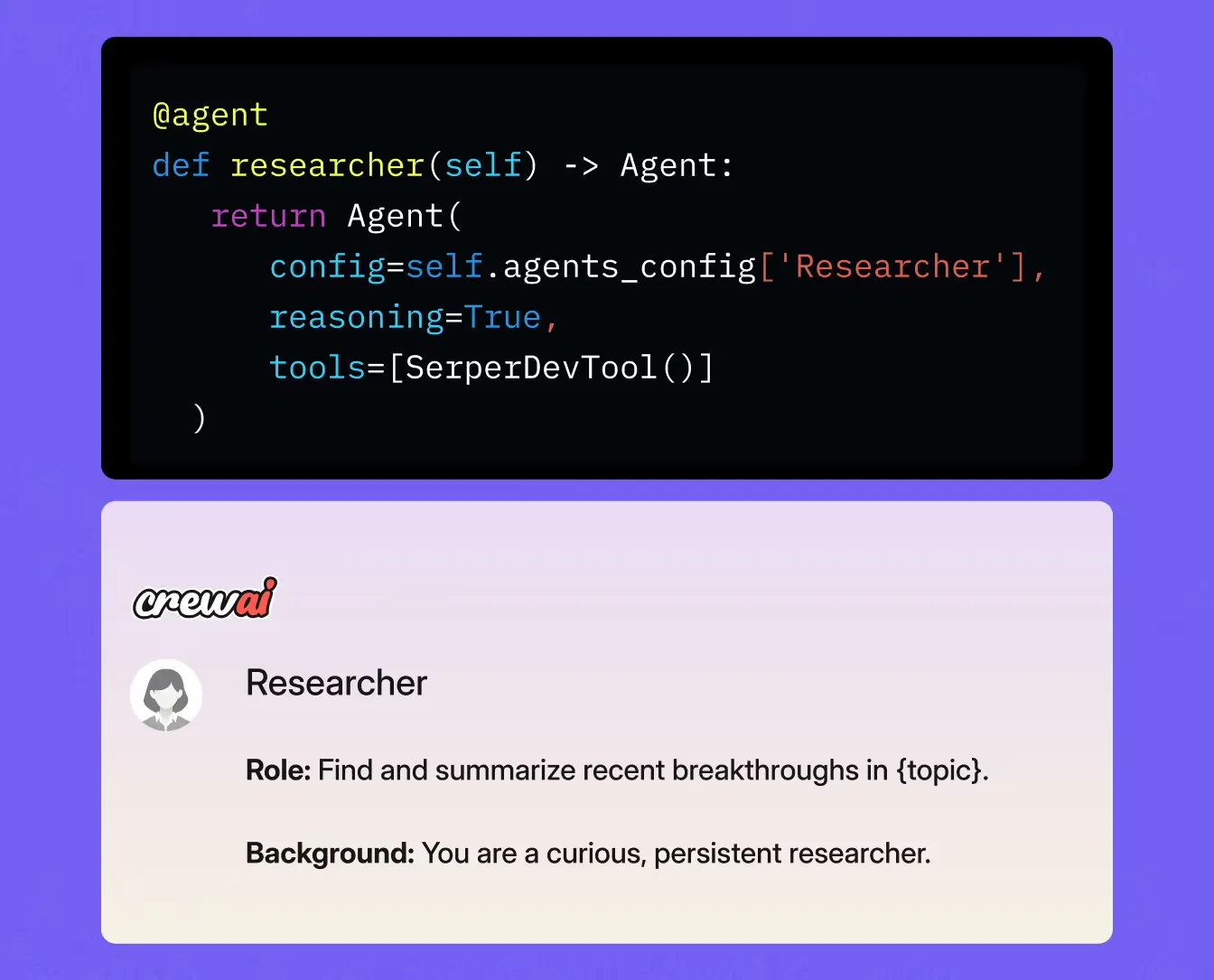
CrewAI
LangGraph
Feature Comparison
| Feature | CrewAI | LangGraph |
|---|---|---|
| Core Architecture | ||
| Primary abstraction | Role-based agents with goals and backstories | Stateful graph nodes with typed state schemas |
| Orchestration model | Sequential, hierarchical, or consensual processes | Directed graph with conditional edges and cycles |
| State management | Automatic shared memory across crew | Explicit typed state dict passed between nodes |
| Multi-language support | Python only | Python and JavaScript/TypeScript |
| Production Capabilities | ||
| Human-in-the-loop | Built-in human input tool for agent queries | Checkpoint-based interrupts at any graph node |
| Persistence | Session-based crew memory | Checkpointers with SQLite, PostgreSQL, Redis and replay |
| Error handling | Automatic retry with configurable max iterations | Try/catch at node level with custom fallback edges |
| Parallel execution | Limited within process types | Native parallel branches via fan-out/fan-in |
| Streaming | Task-level output streaming | Token-level and event-level streaming per node |
| Developer Experience | ||
| Debugging tools | Crew execution logs and callbacks | LangSmith trace visualization and time-travel replay |
| Learning curve | Low -- role/goal/task mental model | Moderate -- requires graph and state machine concepts |
| Tool ecosystem | 50+ built-in tools plus LangChain tools | Full LangChain tool ecosystem |
| Pricing & Deployment | ||
| Open-source license | MIT license, free | MIT license, free |
| Cloud platform cost | $0.50/execution after 50 free/month | LangSmith Plus at $39/seat/month |
| Enterprise tier | Custom pricing with SSO and audit logs | LangSmith Enterprise with custom pricing |
Core Architecture
Primary abstraction
Orchestration model
State management
Multi-language support
Production Capabilities
Human-in-the-loop
Persistence
Error handling
Parallel execution
Streaming
Developer Experience
Debugging tools
Learning curve
Tool ecosystem
Pricing & Deployment
Open-source license
Cloud platform cost
Enterprise tier
Which to choose
CrewAI excels at rapid multi-agent prototyping with minimal code for standard collaboration patterns, including internal automation, research, and content pipelines. LangGraph excels at production-grade agent systems where every execution path must be explicit, debuggable, stateful, and recoverable. Most teams should start with CrewAI when validating a conventional multi-agent workflow, then migrate to LangGraph when they need cycles, complex conditional logic, durable long-running state, or approval gates. Teams already using LangChain components can adopt LangGraph while preserving their existing retrievers, chains, and tools.
Best-fit scenarios
Choose CrewAI if:
Choose CrewAI for internal automation, content pipelines, or research workflows where speed to production matters more than fine-grained control. Its role-based crews, visual editor, AI copilot, and API make standard multi-agent collaboration quick to implement.
Choose LangGraph if:
Choose LangGraph for customer-facing or regulated applications where execution auditability, deterministic behavior, human approvals, and fault recovery are requirements. Its explicit state-machine graph model supports conditional routes, cycles, persistent memory, and controlled long-running execution.
Choose LangGraph if:
Choose LangGraph when your team is already invested in the LangChain ecosystem with existing retrievers, chains, and tools. It provides a graph-based orchestration layer that preserves those integrations while adding durable state and explicit control flow.
Choose CrewAI if:
Choose CrewAI for early-stage exploration of agent architectures and rapid validation of a business use case. Move to LangGraph after edge cases reveal a need for cyclic workflows, complex branching, recoverability, or stricter execution controls.
These scenarios reflect the available product evidence. Your requirements, existing stack, and team expertise should guide the final decision.
Frequently Asked Questions
Can CrewAI and LangGraph be used together?
Yes. CrewAI uses LangChain tools natively, and teams can use LangGraph for overall workflow orchestration while embedding CrewAI crews as individual nodes. The trade-off is increased complexity in dependency management and debugging across two frameworks.
Which framework performs better for production workloads?
LangGraph has a meaningful advantage for production reliability due to explicit state management, precise retry logic, checkpoint-based recovery, and native parallel execution. CrewAI is faster to prototype but harder to make fault-tolerant at scale.
How do the two frameworks compare for testing and debugging?
LangGraph integrates with LangSmith for distributed tracing, latency breakdowns, token tracking, and time-travel replay. CrewAI offers execution logs and callbacks. LangGraph's explicit state schema makes unit testing individual nodes easier via mocked state inputs.
Is one framework better for beginners learning to build AI agents?
CrewAI has a significantly lower barrier to entry with its role-and-goal mental model. A developer can have a working multi-agent system in under an hour. LangGraph requires understanding directed graphs and state machines, adding 2-3 days to onboarding, but forces teams to think through edge cases upfront.