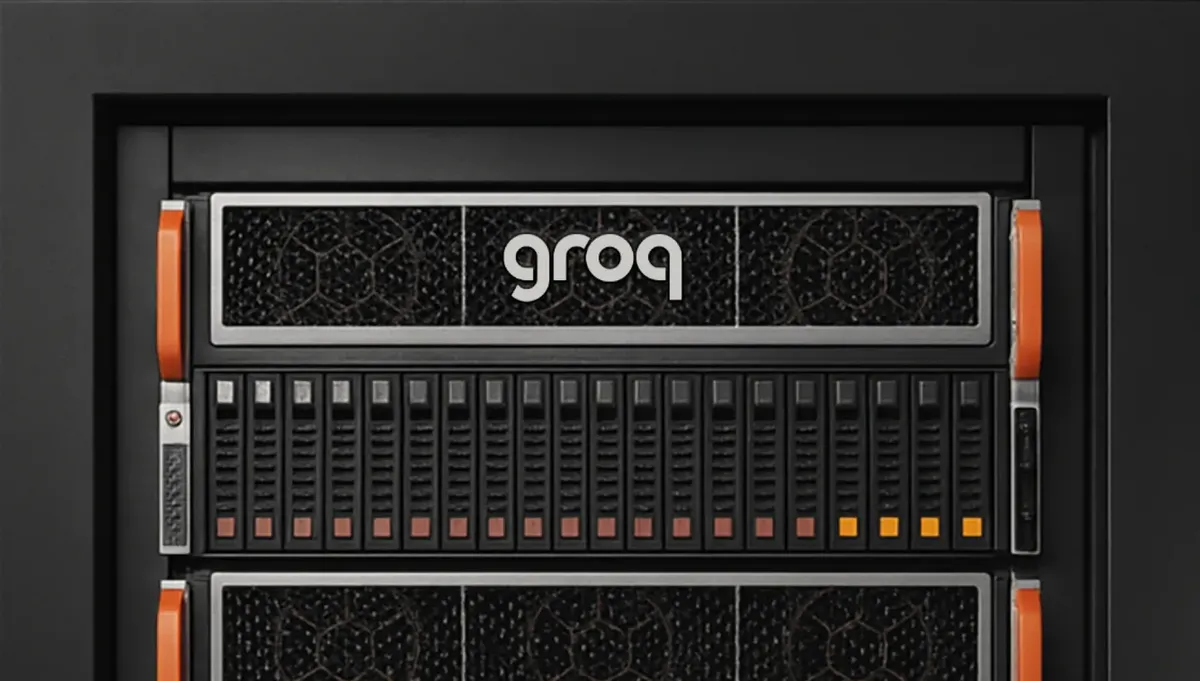
Groq: product and architecture
This Groq review examines the AI inference platform that has built custom LPU (Language Processing Unit) hardware from the ground up to deliver the fastest LLM inference speeds commercially available. Groq targets developers and engineering teams who need ultra-low-latency, high-throughput inference for large language models without managing GPU infrastructure. This review covers Groq's architecture, supported models, API compatibility, pricing structure, and where it fits relative to competitors like OpenAI, Anthropic, Together AI, and Fireworks AI.
Overview
Groq occupies a distinctive position in the AI inference market: rather than optimizing software on commodity GPUs, the company designed purpose-built silicon — the Language Processing Unit — specifically for sequential token generation in transformer-based models. This hardware-first approach delivers inference speeds that consistently exceed GPU-based providers by 3-10x on throughput benchmarks, making Groq a notably fast commercially available inference endpoint for supported models.
The platform serves developers building latency-sensitive applications: real-time chatbots, voice assistants, coding copilots, and any workflow where waiting 5-10 seconds for a response degrades the user experience. Groq provides an OpenAI-compatible REST API, which means existing applications built on the OpenAI SDK can switch to Groq by changing a single base URL. The platform supports open-weight models from Meta (Llama 3.1, Llama 3.3, Llama 4 Scout), Alibaba (Qwen3 32B), Mistral (Mixtral), and Google (Gemma), but does not host proprietary models like GPT-4o or Claude. Groq uses a pay-per-token pricing model with no subscriptions, no seat licenses, and no minimum commitments — you pay only for the tokens you consume.
Key Features and Architecture
LPU Hardware Architecture. Groq's LPU is a custom ASIC designed for deterministic, low-latency inference. Unlike GPUs, which are general-purpose parallel processors optimized for training workloads, the LPU eliminates the memory bandwidth bottleneck that limits token generation speed on GPU clusters. The result is inference that routinely delivers 500+ tokens per second for smaller models, with time-to-first-token measured in tens of milliseconds rather than seconds. This deterministic execution model also means latency variance is extremely low — developers get consistent response times rather than the unpredictable spikes common on shared GPU infrastructure.
Supported Models. Groq hosts a curated set of open-weight models rather than offering the breadth of a model marketplace. The current lineup includes Llama 3.1 8B and Llama 3.3 70B from Meta, Llama 4 Scout, Qwen3 32B from Alibaba, Mixtral from Mistral AI, and Gemma from Google. The platform also supports OpenAI's Whisper v3 for speech-to-text at 217x real-time speed, meaning a 60-minute audio file processes in approximately 17 seconds. Model selection is narrower than Together AI or Replicate, but each hosted model runs on dedicated LPU infrastructure optimized for peak throughput.
OpenAI-Compatible API. Groq's API follows the OpenAI chat completions format, supporting function calling, tool use, and JSON mode for structured outputs. Developers using the OpenAI Python SDK can integrate Groq by pointing the client to https://api.groq.com/openai/v1 and swapping in a Groq API key. This compatibility extends to streaming responses, system messages, and multi-turn conversations, reducing migration effort from minutes to seconds for teams already on the OpenAI API.
Batch API. For workloads that do not require real-time responses — data labeling, document classification, bulk summarization — Groq's Batch API provides a 50% discount on standard per-token rates. Batch jobs are queued and processed within a guaranteed time window, trading latency for cost savings.
Prompt Caching. Repeated prompts with identical prefixes benefit from Groq's prompt caching feature, which delivers 50% savings on cached input tokens. This is particularly valuable for applications that use long system prompts or few-shot examples, where the same prefix appears across thousands of requests.
Ideal Use Cases
Real-time conversational AI. Groq is best for applications where response latency directly affects user experience — voice assistants, customer support chatbots, and interactive coding tools. The sub-100ms time-to-first-token makes conversations feel instantaneous, which is critical for voice pipelines where every 200ms of delay compounds into noticeable lag.
High-throughput batch processing on open-weight models. Teams running Llama 3.3 70B or Qwen3 32B across millions of documents for classification, extraction, or summarization benefit from Groq's throughput advantage combined with the 50% Batch API discount. Processing 10 million documents costs roughly half what it would on GPU-based providers at 3-5x the speed.
Speech-to-text at scale. Whisper v3 running at 217x real-time on Groq hardware makes large-scale audio transcription practical for call centers, podcast platforms, and media companies processing thousands of hours of audio daily.
Prototyping with OpenAI-compatible APIs. Development teams evaluating open-weight models as alternatives to GPT-4o can test Groq endpoints without rewriting API integration code, accelerating model evaluation cycles.
Do not use Groq if you need access to proprietary models like GPT-4o, Claude, or Gemini — Groq only hosts open-weight models. It is also not suitable for fine-tuning or custom model training; the platform is inference-only. Teams requiring models larger than 70B parameters or specialized vision models will need to look elsewhere.
Pros and Cons
Pros:
- Fastest commercially available inference speeds, with 500+ tokens/second on small models and sub-100ms time-to-first-token, though this advantage applies only to the curated set of supported models
- OpenAI-compatible API enables migration from OpenAI endpoints in under 5 minutes, but developers must verify that function calling and tool use behaviors match their specific implementation
- Pay-per-token pricing with no subscriptions or minimums keeps costs proportional to usage, although lack of a free tier means even experimentation has a cost
- Batch API at 50% discount and prompt caching at 50% input savings meaningfully reduce costs for high-volume workloads, provided the workload tolerates batch latency windows
- Whisper v3 at 217x real-time speed is the fastest speech-to-text endpoint available, but only supports the Whisper model family
- Deterministic LPU execution delivers consistent latency with minimal variance, unlike GPU-based providers where shared infrastructure causes unpredictable response times
Cons:
- Model selection is limited to a curated set of open-weight models — no GPT-4o, Claude, Gemini, or proprietary models, which restricts use cases requiring frontier model capabilities
- No fine-tuning or model customization support; teams needing domain-specific model adaptation must use Together AI, Fireworks AI, or self-hosted infrastructure
- No free tier or trial credits, unlike Anthropic and OpenAI which offer limited free usage, creating a barrier for individual developers and students evaluating the platform
- LPU hardware is proprietary and capacity-constrained, meaning availability during peak demand periods can be limited compared to the elastic GPU capacity of hyperscale cloud providers