Choosing a data or AI tool looks simple until the shortlist gets serious.
The information is scattered across vendor pages, pricing calculators, documentation, GitHub repositories, package registries, launch sites, and review platforms. The facts use different formats, change at different speeds, and rarely answer the most important question:
Which combination of tools fits our architecture, constraints, and scale?
Modern DataTools exists to turn that fragmented market into structured, usable decisions. The visible product brings together tool reviews, comparisons, pricing guides, rankings, market landscapes, and stack recommendations. The more important product underneath is the data layer that makes all of those experiences possible.
What exists today
As of July 2026, Modern DataTools covers:
- 300 data and AI tools with weekly-tracked adoption metrics
- 600+ side-by-side comparisons
- 1,100+ verified tool integrations
- Rankings and market landscapes across the modern data, AI, and engineering stack
- Pricing guides, alternatives, and structured technical reviews
- A Stack Recommender that builds and customizes architectures around user requirements
Those numbers matter, but coverage alone is not the value. A list of 300 tool names is easy to reproduce. The hard part is collecting enough reliable evidence to explain how those tools differ, where they fit, how they are changing, and whether they work together.
The data is the product
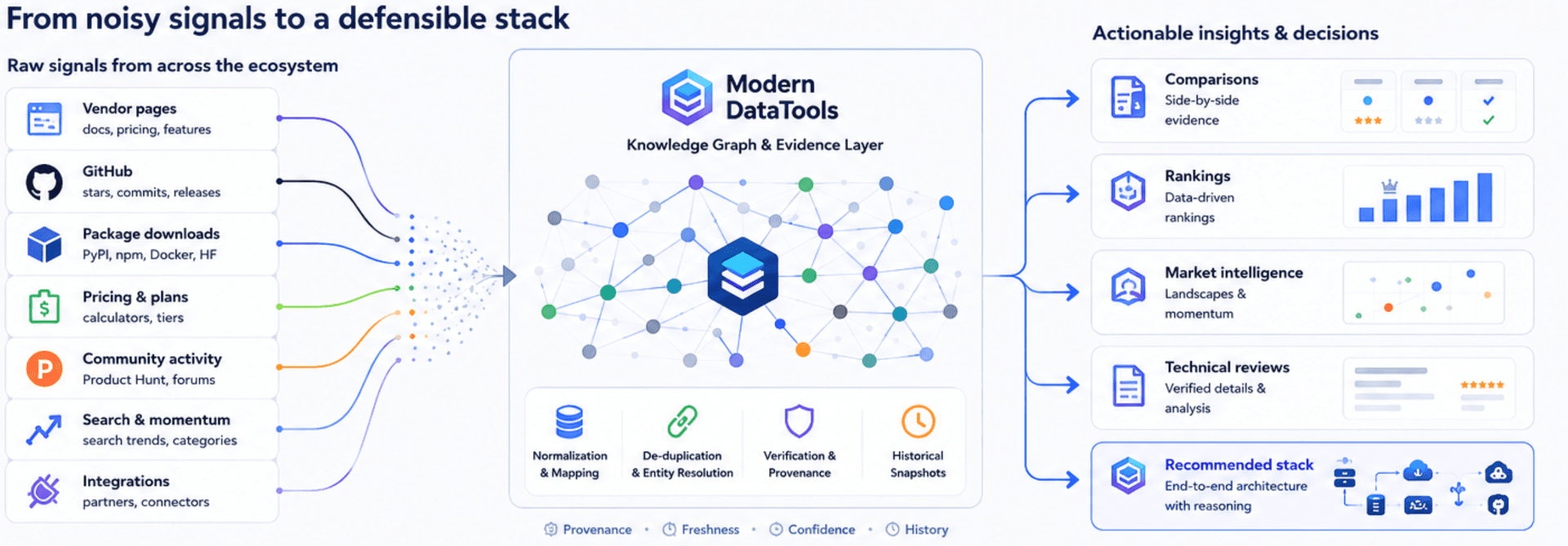
For each tool, we collect and normalize multiple types of evidence, documented in our public data-source methodology:
- Product capabilities, deployment options, pricing, and technical details from official sources
- GitHub activity and release signals for open-source products
- PyPI, npm, Docker Hub, and Hugging Face usage signals
- Product Hunt and technical-community engagement
- Search interest and category momentum
- Alternatives, competitors, and verified integration relationships
- Historical weekly snapshots that show change rather than a single point in time
Each signal is imperfect on its own. GitHub stars can measure attention rather than production use. Package downloads can include automated builds. Search interest can move because of news rather than adoption. Enterprise platforms may have limited public package data despite significant real-world usage.
The value comes from combining the signals, preserving their history, and interpreting them in context. A strong recommendation is rarely based on the biggest number. It comes from the intersection of adoption, architecture fit, integration evidence, pricing, workload scale, and the quality of the underlying sources.
This data also improves with time. A new source strengthens every tool profile it touches. A new integration improves multiple stack combinations. Every weekly snapshot makes momentum easier to distinguish from noise. The asset compounds instead of resetting with every new article.
From research to decisions
The same structured data powers several stages of technology selection.
Discovery. The tool catalog, rankings, and market landscapes help teams understand what exists and which products deserve a closer look.
Evaluation. Reviews, pricing guides, alternatives, and comparisons organize the evidence into consistent decision formats. Users do not have to reconstruct the same research from scratch for every vendor.
Architecture. The Stack Recommender applies requirements such as cloud, budget, team size, deployment model, workload scale, language, and existing tools. It recommends a complete stack, not an isolated winner.
Explanation. Recommendations show why each component was selected, the strength of the supporting evidence, and which required integrations are verified or still uncertain. Users can replace tools, add optional layers, inspect the architecture graph, and share the result.
The goal is decision compression: less time between “we need a new platform” and a shortlist that engineering, finance, security, and procurement can challenge constructively.
Relationships create the moat
Knowing that a product exists is useful for search. Knowing how it relates to the rest of the market is useful for decisions.
Modern DataTools connects tools to categories, capabilities, pricing models, alternatives, adoption histories, architecture roles, and integration partners. This turns a catalog into a knowledge graph.
That graph is especially important for stack recommendations. The most popular ingestion tool is not helpful if it cannot work with the selected warehouse. The most capable agent framework is a poor recommendation if there is no verified path to the chosen model provider or vector database. The cheapest component may create more migration and operating cost than it saves.
This is where structured, connected data becomes more valuable than another generated answer. AI can explain and navigate the evidence, but it still needs reliable evidence to work from.
Who this helps
For data and engineering teams, Modern DataTools shortens research and exposes integration or evidence gaps earlier.
For technology leaders, it creates recommendations that can be explained across technical and commercial stakeholders.
For startups and smaller teams, it provides a structured research layer they may not have the time or specialist staff to build internally.
For data and applied scientists, it connects experimental requirements to production infrastructure—from data pipelines and ML platforms to vector databases, model providers, and agent frameworks—without treating every choice as a separate research project.
For consultants, analysts, and investors, it offers a consistent view of categories, competitors, adoption signals, and market momentum.
And for AI assistants, the underlying structured data and machine-readable site guide can become grounding for recommendations that would otherwise depend on stale model knowledge or unverified web content.
What comes next
The next stage is to make the data deeper, the recommendations more actionable, and the full system usable by both people and agents. We are looking forward for it!
More signals, collected faster, with stronger verification
We want to expand the number and diversity of adoption, product, pricing, reliability, security, and integration signals we track. Important sources should refresh more frequently than weekly where the data supports it.
More data alone is not the objective. Every new signal needs provenance, freshness metadata, anomaly detection, and cross-source checks. The product should be able to say not only what it believes, but why it believes it and how recently the evidence was verified.
An agent that recommends, plans, and deploys
The current Stack Recommender helps a user design a stack. The next step is an agent that can carry the decision further.
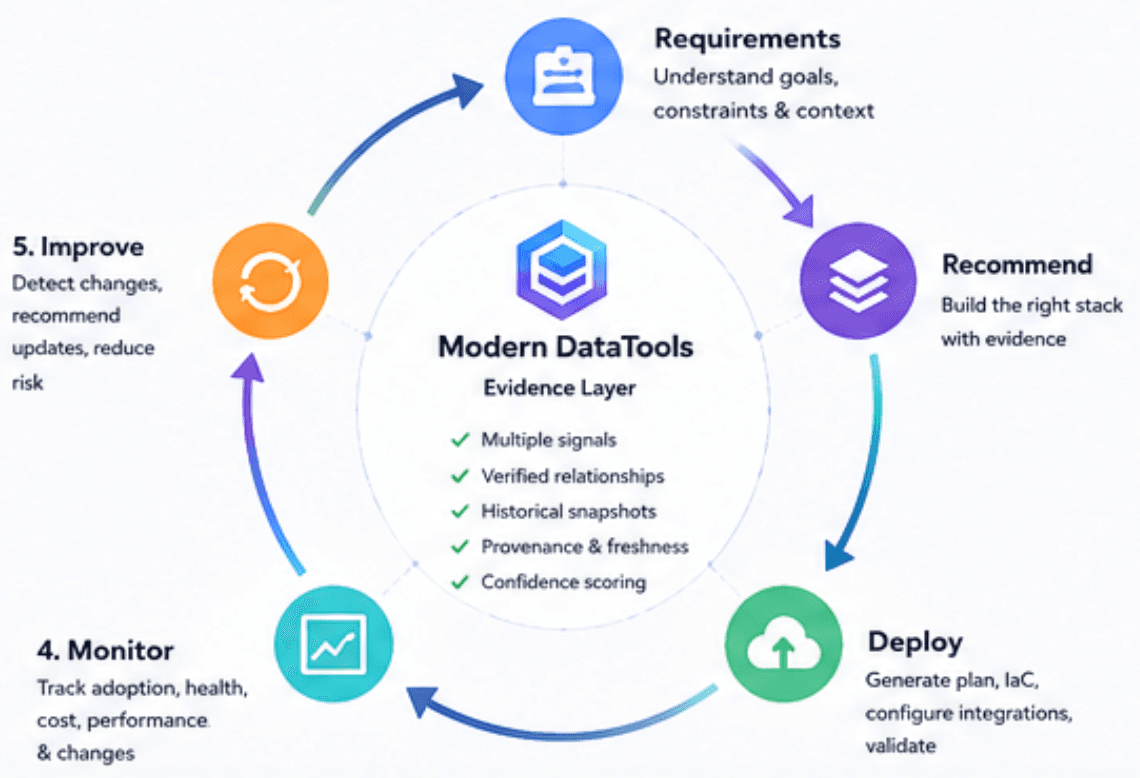
It could compare architecture scenarios, estimate cost and operational complexity, produce a migration plan, generate infrastructure-as-code, configure integrations, and validate the resulting deployment. For an existing stack, it could propose the safest path from the current architecture rather than designing from a blank page.
Deployment would remain controlled: the agent prepares changes, explains risks, and requests explicit approval before state-changing actions. The ambition is not a button that blindly creates cloud resources. It is an evidence-backed architecture agent that can move from recommendation to a working, tested implementation.
A recommendation API and MCP interface
Modern DataTools should not be limited to its own user interface. A recommendation API and MCP interface could let external copilots, internal developer portals, procurement workflows, and autonomous agents query the same structured catalog and evidence model.
An agent could ask: “Which self-hosted vector databases fit this workload and integrate with our current stack?” The response could include candidates, constraints, evidence, confidence, pricing context, and verified relationships in a machine-readable form.
That makes Modern DataTools a decision layer for other products, not only a destination website.
Continuous stack intelligence
Technology selection should not end on deployment day. Pricing changes, projects lose momentum, vendors are acquired, integrations improve, and once-good architecture decisions become constraints.
A saved stack could become a living model of a company’s architecture. Modern DataTools could monitor the evidence behind every component, flag meaningful changes, recommend alternatives, and explain when migration is—or is not—worth the disruption.
Combined with the deployment agent, this creates a continuous loop:
The direction
Modern DataTools started by organizing information about data tools. It is becoming a structured decision system for the modern data and AI stack.
The website is how people access it today. The durable asset is the continuously collected, validated, historical, and connected data underneath it. That data makes the reviews more useful, the comparisons more specific, the recommendations more defensible, and future agents capable of taking action rather than generating another plausible answer.
The long-term opportunity is straightforward: help people and agents make better technology decisions—and eventually implement and maintain those decisions—with evidence they can inspect.