Buying snapshot
Scroll sideways to see all columns. With a keyboard, focus this table and use the arrow keys.
| Decision point | What Braintrust states |
|---|---|
Deployment | Hosted, with a hybrid option that runs the Brainstore data plane on your own infrastructure. On-prem deployment is an Enterprise option. |
Getting data in | SDK auto-instrumentation for supported providers, or point your client's base URL at the Braintrust gateway. SDKs for Python, TypeScript, Go, Ruby, C# and more. |
Security and compliance | SOC 2 Type II certified, GDPR and HIPAA compliant. A BAA is available on Enterprise plans. RBAC: basic roles on Pro, custom on Enterprise. |
Our take
Choose Braintrust if you want production traces to become eval datasets and want releases checked against the same scores, all in one product. If you only need a scoring library in your own code, Autoevals covers that without the platform.
Evaluate Braintrust
Comparisons
Where it stands out
Evals with versioned datasets. You run experiments against real datasets, compare prompts and models side by side, and score outputs with LLMs, code or humans. Braintrust says this lets teams block bad releases before they hit production.
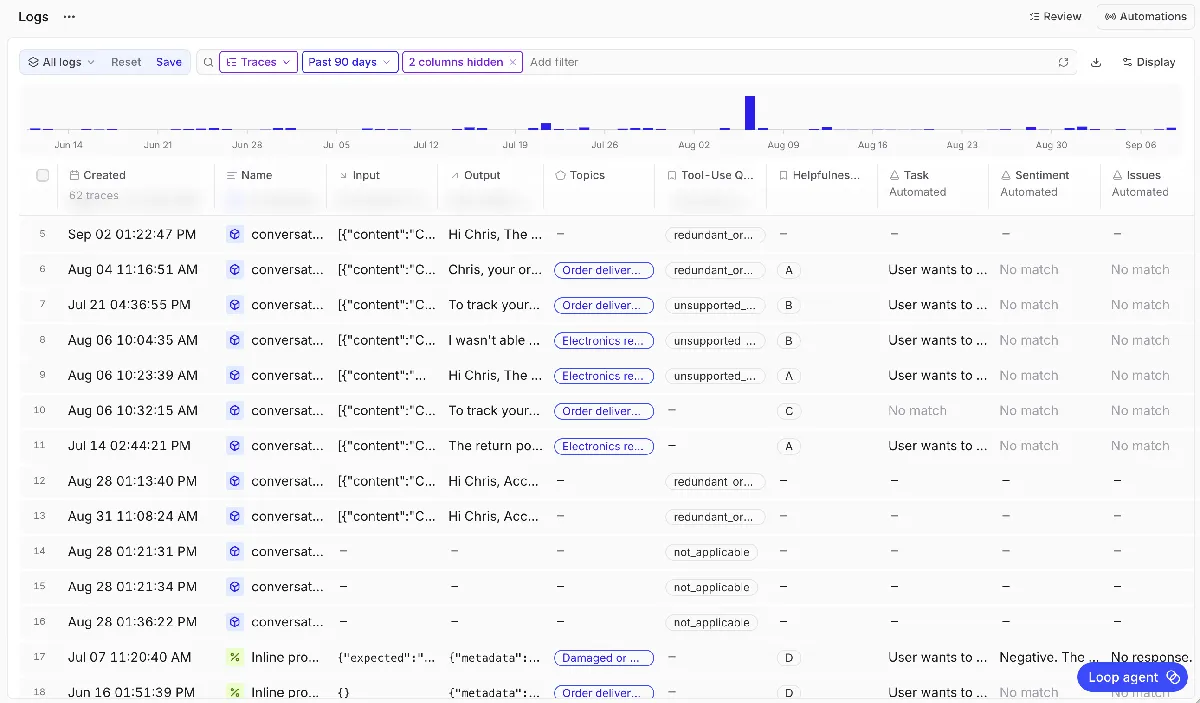
Production feeds the test set. Trace to dataset turns production traces into eval datasets with one click, and online scoring runs the same scorers from offline experiments on production traffic.
Cost and quality per step. Each request is a tree of nested spans with latency, token counts and cost on every step. Dashboards break down LLM spend by model, feature or team, and alerts fire on score drops, latency spikes or error rate changes.
AI help on top of traces. The Loop agent generates prompts, scorers and datasets, Patterns finds recurring issues across production traces, and an MCP server lets a coding agent query logs and run evals from the IDE.
Product screenshot

Trade-offs to weigh
The bill has several moving parts. Beyond the included amounts, Starter and Pro charge for processed data and for scores, so cost depends on trace volume and on how many outputs you score.
Model credits are not a model budget. The monthly credit covers AI features like Topics and any built-in models used without your own API key; after it, token rates apply.
Starter limits review work. Human review scores, which your team fills in manually when reviewing traces, are limited to 1 per project on Starter. Pro allows unlimited.
Pricing and plan conditions
Each plan has a monthly platform fee plus usage meters for model credits (then token rates), processed data per GB, and scores per 1,000; Pro also bills data retention beyond its included 30 days. Scores are scored outputs from LLM-as-a-judge, autoevals or custom code scorers. Starter needs no credit card. Braintrust's own calculator example: 65,000,000 tokens per month at a 15% scoring percentage shows 0.73 GB of storage and 3,656 scores, estimated at $0.00 on Starter and $249.00 on Pro.
Scroll sideways to see all columns. With a keyboard, focus this table and use the arrow keys.
| Plan | Published price | What it adds |
|---|---|---|
Starter | $0 / month | $10 credits / month then token rates; 1 GB / month processed data then +$4/GB; 10K scores / month then $2.50 per 1,000; 14-day retention; unlimited users, projects, datasets, playgrounds and experiments |
Pro | $249 / month | $100 credits / month then token rates; 5 GB / month processed data then +$3/GB; 50K scores / month then $1.50 per 1,000; 30-day retention, then up to 180-day at $0.50 per GB per month; custom charts, environments, priority support, RBAC and more. 6–12 months free for qualifying startups |
Enterprise | Custom pricing | Custom data retention and export, RBAC, premium support, on-prem or hosted deployment for high volume or privacy-sensitive data |
Public signals
About these signals
Verified factual signals from public sources. They indicate observable activity or interest, not total adoption, product quality, or cost.
9 GitHub commits 90d1.1k GitHub stars0 vulnerabilities across 2 packages
See all signals from 5 sources
npm · braintrust@3.43.0 · PyPI · braintrust@0.49.3
Alternatives
Autoevals is an MIT-licensed scoring library from the Braintrust team. It bundles LLM-as-a-judge, heuristic and statistical methods and installs with pip install autoevals or npm install autoevals. Logging its results to Braintrust is optional. Use it to try the scoring approach in code before you commit to the platform. It uses an OpenAI-compatible API when OPENAI_BASE_URL is set and otherwise defaults to the Braintrust Gateway, which is free to use while it is in beta.
Alternatives to Braintrust
The reviewed substitutes for Braintrust among the LLM observability & evaluation, and what would make each one the better answer.
Direct alternatives
Reviewed substitutes: products bought for the same job, where a team picks one.
- Arize Phoenix
- Both score LLM output against datasets and record production traces. They are alternatives for the same evaluation workflow.
- Helicone
- Both are LLM observability platforms with free tiers, bought for visibility into AI application behaviour and cost.
- Langfuse
- Both are LLM engineering platforms covering tracing and evaluation, bought as the team's single place to see and score AI behaviour.