Buying snapshot
Scroll sideways to see all columns. With a keyboard, focus this table and use the arrow keys.
| Decision point | What Langfuse states |
|---|---|
Deployment | Langfuse Cloud (managed by the Langfuse team) or self-hosted: Docker Compose on a local machine or a single VM, Kubernetes with Helm (the preferred production deployment), and Terraform templates for AWS, Azure and GCP. |
License | The repository is MIT licensed, except for the ee folders. The homepage states that all product features are MIT licensed. |
Instrumentation | Native SDKs for Python and TypeScript; Go, Java, .NET, Ruby, PHP and Swift via OpenTelemetry; 100+ integrations, including LangChain, LiteLLM, Vercel AI SDK and CrewAI. |
Cloud data region | US, EU or JP on Hobby and Core; US, EU, JP or HIPAA on Pro and Enterprise. |
Billing terms | Core and Pro: self-serve, credit card, monthly. Enterprise: self-serve, or contact sales for a yearly commitment; credit card or invoice; billing via AWS Marketplace with a yearly commitment. |
Self-hosted telemetry | On by default: basic usage statistics go to PostHog, without raw traces, prompts, observations, scores or dataset contents. Opt out with TELEMETRY_ENABLED=false. |
Our take
Choose Langfuse if you want traces, prompts and evaluations in one tool and may need to keep trace data on your own infrastructure. If you will use the cloud product instead, choose it only after you estimate your monthly unit volume, because that, not the plan fee, sets the bill as usage grows.
Evaluate Langfuse
Comparisons
Where it stands out
One loop from trace to fix. Langfuse connects tracing, monitoring, datasets, experiments and evaluation, so a bad production trace can become a test case for the next prompt or model change.
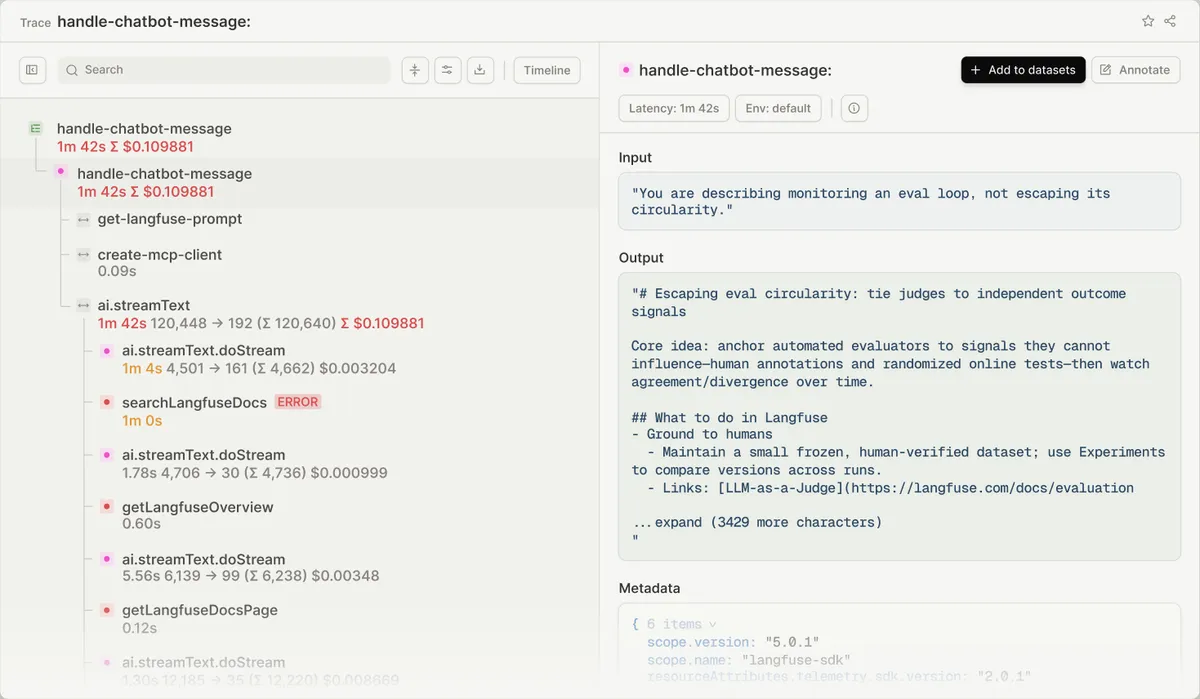
Debuggable agent traces. Hierarchical traces record each LLM call, tool invocation and retrieval step, and you can filter them by user, session, cost, latency or custom metadata. This shows which step failed, not only that the answer was wrong.
Evaluation on live traffic. Evaluators (LLM-as-a-judge, heuristic functions or human review) run on production data or during experiments. Code evaluators, user feedback, manual labeling and custom pipelines via APIs/SDKs are also supported.
Prompts outside the release cycle. Prompt management separates prompts from code with one-click deployments and rollbacks, and caching on server and client side means prompt changes do not add latency to your application.
Built on ClickHouse. The architecture uses a ClickHouse OLAP database, async ingestion via a Redis queue and S3/Blob storage for large payloads; Langfuse says tracing runs in the background with automatic batching.
Product screenshot
Trade-offs to weigh
Self-hosting is yours to run. The default docker-compose.yml inherits Docker's logging setup, and Docker's default json-file driver does not rotate logs unless configured, which can exhaust disk space. Plan log retention and data volumes before production.
License review is not one line. The ee folders sit outside the repository's MIT license, so a procurement check needs someone to read the LICENSE file and docs.
The free plan is for trials. Hobby keeps 30 days of data for 2 users with 1 annotation queue, 2 alerts and a 30 requests/min general API limit. Langfuse describes Hobby as great for hobby projects and POCs, and Core as for production projects.
On Pro, Enterprise SSO needs the Teams add-on. Enterprise SSO, SSO enforcement and project-level RBAC are marked as Teams add-on features on Pro, so a Pro team that needs them must buy the add-on as well.
Pricing and plan conditions
Self-hosting the open source build is free. On Langfuse Cloud, each paid plan includes 100k units a month, and extra usage is billed on graduated tiers: $8/100k units from 100k to 1M, $7/100k from 1M to 10M, $6.5/100k from 10M to 50M and $6/100k above 50M. The vendor's calculator example: Core at 200,000 units is $29.00 base + $8.00 usage = $37.00 a month.
Scroll sideways to see all columns. With a keyboard, focus this table and use the arrow keys.
| Plan | Published price | What it adds |
|---|---|---|
Hobby | Free, no credit card required | All platform features (with limits); 50k units / month included; 30 days data access; 2 users; community support via GitHub. |
Core | $29 / month | Everything in Hobby, plus 100k units / month included (additional $8/100k units, lower with volume); 90 days data access; unlimited users; in-app support (48h response time SLO); 4,000 requests / min ingestion. |
Pro | $199 / month | Everything in Core, plus 3 years data access; data retention management; unlimited annotation queues; high rate limits; SOC2 & ISO27001 reports, HIPAA-ready region; prioritized in-app support; 20,000 requests / min ingestion. |
Teams add-on (optional, on Pro) | $300/mo | Add-on: Enterprise SSO (e.g. Okta), SSO enforcement, fine-grained RBAC, support via dedicated Slack / MS Teams channel. |
Enterprise | $2499 / month | Everything in Pro + Teams, plus audit logs; SCIM API; custom rate limits; uptime SLA; support SLA; named lead support engineer. Optional yearly commitment: custom volume pricing, architecture reviews, billing via AWS Marketplace or invoice, vendor onboarding. |
Langfuse lists discounts for early-stage startups (50% off, first year), research and students (up to 100% off, limits apply), non-profits (USD 199 in credits / month) and open source projects (USD 300 in credits / month, first year); apply via support@langfuse.com.
Public signals
About these signals
Verified factual signals from public sources. They indicate observable activity or interest, not total adoption, product quality, or cost.
2.4k GitHub commits 90d37.2k GitHub stars0 vulnerabilities across 2 packages
See all signals from 6 sources
npm · langfuse@3.39.2 · PyPI · langfuse@5.2.0
Alternatives to Langfuse
The reviewed substitutes for Langfuse among the LLM observability & evaluation, and what would make each one the better answer.
Direct alternatives
Reviewed substitutes: products bought for the same job, where a team picks one.
- Arize Phoenix
- Both are LLM tracing and evaluation platforms built on OpenTelemetry and run by the team itself. A team picks one as its trace destination.
- Braintrust
- Both are LLM engineering platforms covering tracing and evaluation, bought as the team's single place to see and score AI behaviour.
- Helicone
- Both are open-source LLM observability platforms with a hosted tier, bought to see and cost AI requests.