Technology teams rarely suffer from a shortage of options. As of Aug 2026, Modern DataTools tracks more than 300 data and AI technologies across 11 categories. On top of that, every team always has an option that does not appear in any directory: building something internally.
This makes a common technology decision surprisingly difficult. When you need a new capability, the real choice is often not simply which vendor should we pick? It is whether to build the capability, adopt an open-source project, or buy a managed product.
The easiest way to compare these options is by looking at price. Commercial software has a visible licence or usage fee, open-source software is free to download, and internal software appears to cost only the engineers already on payroll. This comparison is attractive because it is simple, but it usually ignores the costs that matter most over several years.
A more useful question is: where should we spend our limited engineering capacity, and what technology do we actually need to control? A concrete example makes this easier to see.
A case study: your data team needs orchestration
Imagine a growing company with a data platform running dozens of pipelines. Every day, data needs to be extracted from operational systems, transformed, validated and loaded into a warehouse. Some jobs depend on others, failed jobs need retries, and engineers need a reliable way to understand what ran, what failed and what needs to be reprocessed.
At first, a few cron jobs and Python scripts may be perfectly adequate. As the number of workflows grows, however, the team starts spending more time managing dependencies, recovering failed jobs and debugging scheduling problems. At that point, orchestration becomes a real platform decision.
The team has three broad options: build something internally, deploy an open-source orchestrator such as Apache Airflow, or pay for a managed product.
Option 1: Build it yourself
Building an internal orchestrator is much more realistic in 2026 than it was even a few years ago. With AI-assisted coding tools such as Claude Code and Codex, a strong engineer can scaffold a working scheduler, API, UI and deployment setup surprisingly quickly. What once looked like a multi-month internal platform project can now reach a usable prototype in weeks or days (or even hours?..).
This changes the economics of building, but not as much as it first appears. AI reduces the cost of producing code; it does not remove the need to decide what the system should do, design the right architecture, validate edge cases, operate it in production and maintain it over time. In some cases it may even make the long-term problem less visible, because generating the first version becomes so easy that teams underestimate what they have committed to owning.
For an orchestrator, the prototype is still only the beginning. Once other teams depend on it, you need reliable retries and backfills, observability, concurrency controls, secrets management, permissions, deployment tooling and a clear upgrade path. AI can help implement all of these features faster, but someone still needs to understand whether they work correctly and how they interact when the system fails at 3 a.m.
The interesting question has therefore shifted. Ten years ago, teams often avoided building because development itself was expensive. In 2026, development is becoming cheaper, so the harder question is whether the resulting system deserves a permanent place in your architecture and continuous maintenance costs.
Building can absolutely make sense when requirements are unusual or when the capability contributes directly to the product. For a commodity problem such as internal workflow scheduling, however, faster coding does not automatically make internal ownership the better choice. It simply lowers the barrier to making that choice.
Option 2: Use open source
The team could instead deploy Apache Airflow. It is one of the most established open-source projects in data engineering, with a large ecosystem and broad industry adoption. Modern DataTools currently records more than 44,000 GitHub stars and significant container usage for the project.
This removes a large amount of development work immediately. Airflow already provides scheduling, dependency management, monitoring, retries and a broad ecosystem of integrations, so the team does not need to invent these capabilities from scratch.
Open source does not, however, remove operational ownership. Someone still needs to deploy Airflow, maintain its metadata database and workers, manage upgrades, monitor performance, troubleshoot failures and ensure that the platform remains secure and available.
This is where the phrase "free software" becomes misleading. The software may have no licence fee, but the organization still pays for infrastructure and, more importantly, engineering time. In many infrastructure systems, engineering time eventually dominates the direct infrastructure cost.
Option 3: Buy the managed version
The third option is to pay someone else to operate the platform. Products such as Astronomer, AWS Managed Workflows for Apache Airflow and Google Cloud Composer provide managed ways to run Airflow while reducing the amount of infrastructure the internal team must own.
This option introduces an explicit bill, which makes it look more expensive than self-hosting. The correct comparison, however, is not "$0 Airflow versus paid Airflow." It is the cost of the managed product versus infrastructure, engineering time, upgrades, support work and the operational risk of running the platform internally.
The answer therefore depends heavily on the organization. A company with a mature infrastructure team already operating Kubernetes and other distributed systems may find self-hosting completely rational. A small data team trying to ship analytics products may be better off paying to make orchestration somebody else's operational problem.
The underlying technology is similar in both cases. What changes is the organization's ability and willingness to own it.
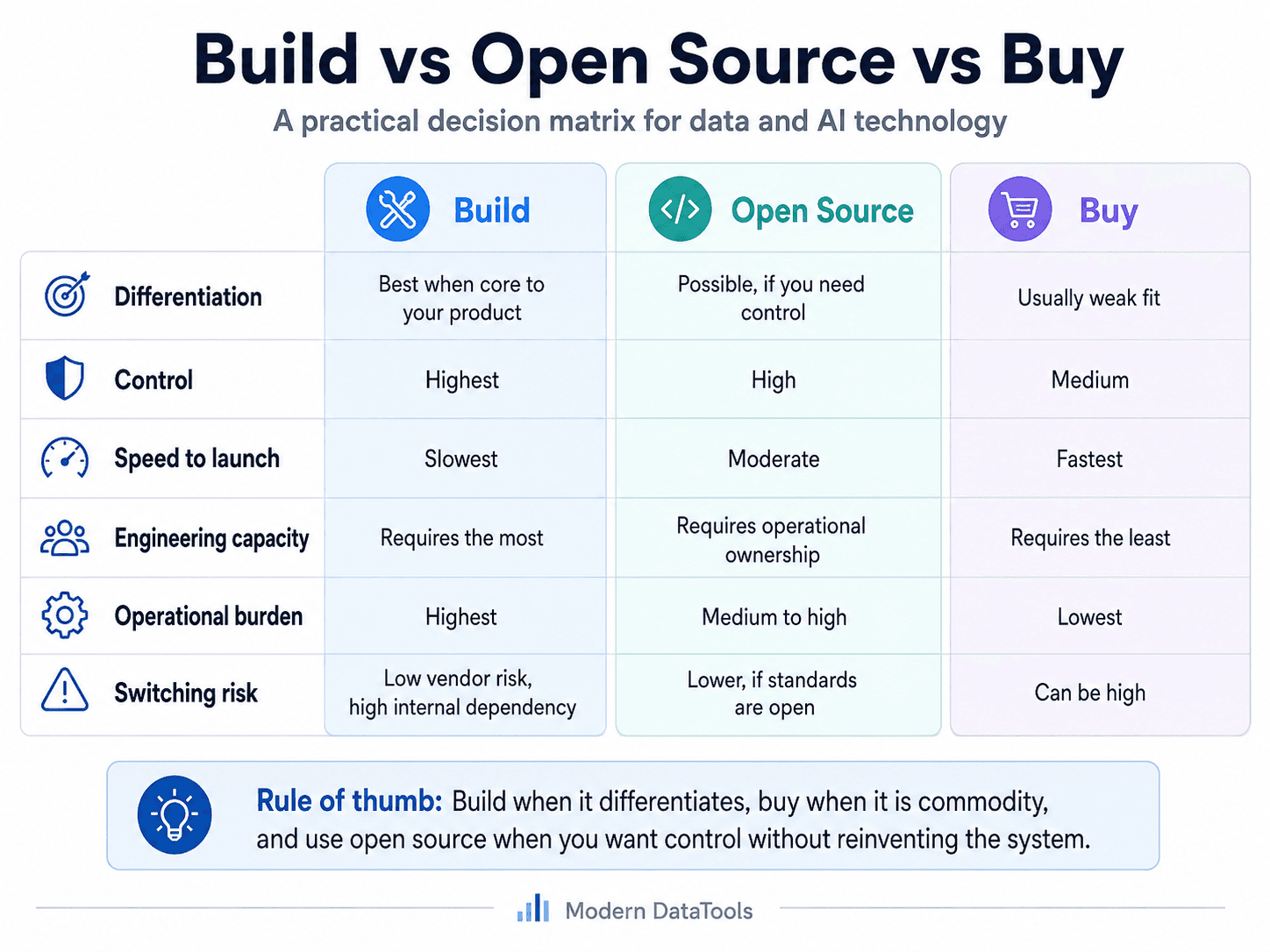
A simple framework
The same reasoning applies well beyond orchestration. Observability, authentication, data quality, BI platforms, feature stores, vector databases and AI infrastructure all create similar choices between internal development, open source and commercial products.
A useful comparison is:
| Question | Build | Open source | Buy |
|---|---|---|---|
| Is this a core competitive advantage? | Strong fit | Possible | Weak fit |
| Do we need deep architectural control? | Strong fit | Strong fit | Depends |
| Do we need to launch quickly? | Weak fit | Good fit | Strong fit |
| Is engineering capacity constrained? | Weak fit | Depends | Strong fit |
| Is this a commodity capability? | Weak fit | Good fit | Strong fit |
| Is there a mature open-source ecosystem? | Weakens case | Strong fit | Still possible |
| Is operating the system difficult? | Weakens case | Weakens case | Strong fit |
| Would switching vendors be extremely painful? | Strong fit | Strong fit | Weakens case |
No single row in the table should decide the answer. The most important question is usually whether owning the capability creates a meaningful advantage for the business.
Recommendation algorithms, optimization engines, proprietary decision systems and core product workflows can fall into this category because improving them may directly improve the product. In those cases, building internally gives the company control over the roadmap and allows the technology to evolve with the business.
Some capabilities are critical to the business without giving the business any competitive advantage. Authentication, monitoring and orchestration are good examples: they have to work reliably, but customers rarely care whether you built them yourself or bought them from someone else.
This distinction matters because critical systems often create a natural desire for ownership. But importance alone is not a good reason to build. The stronger reason is differentiation: does doing this particularly well make your product better, cheaper or harder to compete with? If not, using an existing solution may be a much better use of engineering capacity.
Compare total ownership cost, not licence cost
Different technology models hide costs in different places. Commercial software puts much of the cost on an invoice, open-source software shifts more of it into infrastructure and engineering, and internally built software hides almost everything inside engineering budgets.
A practical way to think about the comparison is:
Total cost of ownership = price + infrastructure + engineering + operations + switching cost
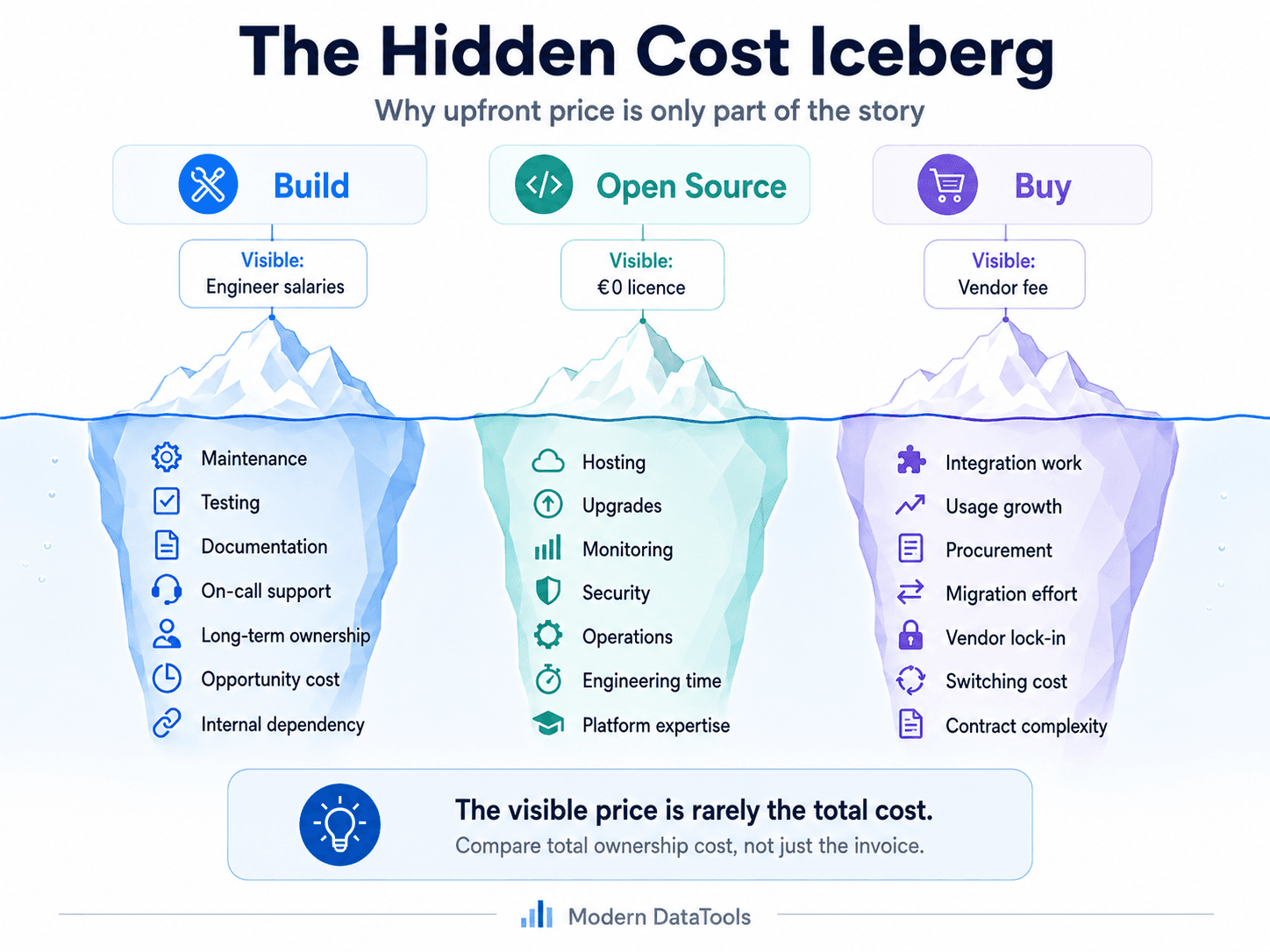
The final term is especially easy to underestimate. A SaaS product can be cheap today but expensive to replace after five years of integrations and platform-specific logic. An internal system may have no licence fee but require several engineers who could instead be working on customer-facing products.
Open source sits somewhere in between. It can provide control and portability without requiring the company to invent the underlying technology, but the organization must still be capable of operating it reliably.
Modern DataTools' pricing data shows how wide this spectrum has become. Across the catalog, products range from fully open-source projects to freemium tools, per-seat subscriptions, usage-based infrastructure and enterprise platforms that publish no price at all.
There is therefore no universally cheapest model. The cheapest option depends on what the company already knows how to operate efficiently and where engineering time creates the highest return.
Control matters more than owning the code
Teams often build software themselves because they want control. The concern is reasonable: a vendor can increase prices, change its roadmap, discontinue a product or make migration progressively harder.
Owning the code is not the only way to preserve control, though. A company can use commercial software while keeping critical data portable, preferring open formats and interfaces, avoiding excessive platform-specific business logic and understanding the migration path before making a long-term commitment.
The useful test is to imagine that a major vendor disappears or doubles its price tomorrow. If replacing it would require a difficult but manageable migration, the dependency may be acceptable. If replacing it would force the company to rebuild a critical part of its product, the decision deserves much more scrutiny.
Internal software can create its own form of lock-in as well. A poorly documented platform understood by two engineers may be harder to replace than a widely used commercial product, so ownership should not be confused with flexibility.
So when should you build, buy or use open source?
Building makes the most sense when the capability genuinely differentiates the product, requirements are unusual, and the company expects to keep investing in the technology. In those cases, internal ownership can create real strategic value rather than simply moving a vendor invoice into the engineering budget.
Buying is usually strongest when the problem is well understood and vendors can solve it more efficiently than the company can internally. The trade-off is worth making when the dependency is manageable and the saved engineering capacity can be used on work that matters more.
Open source is often the middle path when a mature solution already exists and the organization wants more control than SaaS provides. It avoids reinventing established technology while preserving more flexibility, but it also transfers a larger share of the operational burden back to the internal team.
The final question is therefore not whether your engineers can build something. Strong teams can build almost anything given enough time. The better question is whether building this particular thing is one of the best uses of their engineering capacity.