Decision comparison
Apache Airflow vs Bruin
Airflow and Bruin overlap where a team schedules warehouse pipelines, and differ in how much each one does. Airflow is the general orchestrator: Python Dags, provider operators for most cloud services, and executors that scale to many workers, with the work of running and upgrading it on your team. Bruin narrows the job to data pipelines and covers more of it per file: ingestion, SQL and Python transformations and column checks live in one repository and one CLI. They also work together, because Bruin's CLI can run inside an existing Airflow DAG while a team moves pipelines over.
Architecture choice. These take different approaches to the same problem. Read the table as a fit question rather than a feature race.
All 2 are workflow orchestrators.
Quick Comparison
| Decision factor | Apache Airflow | Bruin |
|---|---|---|
| Best for | Engineering teams that write Python and need one scheduler for batch workflows that span many systems: warehouse jobs, cloud services reached through provider operators, and machine learning steps such as training, evaluation and deployment. Airflow coordinates the steps; the heavy data processing runs in the systems it calls. | Data teams that want ingestion, SQL and Python transformations and data quality checks in one Git repository, run by one CLI. A team can self-host the free CLI and schedule it from its own CI, or pay for Bruin Cloud, which adds managed scheduling, a data catalog and an AI data analyst. |
| Scope of the tool | A workflow orchestrator. A Dag declares tasks and their dependencies, and the scheduler runs those tasks on workers through the Celery or Kubernetes executors. Ingestion, transformation and testing run as tasks you write or call through provider operators. The project says Airflow is not a streaming solution, though it is often used to pull data off streams in batches. | A pipeline tool whose assets cover the whole path. Ingestr assets load data from databases, warehouses and apps, SQL and Python assets transform it, and checks such as not_null and unique sit in the asset definition. Each asset declares what it depends on, and bruin run executes the pipeline in that order. |
| How pipelines are defined | In Python. Dags use ordinary Python, such as loops that generate tasks, plus Jinja templating for parameters. Provider packages supply operators for Google Cloud, AWS, Microsoft Azure and many other services, and teams can write their own operators. Providers are released separately from Airflow, with their own version numbers. | As files in the repository: SQL files with a short metadata header, Python files, and YAML for ingestion assets. The header names the asset, its materialization (table, view or incremental table), its dependencies and its checks. Jinja templating avoids repetition, and a dry run validates the pipeline end to end before anything runs. |
| Pricing and licensing | Free and open-source under the Apache License 2.0 | Open Source: the self-hosted Bruin CLI is free. Team (Bruin Cloud): $0.01 per credit, pay-as-you-go with no seat fees; accounts start with $100 in credits and 50 AI tasks. SQL assets use 250 credits per hour ($2.50/hour), billed per second; Python and ingestion assets are priced by instance size, from 250 credits per hour; AI tasks cost 100 to 300 credits. Scale: custom pricing with committed credits and volume discounts; its plan card mentions annual commitments while the comparison table lists no minimum commitment, so confirm contract terms with Bruin. Official pricing page checked October 21, 2026. |
| Deployment and operations | Runs on POSIX systems, and Linux is the only supported production environment; Windows needs WSL2 or Linux containers. Install with pip or uv from PyPI, using version-specific constraint files for repeatable installs, or use the community Docker images and Helm chart on Kubernetes. End-of-life versions get no fixes: Airflow 2 reached end of life on April 22, 2026. | The CLI installs with one command on macOS, Linux and Windows (WSL) and runs on a laptop, an EC2 instance, GitHub Actions, on-prem or in air-gapped environments. Open Source leaves compute and scheduling to you. Bruin Cloud schedules runs on any cron expression, keeps run history and handles backfills; BYOC and private networking are listed only on Scale. |
| Data checks and visibility | Airflow tracks task state. Its UI shows each Dag's graph, asset dependencies, a grid of runs over time, the code, backfills for a date range, and the status and logs of completed and running tasks. Data checks run as tasks, for example the SQL check operators in the common SQL provider. | Checks such as not_null, unique and positive are declared on columns inside each asset, and a failed check stops the assets downstream: in Bruin's example, mart.revenue_daily is skipped because an upstream check failed. Lineage comes with the CLI; Bruin Cloud adds visual lineage, a searchable asset catalog and governance scoring. |
Apache Airflow
- Best for:
- Engineering teams that write Python and need one scheduler for batch workflows that span many systems: warehouse jobs, cloud services reached through provider operators, and machine learning steps such as training, evaluation and deployment. Airflow coordinates the steps; the heavy data processing runs in the systems it calls.
- Scope of the tool:
- A workflow orchestrator. A Dag declares tasks and their dependencies, and the scheduler runs those tasks on workers through the Celery or Kubernetes executors. Ingestion, transformation and testing run as tasks you write or call through provider operators. The project says Airflow is not a streaming solution, though it is often used to pull data off streams in batches.
- How pipelines are defined:
- In Python. Dags use ordinary Python, such as loops that generate tasks, plus Jinja templating for parameters. Provider packages supply operators for Google Cloud, AWS, Microsoft Azure and many other services, and teams can write their own operators. Providers are released separately from Airflow, with their own version numbers.
- Pricing and licensing:
- Free and open-source under the Apache License 2.0
- Deployment and operations:
- Runs on POSIX systems, and Linux is the only supported production environment; Windows needs WSL2 or Linux containers. Install with pip or uv from PyPI, using version-specific constraint files for repeatable installs, or use the community Docker images and Helm chart on Kubernetes. End-of-life versions get no fixes: Airflow 2 reached end of life on April 22, 2026.
- Data checks and visibility:
- Airflow tracks task state. Its UI shows each Dag's graph, asset dependencies, a grid of runs over time, the code, backfills for a date range, and the status and logs of completed and running tasks. Data checks run as tasks, for example the SQL check operators in the common SQL provider.
Bruin
- Best for:
- Data teams that want ingestion, SQL and Python transformations and data quality checks in one Git repository, run by one CLI. A team can self-host the free CLI and schedule it from its own CI, or pay for Bruin Cloud, which adds managed scheduling, a data catalog and an AI data analyst.
- Scope of the tool:
- A pipeline tool whose assets cover the whole path. Ingestr assets load data from databases, warehouses and apps, SQL and Python assets transform it, and checks such as not_null and unique sit in the asset definition. Each asset declares what it depends on, and bruin run executes the pipeline in that order.
- How pipelines are defined:
- As files in the repository: SQL files with a short metadata header, Python files, and YAML for ingestion assets. The header names the asset, its materialization (table, view or incremental table), its dependencies and its checks. Jinja templating avoids repetition, and a dry run validates the pipeline end to end before anything runs.
- Pricing and licensing:
- Open Source: the self-hosted Bruin CLI is free. Team (Bruin Cloud): $0.01 per credit, pay-as-you-go with no seat fees; accounts start with $100 in credits and 50 AI tasks. SQL assets use 250 credits per hour ($2.50/hour), billed per second; Python and ingestion assets are priced by instance size, from 250 credits per hour; AI tasks cost 100 to 300 credits. Scale: custom pricing with committed credits and volume discounts; its plan card mentions annual commitments while the comparison table lists no minimum commitment, so confirm contract terms with Bruin. Official pricing page checked October 21, 2026.
- Deployment and operations:
- The CLI installs with one command on macOS, Linux and Windows (WSL) and runs on a laptop, an EC2 instance, GitHub Actions, on-prem or in air-gapped environments. Open Source leaves compute and scheduling to you. Bruin Cloud schedules runs on any cron expression, keeps run history and handles backfills; BYOC and private networking are listed only on Scale.
- Data checks and visibility:
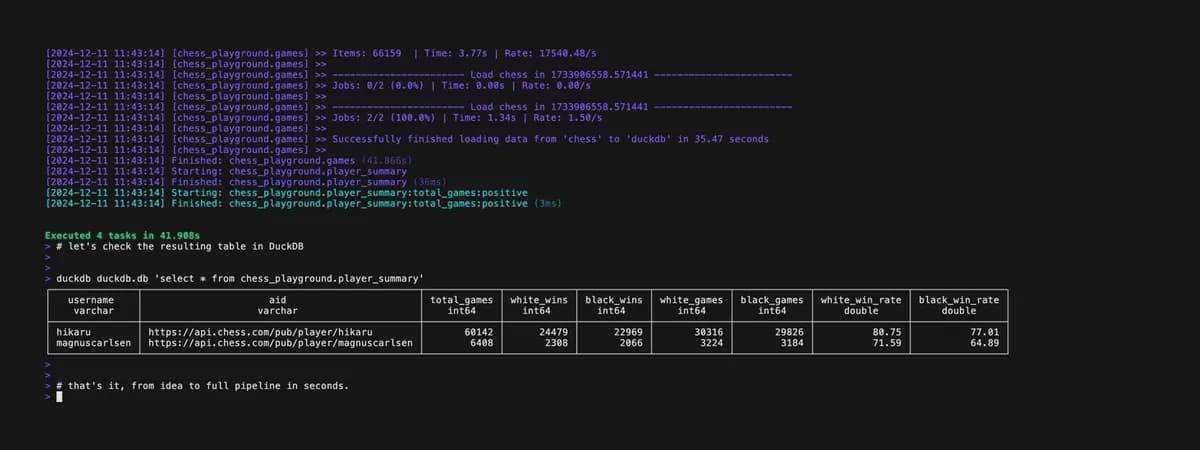
- Checks such as not_null, unique and positive are declared on columns inside each asset, and a failed check stops the assets downstream: in Bruin's example, mart.revenue_daily is skipped because an upstream check failed. Lineage comes with the CLI; Bruin Cloud adds visual lineage, a searchable asset catalog and governance scoring.
Public signals
Verified factual signals only. Bars appear only for like-for-like metrics with five weekly assessments for every tool; missing evidence stays explicit. These signals do not establish enterprise adoption, product quality, or total cost.
| Metric | Apache Airflow | Bruin |
|---|---|---|
| Docker Hub pulls(Product adoption) | 1.7B | Not available |
| GitHub commits, 90d(Product adoption) | 2.7k | 656 |
| GitHub stars(Product adoption) | 47,000+ | 1,500+ |
| Search interest(Market interest) | 1 | Not available |
| Hacker News mentions, 90d(Community interest) | 2 | 1 |
| PyPI weekly downloads(Product adoption) | 1.5M | Not available |
| Stack Overflow questions(Community interest) | 10.6k | Not available |
| PyPI weekly downloads(Developer adoption) | Not available | 3.9k |
As of November 9, 2026 — updated weekly.
Health & risk evidence
Observed public-source checks for mapped package versions and repositories.
Apache Airflow
November 9, 2026Package vulnerabilities
PyPI · apache-airflow@3.4.0
0 vulnerabilities
across 1 package
Repository security score
github.com/apache/airflow
7.6/10
Bruin
November 9, 2026Package vulnerabilities
PyPI · bruin-sdk@0.5.2
0 vulnerabilities
across 1 package
Repository security score
Not available
Interface Preview
Apache Airflow
Bruin
Feature Comparison
| Feature | Apache Airflow | Bruin |
|---|---|---|
| Core capabilities | ||
| Primary job | Scheduling and running tasks across many systems | Ingestion, transformation and checks as pipeline assets |
| Pipeline definition | Python Dags with Jinja templating | SQL and Python files with a metadata header; YAML for ingestion |
| Data ingestion | Provider operators and custom tasks | Ingestr assets for databases, warehouses and apps |
| Transformation languages | Any, run as tasks; Dags in Python | SQL, Python and R assets |
| Data quality checks | SQL check operators in the common SQL provider, or custom tasks | Column checks inside each asset; failures skip downstream assets |
| AI workloads | Orchestrates ML and LLM pipeline steps | AI data analyst, AI dashboards and scheduled agents in Bruin Cloud |
| Operations | ||
| Scheduling | Built-in scheduler and workers you run | Self-managed on Open Source; managed cron schedules on Bruin Cloud Team |
| Scaling | Celery or Kubernetes executors with any number of workers | Per-asset instance sizes from 256 MB to 16 GB on Bruin Cloud |
| Backfills | Backfill view for a date range | Historical backfills on Bruin Cloud Team and Scale |
| Production platform | Linux only; Windows through WSL2 or containers | macOS, Linux and Windows (WSL); local, EC2, GitHub Actions or on-prem |
| Working with existing pipelines | Provider operators for Google Cloud, AWS, Azure and many other services | Reads Airflow DAGs and dbt models; the CLI can run inside an Airflow DAG |
| Commercial | ||
| License | Apache 2.0, Apache Software Foundation project | Apache 2.0 for the CLI; Bruin Cloud is a paid service |
| Pricing | Free; you pay for your own infrastructure | Free CLI; Team at $0.01 per credit; Scale custom |
| Enterprise access controls | Configured in your own deployment | SSO and SAML on the custom Scale plan |
Core capabilities
Primary job
Pipeline definition
Data ingestion
Transformation languages
Data quality checks
AI workloads
Operations
Scheduling
Scaling
Backfills
Production platform
Working with existing pipelines
Commercial
License
Pricing
Enterprise access controls
Which approach fits
Airflow and Bruin overlap where a team schedules warehouse pipelines, and differ in how much each one does. Airflow is the general orchestrator: Python Dags, provider operators for most cloud services, and executors that scale to many workers, with the work of running and upgrading it on your team. Bruin narrows the job to data pipelines and covers more of it per file: ingestion, SQL and Python transformations and column checks live in one repository and one CLI. They also work together, because Bruin's CLI can run inside an existing Airflow DAG while a team moves pipelines over.
When each approach fits
Choose Apache Airflow if:
Choose Apache Airflow when your pipelines reach beyond the warehouse: calling cloud services through provider operators, coordinating machine learning training and deployment, or running many teams' workflows on one scheduler with Celery or Kubernetes workers. It fits engineers who write Python and want control over every task, and organisations that value an open-source project governed by the Apache Software Foundation. Plan for the operating work: a production install needs Linux, a PostgreSQL or MySQL metadata database, version-specific constraint files for repeatable installs, and an upgrade before each version's end of life, as Airflow 2 users faced on April 22, 2026. Airflow hands data processing to other systems by design, so ingestion, transformation and data checks stay separate pieces you choose and connect.
Choose Bruin if:
Choose Bruin when the pipelines are warehouse ELT and your team would rather write SQL files with a metadata header than Python Dags. One CLI loads data with ingestr, runs SQL, Python and R transformations, and skips downstream assets when a column check fails, so a small team does not have to connect separate ingestion, transformation and testing tools. Start with the free Apache 2.0 CLI from your own CI, then move to Bruin Cloud when you want managed cron scheduling, backfills, a catalog or the AI data analyst, billed at $0.01 per credit with no seats. Bruin is the wrong fit for orchestrating work outside its asset types, such as infrastructure or application jobs, and SSO and BYOC need the custom Scale plan.
These scenarios reflect the available product evidence. Your requirements, existing stack, and team expertise should guide the final decision.
Frequently Asked Questions
Can Bruin run inside Airflow?
Yes. Bruin says its CLI can run inside an existing Airflow DAG, and that it reads existing Airflow DAGs and dbt models. A team can keep Airflow as the scheduler, run a Bruin pipeline as one of its tasks, and move pipelines to Bruin at its own pace instead of rewriting everything at once.
Is either tool free?
Both have a free open-source core under Apache 2.0. Airflow is free to run, and the cost is your own scheduler, workers and metadata database. The Bruin CLI is free to self-host; Bruin Cloud bills $0.01 per credit, SQL assets use 250 credits ($2.50) an hour, and new accounts start with $100 in credits and 50 AI tasks without a credit card.
Which one handles streaming data?
The Airflow project says it is not a streaming solution and is often used to pull data off streams in batches. Bruin lists streams and webhooks among the sources it ingests, and runs its pipelines on a schedule or on demand.
Do I need Python for each tool?
For Airflow, yes: every Dag is a Python file, even when its tasks run SQL. For Bruin, a SQL asset needs only SQL and a short metadata header, and Python is needed only for Python assets, which run in isolated environments managed with uv.