Decision comparison
Apache Airflow vs Talend
Apache Airflow and Talend serve overlapping but fundamentally different roles in the data pipeline ecosystem. Airflow excels as a free, highly flexible workflow orchestrator for teams with strong Python skills who need maximum control over pipeline logic. Talend delivers a comprehensive enterprise data integration platform with built-in data quality, governance, and visual development tools that reduce the need for deep coding expertise. The choice depends on whether your organization prioritizes cost and developer control or enterprise-grade data management capabilities with vendor support.
Use-case verdict
Choose Airflow for code-first orchestration; choose Talend for visual integration
Apache Airflow defines and operates batch-oriented workflows in Python. Talend packages visual integration, transformation, governance, and data-quality capabilities for teams that want a broader enterprise data platform. The right choice depends on whether orchestration flexibility or packaged integration is the main requirement.
Pick Airflow when
engineers want Python-defined DAGs, extensible operators, and control over how workflows run.
Pick Talend when
teams prefer visual pipeline design plus packaged integration, governance, and data-quality capabilities.
Do not assume
Airflow is serverless: it requires an execution environment and operational components even when a managed service hosts them.
Architecture choice. These take different approaches to the same problem. Read the table as a fit question rather than a feature race.
These are different kinds of product — Workflow Orchestrator and ETL Platform.
Quick Comparison
| Decision factor | Apache Airflow | Talend |
|---|---|---|
| Pricing | Free and open-source under the Apache License 2.0 | Talend Data Fabric starts at $12,000/year ($1000/month), Talend Cloud and Data Management Platform require contact for custom pricing, Enterprise Custom plans are custom-priced. Plans range from $12,000 to $200,000/year. |
| Ease of Use | Requires Python proficiency; code-first approach with steep learning curve | GUI-based visual interface with drag-and-drop pipeline designer; lower barrier for non-developers |
| Scalability | Highly scalable modular architecture with message queue orchestration | Enterprise-grade with cloud, on-premises, and hybrid deployment options |
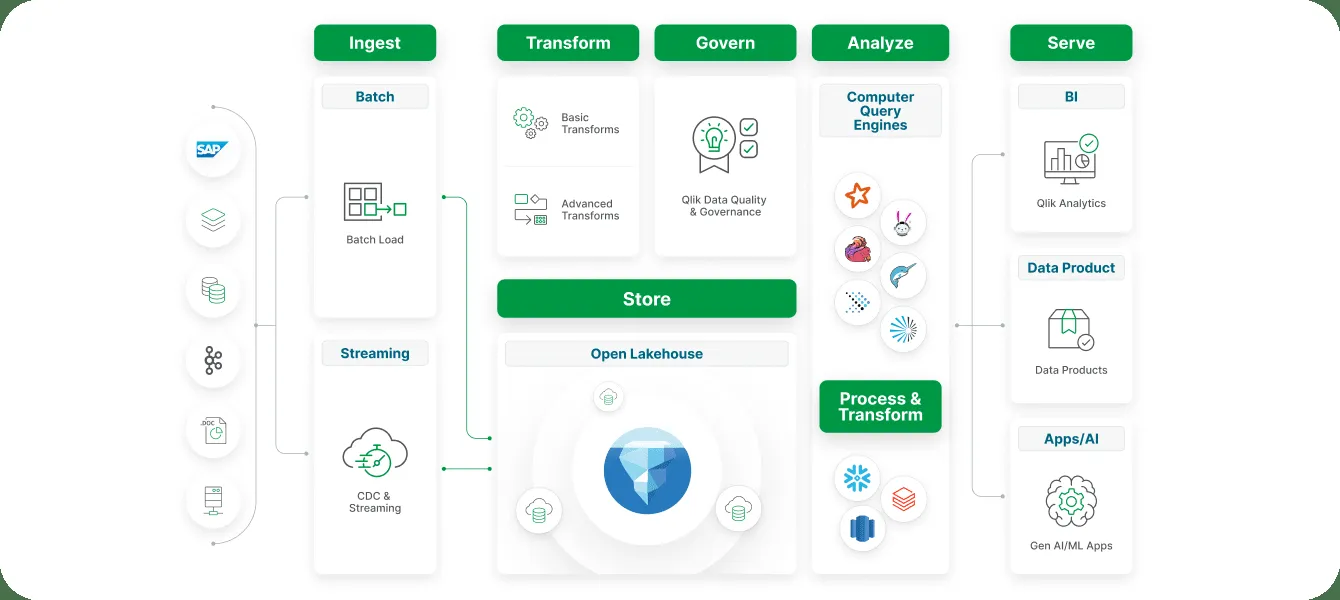
| Data Quality & Governance | No built-in data quality or governance tools; relies on external integrations | Built-in data quality, profiling, lineage, stewardship, and Trust Score |
| Integration Options | Hundreds of plug-and-play operators for AWS, GCP, Azure, and third-party services | Pre-built connectors for SaaS, databases, SAP, mainframes, and cloud warehouses |
| Community & Support | 46,000+ GitHub stars; large active open-source community; no vendor support | Commercial vendor support from Qlik; focused open-source community |
Apache Airflow
- Pricing:
- Free and open-source under the Apache License 2.0
- Ease of Use:
- Requires Python proficiency; code-first approach with steep learning curve
- Scalability:
- Highly scalable modular architecture with message queue orchestration
- Data Quality & Governance:
- No built-in data quality or governance tools; relies on external integrations
- Integration Options:
- Hundreds of plug-and-play operators for AWS, GCP, Azure, and third-party services
- Community & Support:
- 46,000+ GitHub stars; large active open-source community; no vendor support
Talend
- Pricing:
- Talend Data Fabric starts at $12,000/year ($1000/month), Talend Cloud and Data Management Platform require contact for custom pricing, Enterprise Custom plans are custom-priced. Plans range from $12,000 to $200,000/year.
- Ease of Use:
- GUI-based visual interface with drag-and-drop pipeline designer; lower barrier for non-developers
- Scalability:
- Enterprise-grade with cloud, on-premises, and hybrid deployment options
- Data Quality & Governance:
- Built-in data quality, profiling, lineage, stewardship, and Trust Score
- Integration Options:
- Pre-built connectors for SaaS, databases, SAP, mainframes, and cloud warehouses
- Community & Support:
- Commercial vendor support from Qlik; focused open-source community
Public signals
Verified factual signals only. Bars appear only for like-for-like metrics with five weekly assessments for every tool; missing evidence stays explicit. These signals do not establish enterprise adoption, product quality, or total cost.
| Metric | Apache Airflow | Talend |
|---|---|---|
| Docker Hub pulls(Product adoption) | 1.6B | Not available |
| GitHub commits, 90d(Product adoption) | 2.0k | Not available |
| GitHub stars(Product adoption) | 46,000+ | Not available |
| Search interest(Market interest) | 2 | 0 |
| Hacker News mentions, 90d(Community interest) | 1 | 0 |
| PyPI weekly downloads(Product adoption) | 1.8M | Not available |
| Stack Overflow questions(Community interest) | 10.6k | 2.7k |
As of September 21, 2026 — updated weekly.
Health & risk evidence
Observed public-source checks for mapped package versions and repositories.
Apache Airflow
September 21, 2026Package vulnerabilities
PyPI · apache-airflow@3.3.2
0 vulnerabilities
across 1 package
Repository security score
github.com/apache/airflow
7.3/10
Talend
Package vulnerabilities
Not available
Repository security score
Not available
Interface Preview
Apache Airflow
Talend
Feature Comparison
| Feature | Apache Airflow | Talend |
|---|---|---|
| Core Capabilities | ||
| Workflow Orchestration | Python DAG-based scheduling with dependency management and task retries | Visual pipeline designer with drag-and-drop workflow creation and scheduling |
| ETL/ELT Support | Orchestrates ETL/ELT pipelines but does not process data itself | Comprehensive built-in ETL and ELT capabilities with transformation engine |
| Data Quality Tools | No native data quality features; requires third-party tools | End-to-end data quality with profiling, cleansing, and Talend Trust Score |
| Deployment & Infrastructure | ||
| Deployment Options | Self-hosted or managed via Astronomer; cloud and on-premises | Cloud-native SaaS, on-premises, or hybrid deployment through Qlik Talend Cloud |
| Scalability Architecture | Modular architecture with CeleryExecutor, KubernetesExecutor for distributed execution | Enterprise scaling with Spark batch processing and cloud-based auto-scaling |
| Real-Time Processing | Batch-oriented; not designed for streaming or real-time workflows | Supports real-time CDC (change data capture) synchronization in Standard tier and above |
| Usability & Development | ||
| User Interface | Web UI for monitoring DAGs, viewing logs, and managing task status | Full GUI-based pipeline designer with no-code interface and management console |
| Programming Approach | Code-first with Python; workflows defined entirely in Python scripts | Visual low-code tooling with optional full-code control for advanced users |
| Learning Curve | Steep; requires Python, DevOps expertise, and understanding of DAG concepts | Moderate; GUI is accessible but advanced configuration and architecture are complex |
| Governance & Security | ||
| Data Governance | No built-in governance; relies on external tools for lineage and cataloging | Column-level lineage, impact analysis, data stewardship, and data products |
| Data Catalog | No native data catalog capability | Built-in data catalog with dataset discovery, metadata management, and data marketplace |
| Security Features | Basic authentication; role-based access can be configured manually | Enterprise-grade security with VPC access, compliance standards, and encrypted pipelines |
| Ecosystem & Pricing | ||
| Pricing Model | Free and open-source; infrastructure costs only | Usage-based enterprise pricing |
| Cloud Integrations | Operators for AWS, GCP, Azure, Snowflake, Databricks, and many more | Pre-built connectivity to cloud warehouses, SaaS apps, SAP, and mainframes |
| AI/ML Support | Orchestrates ML pipelines; integrates with MLflow, Ray, and custom Python ML code | Enterprise tier includes AI/GenAI pipeline creation and LLM extensibility |
Core Capabilities
Workflow Orchestration
ETL/ELT Support
Data Quality Tools
Deployment & Infrastructure
Deployment Options
Scalability Architecture
Real-Time Processing
Usability & Development
User Interface
Programming Approach
Learning Curve
Governance & Security
Data Governance
Data Catalog
Security Features
Ecosystem & Pricing
Pricing Model
Cloud Integrations
AI/ML Support
Which approach fits
Apache Airflow and Talend serve overlapping but fundamentally different roles in the data pipeline ecosystem. Airflow excels as a free, highly flexible workflow orchestrator for teams with strong Python skills who need maximum control over pipeline logic. Talend delivers a comprehensive enterprise data integration platform with built-in data quality, governance, and visual development tools that reduce the need for deep coding expertise. The choice depends on whether your organization prioritizes cost and developer control or enterprise-grade data management capabilities with vendor support.
When each approach fits
Choose Apache Airflow if:
Choose Apache Airflow if your team has strong Python expertise and you need a flexible, cost-effective workflow orchestrator. Airflow is the clear winner for organizations that want full programmatic control over pipeline logic, benefit from a massive open-source community with 46,000+ GitHub stars, and prefer to avoid vendor lock-in. It handles complex dependency management, supports distributed execution through CeleryExecutor and KubernetesExecutor, and integrates with hundreds of cloud services and third-party tools through its operator library. Airflow works best for data engineering teams that are comfortable managing infrastructure and writing workflows as code.
Choose Talend if:
Choose Talend if your organization requires a comprehensive enterprise data platform with built-in data quality, governance, and visual pipeline design. Talend is the stronger option for teams that include non-developer users who need GUI-based tools, organizations with strict data governance requirements including lineage tracking and data stewardship, and enterprises that need real-time CDC capabilities. With Qlik Talend Cloud tiers ranging from Starter through Enterprise, the platform scales from basic SaaS connectivity to full data fabric with SAP and mainframe integration. Expect to invest $12,000 to $200,000 or more annually depending on your deployment scope.
These scenarios reflect the available product evidence. Your requirements, existing stack, and team expertise should guide the final decision.
Frequently Asked Questions
Is Apache Airflow free to use?
Yes, Apache Airflow is completely free and open-source under the Apache License 2.0. There are no licensing fees. Your only costs are the infrastructure to run it, whether self-hosted or through a managed service like Astronomer. This makes Airflow significantly more affordable than Talend for teams that can manage their own deployments.
How much does Talend cost per year?
Enterprise deployments typically range from $50,000 to $200,000 or more annually. Qlik Talend Cloud uses usage-based pricing measured by data volume, job executions, and execution duration across four tiers: Starter, Standard, Premium, and Enterprise. All tiers require contacting sales for a custom quote.
Can Apache Airflow handle real-time data processing?
No, Apache Airflow is designed for batch-oriented workflows and is not suitable for continuous streaming or real-time data processing. However, it can integrate with streaming platforms like Apache Kafka and Apache Spark to orchestrate near real-time batch workflows. Talend offers real-time change data capture (CDC) synchronization starting from its Standard tier for teams that need real-time capabilities.
Which tool is better for teams without Python expertise?
Talend is the better choice for teams without strong Python skills. Its GUI-based pipeline designer, drag-and-drop interface, and no-code management console allow business users and data analysts to build and manage data pipelines without writing code. Apache Airflow requires Python proficiency for defining workflows as DAGs and demands DevOps knowledge for deployment and maintenance.
Does Talend offer data quality and governance features that Airflow lacks?
Yes, Talend provides comprehensive built-in data quality and governance capabilities that Apache Airflow does not have natively. These include data profiling, cleansing, the proprietary Talend Trust Score for measuring data trustworthiness, column-level lineage and impact analysis, data stewardship workflows, and a data catalog with marketplace. Airflow users must integrate third-party tools to achieve similar governance functionality.