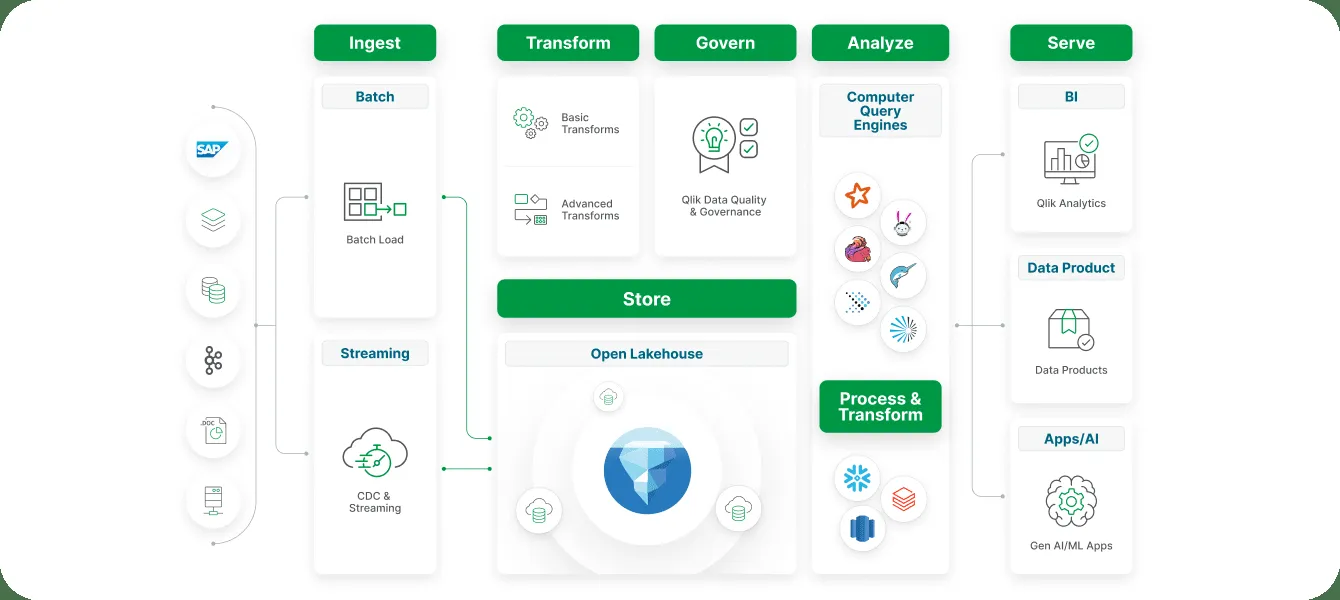
Talend: product and architecture
In this Talend review, we examine one of the longest-standing data integration platforms on the market and evaluate whether it still holds up against modern alternatives. Now part of Qlik following its acquisition, Talend provides enterprise-grade ETL, data quality, and data governance capabilities under the unified Qlik Talend Cloud brand. The platform serves organizations that need to integrate, transform, and govern data across cloud, on-premises, and hybrid environments. We assess Talend's features, pricing structure, strengths, and weaknesses to help data teams decide whether this veteran platform deserves a place in their modern data stack. With 74 verified reviews and an 8.8 out of 10 rating from users, Talend has a solid track record, but its enterprise pricing and steep learning curve deserve careful consideration.
Overview
Talend was founded in 2005 as an open-source data integration company and quickly grew into one of the most recognized names in the ETL space. Qlik acquired Talend in 2023, merging it into the Qlik Talend Cloud platform. Today, Talend offers a comprehensive suite spanning data integration, data quality, master data management, and API services. The platform targets mid-market to large enterprise organizations. Talend supports batch, real-time, ETL, ELT, and API integration patterns within a single platform. It connects to hundreds of data sources including SaaS applications, databases, data warehouses, and mainframe systems. The platform is available as a cloud-native SaaS offering (Qlik Talend Cloud), a client-managed deployment, or a hybrid configuration. With over 40,000 Qlik customers globally, Talend remains a major force in enterprise data integration, though its acquisition has introduced changes around product direction and legacy version support. The platform carries an 8.8 out of 10 rating across 74 verified user reviews, with users praising its data integration breadth and friendly user interface.
Key Features and Architecture
Qlik Talend Cloud is organized into four editions: Starter, Standard, Premium, and Enterprise. Customers subscribe to capacity for the selected edition; usage is measured from a combination of data volume moved, job executions, and execution duration.
Starter is positioned for moving data from SaaS applications and databases. Its listed capabilities include pre-built connectivity to SaaS sources and multiple destinations, managed cloud-based pipelines, ready-to-query schemas, a data catalog, field-level metadata and profiling, and analytics and automation workflows.
Standard adds log-based change data capture for real-time synchronization, additional database and file-format connectivity, cloud, client-managed, or hybrid deployment, private access between VPCs and on-premises networks, unlimited optimized movement to Qlik Cloud Analytics, and Qlik Open Lakehouse ingestion and adaptive optimization for Apache Iceberg.
Premium adds automated ELT or ETL transformations; warehouse, lake, and lakehouse automation; end-to-end column-level lineage and impact analysis; Spark batch processing; application and API integration; data products and a data marketplace; semantic-type-based quality and profiling; data stewardship; and Qlik Talend Trust Score. Premium also includes data-pipeline capabilities for AI and Generative AI use cases and integrated LLM extensibility.
Enterprise adds comprehensive connectivity to SAP applications and Mainframe sources. Qlik Talend is also available as a client-managed solution.
Ideal Use Cases
Talend is best suited for mid-market to large enterprises with dedicated data engineering teams that need comprehensive ETL capabilities combined with data quality and governance. Organizations processing data across multiple cloud providers benefit from Talend's multi-cloud orchestration, which eliminates the need for separate tools like AWS Glue or Azure Data Factory.
We recommend Talend for Fortune 500 companies with complex data landscapes that span SAP systems, mainframe sources, and modern cloud warehouses. The platform excels when organizations need a single tool that handles integration, quality, and governance rather than stitching together point solutions.
Talend is a strong fit for regulated industries such as banking and manufacturing where data lineage, trust scoring, and compliance reporting are mandatory. Teams that need real-time CDC into Iceberg tables for near-real-time analytics dashboards will find the Standard tier sufficient.
Talend is not suitable for small teams or startups looking for quick time-to-value. The platform requires 6 to 18 months for implementation, and its complexity demands dedicated ETL developers. Teams with 10 or fewer data engineers or annual budgets under $12,000 should consider compact alternatives like Airbyte or Stitch.
Strengths & Trade-offs
Pros:
- Comprehensive ETL, ELT, and real-time CDC capabilities in a single platform with hundreds of pre-built connectors
- Strong data quality tools including the proprietary Trust Score metric and automated semantic profiling
- Multi-cloud orchestration without requiring cloud-specific tools like AWS Glue or Azure Data Factory
- GUI-based design that experienced users find intuitive for designing data pipelines and populating data lakes
- End-to-end column-level lineage and impact analysis in Premium and Enterprise tiers
- Proven enterprise stability with an 8.8 out of 10 user rating across 74 reviews
Cons:
- Steep learning curve that requires significant technical expertise and dedicated ETL developers
- Opaque enterprise pricing with real costs ranging from $12,000 to $200,000 per year
- Inconsistent job failures that are difficult to diagnose, causing teams to devote considerable time to fixing failures rather than building new features
- Frequent patches require regular updates to Talend Studio, creating ongoing maintenance overhead
- Complex architecture with many components that require intricate setup and configuration