MuleSoft: product and architecture
This MuleSoft review finds that MuleSoft is a strong enterprise integration platform for organizations that need to connect applications, data, and devices across cloud and on-premises environments—but it is not a lightweight data-pipeline purchase. We recommend MuleSoft for teams that treat APIs as long-lived, governed business products and can support the platform’s enterprise operating model. Smaller teams seeking fast, narrowly scoped warehouse ingestion should look elsewhere.
Overview
MuleSoft’s Anypoint Platform is an enterprise data-pipeline and integration platform designed to connect applications, data, and devices across environments. Salesforce acquired MuleSoft in early 2018, and the platform’s core proposition is API-led connectivity: expose capabilities through APIs, then assemble those capabilities into reusable services and integrations.
The product is best understood as an application integration and API lifecycle platform, not simply an ELT connector service. Its stated scope covers designing, building, and managing the lifecycle of APIs, applications, and products. That breadth is valuable when a data organization must integrate operational systems, partner-facing services, and automation workflows—not merely move tables from a source into an analytics destination.
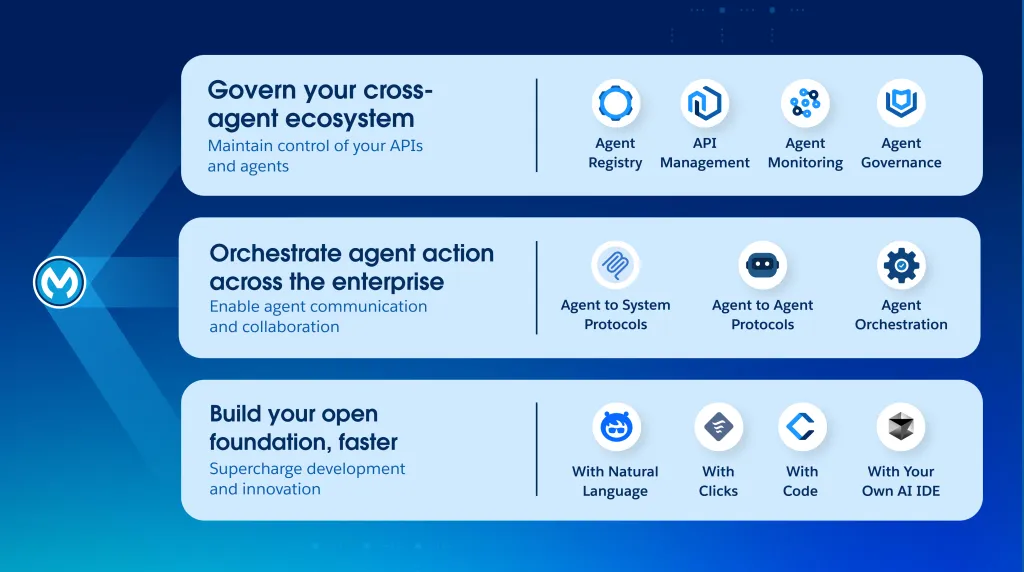
MuleSoft’s current positioning also includes AI governance and orchestration. MuleSoft Agent Fabric is presented as a foundation for governing and orchestrating AI agents across an ecosystem, regardless of where those agents are built. The company’s 2026 Connectivity Benchmark Report draws on input from more than 1,000 IT leaders, which is a useful public signal of the vendor’s enterprise-oriented market conversation, though it is not proof of product adoption or performance.
For data leaders, the decision is straightforward: choose MuleSoft when integration reuse, API governance, and cross-environment connectivity justify platform complexity. Avoid it when the job is primarily batch replication into a warehouse and the organization does not need an API product strategy.
Key Features and Architecture
MuleSoft is organized around an API-led connectivity approach. Rather than treating every integration as a point-to-point project, teams can create APIs that expose applications and data as reusable building blocks. This architecture is intended to form an application network of pluggable services, allowing new projects to consume existing interfaces instead of rebuilding integration logic from scratch.
Key capabilities described for Anypoint Platform include:
-
Out-of-the-box connectors. MuleSoft provides prebuilt connectors so architects and developers can connect systems without beginning each integration from a blank implementation. The trade-off is that connector-based delivery still requires configuration discipline and platform knowledge; a connector does not remove the need to define ownership, error handling, and interface contracts.
-
API lifecycle tooling. The platform supports the design, build, and management lifecycle for APIs, applications, and products. This is important for data teams exposing operational data to downstream consumers, because it places interface design and long-term management in the same platform as implementation work.
-
API-led connectivity. MuleSoft explicitly promotes unlocking applications and data through APIs. The practical architectural value is reuse: a data or application capability can be made available as a managed interface rather than embedded repeatedly in individual workflows.
-
Application network design. MuleSoft describes an app network as connected applications, data, and devices exposed through APIs and assembled as pluggable services. This is a better fit for organizations with multiple integration domains than for a team with one warehouse and a handful of SaaS sources.
-
Cross-environment connectivity. Anypoint Platform is designed to connect assets on-premises and in the cloud. That matters for modernization programs where critical systems cannot all move at once, but it also means implementation must account for both environments rather than assuming a cloud-only operating model.
-
Agent governance and orchestration. MuleSoft Agent Fabric is positioned to govern and orchestrate AI agents across ecosystems, with stated goals including compliance, ROI management, and continuous improvement of agent performance. This broadens MuleSoft’s scope beyond traditional application integration, but buyers should validate the exact controls required for their own AI environment.
The published customer examples emphasize reuse and development speed rather than throughput benchmarks. Bayer is described as doubling product development speed through API-led integrations; Invesco is described as cutting development time by 92%; SMCP achieved a 40% reuse rate for connectors and APIs; and RBC Wealth Management delivered projects three times faster with reusable APIs. These are vendor-provided customer-story outcomes, useful as examples of intended value but not universal performance guarantees.
MuleSoft also has a GitHub repository described as “Mule Community Edition,” with 500 stars, Java as its primary language, a NOASSERTION license designation, and a last push dated June 8, 2026. Those details are public activity signals, not a substitute for evaluating enterprise support, product packaging, or production suitability.
Ideal Use Cases
MuleSoft fits best when integrations are strategic assets that several teams will reuse. A data engineering group working alongside platform, application, and enterprise architecture teams can use API-led connectivity to prevent each project from creating a new point-to-point dependency. The clearest fit is an organization with enough integration demand to justify shared standards, shared interfaces, and a managed API lifecycle.
One strong scenario is a financial-services or regulated enterprise modernizing legacy and cloud systems at the same time. A team of 10 or more engineers spread across data, applications, and architecture can use MuleSoft’s cross-environment model to expose selected capabilities without requiring every operational system to be replaced first. The value is not simply moving data; it is controlling how those systems are accessed and reused as modernization proceeds.
A second scenario is a retailer, manufacturer, or customer-experience organization that needs reusable connections across operational systems, devices, and cloud services. SMCP’s published 40% connector-and-API reuse result illustrates the kind of operating model MuleSoft targets: build a governed integration asset once, then use it in later initiatives. This is particularly relevant when multiple product teams need the same operational data or business action exposed consistently.
A third scenario is an enterprise introducing AI agents that need access to actions and information distributed across an existing technology estate. MuleSoft Agent Fabric is relevant when the priority is governing and orchestrating agents across that ecosystem, rather than building an isolated model demonstration. Teams should still define agent permissions, ownership, and compliance controls before treating orchestration as an implementation shortcut.
Don’t use MuleSoft if your only requirement is simple ingestion from a few source systems into an analytics platform. Its enterprise positioning, API focus, and lifecycle tooling create overhead that is difficult to justify for a small analytics team with low integration reuse. We also would not select it solely because of vendor-reported ROI or customer speed claims; those outcomes depend on disciplined reuse and organizational adoption.
Strengths & Trade-offs
MuleSoft earns a 7.9/10 user rating from 136 reviews in the supplied user-feedback data. That is a useful directional indicator: users identify meaningful value, but the score does not support a claim that the platform is frictionless. The feedback aligns with our assessment that MuleSoft is capable when used as an enterprise platform and demanding when evaluated as a simple integration tool.
Pros
-
Cloud deployment is a user-reported strength. This supports MuleSoft’s value for teams that must deliver integrations in cloud environments while still connecting to systems outside a single cloud boundary.
-
API development is a user-reported strength. MuleSoft’s API lifecycle orientation is concrete: teams can design, build, and manage APIs rather than treating every integration as a disposable script or project-specific connection.
-
Users report reduced delivery time and a workable deployment process. This is consistent with the platform’s reuse model, where existing APIs and connectors can be incorporated into subsequent work instead of recreated.
-
A single place for integration work is a reported benefit. Centralizing lifecycle activities can help data and application teams coordinate ownership, but only if the organization agrees on standards and uses the platform consistently.
-
The interface is described as friendly by users. That can lower initial friction for routine tasks, although it does not eliminate the architectural work required to design durable APIs and integrations.
-
Log files are identified as a strength. Operational visibility matters in integration programs, especially where failures cross application and data boundaries.
Cons
-
Log monitoring is a user-reported weakness. Having log files is not the same as having effective monitoring workflows; teams should test the operational experience before assuming observability requirements are covered.
-
Knowledge-base articles and extensive documentation are reported weaknesses. This is a material onboarding risk. A platform with broad lifecycle scope requires guidance that helps developers resolve real implementation questions, not merely a large volume of reference material.
-
Open API is cited as a weakness in user feedback. Teams with strict API-definition expectations should validate the exact design and interoperability workflows they need during evaluation rather than assuming API-led positioning resolves every standards concern.
-
Customer support is a user-reported weakness. For an enterprise platform, support quality affects delivery risk directly. Procurement should include support expectations in the commercial discussion instead of treating it as an afterthought.
-
XML-based configuration files are a reported pain point. That is a specific developer-experience cost, particularly for teams accustomed to code-first or simpler declarative integration tooling.
-
Navigation is described as difficult by users. This undercuts the “single place” advantage when platform breadth makes finding the right function cumbersome.