Decision comparison
MuleSoft vs Fivetran
MuleSoft is the enterprise integration powerhouse for organizations needing bidirectional API-led connectivity across complex hybrid environments, while Fivetran dominates automated ELT data ingestion with its managed, low-maintenance pipeline approach for analytics teams.
Direct comparison. These are reviewed substitutes bought for the same job, so the differences below are the ones that decide between them.
Applies to: Choosing the tool that moves data from source systems into the analytics platform.
These are different kinds of product — ETL Platform and ELT Platform.
Quick Comparison
| Decision factor | MuleSoft | Fivetran |
|---|---|---|
| Best For | Enterprise API-led integration, multi-system orchestration, and building reusable connectivity assets across cloud and on-premises environments | Automated ELT data ingestion from SaaS apps, databases, and event streams into cloud warehouses with minimal engineering effort |
| Pricing Model | MuleSoft starts at $2,000 per month on a credit model, with one shared credit currency across integrations, APIs, automation and agents, and rates falling as usage scales. Larger arrangements are quoted. | Fivetran is consumption-priced on monthly active rows and quoted through its own estimator. The plans are Free, Standard, Enterprise and Business Critical. The Free plan covers up to 500,000 monthly active rows for connections, 3,500 for activations and 5,000 model runs. Fivetran advertises savings of up to 22% on an annual contract. No per-plan price is published. |
| Ease of Use | Steeper learning curve requiring developer expertise; offers both pro-code Anypoint Studio and low-code Flow Designer options | Highly user-friendly managed platform; data pipelines can be set up in under two minutes with minimal configuration needed |
| Integration Breadth | 1,500+ pre-built connectors supporting APIs, legacy systems, on-premises apps, and B2B partner integrations bidirectionally | 700+ fully managed connectors focused on SaaS replication, database CDC, SAP, file sources, and event streaming ingestion |
| Data Direction | Bidirectional integration platform handling data reads, writes, transformations, and orchestration across any connected systems | Primarily source-to-destination ELT pipelines with reverse ETL capabilities added through Census acquisition for activation |
| Deployment Options | Flexible deployment via CloudHub managed cloud, Runtime Fabric on-premises containers, or hybrid configurations across environments | Cloud-hosted SaaS platform with hybrid deployment option allowing data movement within customer-controlled secure environments |
MuleSoft
- Best For:
- Enterprise API-led integration, multi-system orchestration, and building reusable connectivity assets across cloud and on-premises environments
- Pricing Model:
- MuleSoft starts at $2,000 per month on a credit model, with one shared credit currency across integrations, APIs, automation and agents, and rates falling as usage scales. Larger arrangements are quoted.
- Ease of Use:
- Steeper learning curve requiring developer expertise; offers both pro-code Anypoint Studio and low-code Flow Designer options
- Integration Breadth:
- 1,500+ pre-built connectors supporting APIs, legacy systems, on-premises apps, and B2B partner integrations bidirectionally
- Data Direction:
- Bidirectional integration platform handling data reads, writes, transformations, and orchestration across any connected systems
- Deployment Options:
- Flexible deployment via CloudHub managed cloud, Runtime Fabric on-premises containers, or hybrid configurations across environments
Fivetran
- Best For:
- Automated ELT data ingestion from SaaS apps, databases, and event streams into cloud warehouses with minimal engineering effort
- Pricing Model:
- Fivetran is consumption-priced on monthly active rows and quoted through its own estimator. The plans are Free, Standard, Enterprise and Business Critical. The Free plan covers up to 500,000 monthly active rows for connections, 3,500 for activations and 5,000 model runs. Fivetran advertises savings of up to 22% on an annual contract. No per-plan price is published.
- Ease of Use:
- Highly user-friendly managed platform; data pipelines can be set up in under two minutes with minimal configuration needed
- Integration Breadth:
- 700+ fully managed connectors focused on SaaS replication, database CDC, SAP, file sources, and event streaming ingestion
- Data Direction:
- Primarily source-to-destination ELT pipelines with reverse ETL capabilities added through Census acquisition for activation
- Deployment Options:
- Cloud-hosted SaaS platform with hybrid deployment option allowing data movement within customer-controlled secure environments
Public signals
Verified factual signals only. Bars appear only for like-for-like metrics with five weekly assessments for every tool; missing evidence stays explicit. These signals do not establish enterprise adoption, product quality, or total cost.
| Metric | MuleSoft | Fivetran |
|---|---|---|
| GitHub commits, 90d(Product adoption) | 0 | Not available |
| GitHub stars(Product adoption) | 500 | Not available |
| Search interest(Market interest) | 3 | 1 |
| Hacker News mentions, 90d(Community interest) | 0 | 2 |
| Product Hunt comments(Community interest) | 1 | 9 |
| Product Hunt rating(Community interest) | 5.0/5 | 5.0/5 |
| Product Hunt reviews(Community interest) | 1 | 1 |
| Product Hunt votes(Community interest) | 1 | 85 |
| Stack Overflow questions(Community interest) | 1.9k | 22 |
| GitHub commits, 90d(Developer adoption) | Not available | 23 |
| GitHub stars(Developer adoption) | Not available | 126 |
| PyPI weekly downloads(Developer adoption) | Not available | 32.3k |
As of September 14, 2026 — updated weekly.
Health & risk evidence
Observed public-source checks for mapped package versions and repositories.
MuleSoft
September 14, 2026Package vulnerabilities
Not available
Repository security score
github.com/mulesoft/mule
6.9/10
Fivetran
September 14, 2026Package vulnerabilities
PyPI · fivetran-connector-sdk@2.12.1
0 vulnerabilities
across 1 package
Repository security score
Not available
Interface Preview
MuleSoft
Feature Comparison
| Feature | MuleSoft | Fivetran |
|---|---|---|
| Data Connectivity | ||
| Pre-built Connectors | 1,500+ connectors and integration templates via Anypoint Exchange marketplace covering SaaS, legacy, and B2B systems | 700+ fully managed connectors for SaaS apps, databases, ERPs, files, and event streams with automatic maintenance |
| Custom Connector Development | Anypoint Connector SDK for building custom connectors; Anypoint Code Builder IDE with AI-assisted development | Connector SDK for building custom source connectors; partner-built connector ecosystem; by-request connector program |
| Database Replication | Supports database connectivity through connectors; requires manual configuration for change data capture workflows | Native log-based CDC replication for PostgreSQL, MySQL, Oracle, MongoDB, and other databases with low-latency syncs |
| Data Processing & Transformation | ||
| Data Transformation | DataWeave transformation language built into Mule runtime for complex mapping, filtering, and data format conversion | Built-in dbt Core integration with Quickstart data models; 37.7M+ transformation model runs per month across platform |
| Schema Management | Manual schema design via Anypoint API Designer with RAML and OAS specification support for API contract definition | Fully automated schema evolution handling with 22.2M+ schema changes managed per month across customer pipelines |
| Data Quality & Accuracy | MUnit testing framework for unit and integration testing of APIs and Mule applications before deployment | Automated data type promotion with manual validation; idempotent pipelines that restart from last successful state |
| Security & Compliance | ||
| Security Certifications | Enterprise-grade security through Salesforce infrastructure; Anypoint Security with threat protection and policy enforcement | SOC 1 and SOC 2, GDPR, HIPAA BAA, ISO 27001, PCI DSS Level 1, and HITRUST certifications for comprehensive compliance |
| Access Control | Role-based access control with API governance policies enforced through Anypoint API Manager control plane | Role-based access control on Free tier; custom roles on Enterprise tier; SCIM user provisioning for automated management |
| Network Security | Anypoint Flex Gateway for API security; VPN support; private cloud deployment via Runtime Fabric on-premises | SSH tunnels on Standard tier; VPN tunnels on Enterprise annual contracts; private networking on Business Critical tier |
| Deployment & Operations | ||
| Cloud Deployment | CloudHub fully managed PaaS with 99.999% uptime; multi-region deployment; automatic scaling per demand | Fully managed SaaS platform on GCP, AWS, or Azure; 99.97% uptime with 500+ GB/hr historical sync throughput |
| On-Premises & Hybrid | Runtime Fabric for containerized on-premises deployment; CloudHub-to-on-premises hybrid architecture supported natively | Hybrid Deployment option moves data within customer environment; no on-premises-only deployment available |
| Monitoring & Observability | Anypoint Monitoring with real-time dashboards, alerts, and log access; Runtime Manager for application oversight | Reliability dashboards with sync health logs and alerts; application log exports for pipeline audit and dependency chaining |
| Platform Capabilities | ||
| API Management | Full API lifecycle management with Anypoint API Manager, API Gateway, API Experience Hub portals, and governance tools | REST API for programmatic pipeline management and configuration; no dedicated API lifecycle management tooling |
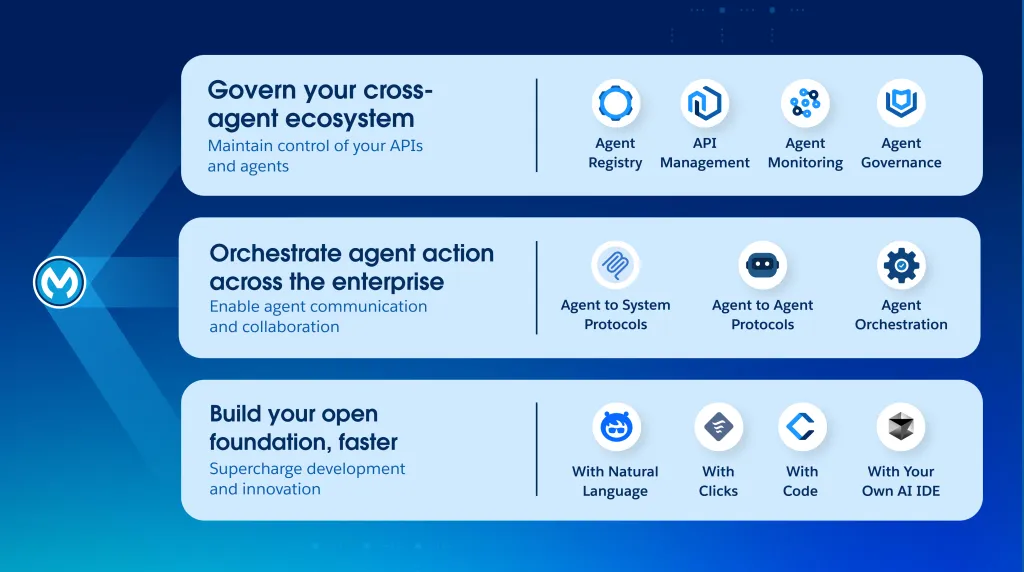
| AI & Automation | MuleSoft Agent Fabric for multi-agent orchestration; MCP support; Agentforce integration; MuleSoft Vibes natural language development | Automated pipeline management handles connector maintenance, schema changes, and incremental syncs without manual intervention |
| Reverse Data Flow | Native bidirectional data flow; any integration can read from and write to connected systems as part of orchestrated workflows | Reverse ETL through Census acquisition syncs enriched warehouse data back into 200+ business application destinations |
Data Connectivity
Pre-built Connectors
Custom Connector Development
Database Replication
Data Processing & Transformation
Data Transformation
Schema Management
Data Quality & Accuracy
Security & Compliance
Security Certifications
Access Control
Network Security
Deployment & Operations
Cloud Deployment
On-Premises & Hybrid
Monitoring & Observability
Platform Capabilities
API Management
AI & Automation
Reverse Data Flow
Which to choose
MuleSoft is the enterprise integration powerhouse for organizations needing bidirectional API-led connectivity across complex hybrid environments, while Fivetran dominates automated ELT data ingestion with its managed, low-maintenance pipeline approach for analytics teams.
Best-fit scenarios
Choose MuleSoft if:
Choose MuleSoft when your organization requires comprehensive API lifecycle management, bidirectional data flows between complex hybrid environments, and orchestration of multi-system business processes. MuleSoft excels for enterprises already invested in the Salesforce ecosystem, teams that need to connect legacy on-premises systems with modern cloud applications, and organizations building reusable integration assets at scale. The platform delivers the most value when you have dedicated integration developers who can leverage its full capabilities across API design, deployment, and governance.
Choose Fivetran if:
Choose Fivetran when your primary goal is centralizing data from multiple sources into a cloud warehouse or data lake for analytics, reporting, and AI workloads. Fivetran is the clear winner for data teams that want fully managed, zero-maintenance pipelines that handle schema evolution and incremental syncs automatically. The platform delivers exceptional value for organizations prioritizing time-to-insight over integration complexity, with pipelines deployable in minutes rather than weeks. Its usage-based pricing with a free tier makes it accessible for teams of all sizes starting their data centralization journey.
These scenarios reflect the available product evidence. Your requirements, existing stack, and team expertise should guide the final decision.
Frequently Asked Questions
Can MuleSoft and Fivetran be used together?
Yes, MuleSoft and Fivetran serve complementary roles in many data architectures. Fivetran handles the automated extraction and loading of data from SaaS applications and databases into your cloud warehouse, while MuleSoft manages bidirectional API integrations, business process orchestration, and connectivity with legacy on-premises systems. Organizations often use Fivetran for their analytics data pipeline feeding Snowflake or Databricks, and MuleSoft for operational integrations that require real-time data writes back to source systems. This combined approach lets each tool play to its strengths.
Which tool is easier to set up and maintain?
Fivetran is significantly easier to set up and maintain. JetBlue reported setting up data pipelines in under two minutes with Fivetran, and the platform handles all connector maintenance, schema changes, and incremental sync logic automatically. MuleSoft requires more upfront investment in learning its development environment and configuring integrations, though its low-code Flow Designer and new MuleSoft Vibes natural language interface have reduced the barrier. MuleSoft customers like Invesco have reported cutting development time by 92% with API-led integration patterns, but the initial ramp-up period is longer than Fivetran.
How do the pricing models compare between MuleSoft and Fivetran?
Fivetran uses transparent usage-based pricing starting with a free tier that includes 500,000 monthly active rows, unlimited users, and 15-minute sync frequencies. Paid tiers scale based on consumption. MuleSoft uses enterprise contact-sales pricing with custom quotes based on deployment needs, making direct cost comparison difficult. MuleSoft offers a 30-day free trial of Anypoint Platform. For smaller data teams focused on ELT, Fivetran provides a more predictable and accessible cost structure. For large enterprises needing comprehensive integration, MuleSoft's ROI can be substantial, with Forrester reporting 426% ROI and 70% reduction in ongoing API management efforts.
Which tool is better for real-time data processing?
Both tools support real-time data movement, but in different ways. Fivetran offers 1-minute sync frequencies on its Enterprise tier and supports streaming replication for event-based data sources, with throughput speeds exceeding 500 GB per hour. MuleSoft provides real-time bidirectional data flows through its event-driven architecture, message queuing via Anypoint MQ, and streaming capabilities. For real-time analytics ingestion, Fivetran is simpler to configure and maintain. For real-time operational workflows that require data to flow in multiple directions across systems, MuleSoft provides the broader orchestration capabilities needed.