Decision comparison
MuleSoft vs Talend
MuleSoft excels at API-led integration and multi-agent orchestration within the Salesforce ecosystem, while Talend delivers stronger ETL/ELT capabilities and data quality tooling for data engineering teams building trusted data pipelines.
Direct comparison. These are reviewed substitutes bought for the same job, so the differences below are the ones that decide between them.
Applies to: Choosing the enterprise integration suite that will run data pipelines.
All 2 are ETL platforms.
Quick Comparison
| Decision factor | MuleSoft | Talend |
|---|---|---|
| Primary Focus | API-led connectivity and integration platform with 1,500+ pre-built connectors for enterprise systems | Data integration, quality, and governance platform with comprehensive ETL/ELT capabilities |
| Pricing Model | MuleSoft starts at $2,000 per month on a credit model, with one shared credit currency across integrations, APIs, automation and agents, and rates falling as usage scales. Larger arrangements are quoted. | Talend Data Fabric starts at $12,000/year ($1000/month), Talend Cloud and Data Management Platform require contact for custom pricing, Enterprise Custom plans are custom-priced. Plans range from $12,000 to $200,000/year. |
| Deployment Options | Cloud via CloudHub, on-premises, hybrid deployment with Anypoint Runtime Fabric containers | Cloud, client managed, or hybrid deployment |
| Best For | Organizations needing API management, multi-agent orchestration, and Salesforce ecosystem integration | Data engineering teams requiring ETL pipelines, data quality scoring, and multi-modal integration patterns |
| Data Integration Approach | API-first iPaaS combining composable APIs, robotic process automation, and low-code integrations | Multi-modal patterns supporting batch, real-time CDC, ETL, ELT, and API integration in one platform |
| User Ratings | 7.9/10 based on 136 reviews; users praise cloud deployment, friendly UI, and API development | 8.8/10 based on 74 reviews; users highlight data integration, easy-to-use interface, and data sources |
MuleSoft
- Primary Focus:
- API-led connectivity and integration platform with 1,500+ pre-built connectors for enterprise systems
- Pricing Model:
- MuleSoft starts at $2,000 per month on a credit model, with one shared credit currency across integrations, APIs, automation and agents, and rates falling as usage scales. Larger arrangements are quoted.
- Deployment Options:
- Cloud via CloudHub, on-premises, hybrid deployment with Anypoint Runtime Fabric containers
- Best For:
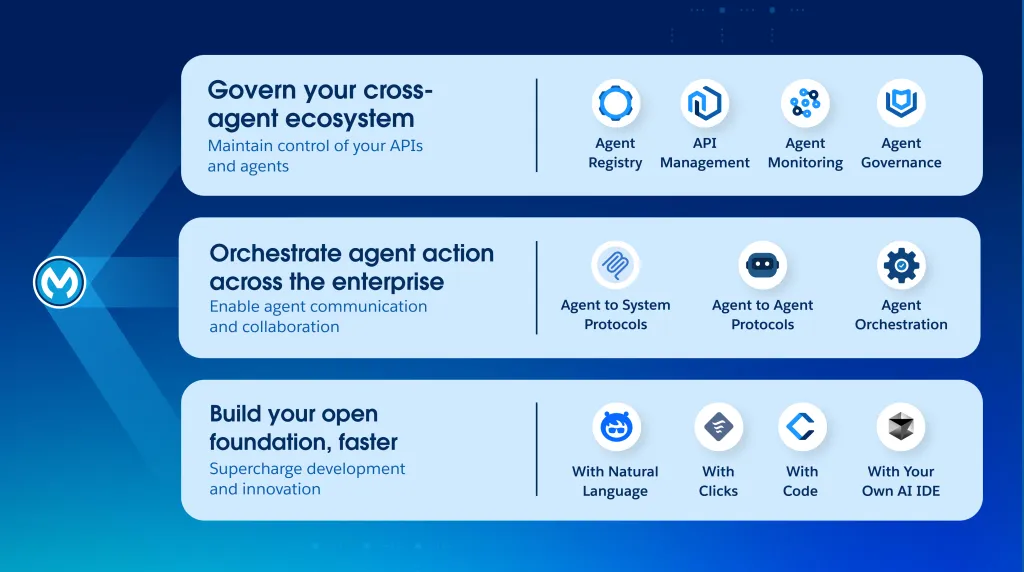
- Organizations needing API management, multi-agent orchestration, and Salesforce ecosystem integration
- Data Integration Approach:
- API-first iPaaS combining composable APIs, robotic process automation, and low-code integrations
- User Ratings:
- 7.9/10 based on 136 reviews; users praise cloud deployment, friendly UI, and API development
Talend
- Primary Focus:
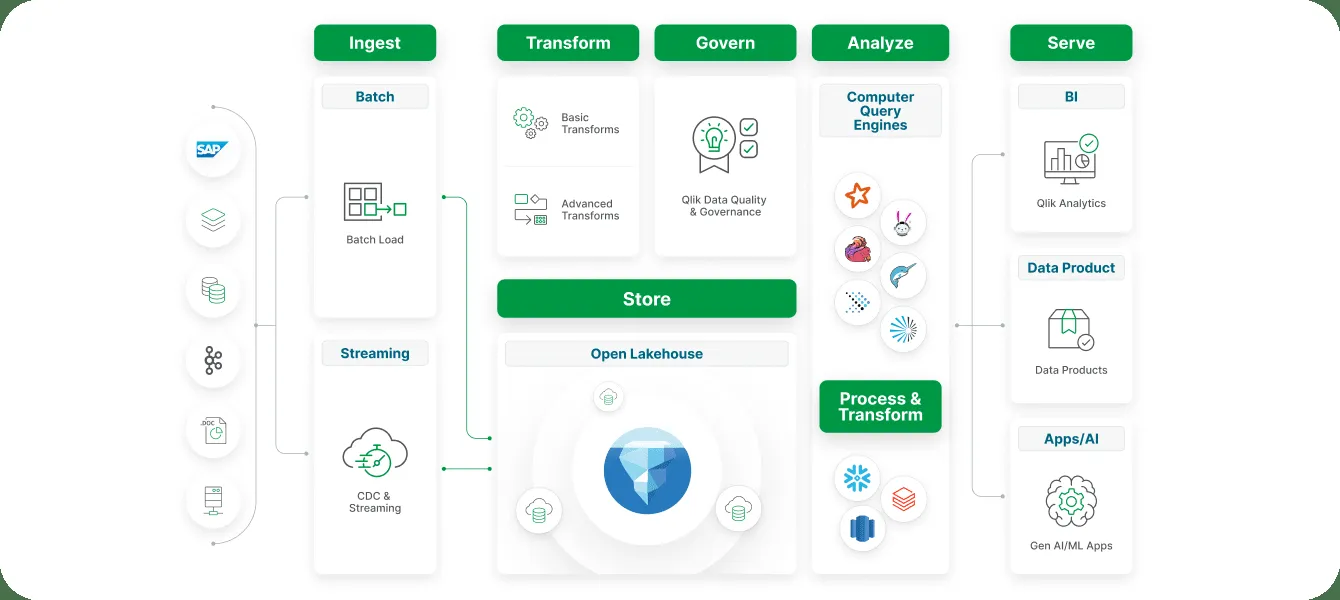
- Data integration, quality, and governance platform with comprehensive ETL/ELT capabilities
- Pricing Model:
- Talend Data Fabric starts at $12,000/year ($1000/month), Talend Cloud and Data Management Platform require contact for custom pricing, Enterprise Custom plans are custom-priced. Plans range from $12,000 to $200,000/year.
- Deployment Options:
- Cloud, client managed, or hybrid deployment
- Best For:
- Data engineering teams requiring ETL pipelines, data quality scoring, and multi-modal integration patterns
- Data Integration Approach:
- Multi-modal patterns supporting batch, real-time CDC, ETL, ELT, and API integration in one platform
- User Ratings:
- 8.8/10 based on 74 reviews; users highlight data integration, easy-to-use interface, and data sources
Public signals
Verified factual signals only. Bars appear only for like-for-like metrics with five weekly assessments for every tool; missing evidence stays explicit. These signals do not establish enterprise adoption, product quality, or total cost.
| Metric | MuleSoft | Talend |
|---|---|---|
| GitHub commits, 90d(Product adoption) | 0 | Not available |
| GitHub stars(Product adoption) | 500 | Not available |
| Search interest(Market interest) | 3 | 0 |
| Hacker News mentions, 90d(Community interest) | 0 | 0 |
| Product Hunt comments(Community interest) | 1 | Not available |
| Product Hunt rating(Community interest) | 5.0/5 | Not available |
| Product Hunt reviews(Community interest) | 1 | Not available |
| Product Hunt votes(Community interest) | 1 | Not available |
| Stack Overflow questions(Community interest) | 1.9k | 2.7k |
As of September 14, 2026 — updated weekly.
Health & risk evidence
Observed public-source checks for mapped package versions and repositories.
MuleSoft
September 14, 2026Package vulnerabilities
Not available
Repository security score
github.com/mulesoft/mule
6.9/10
Talend
Package vulnerabilities
Not available
Repository security score
Not available
Interface Preview
MuleSoft
Talend
Feature Comparison
| Feature | MuleSoft | Talend |
|---|---|---|
| Data Integration | ||
| ETL/ELT Capabilities | Supports data transformation through Anypoint Platform with DataWeave language and pre-built connectors for mapping and routing | Comprehensive ETL/ELT with automated transformations, Spark batch processing, and data warehouse/lake/lakehouse automation |
| Real-Time Data Processing | Real-time event handling and message routing via Anypoint MQ pub/sub and CloudHub streaming architecture | Real-time synchronization using log-based change data capture (CDC) available from Standard tier and above |
| Pre-Built Connectors | Over 1,500 pre-built connectors and integrations available through Anypoint Exchange marketplace | Pre-built connectivity to a wide range of SaaS sources, databases, file formats, and cloud data warehouses |
| API Management | ||
| API Design and Development | Anypoint API Designer for visual/code-based API design, Anypoint Code Builder IDE, and MuleSoft Vibes for natural language API creation | Application and API integration available in Premium tier with focus on data pipeline APIs rather than general API lifecycle management |
| API Gateway | Anypoint Flex Gateway for managing and securing APIs with ultrafast, distributed architecture across any environment | No dedicated API gateway; relies on integration with external gateway services for API traffic management |
| API Governance | Anypoint API Governance with automated security policies, API quality checks, and centralized management from single control plane | Data governance through column-level lineage, impact analysis, and data stewardship rather than API-specific governance |
| Data Quality and Governance | ||
| Data Quality Tools | Focuses on integration quality through monitoring and diagnostics via Anypoint Monitoring dashboards and alerts | Data quality and profiling based on automatically recognized semantic types, with proprietary Talend Trust Score metric |
| Data Lineage | API-level tracking and dependency mapping through Anypoint API Manager and Anypoint Monitoring visualization | End-to-end column-level lineage and impact analysis available in Premium tier for comprehensive data tracking |
| Data Catalog | Anypoint Exchange serves as a catalog for APIs, connectors, templates, and reusable integration assets | Data catalog to view accessible datasets, data marketplace for users to find trusted data, and data product creation |
| AI and Automation | ||
| AI Integration | MuleSoft Agent Fabric for multi-agent orchestration, MCP Support, A2A Support, and Agentforce integration with Salesforce | Enterprise tier includes data pipelines for AI and Generative AI use cases with integrated LLM extensibility |
| Low-Code/No-Code | MuleSoft Flow, RPA, and IDP assets can be turned into reusable agent actions. | AI-augmented no-code pipelines, visual low-code tooling for data transformations, and drag-and-drop Pipeline Designer |
| Process Automation | MuleSoft RPA eliminates manual tasks with robotic process automation; MuleSoft IDP automates data retrieval workflows | Automated data pipeline execution, analytics and automation workflows included from Starter tier |
| Deployment and Operations | ||
| Cloud Infrastructure | CloudHub fully managed PaaS with 99.999% uptime, automatic scaling, and global deployment with data residency compliance | Qlik Talend Cloud with managed and secure cloud-based data pipelines, VPC access, and Qlik Cloud Analytics integration |
| Monitoring and Observability | Anypoint Monitoring for real-time performance dashboards, custom alerts, and instant log access across all deployments | Self-serve telemetry dashboard for usage monitoring with automated alerts as utilization approaches subscribed capacity |
| Enterprise Security | Anypoint Security with threat protection, Trusted Agent Identity for secure AI agent interactions, and built-in governance policies | Secure private access between VPCs and on-premise networks, enterprise-grade data trust through quality and governance controls |
Data Integration
ETL/ELT Capabilities
Real-Time Data Processing
Pre-Built Connectors
API Management
API Design and Development
API Gateway
API Governance
Data Quality and Governance
Data Quality Tools
Data Lineage
Data Catalog
AI and Automation
AI Integration
Low-Code/No-Code
Process Automation
Deployment and Operations
Cloud Infrastructure
Monitoring and Observability
Enterprise Security
Which to choose
MuleSoft excels at API-led integration and multi-agent orchestration within the Salesforce ecosystem, while Talend delivers stronger ETL/ELT capabilities and data quality tooling for data engineering teams building trusted data pipelines.
Best-fit scenarios
Choose MuleSoft if:
Choose MuleSoft if your organization prioritizes API management, needs deep Salesforce ecosystem integration, or is building an agentic enterprise requiring multi-agent orchestration. MuleSoft is the stronger choice when you need to connect hundreds of applications through reusable APIs, empower business users with low-code integration tools, and maintain centralized governance over your entire API and agent network. Its 1,500+ pre-built connectors and Anypoint Platform provide a comprehensive foundation for organizations that treat APIs as strategic assets.
Choose Talend if:
Choose Talend if your primary needs center on data integration, data quality, and building trusted data pipelines for analytics and AI workloads. Talend is the better fit when you require comprehensive ETL/ELT capabilities, real-time CDC, data quality scoring through the Talend Trust Score, and end-to-end data lineage. Customers subscribe to a certain amount of capacity of usage for the chosen edition. and provides multi-modal integration patterns that support batch, real-time, and API-based data movement within a single platform.
These scenarios reflect the available product evidence. Your requirements, existing stack, and team expertise should guide the final decision.
Frequently Asked Questions
What is the main difference between MuleSoft and Talend?
MuleSoft is primarily an API-led integration platform (iPaaS) built around the Anypoint Platform, focusing on connecting applications, managing APIs, and orchestrating multi-agent AI systems within the Salesforce ecosystem. Talend, now part of Qlik, is a data integration and data quality platform with comprehensive ETL/ELT capabilities, data governance, and data lineage features. MuleSoft treats APIs as the central building block for connectivity, while Talend focuses on moving, transforming, and ensuring the quality of data across enterprise systems. The choice depends on whether your priority is API management and application connectivity or data pipeline orchestration and data quality.
How does pricing compare between MuleSoft and Talend?
MuleSoft uses enterprise pricing that requires contacting their sales team for a custom quote, with no published pricing on their website. A Forrester Total Economic Impact study reported 426% ROI for MuleSoft customers. Customers subscribe to a certain amount of capacity of usage for the chosen edition. Both platforms use usage-based and per-seat pricing components, and both may require additional investment in professional services for implementation.
Can MuleSoft and Talend handle real-time data integration?
Yes, both platforms support real-time data integration but through different mechanisms. MuleSoft handles real-time processing through event-driven architecture, Anypoint MQ message queuing with publish/subscribe patterns, and streaming capabilities in CloudHub. Talend provides real-time synchronization using log-based change data capture (CDC) starting from its Standard tier, enabling continuous data replication from databases. Talend also integrates Qlik's Upsolver technology for real-time ingestion into Apache Iceberg tables. MuleSoft is better suited for real-time API-based interactions, while Talend is stronger for real-time database replication and CDC-based data pipelines.
Which platform is better for AI and automation use cases?
Both platforms are investing heavily in AI capabilities but with different approaches. MuleSoft offers Agent Fabric for governing and orchestrating multi-agent AI systems, MCP Support for connecting AI agents to business systems, Agent Registry for cataloging AI assets, and Trusted Agent Identity for secure agent interactions. Talend provides data pipelines for AI and Generative AI use cases in its Enterprise tier, integrated LLM extensibility for enriching data pipelines, and AI-augmented no-code pipelines. MuleSoft is better positioned for organizations building agentic AI architectures, while Talend focuses on preparing trusted, high-quality data to fuel AI and machine learning models.