Decision comparison
Informatica PowerCenter vs Talend
Informatica PowerCenter and Talend serve overlapping but distinct segments of the enterprise data integration market. PowerCenter holds a higher user rating at 9.1/10 from 98 reviews and delivers proven on-premises ETL with a structured cloud modernization path to IDMC. Talend, rated 8.8/10 from 74 reviews, provides more transparent pricing and a cloud-native platform through Qlik Talend Cloud with flexible deployment options across hybrid environments.
Direct comparison. These are reviewed substitutes bought for the same job, so the differences below are the ones that decide between them.
All 2 are ETL platforms.
Quick Comparison
| Decision factor | Informatica PowerCenter | Talend |
|---|---|---|
| Pricing Model | Pricing based on usage; contact for specific details | Talend Data Fabric starts at $12,000/year ($1000/month), Talend Cloud and Data Management Platform require contact for custom pricing, Enterprise Custom plans are custom-priced. Plans range from $12,000 to $200,000/year. |
| User Rating | 9.1/10 | 8.8/10 |
| Review Count | 98 reviews | 74 reviews |
| Deployment | On-premises with cloud modernization path to IDMC | Cloud, on-premises, or hybrid via Qlik Talend Cloud |
| Best For | Large enterprises with established ETL workflows needing cloud migration | Mid-market to enterprise teams needing flexible multi-cloud data integration |
| Data Quality | Built-in data profiling, cleansing, and enrichment tools | End-to-end data quality with Talend Trust Score and semantic-type profiling |
| Learning Curve | Moderate; visual workflow designer with established documentation | Steep for advanced features; GUI-based interface eases entry-level tasks |
| Cloud Strategy | Modernization path moves PowerCenter assets to IDMC cloud platform | Native cloud platform (Qlik Talend Cloud) with four tiered editions |
Informatica PowerCenter
- Pricing Model:
- Pricing based on usage; contact for specific details
- User Rating:
- 9.1/10
- Review Count:
- 98 reviews
- Deployment:
- On-premises with cloud modernization path to IDMC
- Best For:
- Large enterprises with established ETL workflows needing cloud migration
- Data Quality:
- Built-in data profiling, cleansing, and enrichment tools
- Learning Curve:
- Moderate; visual workflow designer with established documentation
- Cloud Strategy:
- Modernization path moves PowerCenter assets to IDMC cloud platform
Talend
- Pricing Model:
- Talend Data Fabric starts at $12,000/year ($1000/month), Talend Cloud and Data Management Platform require contact for custom pricing, Enterprise Custom plans are custom-priced. Plans range from $12,000 to $200,000/year.
- User Rating:
- 8.8/10
- Review Count:
- 74 reviews
- Deployment:
- Cloud, on-premises, or hybrid via Qlik Talend Cloud
- Best For:
- Mid-market to enterprise teams needing flexible multi-cloud data integration
- Data Quality:
- End-to-end data quality with Talend Trust Score and semantic-type profiling
- Learning Curve:
- Steep for advanced features; GUI-based interface eases entry-level tasks
- Cloud Strategy:
- Native cloud platform (Qlik Talend Cloud) with four tiered editions
Public signals
Verified factual signals only. Bars appear only for like-for-like metrics with five weekly assessments for every tool; missing evidence stays explicit. These signals do not establish enterprise adoption, product quality, or total cost.
| Metric | Informatica PowerCenter | Talend |
|---|---|---|
| Search interest(Market interest) | 0 | 0 |
| Stack Overflow questions(Community interest) | 1.3k | 2.7k |
| Hacker News mentions, 90d(Community interest) | Not available | 0 |
As of September 14, 2026 — updated weekly.
Interface Preview
Talend
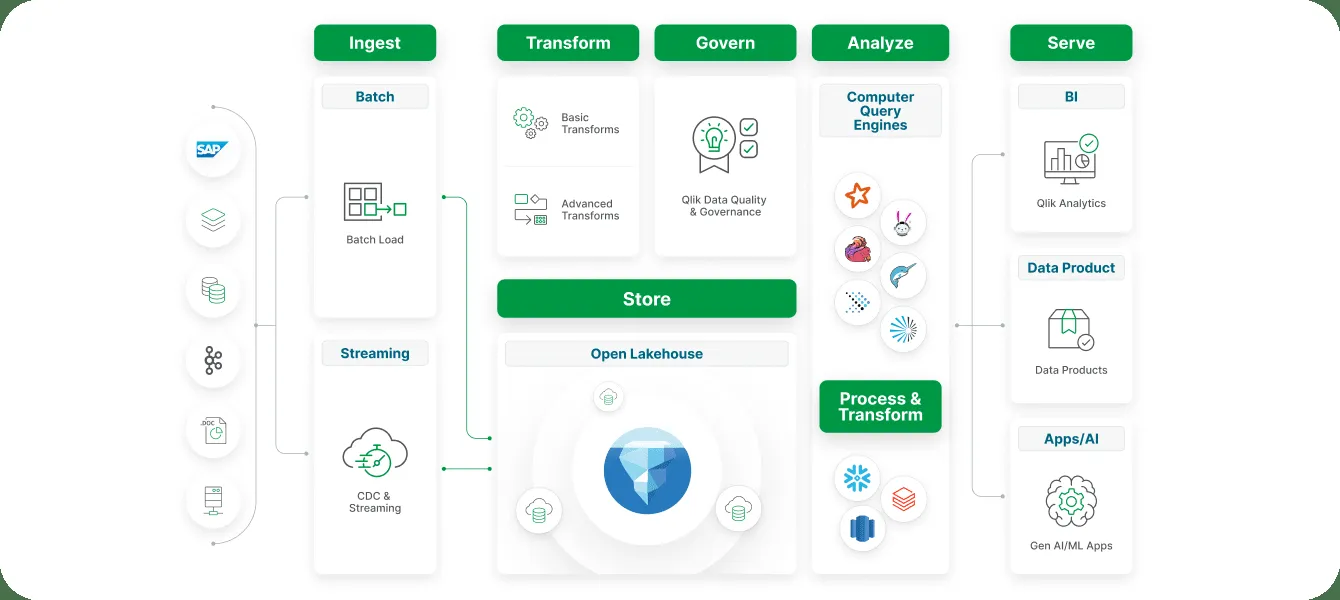
Feature Comparison
| Feature | Informatica PowerCenter | Talend |
|---|---|---|
| Data Integration | ||
| ETL/ELT Processing | Visual workflow designer with PowerCenter Client for building mappings, sessions, and workflows that extract, transform, and load data across databases, flat files, and applications | Supports both ETL and ELT patterns within Qlik Talend Cloud; Premium tier adds automated transformations with Spark batch processing for high-end data movement |
| Real-Time Data Integration | PowerCenter Real-Time Edition processes data for immediate decision-making; handles streaming data from operational systems into target warehouses | Standard tier and above provides real-time synchronization using log-based change data capture (CDC) for continuous replication to cloud warehouses |
| Connector Ecosystem | Connects to databases, flat files, web services, and enterprise applications through built-in adapters; supports SAP, Oracle, and mainframe sources | Pre-built connectivity to hundreds of SaaS sources, databases, and file formats; Enterprise tier adds comprehensive SAP and Mainframe source connectors |
| Data Quality & Governance | ||
| Data Profiling and Cleansing | Includes data profiling, data cleansing, and data enrichment capabilities to identify and correct inconsistencies, duplicates, and errors in source data | Premium tier provides data quality and profiling based on automatically recognized semantic types, plus data stewardship for reviews, validation, and remediation |
| Metadata Management | Repository Manager stores and manages metadata including data definitions, mappings, and workflows; provides lineage tracking across integration processes | Premium tier delivers end-to-end column-level lineage and impact analysis; data catalog lets users view accessible datasets and manage field-level metadata |
| Data Governance Framework | Metadata-driven governance through the Repository Manager; organizations track data lineage and manage mapping documentation across PowerCenter workflows | Qlik Talend Trust Score measures data trustworthiness based on completeness, accuracy, timeliness, and consistency; Enterprise tier adds LLM-integrated pipeline enrichment |
| Architecture & Deployment | ||
| Deployment Options | Primarily on-premises with server-client architecture; IDMC modernization path offers cloud migration that reuses up to 100% of existing PowerCenter assets | Cloud-native (Qlik Talend Cloud), on-premises, or hybrid deployment; client-managed options available across all tiers for data residency and security requirements |
| Scalability Architecture | PowerCenter Server handles large data volumes through grid computing and partitioning; scales by adding integration services across distributed nodes | Cloud platform scales dynamically based on consumption units; Spark batch processing in Premium tier handles high-volume data movement workloads |
| Cloud and Lakehouse Support | IDMC platform provides cloud data integration and engineering services with pay-as-you-go pricing; supports migration from on-premises to cloud environments | Standard tier includes Qlik Open Lakehouse with ingestion and adaptive optimization for Apache Iceberg; Premium tier adds data warehouse, lake, and lakehouse automation |
| User Experience | ||
| Development Interface | PowerCenter Client provides a visual workflow designer for creating mappings and workflows; includes Workflow Manager for designing, executing, and monitoring jobs | GUI-based Pipeline Designer with drag-and-drop interface for creating data integration workflows; supports both visual low-code tooling and full-code control |
| Collaboration and Management | Repository Manager enables team collaboration through shared metadata and version-controlled mappings; Workflow Manager monitors job execution status | Talend Management Console provides no-code framework for planning, managing, deploying, and monitoring projects; facilitates secure resource sharing among team members |
| AI and Automation Capabilities | IDMC modernization path offers AI-powered migration automation to move PowerCenter workloads to the cloud; automated assessment tools evaluate migration readiness | AI-augmented no-code pipelines integrate, cleanse, and transform data; Enterprise tier creates data pipelines for AI and Generative AI use cases with LLM extensibility |
| Data Management | ||
| Data Migration Support | Handles data migration from legacy systems to modern applications with built-in validation; IDMC migration path moves PowerCenter assets to cloud up to 8x quicker | Supports data migration across cloud and on-premises environments; Data Inventory serves as a central repository for cataloging, searching, and managing migrated datasets |
| Data Replication and Synchronization | Replicates data between databases for high availability and disaster recovery; supports data synchronization across different systems to maintain consistency | Standard tier uses log-based CDC for real-time synchronization; provides unlimited and optimized data movement to Qlik Cloud Analytics destinations |
| API and Application Integration | Integrates with enterprise applications through built-in adapters and connectors; handles enterprise application integration for data flow across disparate systems | Premium tier includes application and API integration for seamless connectivity between applications, databases, and APIs without writing code; supports on-premises and cloud |
Data Integration
ETL/ELT Processing
Real-Time Data Integration
Connector Ecosystem
Data Quality & Governance
Data Profiling and Cleansing
Metadata Management
Data Governance Framework
Architecture & Deployment
Deployment Options
Scalability Architecture
Cloud and Lakehouse Support
User Experience
Development Interface
Collaboration and Management
AI and Automation Capabilities
Data Management
Data Migration Support
Data Replication and Synchronization
API and Application Integration
Which to choose
Informatica PowerCenter and Talend serve overlapping but distinct segments of the enterprise data integration market. PowerCenter holds a higher user rating at 9.1/10 from 98 reviews and delivers proven on-premises ETL with a structured cloud modernization path to IDMC. Talend, rated 8.8/10 from 74 reviews, provides more transparent pricing and a cloud-native platform through Qlik Talend Cloud with flexible deployment options across hybrid environments.
Best-fit scenarios
Choose Informatica PowerCenter if:
We recommend Informatica PowerCenter for large enterprises that already operate established on-premises ETL workflows and need a controlled cloud migration path. PowerCenter's Repository Manager and Workflow Manager provide mature metadata management and job orchestration that organizations have relied on for mission-critical data integration. The IDMC modernization path lets teams reuse up to 100% of existing PowerCenter assets while moving to cloud up to 8x quicker, which reduces migration risk for organizations with substantial legacy investments. Its 9.1/10 user rating from 98 reviews reflects strong satisfaction among teams handling bulk data processing, data warehousing, and enterprise application integration at scale.
Choose Talend if:
We recommend Talend for mid-market to enterprise organizations that need a cloud-native data integration platform with flexible deployment across cloud, on-premises, or hybrid environments. Qlik Talend Cloud delivers four tiered editions from Starter through Enterprise, with Talend Data Fabric starting at $12,000/year and plans ranging up to $200,000/year depending on data volume and feature requirements. The platform stands out with its Talend Trust Score for measuring data trustworthiness, AI-augmented no-code pipelines, and native Apache Iceberg lakehouse support. Teams that need both visual low-code tooling and full-code control within a single integrated platform will find Talend's Pipeline Designer and Management Console particularly well-suited to mixed-skill data teams.
These scenarios reflect the available product evidence. Your requirements, existing stack, and team expertise should guide the final decision.
Frequently Asked Questions
How do the pricing models for Informatica PowerCenter and Talend differ?
Informatica PowerCenter uses a usage-based pricing model measured in Informatica Processing Units (IPUs), and the company does not publish specific pricing on its website, requiring teams to contact sales for custom quotes. The IDMC cloud platform operates on pay-as-you-go pricing. Talend provides more pricing transparency, with Talend Data Fabric starting at $12,000/year and plans ranging from $12,000 to $200,000/year depending on the edition and data volume. Qlik Talend Cloud offers four tiered editions (Starter, Standard, Premium, Enterprise), all requiring sales contact for exact quotes. Both platforms use consumption-based components, but Talend offers a clearer published starting point for budget planning.
Which platform provides better cloud deployment capabilities?
Talend delivers a more mature cloud-native experience through Qlik Talend Cloud, which provides cloud, on-premises, or hybrid deployment from the ground up. The Standard tier includes real-time CDC synchronization and Qlik Open Lakehouse with Apache Iceberg optimization, while the Premium tier adds data warehouse, lake, and lakehouse automation. Informatica PowerCenter was built as an on-premises ETL tool and reaches the cloud through its IDMC modernization path, which lets organizations migrate existing PowerCenter workflows to the Intelligent Data Management Cloud. Informatica claims this migration moves assets to cloud up to 8x quicker and reuses up to 100% of PowerCenter mappings and business logic. Organizations starting fresh in the cloud will find Talend's native architecture more straightforward, while PowerCenter teams with years of existing workflows benefit from the structured IDMC migration path.
How do data quality and governance features compare between the two platforms?
Informatica PowerCenter includes built-in data profiling, data cleansing, and data enrichment capabilities through its transformation engine. The Repository Manager handles metadata management by storing data definitions, mappings, and workflows, providing lineage tracking across integration processes. Talend takes governance further with its proprietary Talend Trust Score, which measures data trustworthiness based on completeness, accuracy, timeliness, and consistency. The Qlik Talend Cloud Premium tier delivers end-to-end column-level lineage and impact analysis, data quality profiling based on automatically recognized semantic types, and data stewardship workflows for reviews, validation, and remediation. The Enterprise tier adds LLM-integrated pipeline enrichment for AI-ready data preparation. For organizations where data governance and quality scoring are primary requirements, Talend provides a more comprehensive and structured governance framework out of the box.
What are the main user experience differences between Informatica PowerCenter and Talend?
Informatica PowerCenter uses a desktop-based PowerCenter Client that includes a visual workflow designer for building mappings and a Workflow Manager for executing and monitoring jobs. Users praise its ease of use and user-friendly interface for traditional ETL development, though the client-server architecture requires separate installation of server and client components. Talend provides a GUI-based Pipeline Designer with drag-and-drop capabilities that supports both visual low-code tooling and full-code control within a single platform. The Talend Management Console offers a no-code framework for planning, managing, and deploying projects. Talend also includes a guided onboarding experience with quickstart jobs, tutorials, and sample workflows. Users report that Talend has a steep learning curve for advanced features, while PowerCenter users note that third-party tool integration can require considerable time to configure. Both platforms receive praise for their core interfaces but differ in that Talend targets mixed-skill teams while PowerCenter focuses on dedicated ETL developers.