Decision comparison
MuleSoft vs Informatica PowerCenter
MuleSoft and Informatica PowerCenter serve different eras of data integration. MuleSoft is a modern, cloud-native platform built for API-led connectivity and AI agent orchestration, while PowerCenter is a legacy ETL workhorse that excels at high-volume batch data processing. Organizations planning for the future choose MuleSoft; those maintaining established ETL infrastructure may still rely on PowerCenter while planning their migration path.
Direct comparison. These are reviewed substitutes bought for the same job, so the differences below are the ones that decide between them.
All 2 are ETL platforms.
Quick Comparison
| Decision factor | MuleSoft | Informatica PowerCenter |
|---|---|---|
| Best For | Enterprises needing API-led integration, multi-agent orchestration, and Salesforce ecosystem connectivity | Organizations with established on-premises ETL workloads and legacy data warehouse environments |
| Architecture | Cloud-native Anypoint Platform with hybrid deployment options; acquired by Salesforce in 2018 | Traditional client-server ETL platform with repository-based metadata management; now a legacy product |
| Pricing Model | MuleSoft starts at $2,000 per month on a credit model, with one shared credit currency across integrations, APIs, automation and agents, and rates falling as usage scales. Larger arrangements are quoted. | Pricing based on usage; contact for specific details |
| Ease of Use | Visual designer plus code builder; low-code and pro-code options for different skill levels | Visual workflow designer with drag-and-drop mappings; steep learning curve for advanced transformations |
| Scalability | Enterprise-proven with 99.999% uptime on CloudHub; scales automatically per demand | Handles large data volumes with grid computing and partitioning; on-premises scaling requires infrastructure investment |
| Community/Support | Professional services, partner ecosystem, training certifications, and extensive documentation | Established user base with 98 reviews on TrustRadius; modernization path to IDMC available |
MuleSoft
- Best For:
- Enterprises needing API-led integration, multi-agent orchestration, and Salesforce ecosystem connectivity
- Architecture:
- Cloud-native Anypoint Platform with hybrid deployment options; acquired by Salesforce in 2018
- Pricing Model:
- MuleSoft starts at $2,000 per month on a credit model, with one shared credit currency across integrations, APIs, automation and agents, and rates falling as usage scales. Larger arrangements are quoted.
- Ease of Use:
- Visual designer plus code builder; low-code and pro-code options for different skill levels
- Scalability:
- Enterprise-proven with 99.999% uptime on CloudHub; scales automatically per demand
- Community/Support:
- Professional services, partner ecosystem, training certifications, and extensive documentation
Informatica PowerCenter
- Best For:
- Organizations with established on-premises ETL workloads and legacy data warehouse environments
- Architecture:
- Traditional client-server ETL platform with repository-based metadata management; now a legacy product
- Pricing Model:
- Pricing based on usage; contact for specific details
- Ease of Use:
- Visual workflow designer with drag-and-drop mappings; steep learning curve for advanced transformations
- Scalability:
- Handles large data volumes with grid computing and partitioning; on-premises scaling requires infrastructure investment
- Community/Support:
- Established user base with 98 reviews on TrustRadius; modernization path to IDMC available
Public signals
Verified factual signals only. Bars appear only for like-for-like metrics with five weekly assessments for every tool; missing evidence stays explicit. These signals do not establish enterprise adoption, product quality, or total cost.
| Metric | MuleSoft | Informatica PowerCenter |
|---|---|---|
| GitHub commits, 90d(Product adoption) | 0 | Not available |
| GitHub stars(Product adoption) | 500 | Not available |
| Search interest(Market interest) | 3 | 0 |
| Hacker News mentions, 90d(Community interest) | 0 | Not available |
| Product Hunt comments(Community interest) | 1 | Not available |
| Product Hunt rating(Community interest) | 5.0/5 | Not available |
| Product Hunt reviews(Community interest) | 1 | Not available |
| Product Hunt votes(Community interest) | 1 | Not available |
| Stack Overflow questions(Community interest) | 1.9k | 1.3k |
As of September 14, 2026 — updated weekly.
Health & risk evidence
Observed public-source checks for mapped package versions and repositories.
MuleSoft
September 14, 2026Package vulnerabilities
Not available
Repository security score
github.com/mulesoft/mule
6.9/10
Informatica PowerCenter
Package vulnerabilities
Not available
Repository security score
Not available
Interface Preview
MuleSoft
Feature Comparison
| Feature | MuleSoft | Informatica PowerCenter |
|---|---|---|
| Integration & Connectivity | ||
| Pre-built Connectors | 1,500+ pre-built connectors and integrations via Anypoint Exchange for SaaS, databases, and legacy systems | Connectors for databases, flat files, web services, and enterprise applications through built-in adapters |
| API Management | Full API lifecycle management with Anypoint API Designer, API Manager, and Flex Gateway | Limited API capabilities; primarily designed for batch ETL rather than API-driven integration |
| Cloud Integration | Cloud-native with CloudHub PaaS, hybrid deployment, and Hyperforce support | On-premises architecture with modernization path to Informatica Cloud Data Integration (IDMC) |
| Data Processing & Transformation | ||
| ETL Capabilities | Real-time data transformation with DataWeave language and automatic data mapping | Robust ETL engine with rich transformation functions, expressions, and data cleansing tools |
| Real-Time Processing | Event-driven architecture with real-time message routing and streaming support | PowerCenter Real-Time Edition available for real-time data integration and processing |
| Data Quality | Data validation through integration flows; relies on connected data quality tools | Built-in data profiling, data cleansing, and data enrichment for quality management |
| Development & Workflow | ||
| Development Environment | Anypoint Code Builder IDE, Anypoint Studio desktop IDE, and natural-language MuleSoft Vibes | PowerCenter Client with visual workflow designer and Repository Manager for metadata |
| Workflow Orchestration | Flow-based orchestration with MuleSoft RPA, IDP, and multi-agent broker for complex processes | Visual workflow manager for creating and managing complex data integration workflows and sessions |
| Automation | AI-powered automation with MuleSoft Dev Agent, RPA bots, and low-code flow builders | Scheduled workflow execution with session-based task orchestration and error handling |
| Governance & Metadata | ||
| Metadata Management | Anypoint Exchange for API and asset discovery; centralized registry for agents, tools, and AI assets | Comprehensive metadata management with Repository Manager for data definitions, mappings, and lineage |
| Security & Governance | API governance policies, Flex Gateway for security enforcement, and Trusted Agent Identity framework | Data masking and security transformations for privacy compliance; role-based access controls |
| Monitoring & Observability | Anypoint Monitoring with real-time dashboards, alerts, and Agent Visualizer for network visibility | Workflow Monitor for tracking session status, performance metrics, and error logs |
| AI & Modernization | ||
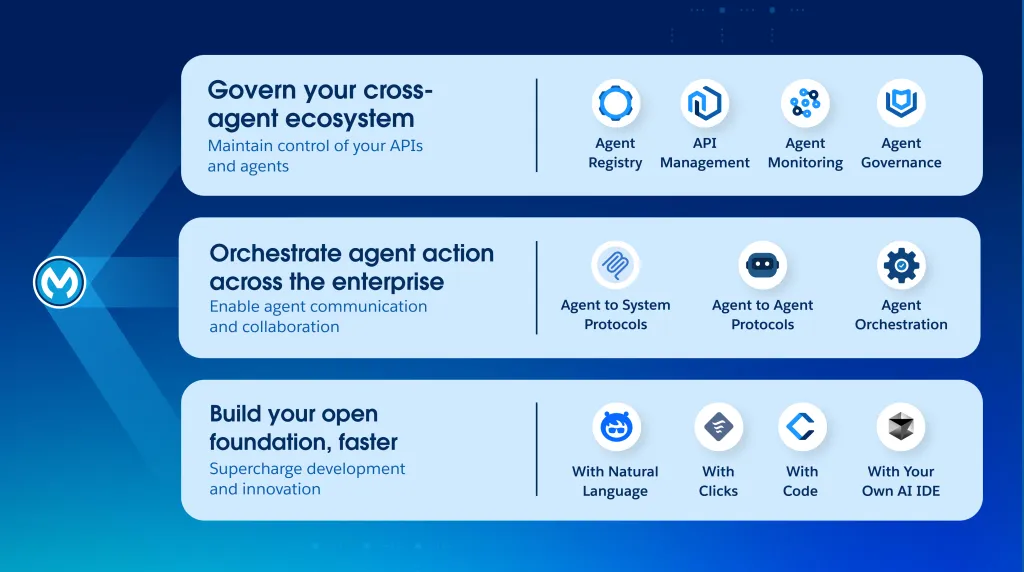
| AI Capabilities | MuleSoft Agent Fabric for multi-agent orchestration; MCP and A2A support for AI agent collaboration | AI-powered migration automation for modernizing PowerCenter workloads to IDMC cloud platform |
| Deployment Flexibility | Deploy anywhere with CloudHub, Runtime Fabric, Docker containers, or on-premises runtimes | Primarily on-premises deployment; PowerCenter Cloud Edition available for cloud migration |
| Ecosystem Integration | Deep Salesforce integration with Agentforce connectors and Topic Center for enterprise workflows | Integrates with Informatica IDMC ecosystem; compatible with major databases and enterprise applications |
Integration & Connectivity
Pre-built Connectors
API Management
Cloud Integration
Data Processing & Transformation
ETL Capabilities
Real-Time Processing
Data Quality
Development & Workflow
Development Environment
Workflow Orchestration
Automation
Governance & Metadata
Metadata Management
Security & Governance
Monitoring & Observability
AI & Modernization
AI Capabilities
Deployment Flexibility
Ecosystem Integration
Which to choose
MuleSoft and Informatica PowerCenter serve different eras of data integration. MuleSoft is a modern, cloud-native platform built for API-led connectivity and AI agent orchestration, while PowerCenter is a legacy ETL workhorse that excels at high-volume batch data processing. Organizations planning for the future choose MuleSoft; those maintaining established ETL infrastructure may still rely on PowerCenter while planning their migration path.
Best-fit scenarios
Choose MuleSoft if:
Choose MuleSoft when your organization needs a modern integration platform that spans API management, application connectivity, and AI agent orchestration in a single environment. It is the right fit for teams building on Salesforce, adopting cloud-first strategies, or unifying hundreds of SaaS applications through reusable APIs. MuleSoft's 1,500+ pre-built connectors, low-code options for business users, and enterprise-grade CloudHub deployment make it ideal for organizations that want to reduce custom integration code while enabling both developers and admins to build and manage connections.
Choose Informatica PowerCenter if:
Choose Informatica PowerCenter when your organization has significant existing investment in PowerCenter workflows and needs to maintain mission-critical ETL pipelines that are already proven and stable. It remains a solid choice for teams running large-scale batch data warehousing with complex transformation logic, data quality requirements, and established metadata governance. However, Informatica itself recommends modernizing to its cloud platform IDMC, which can reuse up to 100% of PowerCenter assets and promises up to 8x quick cloud migration with up to 50% cost reduction.
These scenarios reflect the available product evidence. Your requirements, existing stack, and team expertise should guide the final decision.
Frequently Asked Questions
Can MuleSoft replace Informatica PowerCenter for ETL workloads?
MuleSoft can handle data integration and transformation workflows, but it approaches the problem differently than PowerCenter. MuleSoft is built around API-led connectivity and real-time integration, while PowerCenter specializes in batch ETL with deep transformation logic. For straightforward data movement between systems, MuleSoft provides an effective modern alternative. For complex, high-volume batch ETL with extensive data quality rules and transformation chains, teams may need to evaluate whether MuleSoft's DataWeave transformations match PowerCenter's mature ETL engine for their specific use cases.
What is the modernization path from PowerCenter to the cloud?
Informatica provides a dedicated modernization path from PowerCenter to its Intelligent Data Management Cloud (IDMC). The migration uses AI-powered automation that can reuse up to 100% of existing PowerCenter assets, including business logic and mappings. Informatica claims organizations can accelerate cloud migration by up to 8x and reduce costs by up to 50%. Customers like BMC successfully migrated 99% of their PowerCenter assets to IDMC in six months with zero defects. Informatica offers a 3-minute readiness assessment and dedicated modernization service offerings to help plan the transition.
How do MuleSoft and PowerCenter compare on pricing?
MuleSoft uses enterprise pricing that requires contacting Salesforce for quotes, though it offers a 30-day free trial of Anypoint Platform with no credit card or installation required. A Forrester Total Economic Impact study found 426% ROI from MuleSoft deployments. Informatica PowerCenter uses usage-based pricing and also requires contacting sales for specific details. IDMC offers pay-as-you-go pricing for cloud services. Neither tool publishes transparent per-unit pricing, so organizations need to engage with sales teams to get accurate cost estimates based on their specific integration volumes and requirements.
Which tool has better support for AI and modern architectures?
MuleSoft has a substantial lead in AI capabilities. Its Agent Fabric platform governs and orchestrates AI agents across ecosystems, with MCP support for connecting agents to business context and A2A support for multi-agent collaboration. MuleSoft Vibes enables building integrations through natural language, and Agent Scanners discover AI agents from Amazon Bedrock, Google Vertex AI, and other platforms. PowerCenter's AI story centers on migration automation to move legacy workloads to IDMC. For organizations investing in agentic AI architectures, MuleSoft provides a purpose-built foundation that PowerCenter does not offer.