Decision comparison
Domino Data Lab vs Amazon SageMaker
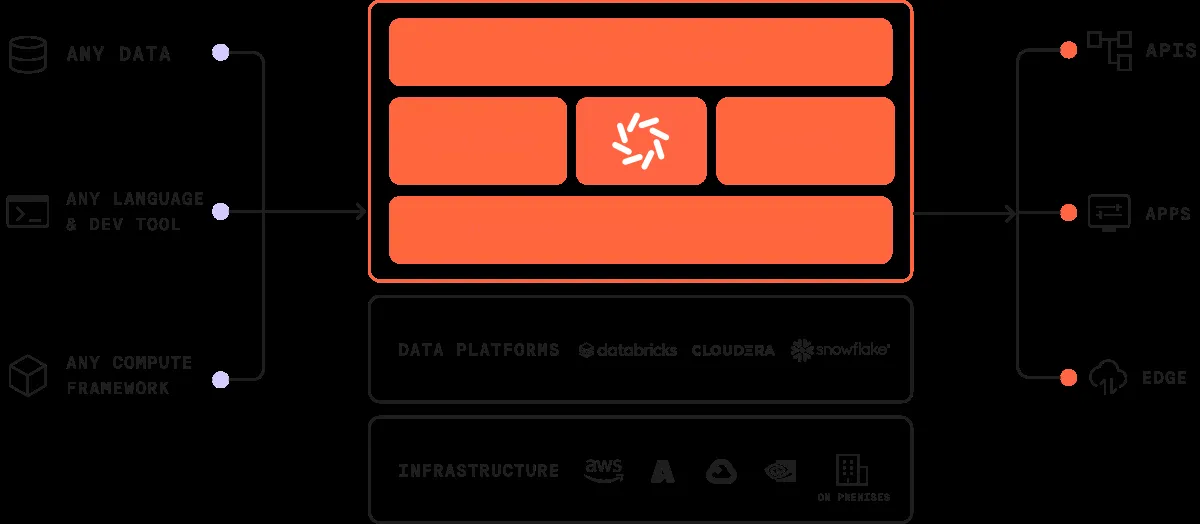
Domino Data Lab and Amazon SageMaker solve the same fundamental problem through fundamentally different architectures. Domino is a governance-first, cloud-agnostic platform that creates an abstraction layer over your infrastructure, giving enterprises centralized control over multi-cloud ML operations. SageMaker is an AWS-native, service-oriented platform providing the broadest set of managed ML tools from any single vendor, with usage-based pricing that scales from individual experiments to enterprise production. The decision hinges on cloud strategy, governance requirements, and budget model.
Direct comparison. These are reviewed substitutes bought for the same job, so the differences below are the ones that decide between them.
All 2 are ML platforms.
Quick Comparison
| Decision factor | Domino Data Lab | Amazon SageMaker |
|---|---|---|
| Best For | Multi-cloud enterprises needing centralized governance, reproducible environments, and vendor-neutral ML operations | AWS-native teams wanting deep integration, usage-based pricing, and broadest managed ML service catalog |
| Pricing Model | Domino Data Lab uses enterprise quote-based pricing only. No public pricing, no self-serve plans, no free tier. Deployment options: Domino Cloud (hosted), self-hosted, or hybrid. Annual enterprise contracts. Contact sales for pricing. Third-party estimates suggest six-figure annual contracts for enterprise deployments. | Pay-as-you-go by component. SageMaker Unified Studio has a free tier: the first 2 months of 250 hours of sc.t3.medium notebook instances, plus 20 MB of metadata storage, 4,000 API requests and 0.2 compute units a month. Beyond that, notebooks bill by instance type and storage duration, the Data Agent is $0.04 per credit, and SageMaker Catalog is $10 per 100,000 requests, $0.40 per GB of metadata storage and $1.776 per compute unit. |
| Cloud Support | Multi-cloud: AWS, Azure, GCP, and on-premises with unified orchestration layer | AWS-only with deep integration across 200+ AWS services including S3, Lambda, IAM |
| Governance | Enterprise-grade: role-based access, approval gates, audit trails, model lineage tracking | IAM-based access control with CloudTrail audit logging and VPC network isolation |
| ML Services Breadth | Focuses on orchestration and governance; relies on third-party tools for labeling, feature stores, and model hubs | Full lifecycle: Studio, Training, Endpoints, Pipelines, Ground Truth, JumpStart, Feature Store, Canvas |
| Deployment Flexibility | Deploy models to any cloud endpoint with infrastructure-agnostic serving | Multiple inference modes: real-time, batch, serverless, and asynchronous endpoints on AWS |
Domino Data Lab
- Best For:
- Multi-cloud enterprises needing centralized governance, reproducible environments, and vendor-neutral ML operations
- Pricing Model:
- Domino Data Lab uses enterprise quote-based pricing only. No public pricing, no self-serve plans, no free tier. Deployment options: Domino Cloud (hosted), self-hosted, or hybrid. Annual enterprise contracts. Contact sales for pricing. Third-party estimates suggest six-figure annual contracts for enterprise deployments.
- Cloud Support:
- Multi-cloud: AWS, Azure, GCP, and on-premises with unified orchestration layer
- Governance:
- Enterprise-grade: role-based access, approval gates, audit trails, model lineage tracking
- ML Services Breadth:
- Focuses on orchestration and governance; relies on third-party tools for labeling, feature stores, and model hubs
- Deployment Flexibility:
- Deploy models to any cloud endpoint with infrastructure-agnostic serving
Amazon SageMaker
- Best For:
- AWS-native teams wanting deep integration, usage-based pricing, and broadest managed ML service catalog
- Pricing Model:
- Pay-as-you-go by component. SageMaker Unified Studio has a free tier: the first 2 months of 250 hours of sc.t3.medium notebook instances, plus 20 MB of metadata storage, 4,000 API requests and 0.2 compute units a month. Beyond that, notebooks bill by instance type and storage duration, the Data Agent is $0.04 per credit, and SageMaker Catalog is $10 per 100,000 requests, $0.40 per GB of metadata storage and $1.776 per compute unit.
- Cloud Support:
- AWS-only with deep integration across 200+ AWS services including S3, Lambda, IAM
- Governance:
- IAM-based access control with CloudTrail audit logging and VPC network isolation
- ML Services Breadth:
- Full lifecycle: Studio, Training, Endpoints, Pipelines, Ground Truth, JumpStart, Feature Store, Canvas
- Deployment Flexibility:
- Multiple inference modes: real-time, batch, serverless, and asynchronous endpoints on AWS
Public signals
Verified factual signals only. Bars appear only for like-for-like metrics with five weekly assessments for every tool; missing evidence stays explicit. These signals do not establish enterprise adoption, product quality, or total cost.
| Metric | Domino Data Lab | Amazon SageMaker |
|---|---|---|
| GitHub commits, 90d(Developer adoption) | 3 | 153 |
| GitHub stars(Developer adoption) | 58 | 2,000+ |
| Search interest(Market interest) | 0 | 1 |
| Hacker News mentions, 90d(Community interest) | 0 | 2 |
| PyPI weekly downloads(Developer adoption) | 11.0k | 4.2M |
| npm weekly downloads(Developer adoption) | Not available | 434.9k |
| Product Hunt comments(Community interest) | Not available | 1 |
| Product Hunt rating(Community interest) | Not available | 4.6/5 |
| Product Hunt reviews(Community interest) | Not available | 17 |
| Product Hunt votes(Community interest) | Not available | 10 |
| Stack Overflow questions(Community interest) | Not available | 3.0k |
As of September 14, 2026 — updated weekly.
Health & risk evidence
Observed public-source checks for mapped package versions and repositories.
Domino Data Lab
September 14, 2026Package vulnerabilities
PyPI · dominodatalab@2.2.0
0 vulnerabilities
across 1 package
Repository security score
Not available
Amazon SageMaker
September 14, 2026Package vulnerabilities
npm · @aws-sdk/client-sagemaker@3.1131.0 · PyPI · sagemaker@3.21.0
0 vulnerabilities
across 2 packages
Repository security score
github.com/aws/sagemaker-python-sdk
5.4/10
Interface Preview
Domino Data Lab
Amazon SageMaker
Feature Comparison
| Feature | Domino Data Lab | Amazon SageMaker |
|---|---|---|
| Development Environment | ||
| Cloud Support | Multi-cloud: AWS, Azure, GCP, and on-premises with unified orchestration | AWS-only with deep integration across 200+ AWS services |
| IDE Options | Jupyter, RStudio, VS Code, Zeppelin with configurable compute backends | SageMaker Studio with JupyterLab, plus Code Editor (VS Code-based) |
| Environment Management | Reproducible compute environments with Docker-based environment snapshots | Managed instances with lifecycle configurations and custom container support |
| Model Training & Experimentation | ||
| Model Training | Distributed training via any cloud provider's GPU fleet | Managed training with built-in distributed strategies and Spot instance support |
| Experiment Tracking | Built-in experiment tracking with automatic metric logging and comparison | SageMaker Experiments with trial components, metrics, and artifact tracking |
| Pre-trained Models | No built-in model hub; bring-your-own models from any source | JumpStart hub with 350+ pre-trained and foundation models including Llama, Falcon |
| No-Code ML | Not available as a dedicated feature | SageMaker Canvas for no-code model building at $1.77/hour |
| Deployment & Serving | ||
| Model Serving | Deploy to any cloud endpoint with auto-scaling | Real-time, batch, serverless, and async inference modes on managed endpoints |
| Model Registry | Built-in registry with version control, lineage, and approval workflows | SageMaker Model Registry with CI/CD integration and model groups |
| Pipeline Orchestration | Project-based workflow management with Domino Flows | SageMaker Pipelines with native step functions and DAG-based workflows |
| Governance & Monitoring | ||
| Model Monitoring | Integrated drift detection and alerting across deployed models | SageMaker Model Monitor with data quality, model quality, and bias detection |
| Governance & Compliance | Enterprise-grade: role-based access, approval gates, audit trails, SOC 2 | IAM-based access control with CloudTrail logging and VPC isolation |
| Data Labeling | No native labeling service; relies on third-party integrations | Ground Truth with automated and human-in-the-loop labeling pipelines |
| Feature Store | No native feature store; integrates with third-party solutions | SageMaker Feature Store with online and offline storage modes |
| Pricing & Plans | ||
| Pricing Model | Enterprise quote-based; annual contracts; no self-serve plans | Usage-based pay-as-you-go; notebooks from $0.04/hour |
| Cost Management | Centralized compute optimization across multi-cloud with usage analytics | AWS Cost Explorer integration with per-service billing granularity |
Development Environment
Cloud Support
IDE Options
Environment Management
Model Training & Experimentation
Model Training
Experiment Tracking
Pre-trained Models
No-Code ML
Deployment & Serving
Model Serving
Model Registry
Pipeline Orchestration
Governance & Monitoring
Model Monitoring
Governance & Compliance
Data Labeling
Feature Store
Pricing & Plans
Pricing Model
Cost Management
Which to choose
Domino Data Lab and Amazon SageMaker solve the same fundamental problem through fundamentally different architectures. Domino is a governance-first, cloud-agnostic platform that creates an abstraction layer over your infrastructure, giving enterprises centralized control over multi-cloud ML operations. SageMaker is an AWS-native, service-oriented platform providing the broadest set of managed ML tools from any single vendor, with usage-based pricing that scales from individual experiments to enterprise production. The decision hinges on cloud strategy, governance requirements, and budget model.
Best-fit scenarios
Choose Domino Data Lab if:
Choose Domino Data Lab if your organization runs ML workloads across multiple cloud providers and needs centralized governance with formal model approval workflows. Domino excels for regulated industries requiring auditable model lineage, reproducible environments, and vendor-neutral infrastructure. Best for enterprises with 50+ data scientists, multi-cloud strategies, and compliance requirements that go beyond basic IAM policies.
Choose Amazon SageMaker if:
Choose Amazon SageMaker if your organization has standardized on AWS and wants the deepest integration with the AWS ecosystem. SageMaker's usage-based pricing starting at $0.04/hour makes it accessible at every scale, from solo experiments to large production deployments. Its breadth of managed services including JumpStart with 350+ models, Ground Truth labeling, and Feature Store covers the full ML lifecycle without managing separate tools.
These scenarios reflect the available product evidence. Your requirements, existing stack, and team expertise should guide the final decision.
Frequently Asked Questions
Can Domino Data Lab run on AWS alongside SageMaker?
Yes, Domino can be deployed on AWS infrastructure and can orchestrate compute on the same AWS account where SageMaker runs. However, the two platforms serve different architectural roles. Domino acts as a governance and orchestration layer, while SageMaker provides managed ML services. Some large enterprises use both: SageMaker for teams that are AWS-native and Domino as a cross-cloud control plane for teams that need multi-cloud flexibility.
How do the platforms compare for LLM fine-tuning and GenAI workloads?
SageMaker has a significant advantage for GenAI workloads through JumpStart, which provides direct access to 350+ foundation models including Llama, Falcon, and Stability AI models with one-click fine-tuning and deployment. Domino supports LLM fine-tuning through its GPU compute orchestration but does not provide a pre-built model hub. Teams using Domino for GenAI typically bring their own model weights and training scripts.
What is the migration effort if we later want to switch platforms?
Migrating from SageMaker requires extracting model artifacts from S3, recreating training pipelines, and re-implementing inference endpoints. The tight AWS coupling means significant re-engineering. Migrating from Domino is generally easier because workspaces use standard tools (Jupyter notebooks, Python scripts, Docker containers) that are portable. Budget 3 to 6 months for a full migration depending on production model count.
Which platform has better community and ecosystem support?
SageMaker benefits from the massive AWS community, extensive documentation, and over 10,000 Stack Overflow tagged questions. SageMaker holds a TrustRadius rating of 8.8/10. Domino has a focused but dedicated enterprise community with detailed documentation and direct support from Domino engineers, concentrated in regulated industries where governance expertise is valued.