Decision comparison
Amazon SageMaker vs Feast
For feature storage and online serving on AWS, SageMaker fits organizations that want a single managed AWS environment for features, training, deployment, governance, and operations. Feast fits teams that specifically need a portable feature-store layer across their existing data and ML infrastructure; it stops being the complete answer when managed training and model hosting are required.
Architecture choice. These take different approaches to the same problem. Read the table as a fit question rather than a feature race.
All 2 are ML platforms.
Quick Comparison
| Decision factor | Amazon SageMaker | Feast |
|---|---|---|
| Best For | AWS-centric teams needing a managed platform to build, train, deploy, govern, and serve ML models alongside feature storage. | Teams needing portable feature definitions, point-in-time training data, and low-latency online feature serving across their existing stack. |
| Architecture | AWS-managed, integrated MLOps platform combining Unified Studio, Feature Store, training jobs, deployment endpoints, Catalog, and Lakehouse capabilities. | Open-source, infrastructure-agnostic feature store separating offline and online stores, with a feature server, registry, transformations, and integrations. |
| Pricing Model | Pay-as-you-go by component. SageMaker Unified Studio has a free tier: the first 2 months of 250 hours of sc.t3.medium notebook instances, plus 20 MB of metadata storage, 4,000 API requests and 0.2 compute units a month. Beyond that, notebooks bill by instance type and storage duration, the Data Agent is $0.04 per credit, and SageMaker Catalog is $10 per 100,000 requests, $0.40 per GB of metadata storage and $1.776 per compute unit. SageMaker AI GPU training and hosting instances cost well over $10 per hour; for example ml.p4de is $23.42 per hour and ml.p5.48xlarge $54.92 per hour (prices effective October 7, 2026, in all available AWS Regions). Verified 2026-10-05 against https://aws.amazon.com/sagemaker/ai/pricing/. | Open source under the Apache-2.0 license; source code at https://github.com/feast-dev/feast. |
| Ease of Use | Managed notebooks, Autopilot, auto scaling, and managed infrastructure reduce setup, though users report an AWS learning curve. | Requires teams to select and operate backing infrastructure, but centralizes feature definitions, discovery, retrieval, and consistent training-serving access. |
| Scalability | Managed training jobs provision EC2 instances and scale model training and hosting; ml.p4de costs $23.42/hour and p5.48xlarge $54.92/hour. | Uses pluggable offline and online stores for high-scale training and inference, including low-latency retrieval and push-based streaming ingestion. |
| Community/Support | AWS commercial support and documentation; user rating is 8.8/10 from 59 reviews; SDK repository has 2,272 stars. | Open-source developer community with 293 contributors, 12M+ downloads, 5.5K Slack members, and a repository with 7,357 stars. |
Amazon SageMaker
- Best For:
- AWS-centric teams needing a managed platform to build, train, deploy, govern, and serve ML models alongside feature storage.
- Architecture:
- AWS-managed, integrated MLOps platform combining Unified Studio, Feature Store, training jobs, deployment endpoints, Catalog, and Lakehouse capabilities.
- Pricing Model:
- Pay-as-you-go by component. SageMaker Unified Studio has a free tier: the first 2 months of 250 hours of sc.t3.medium notebook instances, plus 20 MB of metadata storage, 4,000 API requests and 0.2 compute units a month. Beyond that, notebooks bill by instance type and storage duration, the Data Agent is $0.04 per credit, and SageMaker Catalog is $10 per 100,000 requests, $0.40 per GB of metadata storage and $1.776 per compute unit. SageMaker AI GPU training and hosting instances cost well over $10 per hour; for example ml.p4de is $23.42 per hour and ml.p5.48xlarge $54.92 per hour (prices effective October 7, 2026, in all available AWS Regions). Verified 2026-10-05 against https://aws.amazon.com/sagemaker/ai/pricing/.
- Ease of Use:
- Managed notebooks, Autopilot, auto scaling, and managed infrastructure reduce setup, though users report an AWS learning curve.
- Scalability:
- Managed training jobs provision EC2 instances and scale model training and hosting; ml.p4de costs $23.42/hour and p5.48xlarge $54.92/hour.
- Community/Support:
- AWS commercial support and documentation; user rating is 8.8/10 from 59 reviews; SDK repository has 2,272 stars.
Feast
- Best For:
- Teams needing portable feature definitions, point-in-time training data, and low-latency online feature serving across their existing stack.
- Architecture:
- Open-source, infrastructure-agnostic feature store separating offline and online stores, with a feature server, registry, transformations, and integrations.
- Pricing Model:
- Open source under the Apache-2.0 license; source code at https://github.com/feast-dev/feast.
- Ease of Use:
- Requires teams to select and operate backing infrastructure, but centralizes feature definitions, discovery, retrieval, and consistent training-serving access.
- Scalability:
- Uses pluggable offline and online stores for high-scale training and inference, including low-latency retrieval and push-based streaming ingestion.
- Community/Support:
- Open-source developer community with 293 contributors, 12M+ downloads, 5.5K Slack members, and a repository with 7,357 stars.
Public signals
Verified factual signals only. Bars appear only for like-for-like metrics with five weekly assessments for every tool; missing evidence stays explicit. These signals do not establish enterprise adoption, product quality, or total cost.
| Metric | Amazon SageMaker | Feast |
|---|---|---|
| GitHub commits, 90d(Developer adoption) | 203 | Not available |
| GitHub stars(Developer adoption) | 2,000+ | Not available |
| Search interest(Market interest) | 1 | Not available |
| Hacker News mentions, 90d(Community interest) | 0 | Not available |
| npm weekly downloads(Developer adoption) | 785.7k | Not available |
| Product Hunt comments(Community interest) | 1 | Not available |
| Product Hunt rating(Community interest) | 4.6/5 | Not available |
| Product Hunt reviews(Community interest) | 17 | Not available |
| Product Hunt votes(Community interest) | 10 | Not available |
| PyPI weekly downloads(Developer adoption) | 3.8M | 76.5k |
| Stack Overflow questions(Community interest) | 3.0k | Not available |
| GitHub commits, 90d(Product adoption) | Not available | 235 |
| GitHub stars(Product adoption) | Not available | 7,000+ |
As of November 16, 2026 — updated weekly.
Health & risk evidence
Observed public-source checks for mapped package versions and repositories.
Amazon SageMaker
November 16, 2026Package vulnerabilities
npm · @aws-sdk/client-sagemaker@3.1169.0 · PyPI · sagemaker@3.29.0
0 vulnerabilities
across 2 packages
Repository security score
github.com/aws/sagemaker-python-sdk
5.3/10
Feast
November 16, 2026Package vulnerabilities
PyPI · feast@0.68.0
0 vulnerabilities
across 1 package
Repository security score
Not available
Interface Preview
Amazon SageMaker
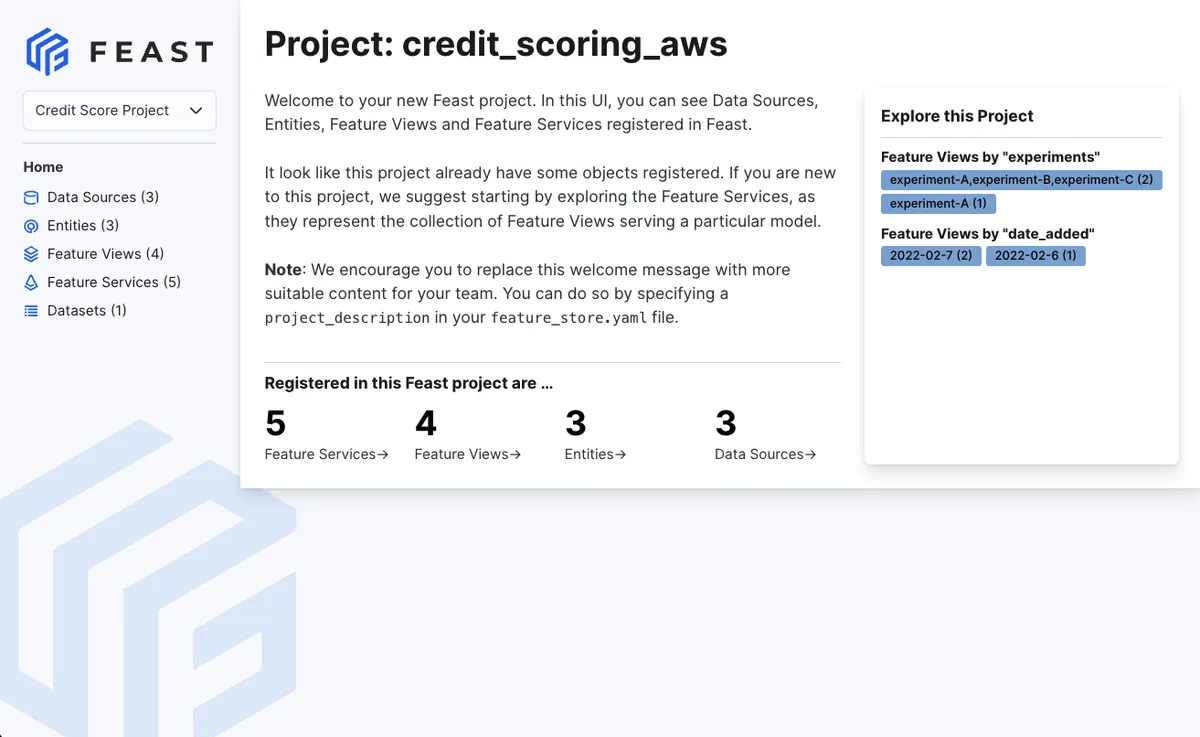
Feast
Feature Comparison
| Feature | Amazon SageMaker | Feast |
|---|---|---|
| Feature Data Management | ||
| Feature store | SageMaker Feature Store manages ML features within AWS-managed MLOps workflows. | Offline and online stores manage reusable feature definitions and values. |
| Training-data correctness | Feature Store supports feature management within SageMaker training workflows. | Point-in-time correct feature sets prevent historical training-data leakage. |
| Feature discovery | SageMaker Catalog enables governed discovery and collaboration for data and AI. | Feature definitions are centrally managed for discovery across teams. |
| Online Serving | ||
| Online feature retrieval | Model deployment capabilities serve trained models using managed AWS infrastructure. | Online stores provide low-latency feature retrieval during inference. |
| Serving interface | Managed model deployment endpoints expose hosted model inference capabilities. | Feature server exposes feature retrieval from configured online stores. |
| Real-time recommendation support | Hosted models can be deployed with auto scaling for inference workloads. | Serves real-time interaction features for personalized product and content recommendations. |
| ML Platform Scope | ||
| Model training | Managed training jobs provision EC2 instances for scalable AI and ML training. | No managed model-training service; supplies features to external training systems. |
| Model deployment | Managed deployment capabilities host trained models for production inference. | No model endpoint hosting; serves data to separately deployed models. |
| Notebook development | Fully managed Jupyter notebooks support interactive model development on AWS. | No managed notebook environment; works from developer-selected tooling. |
| Data Processing | ||
| On-demand transformations | MLOps tools orchestrate model workflows across managed AWS data services. | On-demand transformations compute features during retrieval from source data. |
| Streaming transformations | AWS-managed infrastructure supports scalable model training and hosted inference workflows. | Streaming transformations derive features from continuously arriving data. |
| Streaming ingestion | Feature Store supports feature management within the broader SageMaker platform. | Push-based streaming ingestion writes fresh values to online feature stores. |
| Operations and Governance | ||
| Infrastructure management | SageMaker manages training jobs and provisions EC2 instances on users' behalf. | Infrastructure-agnostic layer relies on user-selected offline and online stores. |
| Automatic scaling | Auto scaling adjusts managed deployment capacity for model-serving demand. | Scaling behavior is determined by configured backing infrastructure and deployment. |
| Data and AI governance | SageMaker Catalog provides secure discovery, governance, and collaboration for data and AI. | Feature definitions provide shared consistency; governance depends on chosen integrations. |
Feature Data Management
Feature store
Training-data correctness
Feature discovery
Online Serving
Online feature retrieval
Serving interface
Real-time recommendation support
ML Platform Scope
Model training
Model deployment
Notebook development
Data Processing
On-demand transformations
Streaming transformations
Streaming ingestion
Operations and Governance
Infrastructure management
Automatic scaling
Data and AI governance
Which approach fits
For feature storage and online serving on AWS, SageMaker fits organizations that want a single managed AWS environment for features, training, deployment, governance, and operations. Feast fits teams that specifically need a portable feature-store layer across their existing data and ML infrastructure; it stops being the complete answer when managed training and model hosting are required.
When each approach fits
Choose Amazon SageMaker if:
Choose SageMaker when your models, data governance, training, notebooks, and inference endpoints are primarily on AWS and your team values managed infrastructure over infrastructure portability.
Choose Feast if:
Choose Feast when feature reuse, point-in-time correctness, low-latency online retrieval, and flexible backing stores matter more than receiving a complete managed ML platform.
These scenarios reflect the available product evidence. Your requirements, existing stack, and team expertise should guide the final decision.
Frequently Asked Questions
What is the main difference between Amazon SageMaker and Feast?
Amazon SageMaker is a broad, fully managed AWS MLOps platform. It includes managed Jupyter notebooks, training jobs that provision EC2, model deployment, auto scaling, Feature Store, Unified Studio, Catalog, and Lakehouse capabilities. Feast is an Apache-2.0 open-source feature store focused on defining, managing, discovering, and serving structured features through offline stores, online stores, and a feature server. Feast does not replace SageMaker's managed training or model-hosting capabilities.
Which is better for small teams?
For a small team already committed to AWS and needing to train and deploy models, SageMaker can reduce operational work because it manages infrastructure, notebooks, training jobs, and deployment. However, its component-based pricing and AWS-specific learning curve need active cost management. Feast can be attractive when the team only needs a feature store and can operate or already has compatible data infrastructure. Its software is free under Apache-2.0, but self-hosting still creates infrastructure and operational responsibilities.
Can I migrate from Amazon SageMaker to Feast?
Yes, but this is usually a change in feature-store architecture rather than a direct platform replacement. A team can move feature definitions and feature-serving workflows to Feast, configure appropriate offline and online stores, and use Feast's feature server for training and inference retrieval. SageMaker training jobs and hosted model endpoints can remain in place if desired. If you rely on SageMaker Catalog, Unified Studio, managed notebooks, or managed model deployment, those platform capabilities require separate AWS or third-party equivalents.
What are the pricing differences?
SageMaker charges by component and usage. SageMaker Unified Studio includes its first two months with 250 hours of sc.t3.medium notebook usage plus limited metadata, API, and compute-unit allowances. Beyond that, Data Agent costs $0.04 per credit, while SageMaker Catalog costs $10 per 100,000 requests, $0.40 per GB of metadata storage, and $1.776 per compute unit. GPU instances can be substantial: ml.p4de is $23.42 per hour and ml.p5.48xlarge is $54.92 per hour. Feast is Apache-2.0 open source and free to self-host, but users pay their selected infrastructure providers for storage, compute, networking, and operations.